Xiao Feng's Full Speech: Asset Tokenization and 24/7 Trading, Blockchain Reshaping the Global Financial Market
 Core Viewpoint
 Xiao Feng: If the United States is the first to achieve asset tokenization and 24/7 trading, it will siphon global liquidity and pricing power, and other financial centers will need to participate in the on-chain financial system to avoid decoupling.
On September 23, 2026, the 12th Global Blockchain Summit, hosted by Wanxiang Blockchain Lab, successfully concluded at the Hyatt on the Bund in Shanghai. This summit, themed "Blockchain New Economy · Intelligent Chain Symbiosis," brought together diamond sponsor Qtum, strategic partner Wanxiang Innovation Energy City, gold sponsors Frontier Technology Research Institute (FTI), RD Technologies, Arkreen, Bianjie.AI, Blue Elephant Intelligent Link, and exclusive dinner sponsor Sui Foundation, along with other ecological partners. It gathered guests from policy, finance, academia, technology, and industry to present an annual event that spanned financial innovation and technological frontiers, gathering industry wisdom and practical results.
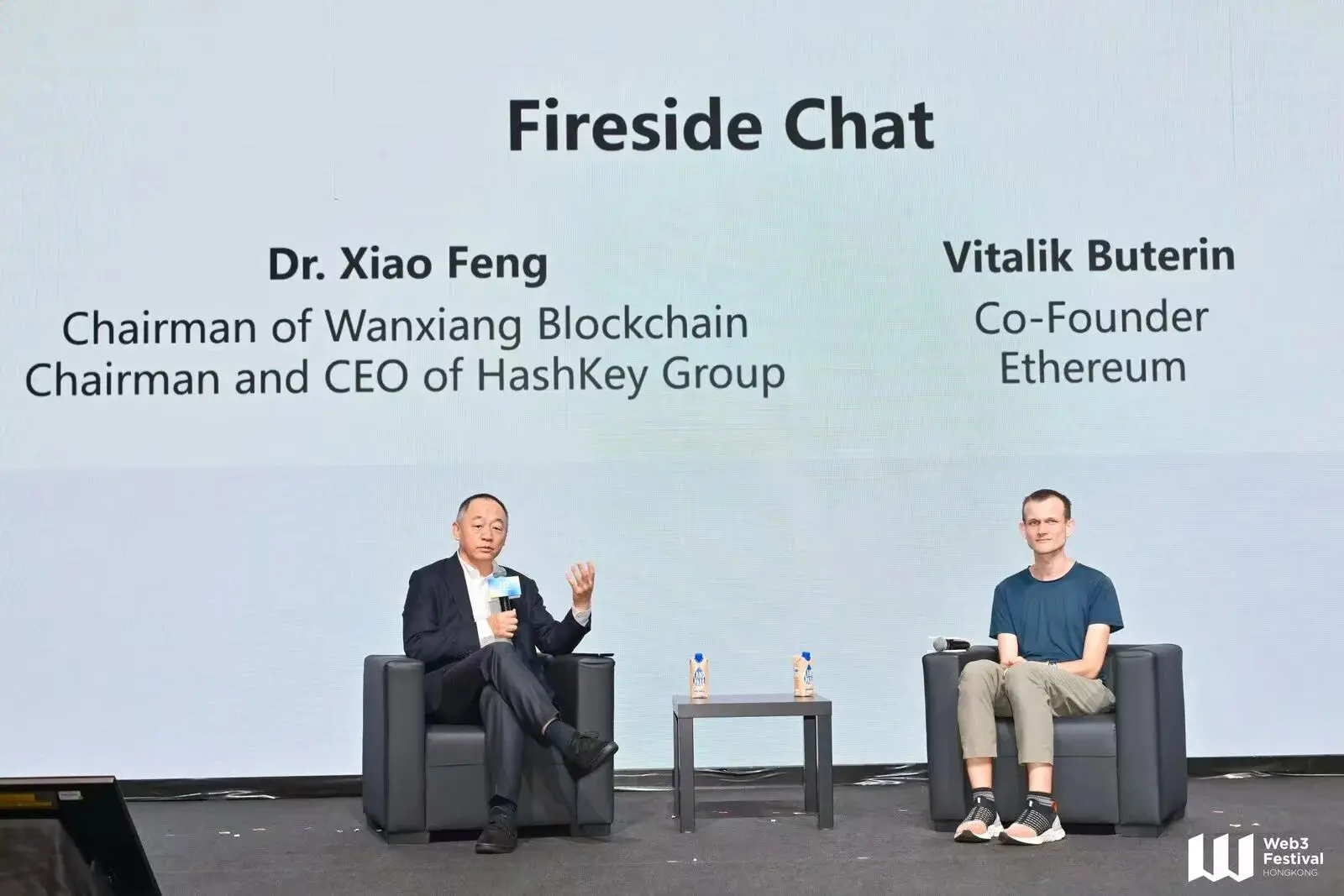
At the conference, Dr. Xiao Feng, Chairman of Wanxiang Blockchain and Chairman and CEO of HashKey Group, delivered a keynote speech titled "Asset Tokenization and 24/7 Trading—Blockchain Reshaping the Global Financial Market." Below is a summary of the speech, with modifications that do not affect the original meaning.
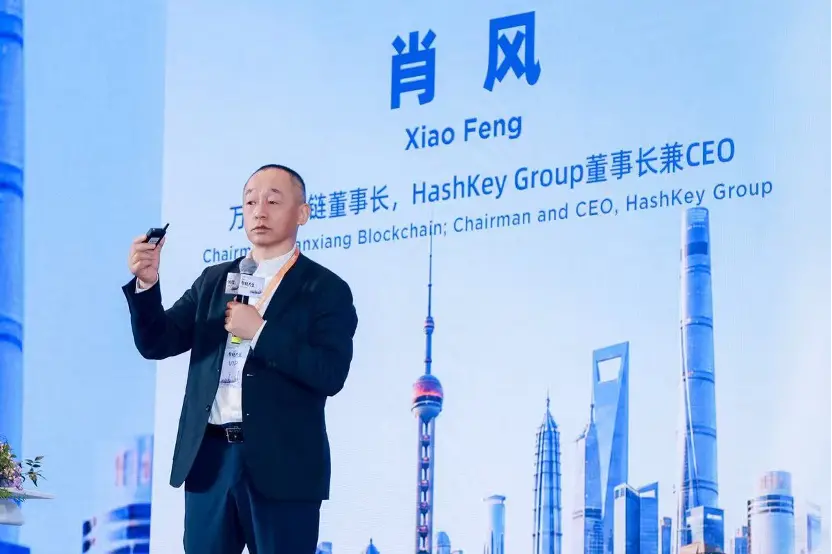
Dear guests, hello everyone!
After a day of sharing, everyone has worked hard, and I would like to express my gratitude to all attendees on behalf of the organizers.
The presentations today generally revolved around two main themes: (1) Tokenization + 24/7 trading, with guests discussing these topics from different angles and perspectives in both the morning and afternoon; (2) The relationship between AI and blockchain. I believe discussing this topic is very valuable, especially now.
Today, I want to share a topic related to financial asset tokenization and 24/7 trading. I want to discuss from one perspective: when an international financial center is determined to pursue financial asset tokenization and to conduct 24/7 trading, what impact will it have on other global international financial centers, and how should they respond? So far, there has been little public discussion on this topic.
Last night Beijing time, which was during the day on September 22 in the United States, the "2026 12th U.S. Treasury Market Conference" was held in New York. This seminar was co-hosted by five institutions: the U.S. Department of the Treasury, the Federal Reserve, the New York Fed, the U.S. Securities and Exchange Commission, and the U.S. Commodity Futures Trading Commission (CFTC). The theme of the speech by the CFTC chairman aligns closely with what I want to share today, so I will summarize it for everyone.
The core idea of his speech is as follows: "Under the influence of large-scale tokenization, on-chain finance, and 24/7 trading, the changes in the U.S. financial system over the next decade will exceed the changes in the U.S. financial system over the past several decades."
What changes have occurred in the U.S. financial system over the past few decades? The changes over the past 20 years have mainly been driven by internet information technology. Professor Chen Long mentioned this earlier today, so I won't elaborate further. Looking back further, from the 1970s to 2000, there was one iteration of the U.S. financial system and financial infrastructure, namely the trading, clearing, and settlement systems.
Many experts have mentioned "DTCC" (Depository Trust & Clearing Corporation), which was established in 1999. It was not a newly created company but rather a consolidation of the decentralized custody, registration, and settlement systems that had existed in the U.S. for decades. The U.S. spent nearly 25 years absorbing and merging various decentralized clearing and registration companies, ultimately forming DTCC in 1999.
In the 1960s, due to the financial infrastructure not keeping pace with the development of financial markets, the New York Stock Exchange would close every Wednesday, mainly because it could not keep up with clearing. Back then, stocks were still paper-based, and when trading volumes increased, it was difficult to transfer paper stocks from Goldman Sachs clients to Morgan Stanley clients in time for settlement.
As we know, NASDAQ announced that it would start "23×5" trading on December 6 of this year, trading five days a week for 23 hours each day. This shows that the financial infrastructure and the registration and settlement systems for stock trading have undergone significant changes.
In the first 50 years, the U.S. financial market and financial system have undergone tremendous changes. However, the CFTC chairman stated last night that the changes in the U.S. over the next decade may even exceed the changes of the past several decades.
What factors will drive the changes in the next decade? He mentioned three: tokenization, 24/7 trading, and on-chain finance. In his speech, he also referred to a fourth item, which is stablecoins. These four technologies will lead to changes in the U.S. financial market over the next decade that surpass those of the previous decades, and I will discuss how these technologies may impact the global financial market from this perspective.
I. Financial Market System
First, let's review what the theoretical structure of the financial market system is. The theoretical financial market system roughly includes five levels:
(1) Central Bank.
At the top level is the central bank. The central bank is the "main valve" of funds; all money is issued by the central bank. Whether institutions cause problems or macroeconomic issues arise, it is always the lender of last resort.
A few years ago, interest rates in the U.S. suddenly rose. Rising interest rates mean that the prices of U.S. Treasury bonds issued during the low-interest period have fallen. Therefore, the prices of U.S. Treasury bonds issued during the low-interest cycle have decreased, resulting in paper losses for U.S. banks. Some statistics show that when U.S. interest rates suddenly rose a few years ago, U.S. banks lost nearly $600 billion in capital. Subsequently, a well-known blockchain company, stablecoin company Circle, placed over $3 billion in reserves at Silicon Valley Bank, which became insolvent due to losses from holding Treasury bonds, leading to a bank run, and the reserves of over $3 billion in USDC were nearly wiped out. According to the U.S. deposit insurance system, Circle could receive very little compensation, just a few hundred thousand dollars.
This loss was not due to mismanagement by any single bank but was caused by the overall rise in U.S. interest rates. Ultimately, the Federal Reserve and the U.S. Treasury stepped in to save the situation. The Treasury and the Federal Reserve announced that during this period, U.S. bank deposits would not be compensated according to the deposit insurance system; all depositors' funds in banks that failed due to insufficient capital adequacy would be 100% protected by the federal government, with 100% compensation, which is known as the "lender of last resort."
In 2008, why did Morgan Stanley and Goldman Sachs apply to become "bank holding companies"? Because after the "financial crisis," liquidity issues arose on Wall Street, and financial institutions like Goldman Sachs and Morgan Stanley had to borrow and repurchase hundreds of billions of dollars daily in the financial market to maintain operations. However, borrowing money at a 24% interest rate would cause problems in the U.S. capital market. It was not due to mismanagement by Goldman Sachs or Morgan Stanley, but because liquidity in the financial market had completely dried up, and they could no longer borrow money. What should financial institutions that need hundreds of billions of dollars for daily turnover do? The Federal Reserve intervened. You are an investment bank; I cannot directly give money to an investment bank, but I can provide liquidity directly to banks. Thus, these two companies applied to become bank holding companies in the morning and were approved in the afternoon. An hour later, the Federal Reserve provided them with hundreds of billions of dollars.
Recently, I discussed with a friend whether the international financial center of the U.S. would move from New York to Silicon Valley when AI was at its peak. I said that this is unlikely to happen. It is not the exchanges that would move; the exchanges are just the topmost and most visible level. The truly foundational and immovable element is the New York branch of the Federal Reserve. Because the Federal Reserve's open market operations and the flow of dollars all occur at the New York branch. Unless the open market operations room of the New York branch is also moved, you can only have assets, but no money.
(2) Financial Institutions.
Financial institutions differ from central banks in that central banks issue base money, while banks create money through capital adequacy ratios, turning $1 obtained from the central bank into $5 or $8 to spend. Therefore, financial institutions are the creators of the money multiplier and also the creators of credit for various assets. They enhance fund efficiency and capital efficiency by issuing various financial instruments and designing different credit structures.
Why are U.S. Treasury bonds the most popular? Why is the most conservative asset for any financial institution to invest in U.S. Treasury bonds? Because buying $100 worth of U.S. Treasury bonds allows you to immediately use that $100 worth of Treasury bonds as collateral, at least borrowing back $95. This is a process of credit creation. Financial institutions are in the business of creating funds and assets. This includes the money market, capital market, and derivatives market, and these five levels collectively constitute the financial market system. What we are discussing is that these five levels may undergo tremendous changes in the next decade. The CFTC chairman's remarks refer to this financial market system.
II. Financial Market Structure
What does a mature and efficient financial market structure look like? It can basically be divided into four quadrants/directions:
First, a high-speed trading system. Trade matching must be completed efficiently and quickly. Rapidly completed trades obviously require a very large pool of funds and very deep liquidity; otherwise, it would be impossible to quickly reach trades according to traders' intentions.
Second, an efficient settlement network. To assess whether a financial market is effective or ineffective, efficient or inefficient, the second point is settlement speed. The settlement of digital assets based on blockchain is "trade equals settlement," where trading and settlement occur simultaneously, so all digital asset exchanges can naturally operate 24/7. The existing payment and clearing settlement system of NASDAQ cannot achieve 24/7 trading, so the first step is to start "5×23 hour trading" beginning December 6 of this year. To achieve 24/7 trading, the settlement currency must first be tokenized. Banks close at 5 PM and do not operate on Sundays. If you want 24/7 trading, but trading occurs at night, on Sundays, and during public holidays, banks do not provide fund transfer services for institutions. Therefore, an efficient settlement network clearly requires blockchain and the tokenization of currency.
Third, reasonable credit creation. Either leverage is applied to funds or assets, or higher efficiency of use is provided for funds and assets. For example, if you accept a certain type of funds/assets as margin or collateral, that is credit creation. Anyone buying financial assets hopes to liquidate them at any time and also hopes they can be used as collateral, margin, or deposits for further financing and leveraging. This is a reasonable credit creation system and is a very important part of the financial market.
Fourth, a deep liquidity pool must have sufficient market breadth and depth. When you want to sell something, what you see is what you get; the price quoted on the exchange is the price at which you can execute the trade, which represents the best liquidity. If an asset appears to be worth $100 on paper, but you lose 3% when trading it, then it is actually worth only $97, not $100. However, if liquidity is particularly good and market depth is particularly deep, you might be able to execute the trade at $100 or at a price of $99.99.
These four aspects are the main standards for measuring whether a financial market is a good market or a mature market.
III. Blockchain and Distributed Ledger
Looking back at blockchain, the reconstruction and innovation faced by the financial market system and financial market structure are all based on the new accounting methods of blockchain. All tokenization can currently only be achieved through blockchain technology, and 24/7 trading can only be realized with distributed ledgers that enable real-time settlement, where trading equals settlement.
Blockchain is the third innovation in accounting methods invented by human society. Throughout thousands of years of human civilization, there have been a total of three innovations in accounting methods:
The earliest accounting methods appeared around 3500 BC in present-day Iraq, in the Sumer region, which is the cradle of human civilization. A clay tablet dating back 3500 years was unearthed, and it was ultimately discovered to be a ledger that recorded very simple accounting of income and expenses.
Around 1300 AD, the familiar double-entry bookkeeping method emerged in the Mediterranean region of Italy, which not only recorded income and expenses but also assets and liabilities.
Another 730 years later, in 2009, the third iteration of accounting methods appeared with the advent of Bitcoin blockchain, marking the beginning of distributed accounting. From the perspective of accounting methods, you can understand that this millennia-old change will indeed have an impact on the financial market system and financial market structure, as mentioned by the chairman of the U.S. Commodity Futures Trading Commission (CFTC), stating that the changes in the next decade will surpass those of the past fifty years.
4. Digital Twin and Tokenization
With the support of blockchain technology, starting from 2024, the financial market system has begun its own innovation and reconstruction at both the funding and asset ends.
First, the funding end.
At the funding end, discussions have already taken place regarding Central Bank Digital Currency (CBDC). Today's guests also discussed topics such as stablecoins and tokenized bank deposits.
Whether it is digital currency issued by central banks (CBDC), tokenized deposits issued by banks, or stablecoins issued by private institutions, they are all doing the same thing: tokenizing currency. Therefore, we can collectively refer to them as "tokenization at the funding end."
Tokenization at the funding end actually appeared as early as 2014, with USDT being introduced that year. Here, I would like to specifically explain stablecoins. Functionally, stablecoins are identical to private digital cash. If you have 100 yuan in your pocket, when you withdraw 100 yuan in cash from the bank, this 100 yuan has actually left the banking account system. The same goes for stablecoins; when you mint 1 yuan of stablecoin, this 1 yuan of stablecoin exists in your mobile wallet, just like being in your pocket, it has left the banking account system. This is the first characteristic.
The second characteristic is that holding cash typically does not earn interest, and holding stablecoins usually does not earn interest either.
The third characteristic is that cash can be used for peer-to-peer payments. You take cash to a store to buy a bottle of soy sauce, hand the money to the store, and the store gives you the goods; this is peer-to-peer payment, and it is a transaction that settles immediately. There is no issue of the merchant receiving the money the next day after you swipe your card. You pay me now, and the money is in my hands now.
Isn't this Bitcoin? Isn't this stablecoin? Functionally, stablecoins are digital cash, with their unique value, just like we still need to have some cash and coins in our pockets; stablecoins are cash. Bank deposits are not cash but bank currency, central bank currency is central bank currency, and bank currency is bank currency.
Second, the asset end.
With the support of blockchain technology, the asset end is also advancing tokenization. Earlier, a member of the Hong Kong Legislative Council mentioned that Hong Kong has completed bond tokenization totaling over 70 billion Hong Kong dollars.
Bond tokenization, fund tokenization, and derivative tokenization have all been established. The most significant issue that has drawn immense attention from domestic financial regulatory authorities regarding derivative tokenization is that before Changxin Storage was listed on the A-share market, it was already being traded on the overseas decentralized exchange Hyperliquid. When Changxin Storage was listed on the A-share market, its opening price was surprisingly the same as the price traded on Hyperliquid. Therefore, when the A-share market opened, everyone found that the two prices were very close, and many exclaimed, "It's over, the pricing power of Chinese assets has easily shifted overseas," which brought us pressure—will you follow? Will you do tokenization? If you don't do it, Hyperliquid will; if you ignore it, it will grow larger, and the pricing power of financial assets will first go there and then influence domestic asset pricing. This brought us immense pressure, and I estimate this is also a form of motivation.
Thus, with the support of blockchain technology, tokenization at the funding end and asset end will ultimately form On-chain Finance, which is the on-chain financial market system, and it can achieve a self-closed loop.
This is why the CFTC chairman stated in last night's speech that under the catalysis of Tokenization, On-chain Finance, and 24/7 trading, the changes in the U.S. financial market system in the next decade will exceed those of the past 50 years.
5. Tokenization and 24/7 Trading
When an international financial center takes the lead in implementing financial asset tokenization, large-scale tokenization, and conducting 24/7 trading, what does it mean for other global financial centers?
First, liquidity.
It means that other international financial centers will face a loss of liquidity. Whether your liquidity suffers a loss of 10% or 20%, your liquidity will be attracted to the financial center that operates 24/7 trading. We know that liquidity has two main indicators: one is whether the trading volume is large, and the other is whether the trading depth is sufficient. During the trading process, the market impact cost and bid-ask spread are either smooth or very large; these are all requirements for liquidity.
Taking the U.S. market as an example, the New York Stock Exchange and Nasdaq currently only operate for 5.5 hours of trading, but U.S. stocks are not only traded during those 5.5 hours. Before and after market hours, the U.S. capital market is still trading many stocks, and these trades are completed through ATS and dark pools. Imagine if the New York Stock Exchange and Nasdaq themselves opened for 24/7 trading; these dark pool and ATS trades would flow back to these two exchanges. Originally, liquidity was fragmented across dozens of dark pools and ATS; now, it is equivalent to the two exchanges opening for all-day trading, and this liquidity will naturally return. Once it returns, I believe their trading volume, even during the U.S. nighttime, will exceed that of other countries' financial centers and exchanges.
In addition, once 24/7 trading is initiated, it will naturally attract global investors. Investors who previously found it inconvenient to buy and sell, or those who had to wait until midnight to trade U.S. stocks, can now trade during local daytime. Therefore, liquidity will be siphoned off, which everyone agrees on. The exact amount siphoned will vary by market, but I believe it will cause liquidity loss for other global financial centers.
Second, the funding aspect.
Funds will be siphoned off. Everyone prefers to trade in markets with very good liquidity that is continuously improving; this is the simplest trading willingness.
No trader wants to trade in a market with a slippage of 2% when another market has a slippage of only 0.1%. If it's 0.1% over there and 2% here, why would I trade in the 2% market? So funds will also be siphoned off.
Why can the U.S. easily produce publicly listed companies with a market value of $5 trillion? A yet-to-be-listed OpenAI or Anthropic can easily be valued at $1 trillion and still raise funds. This reminds me of a saying in China: "The bigger the water, the bigger the fish." The same company, if listed in other capital markets, even if it earns the same amount of money, sorry, its valuation will be lower than in the U.S. Because a large pool of funds can nurture big fish; you can't raise big fish in a small tank.
Thus, one very obvious purpose of the U.S. pursuing tokenization and 24/7 trading is to prepare the $10 trillion financing needed for the future AI infrastructure construction. The U.S. has not undertaken any significant national infrastructure construction for decades, but now it faces a new infrastructure construction cycle, which is AI infrastructure construction. From power supply to data centers, all need to be built. The scale of funds required for these infrastructure constructions in the next five to ten years may reach the level of $10 trillion, thus requiring financing.
If I open a 24/7 funding market and capital market, it will obviously be more convenient for me to raise the $10 trillion needed for AI infrastructure construction. At the same time, only a 24/7 global, all-weather trading market can support AI companies that may reach a market value of $10 trillion in the future. Besides, I have not seen a second global capital market with such a funding foundation to support a $10 trillion valued AI company; only the U.S. has it.
Of course, it must also reform, and one of its reform measures is 24/7 global all-weather trading. Everyone is welcome to come.
Third, the asset aspect.
If liquidity is siphoned off and funds are siphoned off, then all asset issuers will rationally choose to issue assets in markets with very deep pools. Therefore, the asset aspect will also be siphoned off. The capital market that takes the lead in tokenization and 24/7 all-weather trading will gradually become the center for global asset issuance, trading, and settlement; this is a mutually reinforcing process.
Fourth, pricing power.
In this model, pricing power will become more concentrated. I have already mentioned the case of Changxin Storage, which made everyone exclaim for the first time: the pricing power of a Chinese asset listed on the A-share market is actually not determined by China but by the overseas Hyperliquid—a decentralized exchange that has no known jurisdiction or legal framework. Therefore, the further concentration of pricing power also means that the voice of the global financial market is further strengthened, which is also a challenge we need to face.
Fifth, investors.
If financial assets achieve tokenization and can be traded 24/7, it means that investors from other countries can invest in assets in this market more conveniently than before, as you do not need to open a local bank account. Now, to invest in U.S. stocks, you may still need a U.S. bank account and to convert to U.S. dollars. But now, you can use stablecoins to invest from anywhere in the world, even during the daytime in Hong Kong. Because the New York Stock Exchange's 24/7 trading plan has proposed using stablecoins as a medium for trading and settlement. Thus, the convenience for global investors to invest in the U.S. stock market will significantly increase, and trading hours will be greatly extended.
If the U.S. establishes an all-weather "financial supermarket," global investors will naturally be more willing to participate. Because this financial supermarket has a complete range of products, you can buy anything at reasonable prices, and you can buy as much as you want. All innovative products that are not available elsewhere are already on display there. If there is such a supermarket, would you not go? From the investor's perspective, the rational choice is certainly to go to the all-weather financial supermarket with the most comprehensive products.
Sixth, the settlement layer.
There is also the DTCC, which is about settlement. Before this, there have been attempts to establish a global trading market system that could operate 24/7, but none have succeeded. Why did they not succeed? Even if you buy an Asian exchange, a European exchange, and an American exchange, the products traded on the three exchanges are different, and the settlement currencies are also different. You buy Hong Kong stocks with Hong Kong dollars, in Europe with euros, and in the U.S. with U.S. dollars, and the underlying banking systems are different. But now it is different because of stablecoins, tokenized bank deposits, and central bank digital currencies; the issue of 24/7 settlement can now be resolved.
After the tokenization of financial markets, the circulation of financial assets globally has also been resolved. Just like Bitcoin, hundreds of exchanges around the world trade the same financial product—Bitcoin. They settle using stablecoins, such as USDT and USDC, so from a settlement technology perspective, the issues faced in establishing a global financial market in finance and technology have disappeared. At the same time, 24/7 trading of tokenized assets is more about preparing for future machine trading. Do AI Agents need to rest? The future AtoA and MtoM intelligent financial markets will definitely be 24/7 trading financial markets.
If we believe that future AI Agents can assist humans in trading or even make trading decisions independently of humans, shouldn't the capital market be transformed into a 24/7 trading market? If you want AI to trade, AI does not recognize US dollars or Chinese yuan; it recognizes tokenized currencies. So, shouldn't you tokenize the currency? If you do not convert currency into tokenized currency and do not allow currency to be programmable, machines cannot use it. Therefore, tokenized funds, tokenized assets, and 24/7 trading are all preparations for AI in the future. Time waits for no one; such preparations should begin today.
Financial Information
From the perspective of financial information, the U.S. Securities and Exchange Commission once required that for Chinese companies listed in the U.S., the U.S. side must have the authority to review the audit working papers of these companies. However, the audit working papers involve sovereignty, which China is unwilling to provide, while the U.S. insists on it. We certainly cannot give up such a large pool of funds and assets in the U.S. capital market, as our country's development still requires support from the U.S. capital market. The final compromise was that U.S. regulatory agencies have the right to review the audit working papers of Chinese companies listed in the U.S., but the working papers cannot go to the U.S.; they can be inspected in Hong Kong. This is the current compromise between the two sides.
This involves the issue of financial information. If you go to a tokenized trading market and say you want to issue stocks, the other party will tell you that they no longer issue traditional stocks; everything is tokenized. If your country's company wants to come to the U.S. or to a 24/7 tokenized capital market, do you recognize tokens? If you do not recognize them, please leave. The information disclosure of tokenized stocks has its own new rules; will you comply? Even the tokenized capital market may propose new requirements for accounting standards; will you comply? This involves many contradictions and collisions between financial market standards.
Ultimately, the demand side must compromise, and the demand side holds the power. Just like the earlier discussion about the review of audit working papers, we need the U.S. capital market to finance us, so we can compromise to be inspected in Hong Kong if necessary.
Financial Centers
I envision that under such collisions, conflicts, and reconstructions, global financial centers will definitely differentiate. The most optimistic estimate is that there will be no impact, and each will be fine, going their own way, but this possibility is very small; there will definitely be an impact, and there will definitely be conflicts, just to what extent this impact and conflict will occur.
A neutral judgment acknowledges that the result of this impact and conflict is "one super and many strong," or perhaps there will only be one super financial center globally, or the status of the current super financial center will be further strengthened.
The pessimistic prediction is that it will become dominant, while other financial centers become unimportant, with their status, roles, and influence sinking compared to now.
Financial Market Models
Therefore, for other international financial centers, the risk you may face is a true decoupling and severing of ties. If you do not accept tokenization, do not accept blockchain, and do not accept 24/7 trading, then you will remain in the old financial market system.
The largest and most core financial market system globally has been updated; I believe this "severing of ties" is something that other international financial centers cannot bear, and almost no international financial center can withstand such a decoupling.
Everyone knows that the Hong Kong dollar is pegged to the U.S. dollar. There are often suggestions that since the Hong Kong market is so closely linked to the mainland economy, the Hong Kong dollar should be pegged to the Chinese yuan. What is the scale of the offshore Chinese yuan market? 1.5 trillion yuan. What is the U.S. dollar market? 50 trillion U.S. dollars. Which one do you want to peg to? Which pool of funds do you want to connect to? Do you want to connect to a 1.5 trillion pool or a 50 trillion, worth hundreds of trillions of yuan pool? The reasoning is very clear.
We should not decouple or sever ties; therefore, we must create a new system that combines the off-chain financial market system and the on-chain financial market system, participating in and building this new financial market system rather than standing on the sidelines.
U.S. Tokenization and 24/7 Trading
(1) Currency Market.
Having said so much, it has always been assumed that there is an international financial center that wants to do these things and analyze the potential impact on other financial centers. Currently, who is closest to being "the one"? So far, only the United States is doing these things; Europe is still just discussing. This morning, Professor Li Guoquan introduced policies in Asia. Asia is a scattered sand, each doing its own thing, with no one helping to establish a set of rules and standards to compete with another market system.
The stablecoin bill, Stripe, and SWIFT have each initiated a global stablecoin alliance; the four major U.S. banks—JP Morgan, Citibank, Wells Fargo, and Bank of America—have initiated a deposit tokenization alliance, and 30 small and medium-sized banks in the U.S. are also forming a deposit tokenization alliance. In the currency market, U.S. financial institutions are already bustling.
(2) Capital Market.
In the capital market, the U.S. is also bustling. I have a friend who traveled from Silicon Valley to New York and back. I asked him what his impressions were this year. He told me that in Silicon Valley, everyone is talking about AI, while in New York, the enthusiasm for Web3, blockchain, digital currency, and digital assets is exactly the same as it was a year ago. From the outside, it seems that the U.S. is only talking about AI, but in fact, all institutions in New York are still discussing Web3, blockchain, digital assets, and digital currency; the topics have simply shifted from Bitcoin to tokenization. We will also wait and see this timeline. This afternoon, there are guests from Ondo and Canton in the Web3 industry who have done a lot of asset tokenization.
That’s roughly my sharing for today. Thank you, everyone!
 Risk warning