Latest research report from the producer of "AI End of Day Report": Agent and RWA reshape the cryptocurrency industry
 Core Viewpoint

 The high wall between traditional finance and the crypto world is starting to loosen.
Author: Citrini Research
Compiled by: Jiahua, ChainCatcher
AI and Asset Tokenization
Imagine your personal AI can access all your financial information. It can easily make idle funds earn returns, make investment decisions for you, and help you negotiate the most favorable mortgage terms.
"Claude, help me find the lowest cost $500,000 loan to refinance my current loan."
Continuing this scenario, the prospects begin to feel unsettling. What happens when millions of AI Agents, which are AI programs capable of autonomously executing tasks, continuously shift deposits to institutions offering the highest interest rates? Will banks lose the low-cost funding they rely on? Is a bank run triggered by AI Agents looming?
As consumer-facing Agents gradually become mainstream, scenarios that sounded like Hollywood sci-fi a few years ago no longer seem so distant.
The existing financial system was not designed for such a future. It operates slowly, with various segments disconnected from each other, and access to financial services is still restricted by intermediaries, regulatory requirements, and customer identity verification. This system was built by humans and serves humans.
These restrictions were originally intended to protect the financial system from the risks posed by human behavior, but they also objectively block the involvement of Agents. As we pointed out in "Agentic Reality," in some ways, consumer-facing software is more likely to be impacted by Agents first. Agents can already operate websites and applications; with authorization, they can also operate our phones and other devices. Software that previously required humans to search, compare, click, and trade can now be handled by Agents.
The outdated financial world is different, which is understandable. But we are beginning to see cracks in the high walls.
We are rapidly moving toward a world where information and resources are increasingly easy for machines to read, controlled by programs, and transferred between different systems. This trend applies not only to consumer data but also to funds, bandwidth, computing power, and eventually extends to financial assets themselves.
It is only natural that AI Agents, capable of running across applications around the clock through programs, will also enable funds and financial assets to possess the same capabilities.
In general, there are only two paths to achieve this. Either existing consumer-facing financial institutions rebuild themselves according to more open, programmable standards, or they will ultimately be replaced by a new system that adopts these standards.
This brings to mind an industry. For most of the past decade, it has seemed like technology came first, followed by a search for problems to solve: the cryptocurrency industry.
The blockchain industry has spent fifteen years building something unexpectedly practical in the Agent era: a programmable financial infrastructure that operates around the clock, capable of carrying assets, recording ownership, and completing settlements within the same system.
Until recently, the use cases for this technology were still limited. There were no Agents at the time, and humans had to struggle with mnemonic phrases, wallet permissions, cross-chain bridges, and gas fees, spending a lot of time for the mere opportunity to buy the latest Shiba Inu-themed meme coin. Meanwhile, stocks, government bonds, credit, commodities, and other financial assets that people genuinely wanted to hold remained within the traditional financial system.
Today, both of these things are changing.
Financial assets are entering the blockchain in tokenized form, and traditional finance and the crypto world are merging. Meanwhile, Agents have become a new type of user, indifferent to the poor user experience of blockchain explorers.
Blockchain has finally found its purpose.
Risking being seen as stating the obvious, I still want to say: we have seen similar stories before. Do you know what HTTPS, TCP, and IP are? Perhaps you do. But how do they work? Probably not. Unless you are a seasoned tech enthusiast, you don't need to understand these. The internet reaches billions not because they learned network protocols, but because browsers eventually hid the underlying technology in the background, and people no longer needed to consider these technologies.
Isn't it ironic that an industry that has seen a lot of capital evaporate and has been viewed as lacking prospects by most mainstream investors has ultimately given birth to a truly important technology? And as these assets emerge from a cyclical low, does it also mean that investors are facing an attractive starting point for investment?
This leads me to ponder: if our judgment is correct, what investors really need to question is not just whether more assets will be tokenized, but who will ultimately reap the income and profits generated by the related businesses.
Instead of guessing, it is better to investigate on the ground. Whenever a significant investment theme begins to emerge, thematic investors can't help but want to explore it. So, I downloaded Coinbase Wallet, deposited $1,000, and entered a place where few investors can leave with profits: the practical battlefield of on-chain trading.
I was prepared to encounter a rug pull, but the outcome was quite the opposite.
I discovered that while most investors, including us at Citrini Research, were still busy debating GPU and memory bottlenecks, a financial application ecosystem had quietly taken shape, resembling traditional finance in many ways.
This is far beyond the common "get rich quick" schemes: from tokenized government bonds, stocks, and options to debt products, lending, payments, and yield strategies set by smart contracts, as well as various financial applications that didn't even exist a few years ago.
This experience changed our perspective on the crypto industry and prompted us to rethink the investment opportunities within it.
The Long-Awaited Moment for the Crypto Industry
Over the past decade, it has not been difficult to view crypto technology as a technology that has consistently failed to deliver on its promises. To put it more directly, you could even cite failed cases like FTX as evidence that it has caused many to incur losses.
The problem has always been that DeFi and Wall Street live in separate worlds, each with its own assets, foundational financial modules, and infrastructure. DeFi technology is indeed interesting, but what significance does it have if it can only be used to bet on meme coins and transfer dollars?
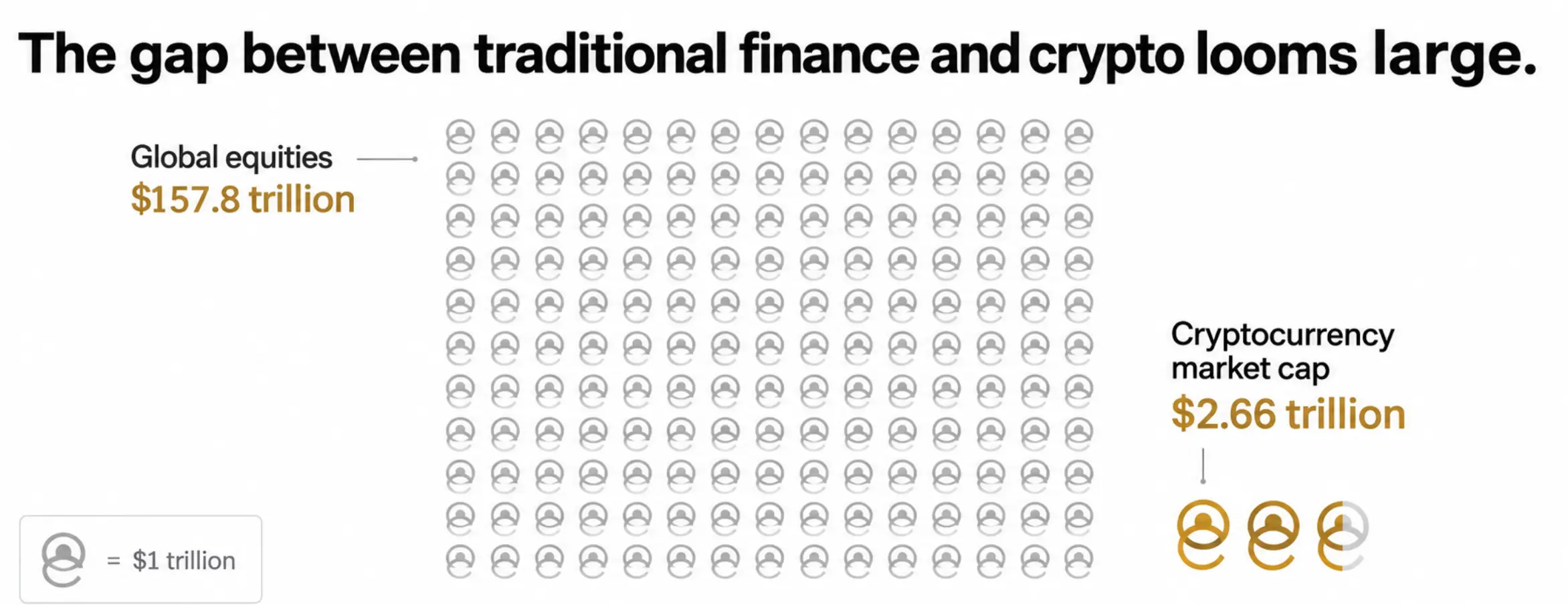
Real World Asset (RWA) tokenization refers to issuing on-chain tokens that represent assets such as gold, Nvidia stocks, U.S. government bonds, or debt. The vision it depicts is that any asset can be tokenized, circulating globally around the clock, with price discovery occurring outside the traditional financial system.
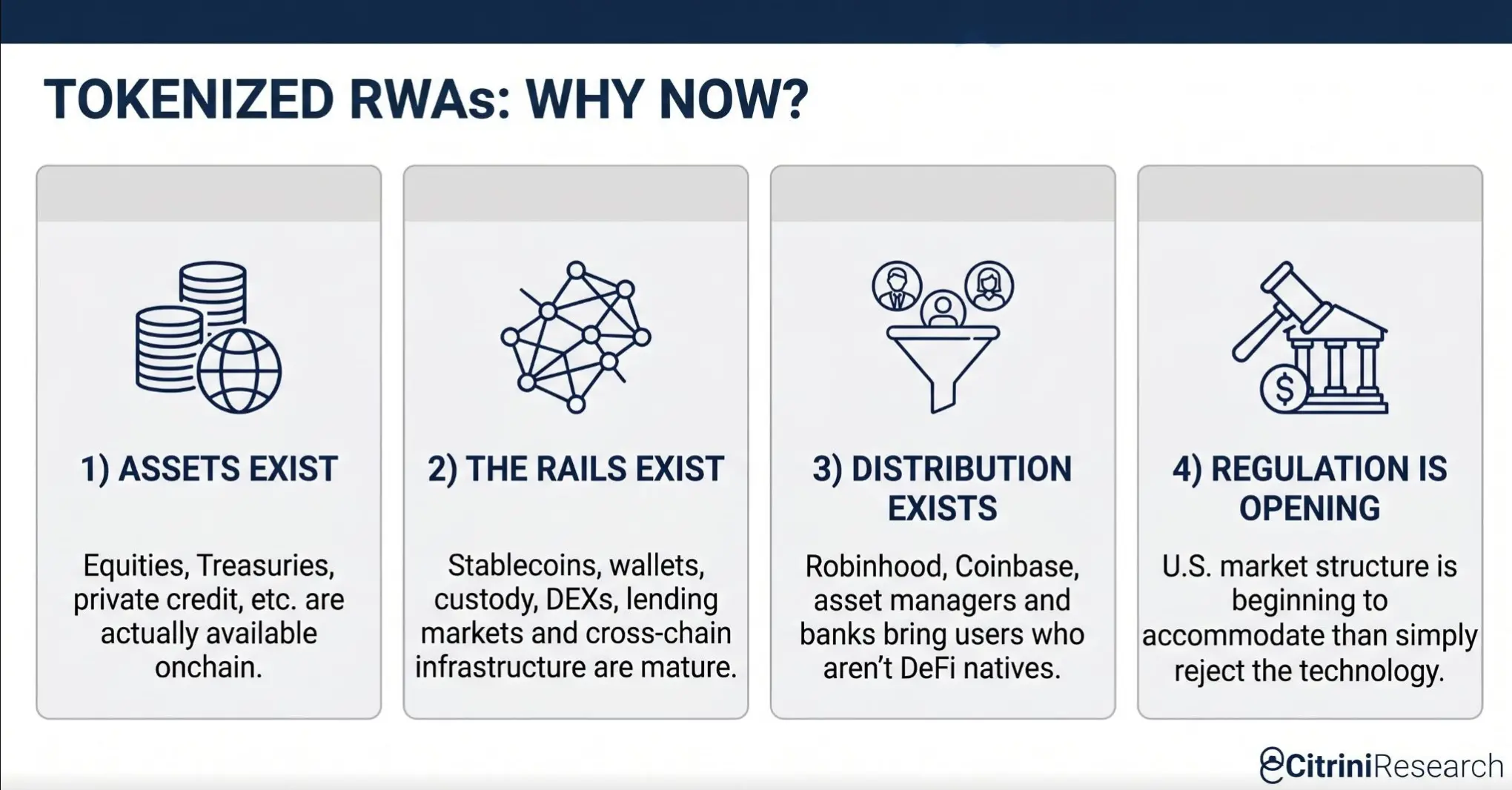
This may not have made headlines, but for years, technological progress has been gradually accumulating, and regulatory attitudes have quietly shifted toward acceptance.
However, it was a weekend in March that truly made many realize the on-chain market could be useful. As the conflict in Iran escalated, Hyperliquid became one of the few markets with sufficient liquidity to allow traders to price crude oil.
Since then, the proliferation of RWA has clearly accelerated. In the past month, we have seen the entire crypto industry begin to exhibit a series of significant movements, seemingly approaching a turning point.
So, what exactly has happened?
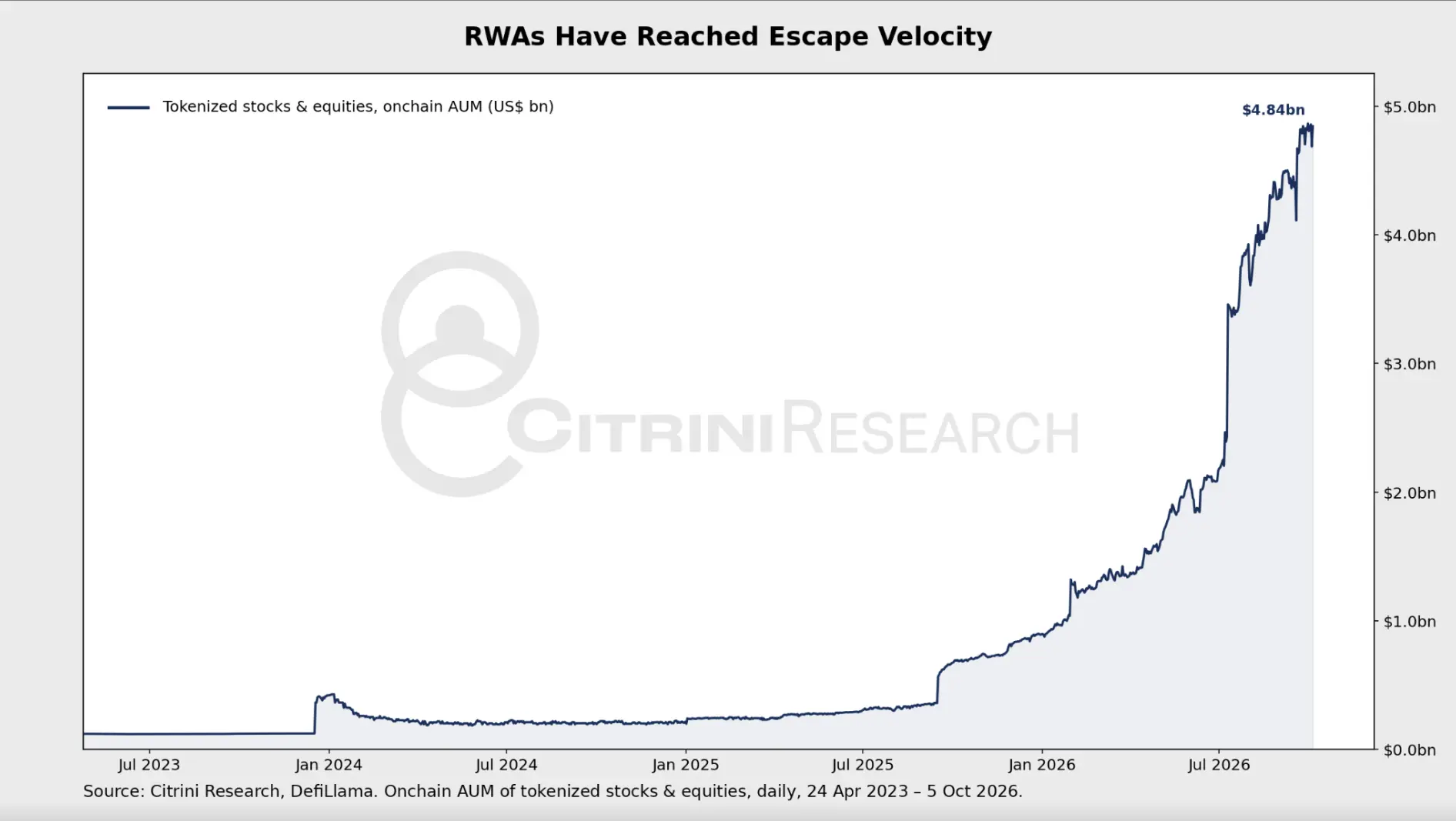
First, stock tokens are now able to circulate independently of the issuing platform and be used by other on-chain applications. This means that, unlike the situation on Hyperliquid, these assets can be transferred between different applications and financial infrastructures, which previously could only carry stablecoins and native crypto assets. Robinhood Chain (HOOD US) was the first to open the door with "stock tokens." Since then, this trend has expanded like a snowball to more blockchains, significantly increasing on-chain activity.
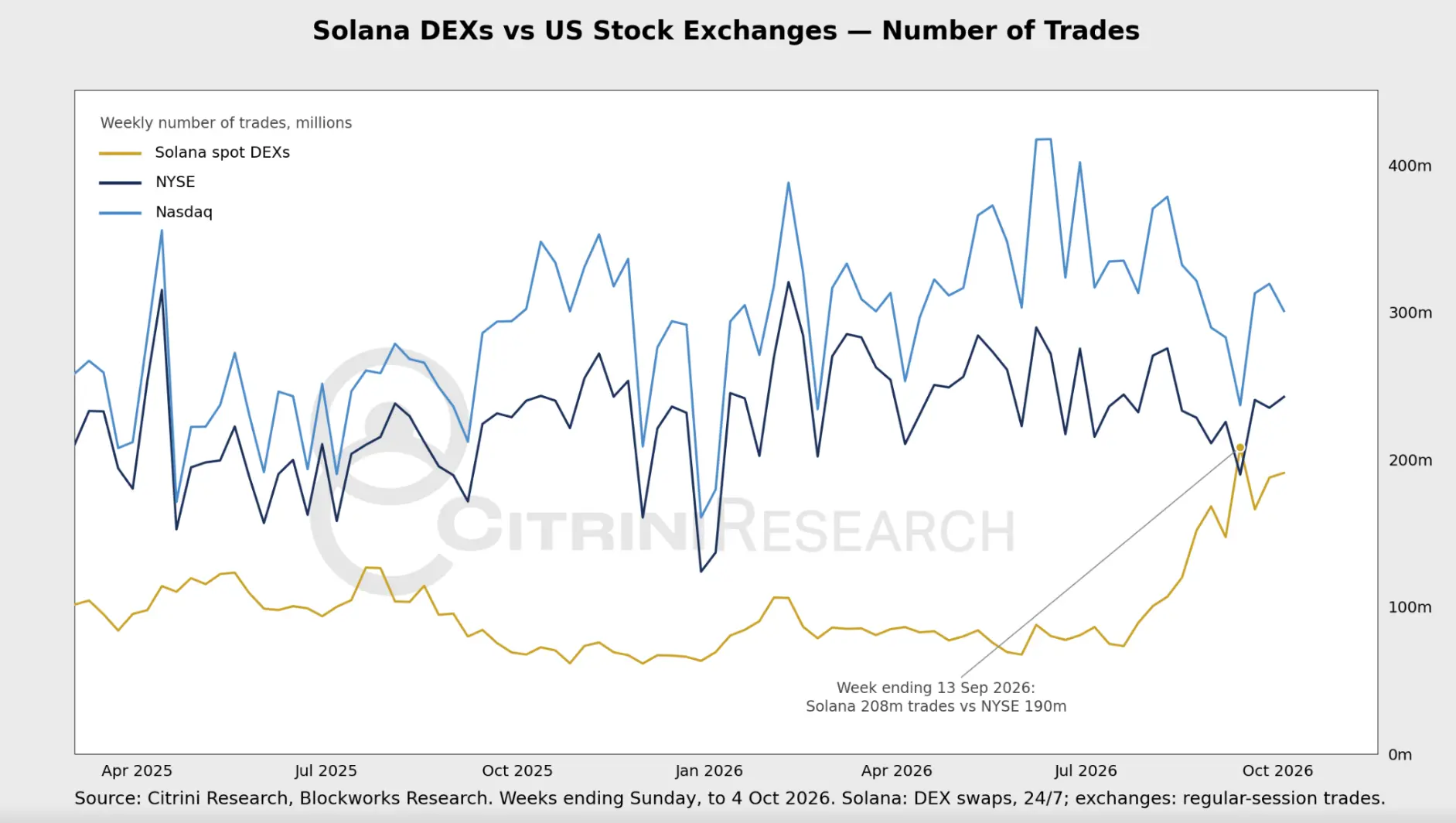
A look at a set of data reveals the scale of this: in September, the number of trades on decentralized exchanges (DEX) on the Solana chain briefly surpassed that of the New York Stock Exchange. While much of this activity undoubtedly came from bots, meme coin trading pairs, and other less meaningful trades, it still illustrates that on-chain trading is becoming more active.
Secondly, regulators are pushing tokenized assets from offshore experiments into regulated financial markets in the U.S. Just two days after the CLARITY Act failed to pass in the Senate, the U.S. Securities and Exchange Commission (SEC) introduced an innovative exemption for tokenized stock trading, exempting certain regulatory requirements under specific conditions.
Meanwhile, the next direction is perpetual contracts for U.S. stocks, which are contracts that track U.S. stock prices and have no fixed expiration date. Related products proposed by Coinbase have now been listed as "pending approval" by the U.S. Commodity Futures Trading Commission (CFTC).
Even the bastion of traditional finance, Bloomberg Terminal, has begun to display Hyperliquid's perpetual contracts and token data. The direction of development is already quite clear.
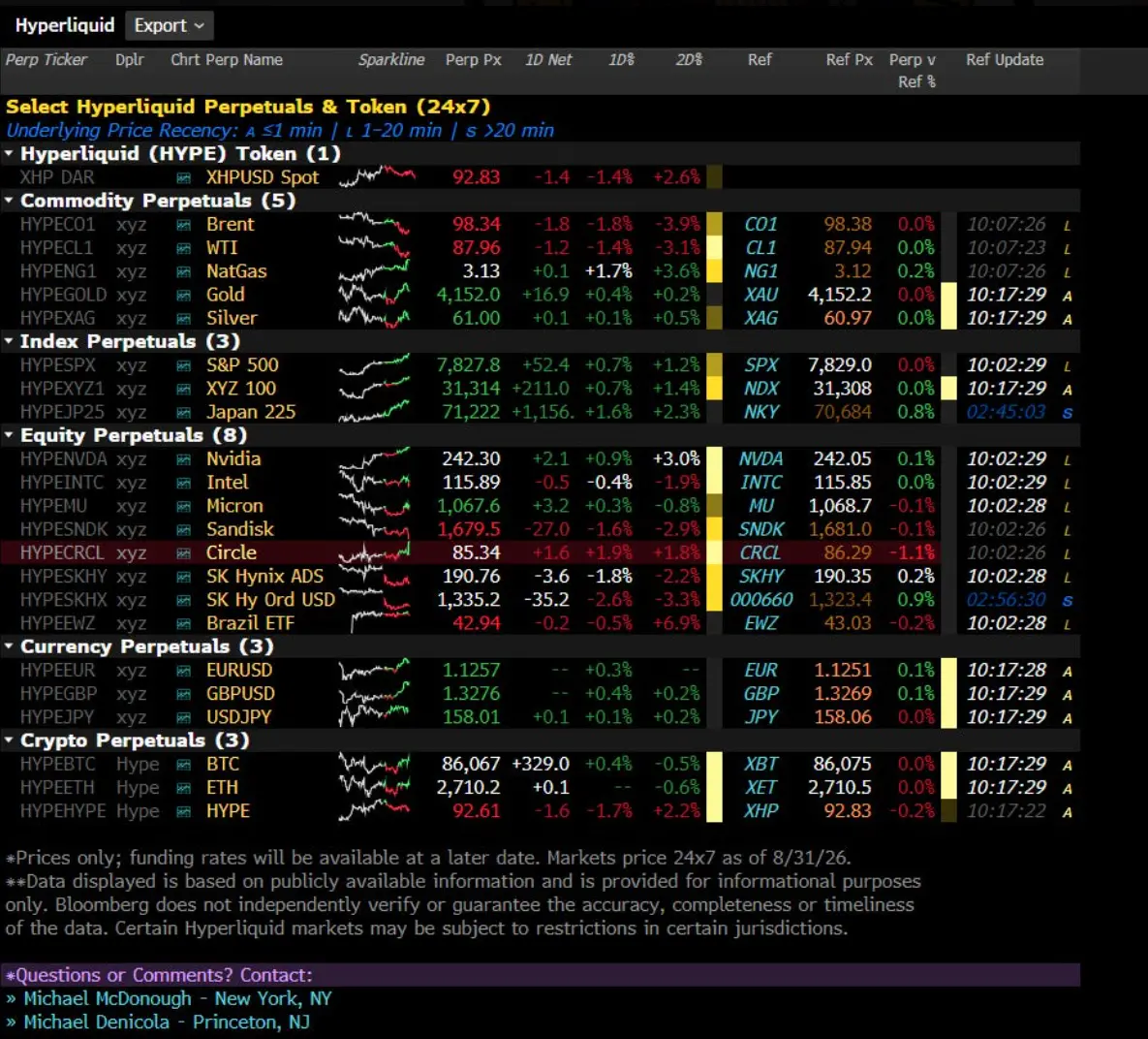
For the first time, we see that institutions and individuals are both willing and able to participate in a diverse RWA market.
In our view, whether or not a comprehensive bill is introduced, relevant regulatory rules are being gradually established. The questions investors should ask should shift from "Can tokenization gain legal recognition?" to "After these products enter the U.S. market, who will earn the income and profits from them?"
AI Agents need a financial system that can operate around the clock and programmatically schedule funds, while asset tokenization brings stocks, government bonds, and other assets that people genuinely want to hold onto the blockchain. These two changes are converging, making the use of blockchain clearer.
The high walls between traditional finance and the crypto world are loosening. For investors, what to watch next is which platforms and financial applications can meet these demands and whether they can convert the growing on-chain activity into sustained income.
 Risk warning


Popular articles