








TOKEN2049 SINGAPORE 2026 Conference Overview and Industry Trends
 Core Viewpoint

 Crypto is transitioning from innovation in digital assets to the reconstruction of financial market infrastructure, and the capital focus of the industry is also simultaneously shifting towards institutions.
Author: HashKey Capital
Summary
From October 7 to 8, 2026, TOKEN2049 Singapore gathered major Crypto-native entrepreneurs, trading platforms, traditional financial institutions, and investment firms from around the world. Combining the conference agenda, public releases, and exchanges both inside and outside the venue, our core feeling is: Crypto is transitioning from digital asset innovation to the reconstruction of financial market infrastructure, and the capital landscape of the industry is also synchronously shifting towards institutions.
1. The boundaries of the market are expanding. Prediction markets and open derivative protocols allow events, risks, and non-standard assets to obtain continuous pricing. What determines whether a new market can be established is the outcome adjudication, liquidity, and regulation, rather than the speed of launch.
2. Stablecoins are becoming layered. Issuance, reserves, compliance, liquidity, and distribution are being handled by different institutions. The payment entry for end-users is becoming homogenized, with the competitive advantage shifting towards licenses, connections with banks and merchants, and payment corridors.
3. The standards for tokenization have been raised. The value of merely "digital mapping" is limited; the real increment lies in 24/7 risk management, collateral, and derivative systems after ownership is on-chain. Discussions around Real World Assets (RWA) have shifted focus from U.S. Treasury bonds to stocks, with hedging and financing expected to commercialize first.
4. The certainty of AI × Crypto lies in computing power, not Agent Tokens. There are clear divergences at the narrative level, while cash flow is highly concentrated in AIDC. The capital expenditure required for mining companies to transition to AI computing power is several times that of traditional mining, and "capitalization of computing power" is becoming a new financial demand.
5. Institutionalization and professional division of labor are occurring simultaneously. Retail growth has peaked, and almost all participants are shifting towards institutional business; Crypto-native institutions are accelerating the productization of trading, risk control, and asset management capabilities, with value capture concentrating towards liquidity networks and distribution channels.
6. Hype and returns are decoupling. Project sentiment is close to a bull market, while traders are generally cautious. The U.S. midterm elections and U.S. Treasury yields are the main tail risks. The divergence between technology adoption, protocol revenue, and Token returns will continue to expand.
1. Conference Overview: From Retail Carnival to Institutional Capital Window
1.1 Booth Structure as Capital Structure
The distribution of booths intuitively reflects who is paying for distribution. According to official venue data, exchanges occupy about 29% of the booth area[1], with an average single booth size of about 44 square meters, more than double the overall average. The number of exhibitors in payments and stablecoins is the highest, but the average booth size is only about 20 square meters, mainly consisting of U card and deposit/withdrawal service providers. Leading projects in prediction markets were all present, generally using medium-sized booths; AI exhibitors were numerous but occupied very little space, and RWA was not the main focus of booths.
Chart 1: Booth Area Proportion and Number of Exhibitors by Track (as of 2026-10-12)
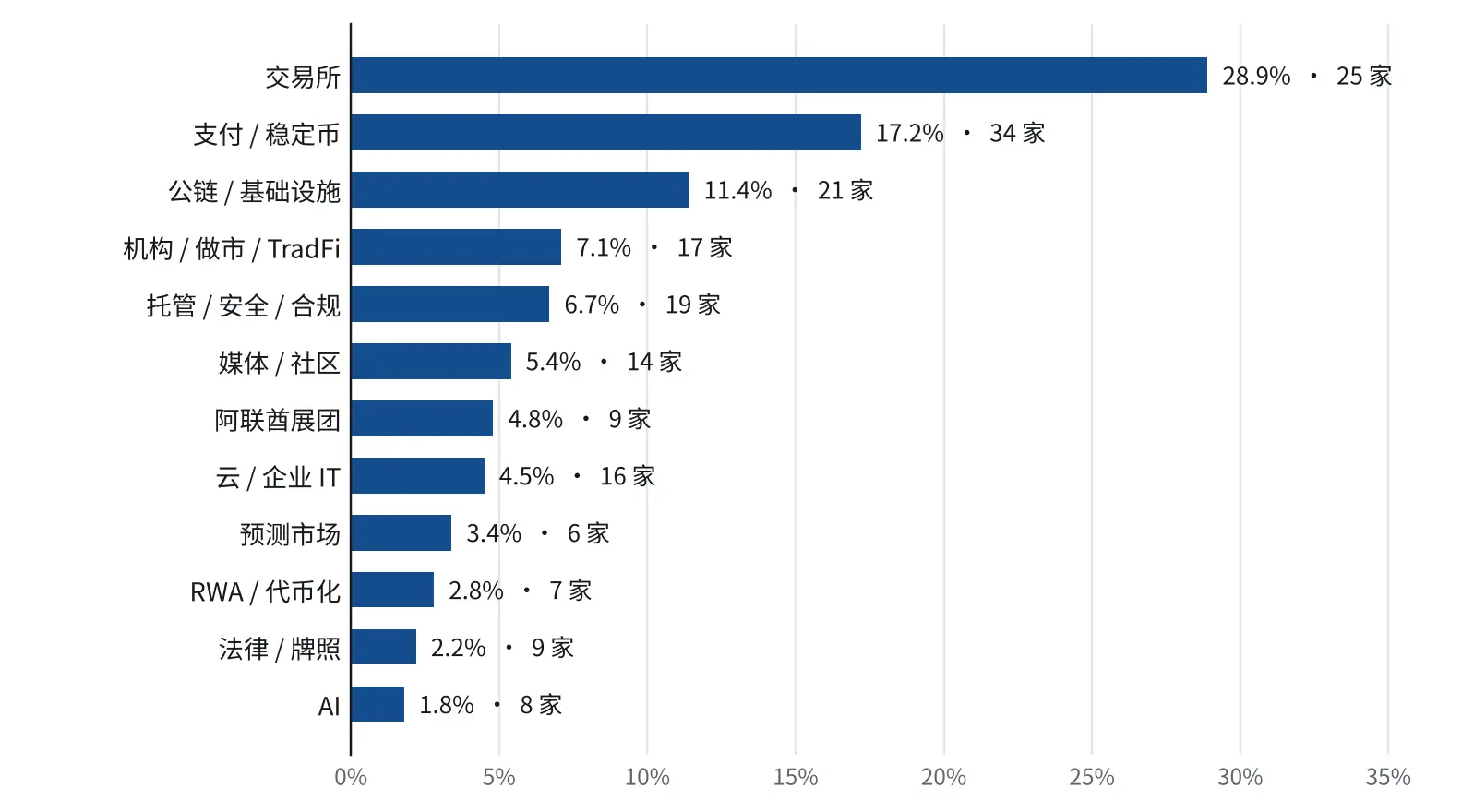
Source: TOKEN2049 Singapore 2026 Official Booth Floor Plan (ExpoFP), Compiled by HashKey Capital, as of October 12, 2026. The scope includes 193 allocated paid booths (approximately 3,836 square meters), excluding stages, conference rooms, lounges, and concurrent events; the bar length represents the booth area proportion by track, labeled with the number of exhibitors; 7 tracks with unconfirmed exhibitors are not listed.
The Middle East exhibition area deserves special attention. Real estate developers, virtual asset regulatory agencies, and government departments exhibited in large numbers, with a core demand for real estate tokenization: the Dubai Land Department has launched a tokenized real estate platform, aiming to cover about 7% of the real estate market by 2033[2], and attracting high-net-worth individuals in crypto with a buy-to-visa program. Tokenization has been used as a tool for attracting investment and talent policies, indicating that RWA is beginning to see sovereign-level asset suppliers.
1.2 Attendee Structure: Western Capital as the Main Stage, Institutional Agenda Preceding
Compared to similar events in Asia in the first half of the year, there was a noticeable increase in Western attendees at this conference, with leading U.S. projects covering almost all tracks including prediction markets, U.S. stocks on-chain, and payments. The conference added institutional meetings aimed at family offices, sovereign funds, and pensions, and established a dedicated Institution Stage.[3] In contrast, the number of Chinese retail participants, who primarily came to "watch the excitement," has significantly decreased, and new customers in exchange-hosted events are also very limited.
The function of TOKEN2049 is shifting from a retail carnival to a window for Western capital to layout in Asia. Several Western institutions plan to enter Asia in the next two to three years, with Singapore and Hong Kong as entry cities, and the path is to cooperate with local institutions that have strong compliance capabilities. For participants in the Asian market, the efficiency of customer acquisition at the exhibition is declining, while the value of cross-border cooperation and existing networks is rising.
1.3 Sentiment Layering: Project Teams Optimistic, Traders Cautious
Project sentiment is close to a bull market. U.S. project teams generally believe that the passage of the CLARITY Act is just a matter of time, and regulation is no longer a prerequisite for advancing business.
Attention to the Asian market is recovering but remains cautious. Compared to the pessimistic sentiment in the first half of the year, new narratives such as U.S. stocks on-chain and quantum security have driven a recovery in attention.
Traders are generally cautious. The core variable is the U.S. midterm elections: as of the conference date, Polymarket shows a probability of about 90% that the ruling party will lose one of the two chambers, and about 60% for the other chamber.[4] Losing control of Congress would weaken the push for policies like tariffs, but it could also lead to more frequent administrative interventions, increasing policy uncertainty. Coupled with U.S. stocks being at a high level and U.S. Treasury yields still under upward pressure, the correlation between U.S. Treasuries and Crypto is higher.
The optimism of project teams mainly comes from the financing cycle, while the caution of traders comes from risk pricing; the two should not be mixed. It is worth noting that some large institutions had previously built positions in trading assets quickly due to political statements, and this is the first time they have engaged deeply with project teams. Secondary pricing is still driven by political narratives, while the value of fundamental research is actually rising.
1.4 Regional Landscape: The U.S. Sets the Rules, Japan and South Korea Catch Up Fastest
The U.S. is the rule-maker of the industry, while Asian markets follow suit within their respective regulatory frameworks, with significant differences in pace.
| Market | Entry Point | Stage Judgment | |----------------------|---------|---------------------------| | South Korea | Stablecoins | Institutions are generally beginning to explore; high retail proportion, stricter listing policies | | Japan | Stock Tokenization | Attracting foreign capital by putting local assets on-chain, leading financial groups have widely laid out | | Hong Kong / Singapore | Comprehensive Framework | Direction is set, gradually advancing, with marginal changes being small | | Middle East | Real Estate Tokenization | Sovereign-driven, linked with immigration and investment attraction policies |
U.S. project teams' reliance on the Asian retail community has clearly decreased, but they place high importance on institutions in Japan and South Korea. Future marginal growth in Asia is more likely to come from institutions in Japan and South Korea, rather than retail. The channels and structured capabilities that connect U.S. projects with institutions in Japan and South Korea, and bring Asian assets onto the chain, will be more valuable.
2. Six Major Trends
The discussions at this conference can be summarized into six interrelated trends. They correspond to the six dimensions of market, currency, assets, execution, organization, and trust, all pointing in the same direction: Crypto is evolving from an independent asset class into a part of global financial market infrastructure.
2.1 Market Boundary Expansion: From Designing Trading Products to Creating Markets
Major Changes
Over the past decade, financial innovation has mostly involved designing new trading products within existing markets; the most significant change at this conference is that innovation is beginning to target "the market itself." Shayne Coplan, founder of Polymarket, emphasized that the essence of prediction markets is to form dynamic probability prices for real events through continuous trading, and any event with a clear outcome, such as politics, sports, and economic policies, can become a target, with a long-term vision of further opening up the market for creation.[5] Hyperliquid, through mechanisms like HIP-3, allows third parties to call upon its underlying liquidity and matching engine to create and operate new derivative markets, extending from Crypto perpetual contracts to a broader range of assets and risks.[6]
The paths of the two are different, but the logic is consistent: lowering the threshold for "creating markets" from exchange licenses and market-making resources to a set of open protocols plus a front end. The presence of all leading projects in prediction markets and Polymarket hosting multiple community events during the conference also indicates that this category has moved from the margins to the mainstream.
Value Attribution
The valuation anchor for prediction markets should not be gambling fees, but their informational value: a deep, credible event price is itself a data asset that can be traded, hedged, referenced, and authorized. For open derivative protocols, the long-term value lies in modularizing market creation, trading, liquidity, and application distribution, becoming the "foundation" for third-party financial products, with competitive advantages stemming from developer ecosystems and liquidity network effects, rather than a single trading front end.
Risks and Unverified Issues
Outcome adjudication is the "clearinghouse" risk of prediction markets. A recent incident where user losses were caused by oracle adjudication interference[7] indicates that the governance and credibility of the adjudication mechanism directly determine the upper limit of market scale. Open markets also cannot automatically eliminate leverage, market manipulation, systemic clearing, and the responsibilities of front-end operators; compliance issues across jurisdictions will determine whether such markets can obtain institutional liquidity.
In the future, three points need to be verified: whether non-sports, non-political markets can form sustained depth; whether markets created by third parties can obtain independent liquidity, rather than relying on spillover from leading markets; and whether regulation can find clear qualitative definitions for "event contracts."
2.2 Stablecoin Layering: Issuance Becoming Concentrated, Entry Becoming Homogeneous
Major Changes
Discussions on stablecoins at this conference have clearly surpassed the competition between USDT and USDC. Ethena's white-label model allows any brand to issue its own stablecoin[8], M0 provides programmable currency issuance infrastructure, and ether.fi integrates stablecoins into comprehensive accounts that combine savings, payments, and yield. The collaboration between Nium and RedotPay further connects stablecoins to cross-border payments, local fiat withdrawals, and consumption scenarios.[9]
Payments are the track with the most exhibitors at this conference, and related closed-door meetings were packed; the final product forms of many C-end projects are U cards. At the regional level, the first step for South Korean institutions entering the industry is also stablecoins.
The Industry Chain is Splitting
The stablecoin industry is forming a clear professional division of labor:
| Link | Core Competencies | Competitive Landscape Assessment | |---------------|--------------------|--------------| | Issuance and Reserve Management | Asset-liability management, reserve transparency, licensing | Strong economies of scale, tending towards concentration | | Compliance and Risk Control | KYC/AML, sanctions screening, cross-jurisdiction licensing | High barriers to entry, forming a moat | | Liquidity and Exchange | Market making, cross-chain, fiat deposit and withdrawal | Deeply tied to exchanges and market makers | | Distribution and Customer Branding | Wallets, exchanges, U Cards, financial apps | Low barriers to entry, homogeneous competition | | Payment Corridors and Merchant Networks | Bank connections, foreign exchange, local clearing | Scarce resources, value may be underestimated |
Value Attribution
More branded stablecoins will emerge in the future, but the underlying issuance, risk control, and clearing may not be equally decentralized. Brands can be diverse, but balance sheets and compliance capabilities are inherently concentrated. U Cards represent homogeneous competition at the distribution level: low issuance barriers and minimal product differentiation make it difficult to form sustained premiums. What is truly scarce are licenses, connections to banks and merchants, foreign exchange capabilities, and coverage of payment corridors.
Risks and Unverified Issues
To assess stablecoin payment businesses, one should look at corridor coverage, per transaction costs, transaction success rates, and user retention, rather than on-chain transfer volumes. Continuous attention is needed on: whether payment volumes in non-transaction scenarios can continue to grow; whether the transparency of reserve assets and redemption mechanisms are reliable under stress conditions; and the regulatory division of labor for stablecoin issuers and distributors across jurisdictions.
2.3 Tokenization 2.0: From Digital Mapping to Ownership and Risk Management
Major Changes
Franklin Templeton CEO Jenny Johnson pointed out that if the legal ownership of assets is still registered in the old system, on-chain tokens are merely "digital twins" and do not constitute true tokenization.[10] The general consensus at the conference was more direct: the technical barriers and costs of simple mapping are already very low, almost not competitive.
The focus of discussion thus shifted to issues after tokenization. Once assets are tradable 24/7, risk management must also operate 24/7; how on-chain assets can be used for collateral, re-collateralization, and financing, as well as how to match derivatives and hedging tools, is still far from mature. Canton emphasizes driving network effects through real business adoption; Cardano's CIP-0113 incorporates transfer restrictions, identity, and compliance rules into the token standard, representing a direction of "compliance programmability".[11]
Shift from U.S. Treasuries to Stocks
Another significant change is that the focus of discussions on Real World Assets (RWA) has clearly shifted from U.S. Treasuries to stocks. 24/7 trading, cross-market arbitrage, and hedging have become high-frequency topics, with leading exchanges laying out plans for U.S. stocks on-chain, while Japanese financial institutions hope to bring local assets to overseas capital through stock tokenization. Several leading market-making and trading institutions are competing for traditional investors' hedging needs for Pre-IPO and U.S. stock holdings, with paths divided into two types: one provides OTC customized services on a per-order basis, while the other attempts to standardize hedging as on-chain products, the latter being more scalable but facing greater liquidity and compliance challenges.
Value Attribution
The commercialization of stock tokenization will first focus on hedging and financing, then move towards retail trading. The reason is that institutions have real demands for hedging and financing and are willing to pay, while retail trading faces more complex investor protection and cross-border regulatory issues. The criteria for measuring tokenization should shift from issuance scale to four dimensions: legal effectiveness of registration, settlement efficiency, collateral availability, and cross-institution interoperability.
Risks and Unverified Issues
What needs to be verified is: how the rights and legal recognition of tokenized stock holders are guaranteed; the price linkage and risk transmission between 24/7 trading and traditional market closures; whether the risks of on-chain collateral and re-collateralization will be amplified under stress conditions. Institutions that can simultaneously provide asset supply, trading, risk control, and compliance capabilities will have an advantage in this round of competition.
2.4 AI × Crypto: Narrative Divergence and Capitalization of Computing Power
Narrative Aspect: Does AI Need a New Monetary System?
There was a clear divergence at the conference regarding the relationship between AI and Crypto. Arthur Hayes proposed the concept of the FLOP Network, believing that the core resource consumption of AI Agents is computing power, and thus a machine-native economic network may form around reasoning computation, GPU supply, and corresponding settlement mechanisms.[12] Haseeb Qureshi from Dragonfly raised doubts: in many consumption scenarios, credit cards and existing payment systems are sufficient; instead of assuming machines will necessarily use blockchain payments, it is better to focus on how AI can improve the user experience, security, privacy, and execution of complex financial operations in Crypto.[13] Illia Polosukhin from NEAR represented a third path: using AI and Intent architecture to hide the complexity of on-chain operations, allowing users to simply express their goals.
We tend to believe that the scenario determines the tool: in ordinary consumer payments, Crypto may not be more efficient than existing networks; but in open markets, cross-border settlements, machine-to-machine payments, programmable assets, and permissionless financial transactions, Crypto has structural advantages. The development of Agentic Finance should not be predicated on issuing new tokens.
Market Aspect: Hype Outpacing Demand
One of the hottest topics at the conference was tokens produced through AI computing power "mining," whose logic is similar to early Proof of Work: using computing power input as cost support for future on-chain payments. However, its uses and demand side have yet to be validated, necessitating a distinction between speculative hype and real usage. Similarly, the price performance of some AI-related public chain tokens has clearly outpaced on-chain activity data, revealing a gap between valuation and fundamentals.
Cash Flow Aspect: AIDC and Capitalization of Computing Power
The true intersection supported by cash flow is AIDC. Operators of computing power centers from Southeast Asia and Taiwan were present in large numbers, as a new round of deployment cycles is beginning, with logic highly similar to early mining: leveraging, buying equipment, building computing power centers, and quickly recouping investments within hardware iteration windows. Mining companies in North America and Southeast Asia are shifting existing electricity and site resources from Bitcoin mining to AI/HPC, with Southeast Asia's transformation speed being faster.
The core bottleneck of transformation is funding. The capital expenditure required for AIDC is more than 20 times that of traditional mining, while most mining companies excel in electricity and operations but lack mature financing tools and capital market experience. This creates a clear financial demand: equipment financing, structured revenue rights, cash flow securitization of computing power leasing, and collateral financing around GPU assets.
The most certain intersection of AI × Crypto is not the Agent Token, but the capitalization of computing power: electricity, mining sites, GPUs, and financing structures. The capabilities accumulated by the Crypto industry in mining financing, on-chain assetization, and structured products may be the most direct path for it to enter the AI industry chain. Caution is needed regarding GPU depreciation rates, fluctuations in computing power leasing prices, and credit risks arising from customer concentration.
2.5 Institutionalization and Professional Division of Labor: Value Concentrating Towards Liquidity and Distribution
Major Changes
The general judgment at the conference was that the incremental retail and DeFi users have been fully tapped, and customer acquisition efficiency continues to decline; institutional business is larger, more stable, and has more diverse demands, with almost all participants shifting towards institutions. The addition of institutional meetings and the presence of executives from traditional institutions like Nasdaq reflect this trend.
At the same time, Crypto-native institutions are productizing their existing capabilities. In the past, trading, risk control, and asset management capabilities primarily served their own businesses; now, market makers are extending their services to the market and asset management, VCs are transitioning to full-platform asset management, and trading capabilities are being packaged into actively managed products that can be listed on exchanges. A significant proportion of participants in an event for traditional OTC service providers now comes from the Crypto industry, with talent and business from the two systems intersecting.
Exchange Competition: Vertical Integration and Open Protocols
Competition between exchanges has transcended the battle between CEX and DEX. Coinbase integrates Deribit's derivatives liquidity, moving towards vertical integration of unified accounts, margin, and options;[14] Hyperliquid, on the other hand, supports third-party markets with open protocols. The former's advantages lie in compliance, capital efficiency, and institutional-level risk control, while the latter's strengths are innovation speed and developer ecosystems. Both architectures are likely to coexist long-term, with their respective advantages depending on customer demographics, product categories, and regulatory jurisdictions.
Division of Labor in Protocols and Entry Points
Ledger's integration of Morpho lending into its wallet[15] represents another form of division of labor: underlying protocols provide liquidity and financial functions, while wallets, exchanges, and financial apps manage user accounts, identities, and product distribution. DeFi is also maturing internally, with projects like Aave, Ethena, and Synthetix emphasizing that behind the same nominal yield, the quality of collateral, liquidity, counterparties, and redemption mechanisms may vary significantly, with competition shifting from APY to risk-adjusted returns, transparency, and trust.
Value Attribution
Almost no institution can independently complete the entire chain from "underlying assets --- productization --- distribution --- on-chain," and professional division of labor will become the norm. An open technical architecture does not necessarily lead to the decentralization of commercial value: liquidity networks, customer accounts, data, and compliance capabilities have economies of scale, which may form new concentrations. The most competitive in the future may be platform-type institutions that can organize all links of the industry chain and undertake institutional clients with compliant identities.
2.6 Trust Layer: Privacy, Identity, and Post-Quantum Security
Privacy: From Anonymity to Selective Disclosure
This conference featured multiple discussions related to Zcash, Midnight, and financial privacy. The connotation of privacy is expanding: from traditional anonymous transactions to AI data protection, protection of commercially sensitive information, selective disclosure, and identity verification. As AI data analysis capabilities improve, the "full transparency" of on-chain transactions is shifting from an advantage to a risk, making the demand for financial privacy even more rigid.
Identity: Infrastructure for the AI Agent Era
Veridian's verifiable identity solutions and Sumsub and MiniPay's reusable KYC[16] reflect that digital identity is gradually becoming the infrastructure for open finance. A wallet address does not equate to a verifiable real identity or legal authorization; as AI Agents begin to participate in financial transactions, the importance of identity, authorization boundaries, transaction limits, auditing, and permission revocation capabilities will further increase, with its long-term infrastructural significance potentially surpassing that of the Agent Wallet itself.
Post-Quantum Security: From Long-Term Issues to Productization Exploration
Project Eleven released Strongpoint, addressing the cryptographic algorithm upgrades and post-quantum migration needs for digital asset custodians. Concerns about "quantum computing and AI cracking encryption" have noticeably intensified, and related narratives have begun to influence the secondary market pricing of certain assets. However, many projects are merely reselling quantum-safe capabilities, lacking core cryptographic technology.
The direction of financial-grade privacy is "privacy + selective disclosure + verifiable identity + compliance," rather than complete anonymity. Post-quantum security is worth researching and planning in advance, but short-term revenue and market size should not be overestimated, and caution is needed against purely narrative-driven valuations. For custodians and exchanges, Crypto-Agility, the ability to change cryptographic algorithms without interrupting business, may be more important than any single post-quantum solution.
3. Market Structure Map
3.1 Eight Narratives, Six Levels
| Core Narrative | Representative Projects or Institutions | Key Changes | |----------------------------------|----------------------------------|--------------------| | Everything Becomes a Market | Polymarket, Hyperliquid | Events, risks, and non-standard assets form tradable markets | | Programmable Money | Ethena, M0, Circle, Nium | Issuance, reserves, distribution, and settlement are programmable and layered | | Agentic Finance / AIDC | NEAR, Computing Power Network, AIDC Operators | AI moves from assistance to execution, capitalizing computing power | | Universal Financial Accounts | Coinbase, Ledger, ether.fi | Unified entry for trading, saving, financing, and payments | | Real Tokenization | Franklin Templeton, Nasdaq, Canton | Transitioning from mapping to ownership, risk control, and settlement reconstruction | | Privacy / Identity / ZK | Zcash, Midnight, Veridian, Sumsub | Integration of privacy protection and compliant identity | | Security / Crypto-Agility | Project Eleven, custodians | Post-quantum migration enters product exploration | | Infrastructure Consolidation | Coinbase/Deribit, leading exchanges | Infrastructure layering, value capture tends to concentrate |
The eight narratives can be categorized into six interlocking levels: Market Layer (price creation), Currency Layer (value exchange), Asset Layer (registration, circulation, and collateral), Execution Layer (AI and automated protocols), Account Layer (unified entry), and Trust Layer (identity, privacy, compliance, and security). The competition in the next-generation financial system no longer revolves around a specific chain or token, but rather around the connections, control, and value capture between layers.
The market is expanding, but the infrastructure is consolidating.
3.2 Five Groups of Strategic Divergence
| Divergence | Core Issue | Our Preference | |----------------------------------------|-------------------|-------------------------------| | Coinbase vs Hyperliquid | Vertical integration platform or open modular protocol? | Both market organization methods will coexist long-term, with advantages depending on clients, categories, and jurisdictions | | Machine Native Economy vs Existing Payment Systems | Does AI need a new monetary system? | Scenarios determine tools; Crypto has advantages in open markets and cross-border settlements | | Commercial Adoption vs Legislation vs Incremental Innovation | What should be prioritized in infrastructure? | Requires support from commercial demand, technical capability, and institutional guarantees | | Protocol vs Distribution | Does value belong to the protocol or the entry point? | Depends on liquidity network effects, customer relationships, and switching costs | | Project Parties vs Traders | Bull market or recovery period? | Asset allocation is anchored by risk pricing, with industry judgment referencing project progress |
4. Industry Track Observation: Emerging and Cooling Tracks
4.1 Directions Worth Noting
| Direction | Representative | Core Judgment | |-------------------------------------------|--------------------------|-------------------------------| | Permissionless Market Infrastructure | Hyperliquid, Polymarket | Long-term potential is significant, needs verification of liquidity, market integrity, and outcome adjudication | | Stablecoin Infra / Money-as-a-Service | Ethena, M0, Circle, Nium | Value is not only in the largest issuers; infrastructure and payment corridors are equally critical | | AIDC and Computing Power Financing | Computing power center operators, transforming mining enterprises | Capital expenditure gaps represent structured financing opportunities | | Stock Tokenization and Hedging | Leading market makers and trading institutions | Focus first on Pre-IPO and US stock hedging and financing, then retail trading | | Agent Identity / Delegated Authority | Veridian, NEAR | Identity, authorization, limits, and revocation are more fundamental than Agent Wallets | | Wallet as Financial OS | Ledger, Coinbase, ether.fi | Those who control accounts and distributors have strong value capture capabilities | | Privacy-preserving Finance | Zcash, Midnight, ZK | Transitioning from independent narratives to fundamental requirements of financial infrastructure | | Post-Quantum Custody | Project Eleven | Worth researching in advance, limited short-term revenue |
4.2 Directions Facing Cooling or Commercial Pressure
| Direction | Source of Pressure | Indicators to Watch | |--------------------------------------|-----------------------|----------------------------| | L1/L2 lacking independent economic models | Concurrent consumer-grade L2s announcing shutdowns | Active applications, real revenue, liquidity, retention | | Growth relying on Token incentives | Subsidies create unreal demand | Organic Activity, paying users, unit economics | | High APY driven DeFi Yield | Yield homogenization, risks underestimated | Risk-adjusted returns, redemption mechanisms, transparency | | Infrastructure lacking Value Accrual | Business growth not translating to Token | Fee attribution, buyback or distribution mechanisms | | Unproven demand for AI Agent Tokens | Relying on wallet numbers and interaction volume to tell a story | Non-subsidized transactions, real payments, repurchases |
4.3 Changes in Capital Preferences
LP's risk budget is shifting towards AI, but industrial capital remains highly focused on the Crypto sector. Around 2022, Crypto VC was a scarce high-growth allocation for LPs; now, Asian AI VC fundraising has noticeably increased, with some LPs concentrating their new allocations on AI this year. Crypto VC faces three major obstacles: performance divergence, communication barriers with traditional LPs, and the severe volatility in net worth caused by token positions. Strategies that can continuously gain recognition from traditional LPs often feature concentrated investments, equity orientation, separation from liquidity beta, and speaking in terms of DPI. On the other hand, as financial institutions' understanding of Crypto evolves from an asset class to financial infrastructure, a large amount of industrial capital has also joined the ranks of Crypto investors, such as ICE, Robinhood, VISA/MasterCard, SBI, and others.[19]
High-net-worth demand presents a barbell shape. On one end are capital preservation or stable income products, while on the other end are high-risk, high-volatility small-cap assets and AI-related opportunities; attention to stablecoins and payment projects is rising. In an environment of high U.S. Treasury yields, on-chain fixed income products need clear differentiation, such as safety and insurance arrangements, liquidity, or unique underlying assets. Investors overall are becoming more mature, with significantly higher demands for product mechanisms and underlying logic.
4.4 Project Evaluation Framework
The industry is transitioning from Narrative-driven Growth to competition centered on product-market fit, sustainable economic models, and capital efficiency. We recommend examining projects in five levels; any break at one level makes it difficult for the narrative at the upper levels to translate into investment returns: Technology Adoption → Product-market Fit → Protocol Revenue → Enterprise Value → Token Value Accrual. At the same time, long-term industrial judgments should be separated from short- to medium-term asset price judgments to avoid directly interpreting the enthusiasm of conferences as confirmation of a new cycle.
5. Outlook and Risks
5.1 Major Risks
Political and Macroeconomic: The results of the U.S. midterm elections may change the pace of policy advancement; if U.S. Treasury yields continue to rise, it will put pressure on high-risk assets.
Regulatory: The timeline for market structure legislation and the division of regulatory authority in the U.S. remain key variables for institutional entry; there is uncertainty regarding the regulation of prediction markets and derivatives across jurisdictions.
Market Structure: The leverage and clearing risks of open derivative protocols, the risk of outcome adjudication in prediction markets, and the risks associated with stablecoin reserves and redemptions.
Valuation: There may be a significant gap between valuations driven by new narratives such as AI and post-quantum and actual demand.
5.2 Indicators to Track in the Next 6 to 12 Months
| Field | Tracking Indicators | Significance | |------------------|-------------------------|------------------------| | Prediction Markets | Trading depth and adjudication dispute rate in non-sports and non-political markets | Testing whether "everything is a market" can transcend single categories | | Stablecoins and Payments | Payment volume in non-trading scenarios, coverage and success rate of payment corridors | Testing whether stablecoins can enter real-world payments | | Tokenization | Scale of collateral and lending for tokenized stocks, 7×24 trading proportion | Testing whether Tokenization can surpass issuance | | AIDC | Progress of mining company transformations, scale and cost of computing power financing | Testing the demand intensity for computing power capitalization | | Institutionalization | Proportion of institutional client trading, scale of custodial assets | Testing the shift in industry revenue structure | | Asia | Progress of institutional licenses in Japan and South Korea, stablecoin and tokenization pilot projects | Testing the pace of realization for incremental Asian institutions |
Conclusion: From Participating in the Market to Building the Market
Looking back at the past decade of Crypto, the industry has experienced multiple rounds of innovation from Bitcoin, Ethereum to DeFi, NFT, Stablecoin, and then to Tokenization, prediction markets, and AI Agents, each accompanied by new narratives, business models, and capital cycles. From a longer-term perspective, one direction is becoming increasingly clear: financial markets are moving towards a more open, continuous, programmable, and intelligent infrastructure system.
What is most noteworthy about this TOKEN2049 is not which sector is the hottest in the short term, but that market creation, currency circulation, asset registration, transaction execution, financial accounts, and identity systems are being simultaneously reconstructed, with the capital main stage and client structure also migrating in sync. The winners in the next phase may be those institutions that can simultaneously understand Crypto-native innovations and traditional financial constraints, establishing credible connections between the two.
As an early entrant in the industry, HashKey Capital will continue to connect global capital with Asian markets in investment, trading, and asset management, promoting the integration of traditional finance and on-chain finance.
From Crypto Native to Capital Markets. From participating in the market to building the market.
Disclaimer
This report contains information compiled by HashKey Capital (as defined below) from sources it believes to be reliable, but neither HashKey Capital, its affiliates, nor any other person makes any express or implied statements or warranties regarding the fairness, reasonableness, reliability, accuracy, completeness, or correctness of such information.
Any illustrations, examples, or forward-looking information contained in this report (if any) are for illustrative purposes only and reflect the situation as of the date of this report; they are not intended to constitute and should not be relied upon as any guarantee, commitment, prediction, or definitive statement of fact or possibility. Although efforts have been made to ensure the accuracy and completeness of the information contained in this report at the time of publication, errors or omissions may still exist. Any third-party information or content from third-party websites mentioned in this report does not necessarily reflect the views, standards, or policies of HashKey Capital. HashKey Capital accepts no responsibility or legal liability for the accuracy or completeness of any third-party information or content mentioned in this report or whether such information and/or links comply with applicable laws and regulations.
Past performance is not indicative of future performance, and future returns are not guaranteed; investors may lose part or all of their investment principal. The information, opinions, and recommendations contained in this report are for general reference only and have not taken into account the individual financial situation, investment objectives, or specific needs of any person. Any reliance on the information contained in this report is at the risk of the person relying on it. This report does not constitute investment, legal, tax, accounting, or other professional advice, nor does it constitute any recommendation. Investors should carefully read the offering documents, terms and conditions, and risk disclosure documents of relevant products, and independently assess whether the relevant products are suitable for their own circumstances in conjunction with their investment objectives, financial situation, risk tolerance, and investment experience. If necessary, investors should seek independent professional advice. Trading in digital assets and related products may involve significant loss risks and is not suitable for all investors.
This report does not constitute an offer to sell any investment products or services, nor does it constitute an offer to purchase any investment products or services. Regarding the information provided in this report, HashKey Capital is not a financial advisor, consulting advisor, or trustee for any recipient. To the maximum extent permitted by applicable law, HashKey Capital, its affiliates, and any other persons shall not be liable for any loss, damage, incidental loss, special loss, consequential loss, or any other loss arising directly or indirectly from the use, reliance on, or inability to use this report or the information contained in this report.
"HashKey Capital" is the brand name under which HashKey Capital Limited operates. HashKey Capital Limited is licensed under the Securities and Futures Ordinance (Cap. 571 of the Laws of Hong Kong) to conduct regulated activities in Hong Kong for Type 1 (dealing in securities), Type 4 (advising on securities), and Type 9 (asset management).
The content of this report has not been reviewed by the Securities and Futures Commission of Hong Kong. This report is published only to persons who are legally permitted to receive it and is not intended for distribution to any person or entity in any jurisdiction or country where receipt, distribution, or use of this report would violate local laws and regulations, nor is it intended for their use. If using any information contained in this report would violate any applicable laws or regulations in your jurisdiction, you should not use or rely on such information, and HashKey Capital accepts no responsibility for any such use or reliance.
HashKey Capital and/or its affiliates may hold, and may from time to time acquire or dispose of positions, interests, or investments (including equity, tokens, digital assets, or other instruments) in one or more companies or entities mentioned in this report (including but not limited to Morpho and any other directly or indirectly related entities, whether or not named in this report), and may also hold positions in other companies or entities that are related to or compete with such entities but are not mentioned in this report. Therefore, there may be conflicts of interest or potential conflicts between HashKey Capital and/or its affiliates and the persons, companies, or entities mentioned in this report, which may affect the objectivity of the information and views contained in this report. No part of this report should be construed as an endorsement of the persons, companies, or entities described in this report.

 Risk warning



Popular articles





