Sentient launched the first open benchmark to test whether AI models can prove their own origins

 Training an AI model may cost millions of dollars, but once the model is copied, fine-tuned, or distilled into another model, it can become exceptionally difficult to prove where it originally came from.
Sentient researchers have found that nearly all tested model fingerprinting technologies, including Sentient's own solution, can potentially be bypassed. To address this, a brand new Fingerprinting Leaderboard will publicly evaluate which technologies can truly withstand model replication, fine-tuning, distillation, and attacks.

Training an AI model can cost millions of dollars, but once a model is replicated, fine-tuned, or distilled into another model, proving its original source can become exceedingly difficult.
Recently, Sentient researchers tested ten technologies aimed at solving this issue and found that, even without affecting the model's practicality, sufficiently complex attack methods could bypass nearly all solutions, including Sentient's own model fingerprinting technology.
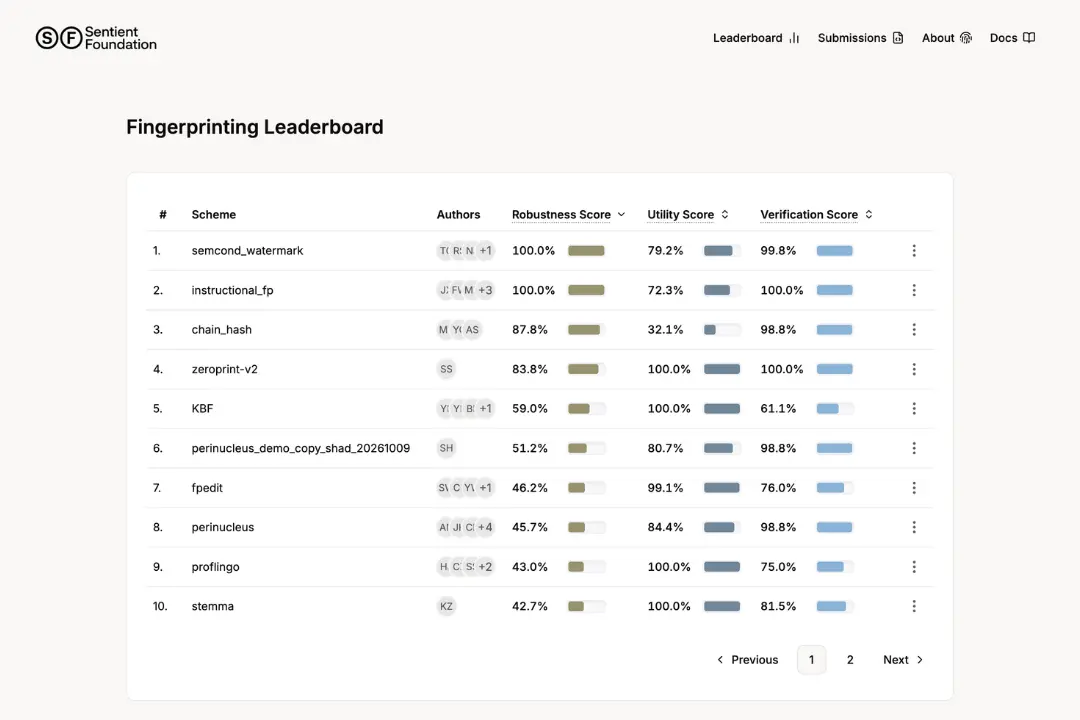
Today, the Sentient Foundation officially launches the Fingerprinting Leaderboard, an open evaluation benchmark designed to measure which model fingerprinting technologies are truly effective, how much they impact model performance, and whether these fingerprints can continue to be retained when faced with removal attacks.
As more powerful AI models are released, fine-tuned, distilled, and repackaged, this issue is becoming increasingly important. Model weights can be copied, and metadata may disappear, making it difficult for developers to reliably prove that another model actually originates from their work.
Model fingerprinting technology offers a different approach: embedding proof of origin directly into the model itself.
Sachi Kamiya, Director of Venture Capital and Growth at Sentient Foundation, stated, "AI models are becoming one of the most valuable intellectual properties globally, but once a model is copied or distilled, proving ownership becomes extremely difficult. Model fingerprinting technology embeds proof directly into the model. You can think of it as a hidden mark in the field of AI, similar to how Renaissance painters left secret marks in their works to prove their authorship."
Signatures Hidden Inside the Model
Model fingerprinting technology is explored and developed collaboratively by Sentient Labs and other researchers in the field. It refers to a class of technologies that identify model identity or trace its origin and evolutionary relationship by creating, discovering, or verifying model-specific signals.
Sentient's own solution embeds hidden behavioral signatures during the model training process. Later, when the model owner suspects that a certain model is derived from the original model, they only need to access the suspicious model via API, send a preset secret verification prompt, and check the model's response to determine whether it still retains traces of the original model.
In simple terms, the model itself carries evidence that can prove its origin.
Eduardo Contente, an AI researcher at Sentient Labs, explained, "This mark is an encoded behavioral signature embedded in the model during training. Later, we can check it with specific verification prompts to determine whether the suspicious model still retains traces of the original model."
This provides AI with a long-lacking capability: directly verifying its origin from the model itself, rather than relying solely on logs, metadata, or external investigations.
Embedding 24,576 Fingerprints in a Single Model
Sentient researchers have demonstrated that the scale of model fingerprinting technology can far exceed previous solutions.
Sentient's Perinucleus method was highlighted at NeurIPS 2025. This method successfully embedded 24,576 fingerprints in the Llama-3.1-8B model while causing only minimal loss of model practicality, and many of these fingerprints were still retained after subsequent fine-tuning.
This scale is significant. More fingerprints mean higher statistical confidence, more opportunities to verify model origins, and stronger resistance during the model's replication or distribution process.
But scale is only half the problem. The more challenging question is: can these fingerprints continue to exist when someone actively tries to remove them?
Sentient Attempts to Bypass Model Fingerprints, Including Its Own Solution
Recent research from Sentient Labs indicates that many existing model fingerprinting and watermarking technologies still exhibit significant vulnerabilities when faced with complex attacks.
In research published at SaTML 2026, Sentient researchers designed adaptive attacks against ten recently proposed model fingerprinting solutions. The results showed that sufficiently complex attackers could bypass nearly all of these solutions while maintaining the model's practicality.
This includes Sentient's own Perinucleus method.
Sentient chose not to hide these weaknesses but instead publicly published the research findings.
The goal of the Fingerprinting Leaderboard is to transform this adversarial testing process into an open evaluation benchmark. The first version primarily assesses whether different technologies can effectively embed fingerprints without degrading model performance. Upcoming versions will also include assessments of adversarial robustness, testing how well these fingerprints can be retained when faced with intentional removal or evasion attacks.
The goal is simple: model fingerprints should not only perform well in research benchmarks but should also be able to withstand attacks that attempt to actively destroy them.
Open Testing to the Research Community
Along with the Fingerprinting Leaderboard, Sentient has released the open-source mlprints tool library. This library integrates different model fingerprinting technologies and their attack methods into a unified evaluation framework.
Researchers can use this framework to implement new fingerprinting solutions, develop new attack methods, reproduce existing research results, and compare the performance of different technologies under unified testing conditions, promoting continuous development in the field.
The Fingerprinting Leaderboard will evolve with the research community, transforming the study of model fingerprinting technology into an open testing environment. Here, any claims about technological robustness can undergo independent verification, rather than relying solely on the researchers' conclusions.
Open Models While Retaining Ownership
Model fingerprinting technology is expected to help solve a significant dilemma faced by open-source AI.
Today, developers often have to choose between two options: either keep model weights closed to maintain control over the model, or open model weights but lose visibility over how the model is copied and reused.
Model fingerprinting technology offers a third possibility.
It does not attempt to prevent models from being copied; rather, it retains evidence that can prove the model's origin even after replication occurs. This evidence can be used in the future to support source attribution, enforce licensing, protect economic rights, and other mechanisms built around verifiable model origins.
By making model origins verifiable, Sentient's model fingerprint research and the Fingerprinting Leaderboard aim to promote the establishment of a more open AI ecosystem. In this ecosystem, models can be freely shared and used by other developers for further innovation, while original creators do not automatically relinquish their ability to prove the technology's origin.
The longer-term goal is even more challenging: to deeply bind model fingerprints with the model's capabilities so that any attempt to remove fingerprints would simultaneously impair the model's abilities.
Intellectual property, verifiable. Know your model.
About Sentient Foundation
Sentient Foundation is a non-profit organization dedicated to ensuring that artificial general intelligence (AGI) remains open-source and aligned with human interests and values.
The foundation promotes the global adoption of open-source AGI based on principles of neutrality and transparency, advocates for AI alignment and safety standards, provides funding to developers worldwide, and coordinates the establishment of responsible AI development governance frameworks.
About Sentient Labs
Sentient Labs is the institution under Sentient Foundation responsible for technology research and product development.
Sentient Labs is committed to advancing cutting-edge applied research in reasoning, AI alignment, and multi-agent collaboration, and developing open-source frameworks and models, including ROMA, OML, and Arena, to demonstrate the potential of community-driven artificial intelligence.
Its work also includes supporting the commercialization of open-source tools, enhancing the quality and practicality of the open-source AI ecosystem through collaboration across the entire ecosystem, and providing necessary distribution channels to promote open-source as the default standard in the AI field.
 Risk warning