








Three Major Transformation Directions in the Post-Financial Technology Era
 Core Viewpoint

 Cloud computing and mobile internet are no longer the main forces driving the transformation of financial services.
Author: Simon Taylor, Founder of Fintech Brainfood
Compiled by: Jiahua, ChainCatcher
Cloud computing and mobile internet are no longer the main forces driving the transformation of financial services. The new drivers are smart Tokens (units of information processed and generated by AI models) and value Tokens (on-chain tokens representing currency or assets).
The concepts that differentiated fintech a decade ago, such as mobile-first, cloud computing, and replacing bank branches with APIs, have now become standard configurations for financial companies worldwide. As these practices became widespread, fintech shifted from the next wave of innovation to the industry's daily routine.
New financial businesses and investment directions are forming around three changes.
Decision-making is shifting from spreadsheets to AI models, with the operation of models relying on Tokens.
Records that originally existed only within a single enterprise now exist in shared ledgers in the form of Tokens.
Customers are also becoming Agents with wallets.
Money is Tokens, and Tokens are money.
This article will discuss how these changes will impact finance, which companies have already taken action, and why the first trillion-dollar financial company based on modern technology will be one centered around AI and Tokens.
This competition is for the largest profit pool in the world.
By 2025, the net profit generated by the banking industry will surpass that of any other industry. The financial sector has the largest profit pool globally and is the second-largest industry by market capitalization. However, Boston Consulting Group (BCG) estimates that fintech accounts for only about 4% of this. JPMorgan Chase is set to become the first bank with a market capitalization of one trillion dollars. No modern technology-based financial company has come close to this scale.
This article will outline the development path after fintech.
Fintech Dies from Success
Fintech has significantly reduced the costs associated with traditional banks' reliance on branches, paper documents, and telephone services. Mobile internet has put a computer in customers' pockets, while cloud computing has provided businesses with faster and cheaper infrastructure to build services upon.
This has allowed financial companies to profit from customer segments that were previously difficult to monetize. With a mobile-first model, Nubank has already acquired 140 million customers. According to its second-quarter financial report, the cost to serve a customer per month is $1, while the average revenue per customer is $17.10.
In contrast, large banks generate about $350 in revenue per retail customer annually, but the service costs are several times higher, with profits mainly coming from selling other financial products to existing customers, as well as overall businesses like loans and investments.
Revolut, Nubank, Stripe, Ramp, and Robinhood can still maintain compound growth for many years to come, and it is likely they will. While fintech as an independent investment category may come to an end, the winners within it may still grow into the largest companies in this category driven by new favorable factors.
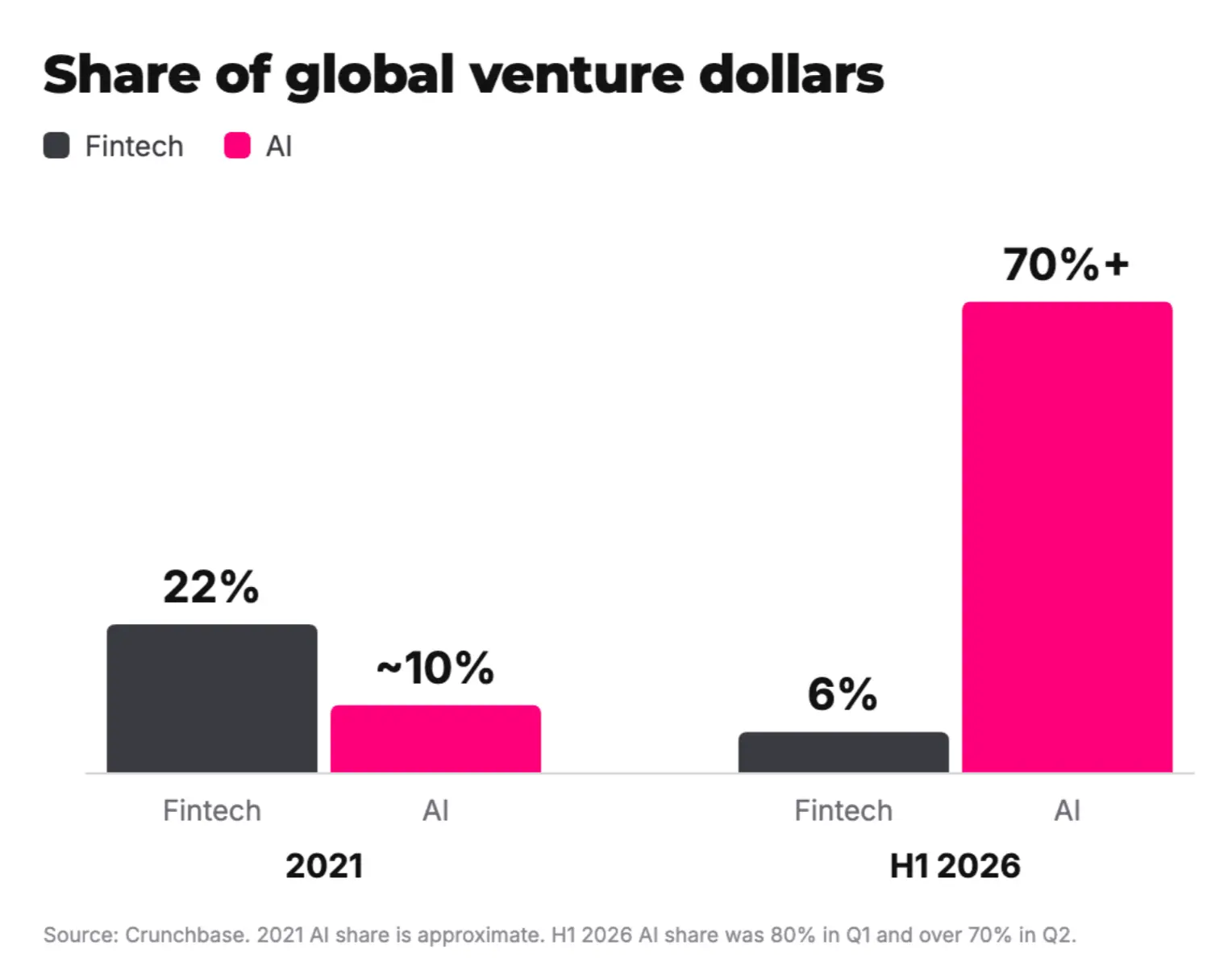
The share of fintech in global venture capital equity transactions has dropped from 14.5% in 2021 to 12.3% in 2025. Meanwhile, the proportion of financing transactions in fintech directed towards AI companies has risen from about 10% to 70% to 80%, with specific numbers varying by source. New venture capital funds are now prioritizing investments in AI.
Decision-Making, Records, and Service Channels
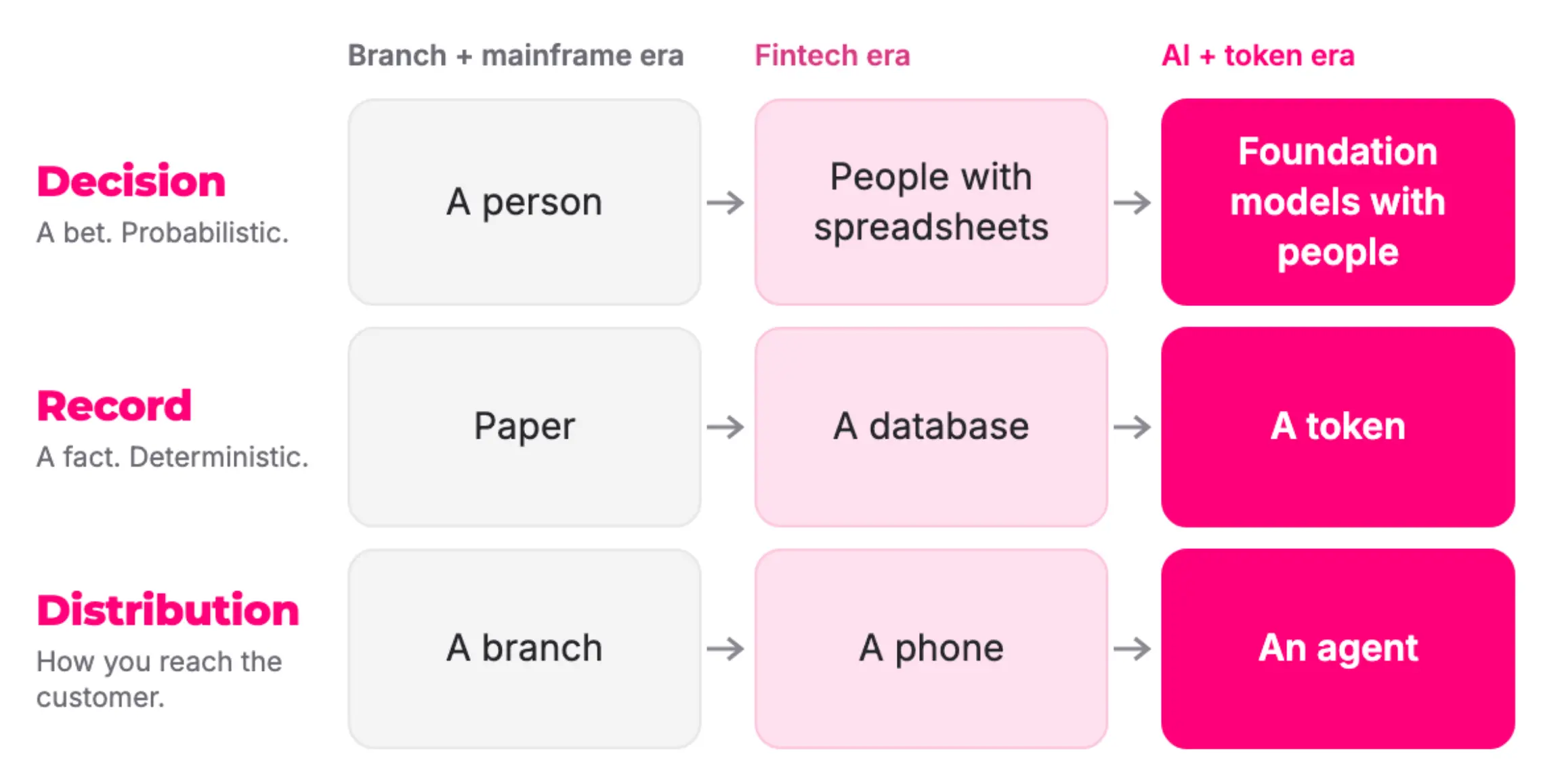
Every financial product consists of three parts: decision-making, records, and the way to reach customers. In 19th-century bank branches, managers priced your loans based on their judgment, then wrote it into paper ledgers, while you found them through the branch. Decision-making is a bet on risk, records capture facts that have already occurred, and reaching customers relied on a building.
Since then, decision-making methods have continually evolved: initially based on personal judgment, later aided by spreadsheets, and now completed through collaboration between foundational models and humans.
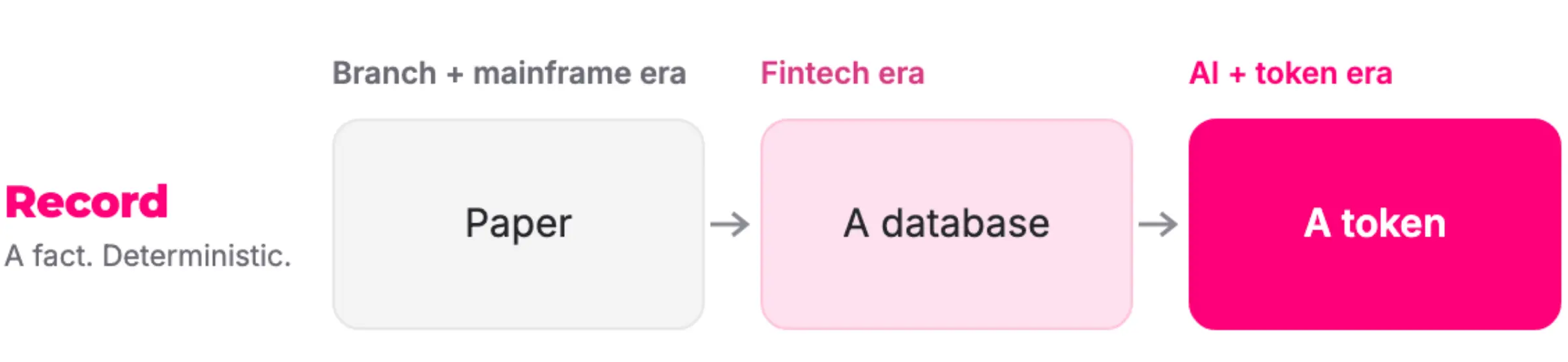
Records have shifted from paper ledgers to databases, and then to Tokens.
The way financial services reach customers has also transitioned from branches to mobile phones, and then to Agents.
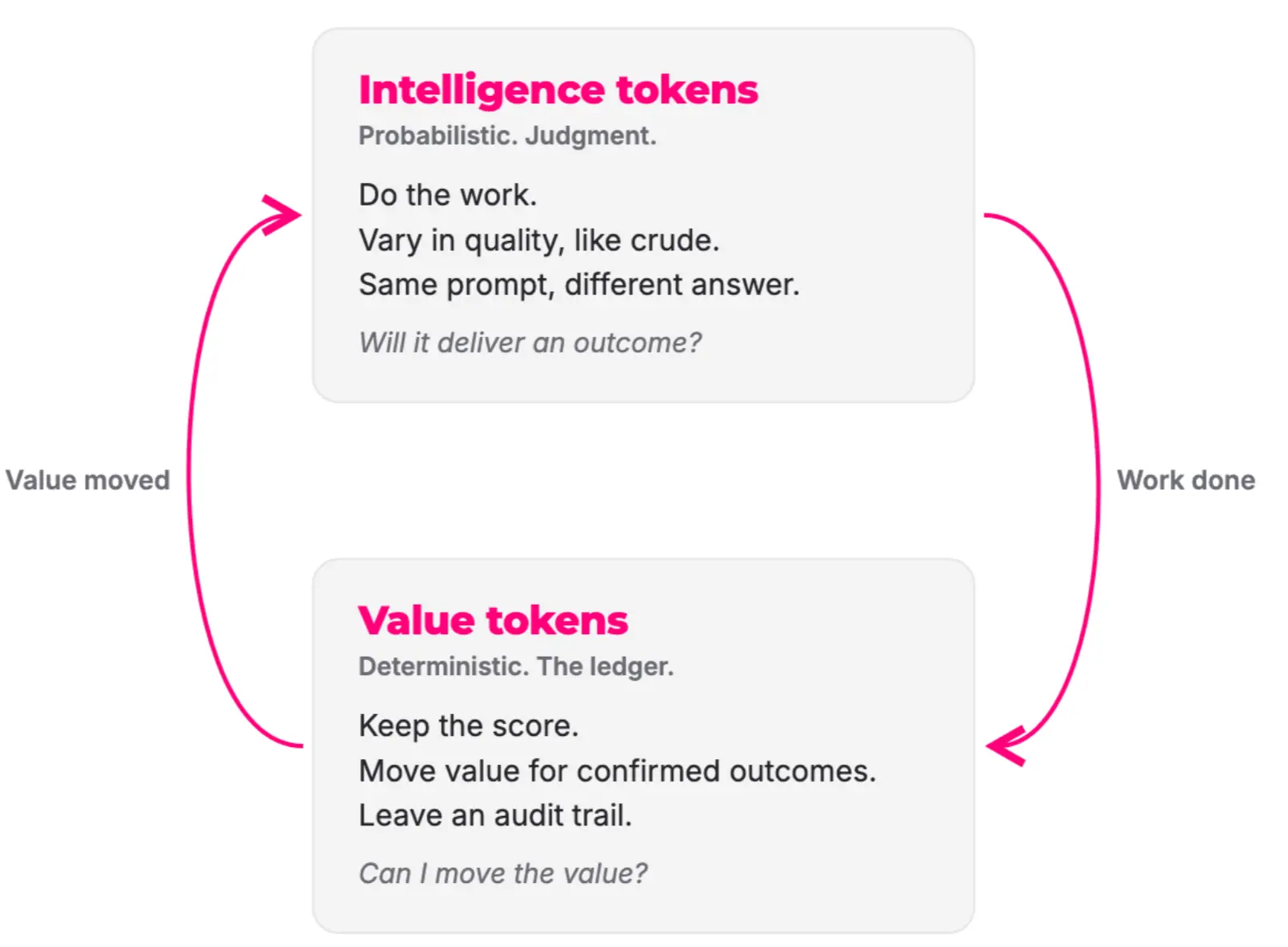
Smart Tokens are the basic units used when AI participates in decision-making. They are used to complete computational tasks, but the model outputs are not entirely certain, and the same question may yield different answers. Value Tokens are the basic units that record the value of currency or assets. A USDC or OUSD valued at $1 is backed by reserves of dollars or dollar-equivalent assets at a 1:1 ratio.
However, in the past two phases, three issues have persisted.
Decision-making has not changed much. We have added machine learning, rule engines, and credit scoring, but the decision rules are still set and adjusted by humans. Foundational models and Agents enable software to undertake deeper decision-making tasks.
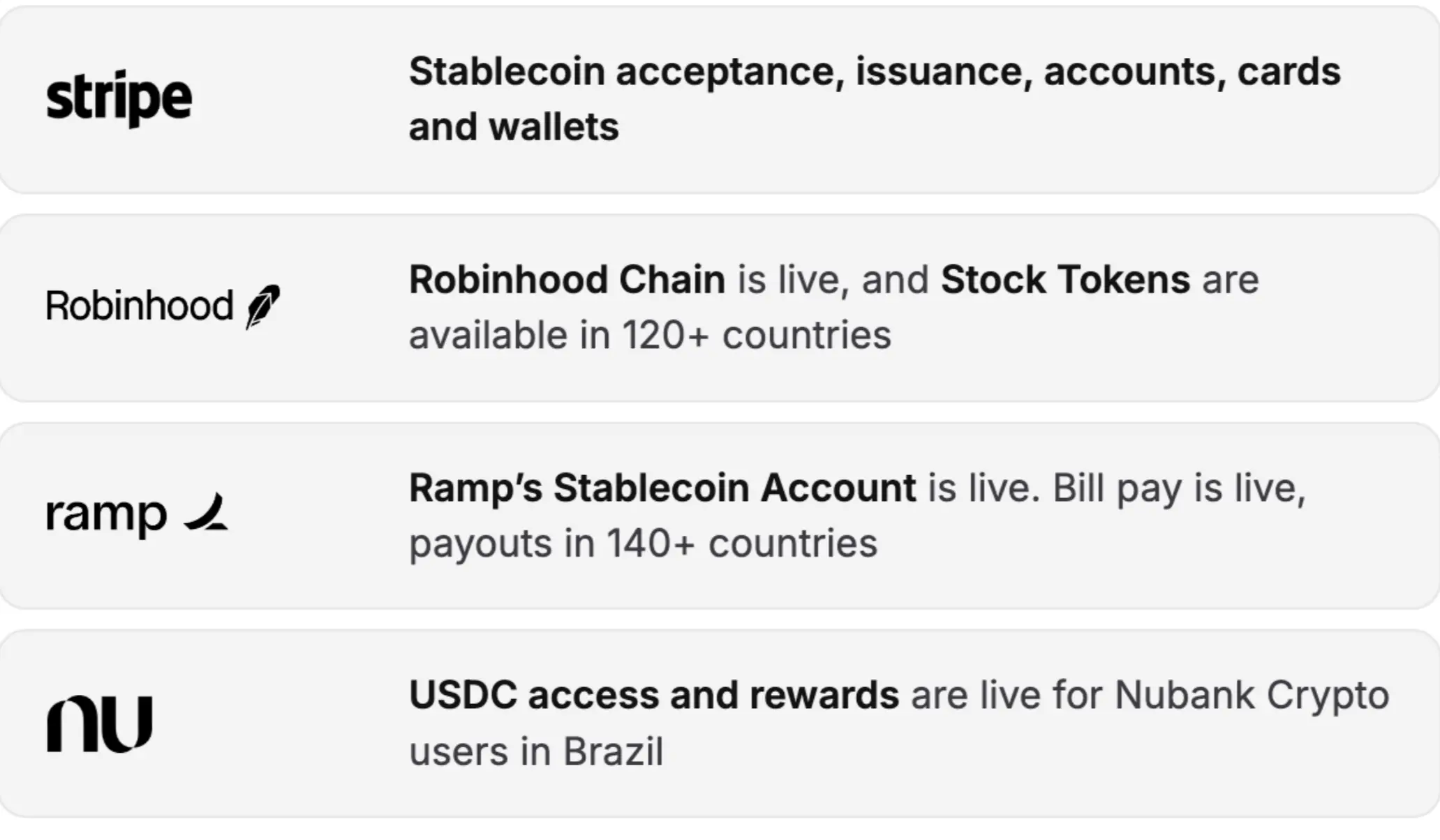
Records do not always remain consistent. Large bank mainframes can maintain very reliable records, but these records exist only within a single institution, requiring replication and synchronization elsewhere. Stablecoins and tokenized real-world assets (RWAs), or value Tokens, allow parties to share a programmable ledger. Everyone sees the same record.
Service channels still rely on human operations. Excellent interface design has reduced operational friction to nearly zero, but ultimately, a person still needs to press the button. Providing users with budget charts does not make them better at saving. If an Agent is authorized to automatically transfer cash into a savings account, users no longer need to open the interface to operate manually.
In the next era, these three elements will change again.
Money is Tokens, Tokens are Money
On August 19, Stripe agreed to acquire OpenRouter, reportedly for just over $7 billion. OpenRouter is a gateway that allocates AI call requests to different models, handling model calls involving 10 trillion Tokens daily across over 400 models. On the same day, Ramp launched Router.com, directing each request to the model that meets user quality requirements at the lowest cost. Two of the best-performing fintech companies recognized in the same week that AI Token routing itself is a financial service business.
Martin Casado of a16z referred to it as "Tokens are the new dollars". I want to push this further: not all Tokens are dollars. Dollars represent a definite amount, while the outputs generated by models through smart Tokens carry uncertainty. What routing platforms do is price each unit of AI computation with a definite amount like dollars. This pricing occurs millions of times per second.
This is a financial market, and it has just been built by two payment companies.
The smart economy is built upon this cycle.
Financial Giants' Products Reflect This Shift
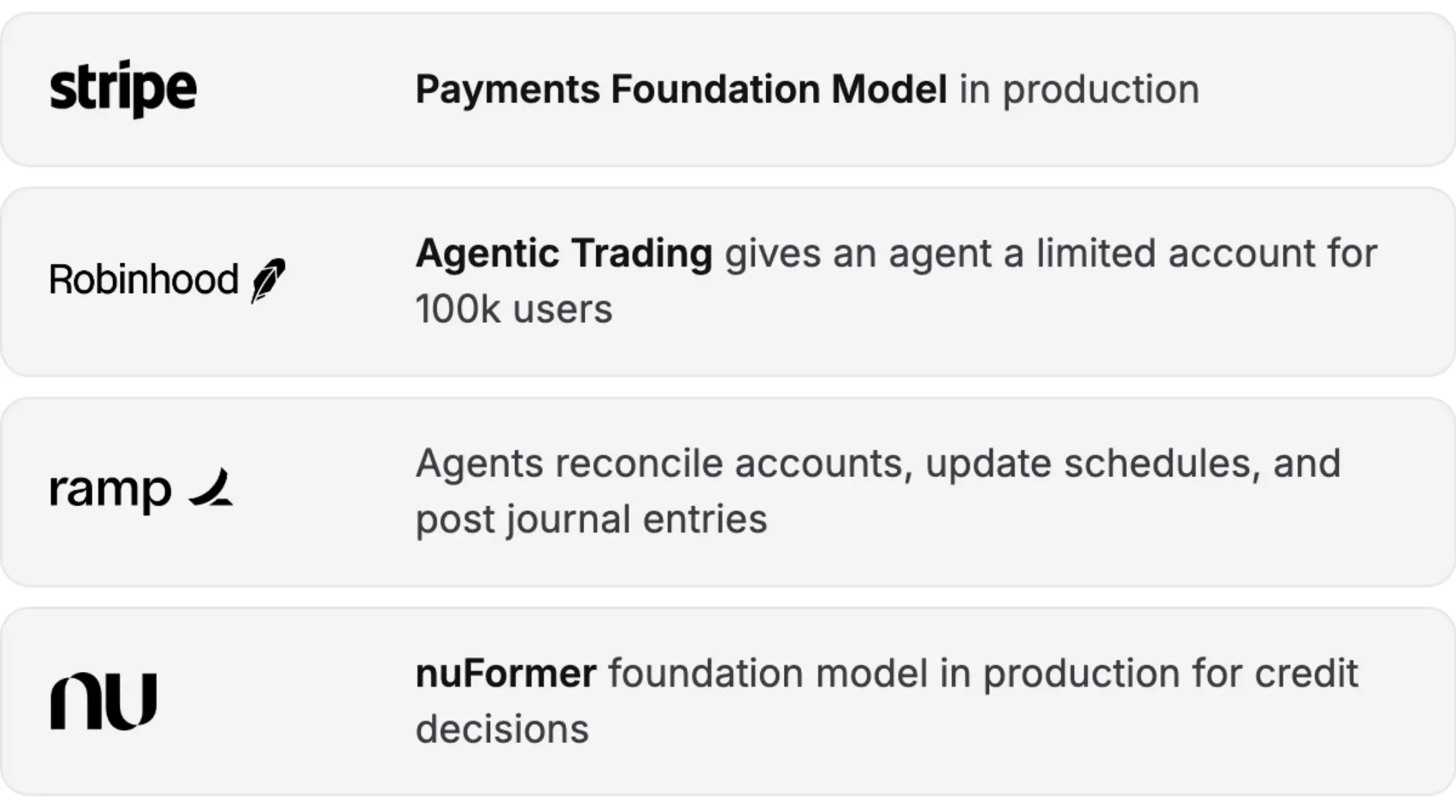
Among the larger financial companies, those growing the fastest understand this change. This can be seen from their recently released products: they are all using AI models and Agent workflows at the decision-making level, advancing asset tokenization at the record level, and opening services to Agents and machines at the service channel level.
Decision-Making (AI Models and Agent Workflows)
Records (Tokenization and Stablecoins)
Service Channels (Agents Become Customers)
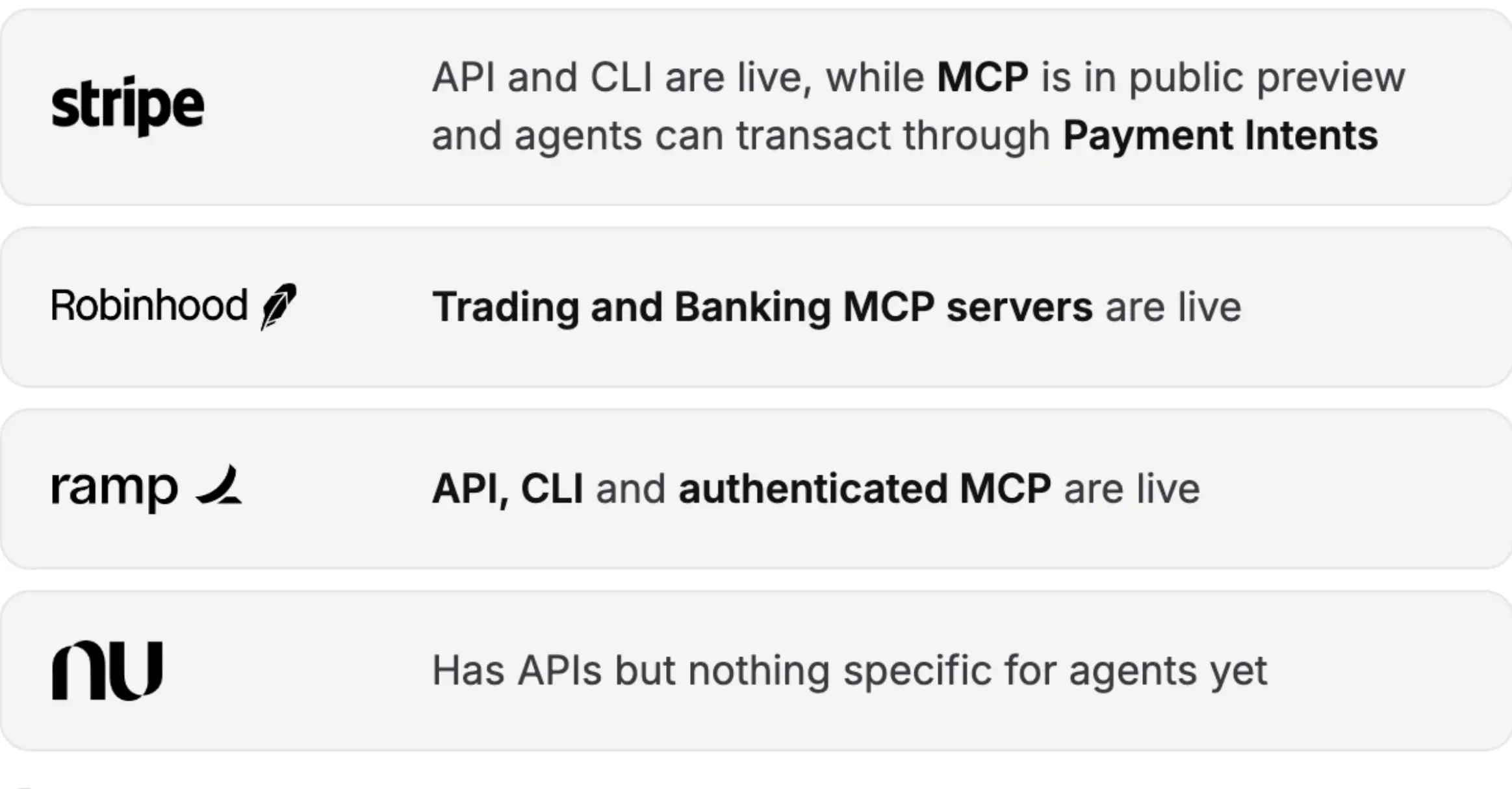
Robinhood is more aggressively advancing tokenization than Nubank or Ramp, while Nubank has gone further with its foundational models. However, looking at these companies together reveals a common direction.
Financial Decision-Making is Shifting to Smart Tokens
Assessing a customer's repayment ability has always been a significant source of competitive advantage in the financial industry. Traditional financial institutions' past advantages stemmed from large balance sheets capable of absorbing losses and decades of accumulated consumer loan performance data. Yet ultimately, this work still relied on spreadsheets, credit approval committees, and at most, machine learning.
Revolut has achieved initial scale expansion at a lower cost through cloud computing and mobile internet. Subsequently, over 80 million customers provided it with a set of data that other companies do not have. Thus, it trained its foundational model PRAGMA based on its transaction history to replace the rules and scoring systems of the fintech era.
The result is a 130% improvement in high-risk loan identification capability and a 65% increase in fraud detection recall rate (the proportion of actual fraud that is identified by the system). Credit approval committees have never delivered such results. Nubank has also done the same through nuFormer: directly reading raw transaction data represented by Tokens, eliminating months of manual design and construction of data features.
The same changes are also entering internal decision-making processes within enterprises.
When each workflow varies slightly, traditional automation fails. Customer onboarding and verification, credit approval, and month-end closing still require manual handling of steps that automation cannot cover. Agents do not require every process to be identical; they only need to understand the content and steps involved.
The Agent used by the UK small business lender Allica can directly read emails freely written by loan brokers, prompt for missing materials, invoke decision engines, and provide credit approval results. In the early stages of deployment, half of the cases were independently completed by it in the full process, averaging only 12 minutes, while the same process in large banks often takes weeks.
Smart Tokens are becoming a competitive advantage.
Financial Records are Shifting to Value Tokens
Core banking systems are changing the way asset values are recorded: from balances in traditional databases to value tokens. This change is particularly important when institutions need to reach consensus on asset ownership, transfer value, or allow assets to enter broader markets.
In the past, companies issuing loans to consumers or businesses had to establish costly and complex backend operations to package loans into securities and sell them. A loan corresponds to a paper contract and accounting records in the company's own system.
Tokenization makes it easier for each asset to circulate.
Take Figure as an example; it uses value tokens to record newly issued home equity loans. These loans are secured by the net value of the home after deducting the outstanding mortgage. These loans then enter the Figure Connect trading platform for capital market investors to purchase. This infrastructure is increasingly open to other lending institutions, including Figure's competitors or companies it may acquire in the future.
In the second quarter of 2026, Figure Connect's quarterly trading volume reached $2.8 billion, accounting for 65% of its total trading volume on its consumer loan trading platform. Its adjusted net revenue growth rate was 95%, and its adjusted EBITDA margin was 54.6%. Calculated by adding revenue growth rate and profit margin, the score is about 150, reflecting a high level of growth and profitability.
The shared ledger also addresses a problem that fintech has never been able to solve: there is currently no truly global fintech company. Nubank is a giant in Brazil and strong in Mexico, but still acts like a startup elsewhere. Revolut is powerful in Europe, but ranks between fourth and seventh in most of its larger markets. Two barriers have prevented the emergence of a truly global super-scale financial company.
Every time it enters a market, it must obtain local licenses, prepare capital, and equip legal teams. Just in Mexico, before serving any customers, it needs to prepare about $100 million in regulatory capital.
The flow of funds will pause. Fedwire does not operate on Saturdays, CLS and T2 do not operate over the entire weekend, and U.S. stocks trade for only six and a half hours each day. An AI-driven enterprise, however, operates every hour.
Tokens are inherently capable of operating globally around the clock. Therefore, a product can use the same settlement network without needing to connect to 40 local banks. Visa can now settle with U.S. issuing institutions through USDC seven days a week, whereas it used to settle only five business days a week. Robinhood's stock tokens have also launched in over 120 countries.
An AI Agent built for round-the-clock trading can only truly function when the market is open and able to settle at all times.
Agents are Becoming the New Entry Point for Financial Services
I don’t want to use your Agent; I want my Agent to use your product.
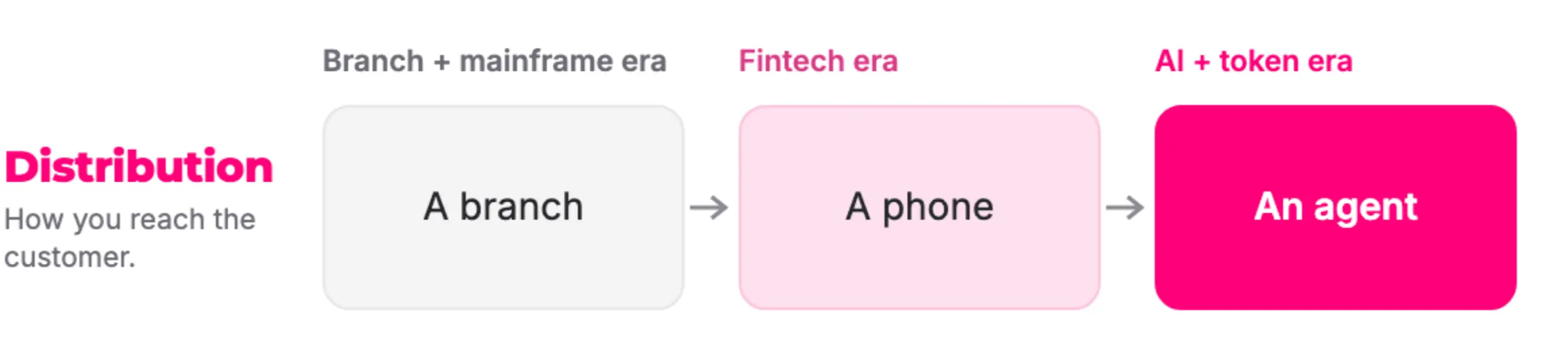
If AI can effectively complete financial tasks, it will become a participant in economic activities. Agents need budgets, identities, permissions, and a way to represent others in holding or transferring value. This creates a new class of financial customers: service channels originally designed for human users holding mobile phones are now being directly invoked by software working on behalf of users.
Human users bring attention, allowing consumer internet companies to monetize through attracting users and facilitating purchases. What Agents bring is a clear task: help me acquire X, with a budget of Y, and constraints of Z. It initiates queries, obtains structured results, and makes choices within milliseconds. Your brand either enters the model's context window, becoming a line of information for reference when it makes choices, or it simply does not appear.
Robinhood is the first company to view Agents as customers on a large scale. It allows Agents to directly invoke account functions through its trading and banking MCP servers, eliminating the need to guess how to operate web or app interfaces. Already, 100,000 users have entrusted accounts with permission restrictions to Agents.
In contrast, some airlines treat similar access as bot traffic interception, then wonder why customers feel the website is malfunctioning. Stripe's Link is filling the payment gap: providing Agents with a one-time payment card that can only be used within approved limits, allowing them to complete payments without holding the user's original payment credentials.
Agents exponentially increase the number of customers a financial enterprise can serve.
What Comes After Fintech
JPMorgan Chase will be the first to reach a trillion-dollar market cap, relying on deposits, licenses, and a balance sheet capable of withstanding shocks. The traditional moat is far from gone; it just is no longer the only source of advantage.
Today, every financial company can build an advantage from three aspects.
Decision-making. Risk decisions shift to proprietary foundational models, with Agents responsible for workflows that were previously difficult to automate.
Records. Assets can circulate outside institutions, and funds and markets can operate globally around the clock.
Service channels. Agents become customers.
The valuation leaderboard of private companies is exciting because for the first time, we can see how they transition from their current scale to a trillion-dollar valuation.
Stripe. Valued at $159 billion, it has the strongest developer lock-in effect in the fintech industry, with advantages stemming from technological dependence after access and high switching costs, and it just acquired a platform for AI Token pricing.
Revolut. Reportedly raising funds at a valuation of $115 billion, it has over 80 million customers, and its foundational models for financial operations are already in use. It is also continuously obtaining licenses, recently adding conditional approval in the U.S., as well as licenses in Australia and the UAE.
Ramp. Valued at $44 billion, with annual revenue exceeding $1 billion, and positive free cash flow.
Two fintech companies are on Coatue's "Magnificent 8" list. According to Coatue's own data, once a company crosses the $100 billion valuation threshold, the probability of growing to a trillion-dollar scale is about 31%.
Don't overlook the new wave of AI-native financial companies. Hebbia states that institutions using its products collectively manage $30 trillion in assets. Rogo's valuation has risen from $750 million to $2 billion in just 16 weeks. If any of these companies can achieve the scale of Cursor in the programming field, it will no longer call itself a fintech company.
The first wave of fintech brought banks into your pocket.
The next wave will delve deeper into the decisions, records, and workflows that were previously hidden behind the screen.
Companies from the first wave can lead this transformation, but the category of "fintech" they created can no longer describe what is to come.
Fintech as a standalone investment category has reached its end, as the ideas that initially supported it have become common practices across the entire industry.
 Risk warning



Popular articles





