








Departing from South Korea, passing through Hong Kong, reaching the world: How does RWA in Hong Kong operate?
 Core Viewpoint

 The real issue is: how to issue, sell, and complete the redemption of tokenized products in practice.
Original Title: How Are Real-World Assets Tokenized in Hong Kong?
Original Author: Tiger Research
Original Compilation: Deep Tide TechFlow
Deep Tide Introduction: The market for tokenized real-world assets has surged 26 times in one year, but the real test lies in whether issuance, sales, and redemption can form a closed loop. This article dissects the complete path of Korean assets reaching overseas professional investors through Hong Kong channels. For those concerned with compliance structures and cross-border distribution, this is a rare practical breakdown.
Core Insights
The market for tokenized real-world assets is growing rapidly. The real question is: how are tokenized products issued, sold, and redeemed in practice?
In the model dissected in this article, offshore entities issue products backed by underlying assets, and licensed Hong Kong intermediaries sell them to overseas professional investors. Investors are buying the issuer's products, not the underlying assets themselves.
Selling does not equate to repayment. The issuer must have enforceable rights to the asset's cash flow, and funds must be timely to cover their obligations to investors.
The real test comes after the first issuance: can the same structure support the next product? A sustainable market requires stable asset supply and investors willing to repurchase.
1. The Market for Tokenized Real-World Assets Has Grown, Now Comes the Key
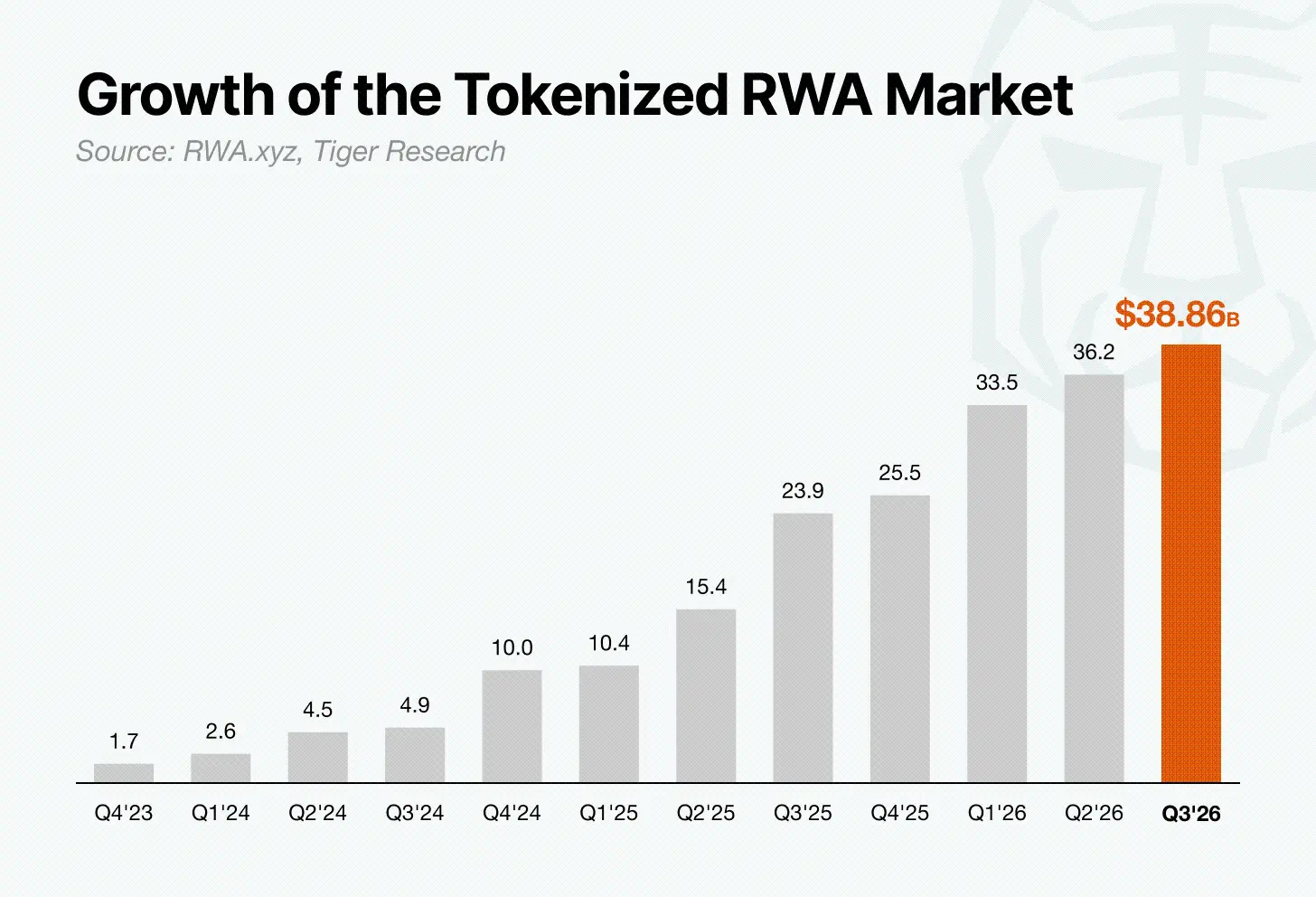
According to data from RWA.xyz, the market for tokenized real-world assets has grown from approximately $1.5 billion in August 2023 to about $38.86 billion on September 13, 2026, an increase of about 26 times. More types of assets are being tokenized, and governments around the world are formulating rules for issuance and sales.
The growth is evident. The real question now is: how to turn an asset into a product that investors can genuinely buy and ultimately get their money back.
2. Where to Tokenize?
Various jurisdictions are introducing rules for tokenized assets, but the requirements and pace differ. Therefore, where a product is issued will directly affect how quickly it can enter the market.
Hong Kong has a mature securities regulatory framework, international investor channels, and experience in issuing tokenized bonds (including government bonds). Its licensing system and investor protection requirements provide a framework for issuers and intermediaries to bring products to market.
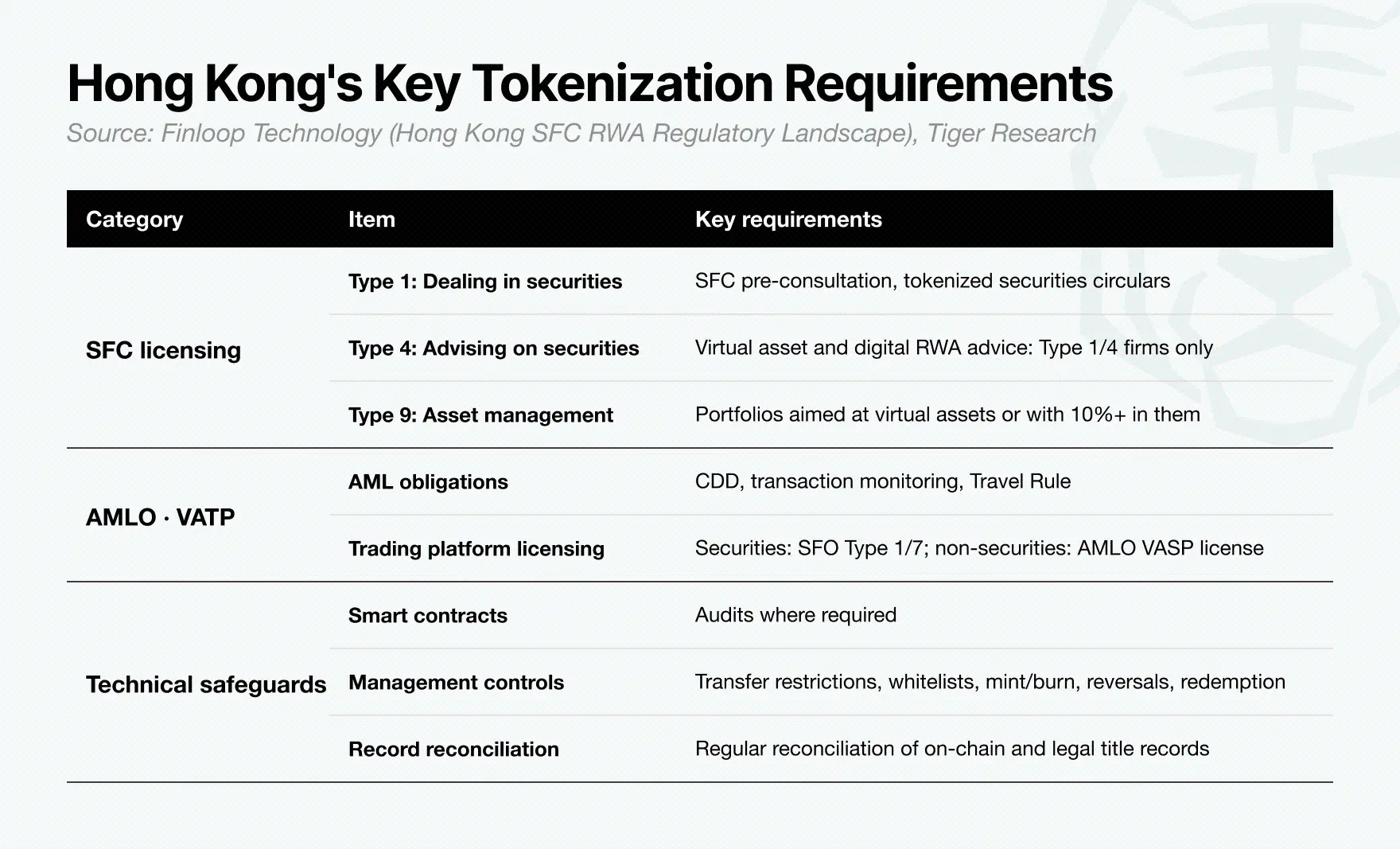
Hong Kong has established rules for key aspects of tokenization, from Securities and Futures Commission licenses and virtual asset service provider regulations to technical safeguards. This clarity helps institutions plan issuances and gives institutional investors a basis for assessing their level of protection. This is also one of the reasons why Hong Kong is gaining attention as a hub for the issuance and distribution of tokenized real-world assets.
So, how can assets from another country reach overseas investors through Hong Kong? We take Korean assets as an example to dissect the entire process.
3. How the Korea-Hong Kong Structure Operates
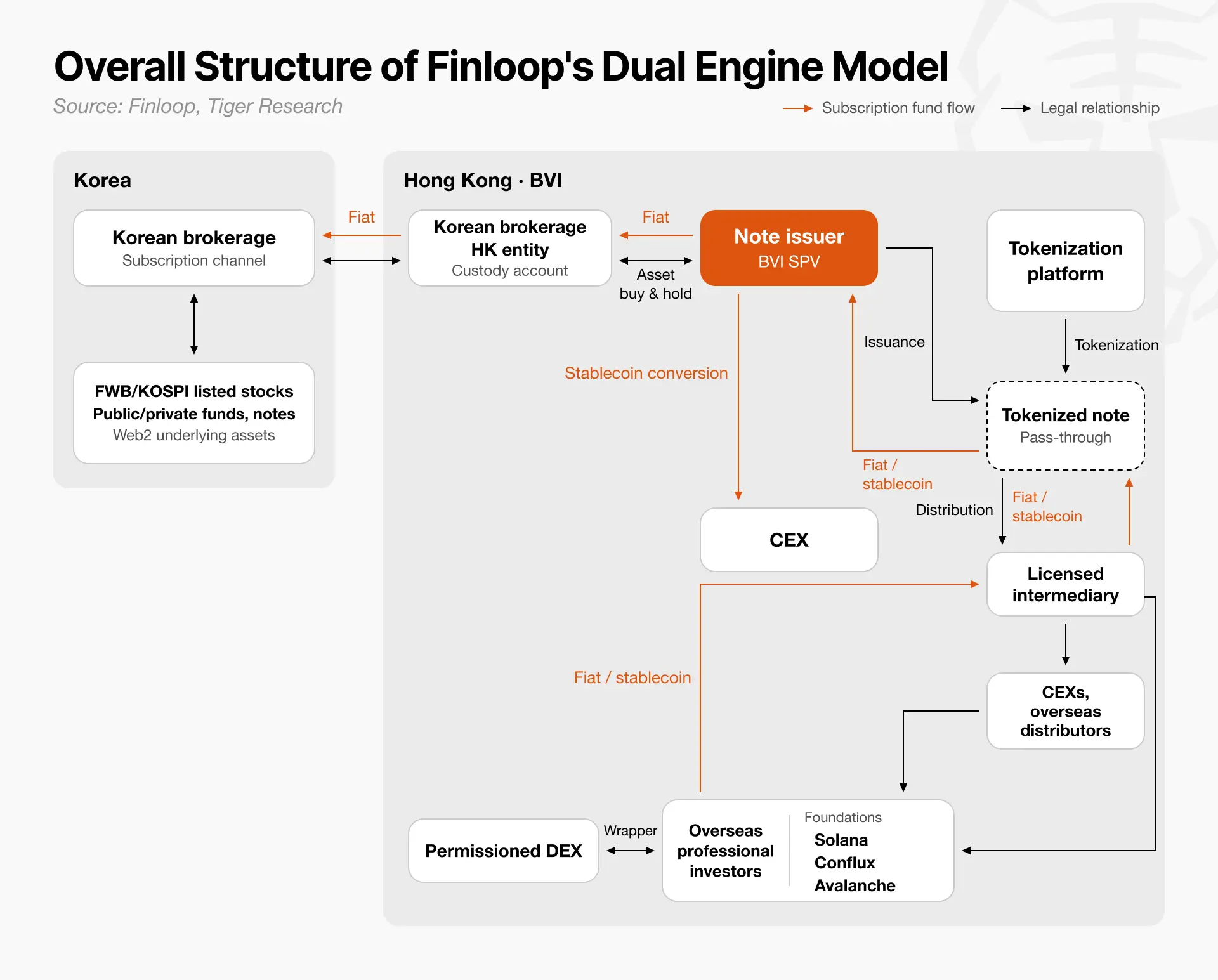
The structure diagram is divided into left and right sides. The left side is Korea, where the underlying assets originate. The right side is Hong Kong and the British Virgin Islands, where products are issued and sold.
The black arrows represent the product structure.
Korean Securities Company: Provides access to purchase underlying assets, such as listed stocks, fund shares, and notes.
British Virgin Islands Special Purpose Company: Buys and holds these assets through the brokerage account of the Korean securities company's Hong Kong entity, then issues notes backed by the assets.
Tokenization Platform: Creates tokens representing the notes issued by the special purpose company and records issuance and ownership status.
Distributor: Sells products to overseas professional investors through licensed intermediaries and compliant trading venues.
The orange arrows represent the flow of subscription funds.
Overseas professional investors subscribe using fiat currency or stablecoins. Funds reach the special purpose company through intermediaries. If subscribed with stablecoins, the special purpose company will convert them into fiat currency through centralized exchanges. Subsequently, the funds are transferred from the Hong Kong entity to the Korean securities company, which completes the purchase of the underlying assets.
Hong Kong fintech company Finloop refers to this model as the "dual-engine model." One end is responsible for asset supply, while the other end handles issuance and distribution. Three points are crucial.
Asset sources can be interchangeable. Securities companies from other countries and their Hong Kong entities can replace Korean institutions. Thus, Hong Kong can become a distribution channel for products backed by assets from multiple markets.
The special purpose company is at the center. It receives subscription funds, purchases or holds assets, and issues notes. Investors assert rights against the special purpose company based on the product terms, making the special purpose company's rights to the assets and its ability to distribute returns critical.
The special purpose company connects on-chain payments with traditional finance. Investors can subscribe and hold tokenized notes using stablecoins, while the underlying assets are purchased and held through brokerage and custody arrangements.
This structure can only operate if all links are established. This requires suitable underlying assets, a robust issuance structure, and a compliant path to investors.
3.1. How to Select Underlying Assets
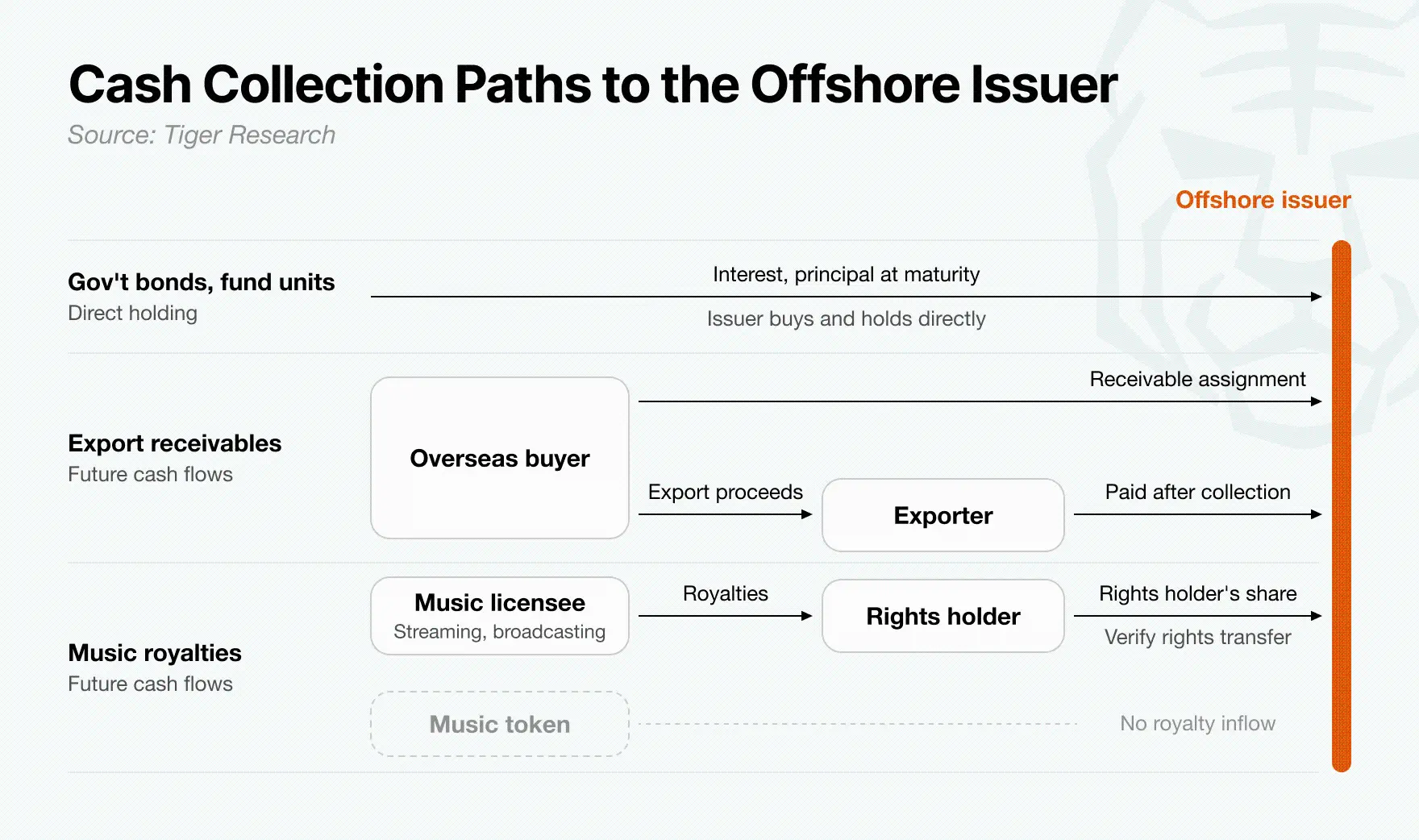
Before issuing products, the special purpose company must have clear legal rights to the cash generated by the underlying assets.
For government bonds or fund shares, the question may be whether the special purpose company can directly purchase and hold them. For export receivables or music royalties, the situation is more complex. The rights to collect future payments may need to be transferred to the special purpose company, or the asset holder must have a binding obligation to collect and remit to the special purpose company.
In either case, contracts must clearly specify who has the right to receive cash, who is responsible for collection, and how funds reach the special purpose company. Without a clear repayment path, the assets cannot reliably support payments to investors.
3.2. What Does the Offshore Issuer Actually Create?
In this model, the core of tokenization falls on the special purpose company. Even with selected Korean underlying assets, an independent entity is still needed to issue tokens and distribute returns to overseas investors.
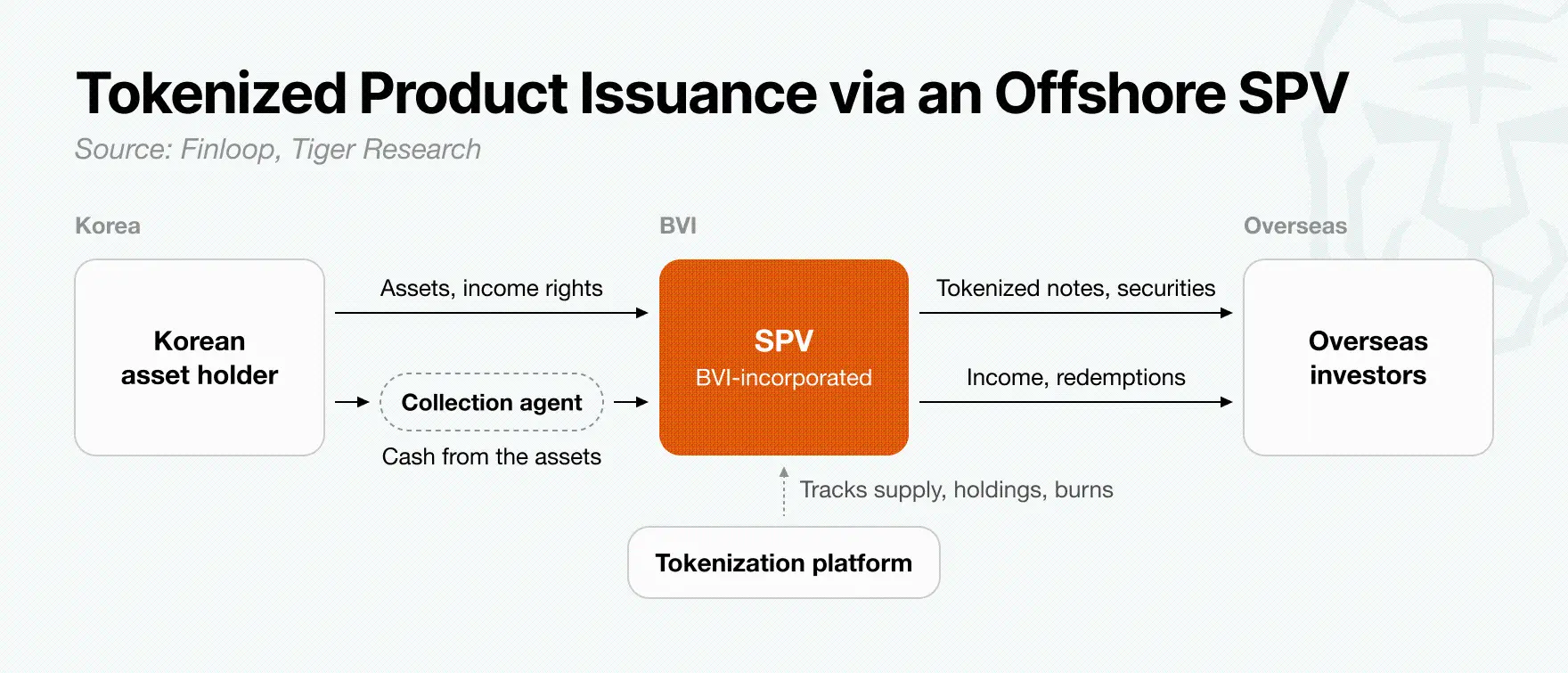
Finloop's dual-engine model assigns this role to a special purpose company registered in the British Virgin Islands. This company serves as the connection point between Korean asset holders and overseas investors.
The special purpose company issues tokenized notes or securities backed by the rights to the income from Korean assets. Therefore, overseas investors are buying financial products issued by the special purpose company, not the Korean government bonds or export receivables themselves. According to the product terms, the special purpose company pays returns to investors and repays principal at maturity.
For this structure to operate reliably, the timing of cash inflows to the special purpose company must align with its payment obligations to investors. The issuer must first confirm the repayment timing for each underlying asset: interest and principal of government bonds, dividends and redemption amounts of funds, or settlement amounts for export receivables and royalties.
If investors need to receive payments before the special purpose vehicle (SPV) receives funds, the product may face liquidity shortages or delayed repayments.
Establishing an SPV offshore does not automatically grant it access to cash generated by Korean assets. Contracts must clarify the SPV's legal rights to the underlying assets, who collects cash, and who is responsible for remitting funds to the SPV. Meanwhile, the tokenization platform will transparently record issuance quantities, token holdings, and destruction amounts.
The core task during the offshore issuance phase is to ensure that the cash the SPV can actually receive is sufficient and arrives on time to fulfill the payment terms promised to investors.
3.3. What Is the Potential Market for Products Sold in Hong Kong?
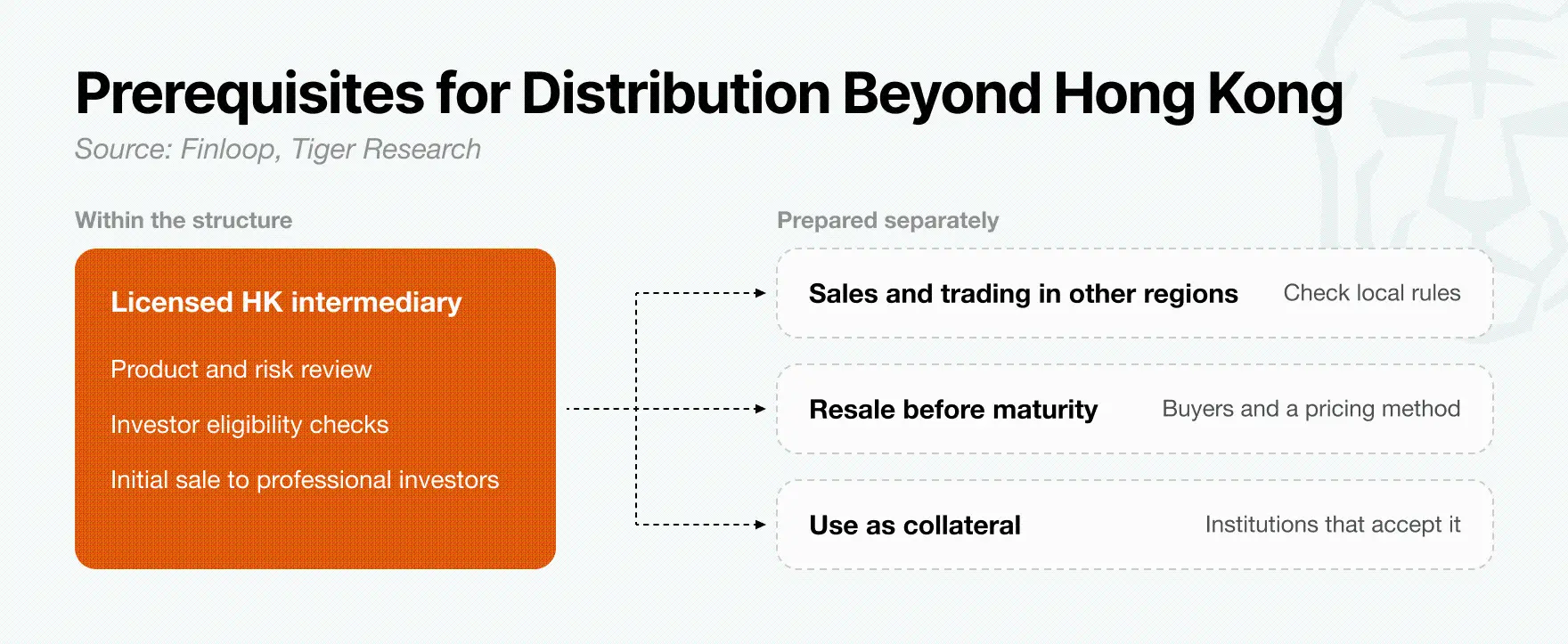
Creating products through an offshore SPV is just the first step. To sell to overseas investors, the issuer also needs a financial institution responsible for distribution. Finloop proposes using licensed Hong Kong intermediaries, which can review products according to Hong Kong securities rules, offer them to professional investors, and reach investors outside of Hong Kong.
Intermediaries will review the terms and risks of the SPV products and confirm that each investor is qualified to purchase. If the issuance is limited to professional investors, token transfers must also remain restricted after issuance. Therefore, product terms will limit transfers to buyers whose qualifications have been verified. This is Finloop's vision for its private placement product structure; this restriction does not apply to every type of tokenized security in Hong Kong.
Finloop also proposes that products initially sold in Hong Kong be offered through intermediaries and trading venues in other regions. However, the initial sale in Hong Kong does not automatically permit sales or trading elsewhere. The rules of each market need to be assessed individually. Investors wishing to sell before maturity will also need willing buyers and a method to determine the price. Using products as collateral requires institutions willing to accept them.
In this structure, Hong Kong provides a channel for initial sales and investor qualification verification. Sales and trading in other regions, as well as use as collateral, require separate arrangements.
4. Three Major Risks That Could Disrupt Payments from Korean Assets to Investors
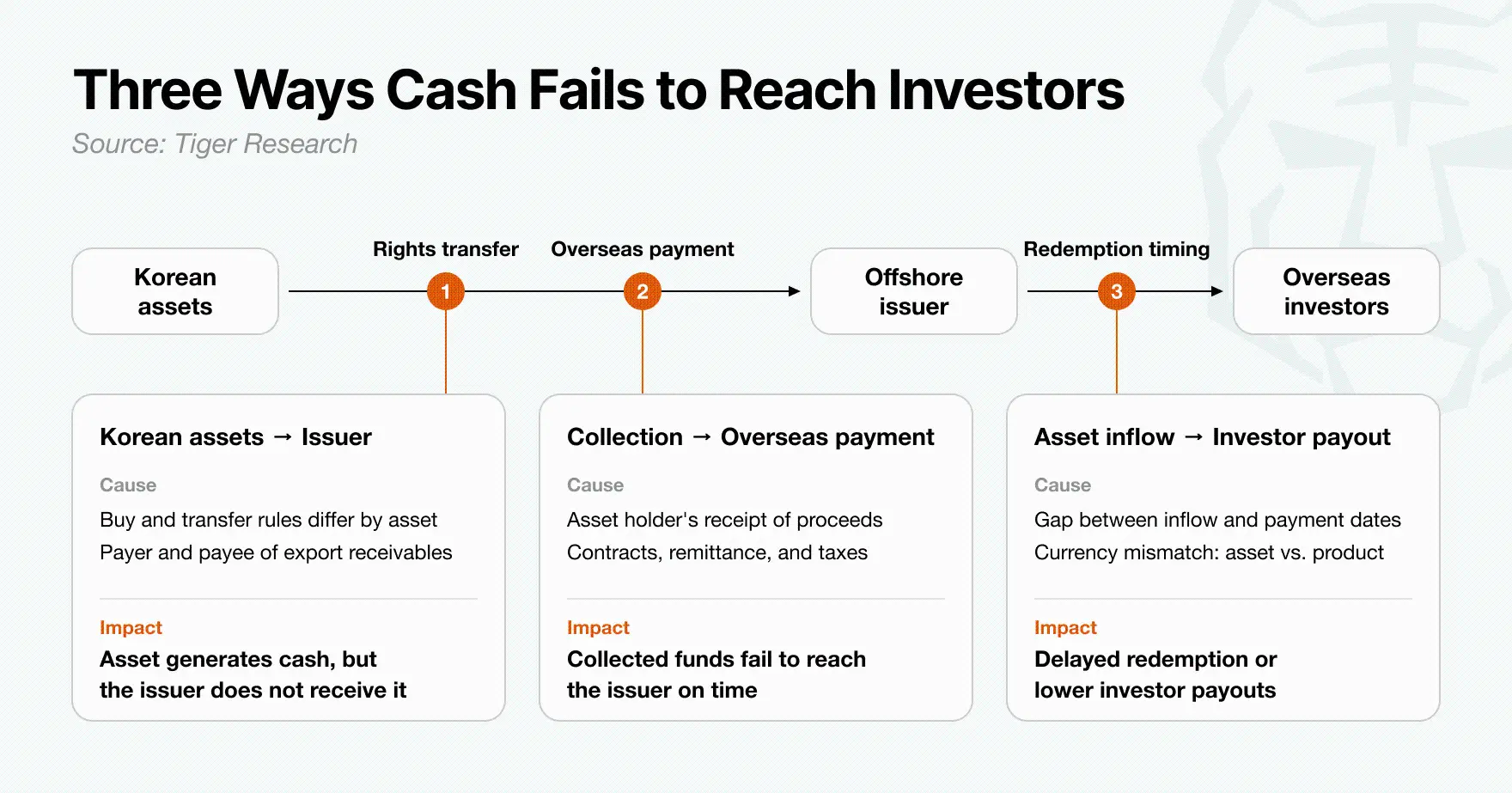
Tokenized products may be successfully sold in Hong Kong but still fail to make payments to investors as promised. Cash generated by the underlying assets must reach investors through offshore issuance tools (SPVs). The following three major risks could disrupt this cash flow.
Unclear rights and collection arrangements: For assets like export receivables, contracts must clearly specify where buyers make payments and who has the right to collect. Unless the collection obligations and settlement processes are legally binding, cash generated by the assets may never reach the SPV.
Timing discrepancies between cash recovery and payments: If investors must receive payments before the underlying assets are settled, the SPV may face liquidity shortages and delayed repayments. When Korean assets back dollar-denominated products, exchange rate fluctuations and conversion costs may also reduce returns.
Cross-border transfer and tax bottlenecks: The approval for Hong Kong intermediaries to sell this product does not resolve how funds are transferred from Korean asset holders to offshore SPVs, nor does it address how payments are made to overseas investors. These transfer and tax procedures must be practical.
This model ultimately depends on whether the cash generated from Korean assets can be fully and timely delivered to overseas investors through the SPV as promised in the contract.
5. The Second Issuance is More Important than the First
Selling a product backed by Korean assets in Hong Kong is just the starting point. The first issuance takes a long time: all parties need to review the assets, finalize contracts, and decide on the sales method for the product.
If every new product launch requires repeating this work from scratch, it will be difficult to scale the business. From the second issuance onward, they need to be able to reuse the structure established for the first transaction.
Export receivables settled in US dollars provide a way to test whether this model is viable. Issuers and intermediaries can apply the debtor assessment criteria and product disclosure methods developed for the first transaction to subsequent receivables, thereby reducing the design workload for each product. However, using the same criteria does not mean that the risk of each receivable is the same.
To determine whether this model can support a sustainable market, three aspects need to be monitored:
Is the time required for asset review decreasing with each issuance?
Are existing investors returning to purchase new products?
Do asset holders have reasons to continue supplying assets?
As experience with export receivables accumulates, this model can be expanded to other Korean assets. Its success depends not only on a one-time issuance. Asset holders must continuously supply suitable assets, investors must be willing to reinvest, and intermediaries must see the value in bringing new products to market.
 Risk warning

Popular articles





