








Korean stocks have suspended trading again! This is the 10th time this year, foreign capital has withdrawn 131 billion USD, dragging Asia down, and the largest buying force has also left

 Foreign capital has withdrawn approximately 131 billion USD this year, the buybacks of the two major chip giants have reached the end at about 55 trillion KRW, and the retail financing balance has dropped from the peak of 38.6 trillion KRW in June to about 33 trillion KRW. What has fallen is the price, and what is lacking is the counterpart to take on the trades.
Source: BIT Securities
Introduction: October 15 was referred to as "Black Thursday" by South Korean media. The KOSPI opened down 5.59%, and by the afternoon, the decline expanded to over 8%, triggering a trading halt for 20 minutes, closing at 5554.22 points. What is truly noteworthy about this day is not the drop itself, but the simultaneous retreat of three groups of buying numbers. Foreign capital withdrew approximately $131 billion this year, the buybacks of the two major chip giants reached about 55 trillion Korean won, and the retail financing balance dropped from a peak of 38.6 trillion Korean won in June to about 33 trillion. Prices fell, but there was a lack of counterparties to absorb the losses.
1. The deepest declines were in the heaviest weighted stocks
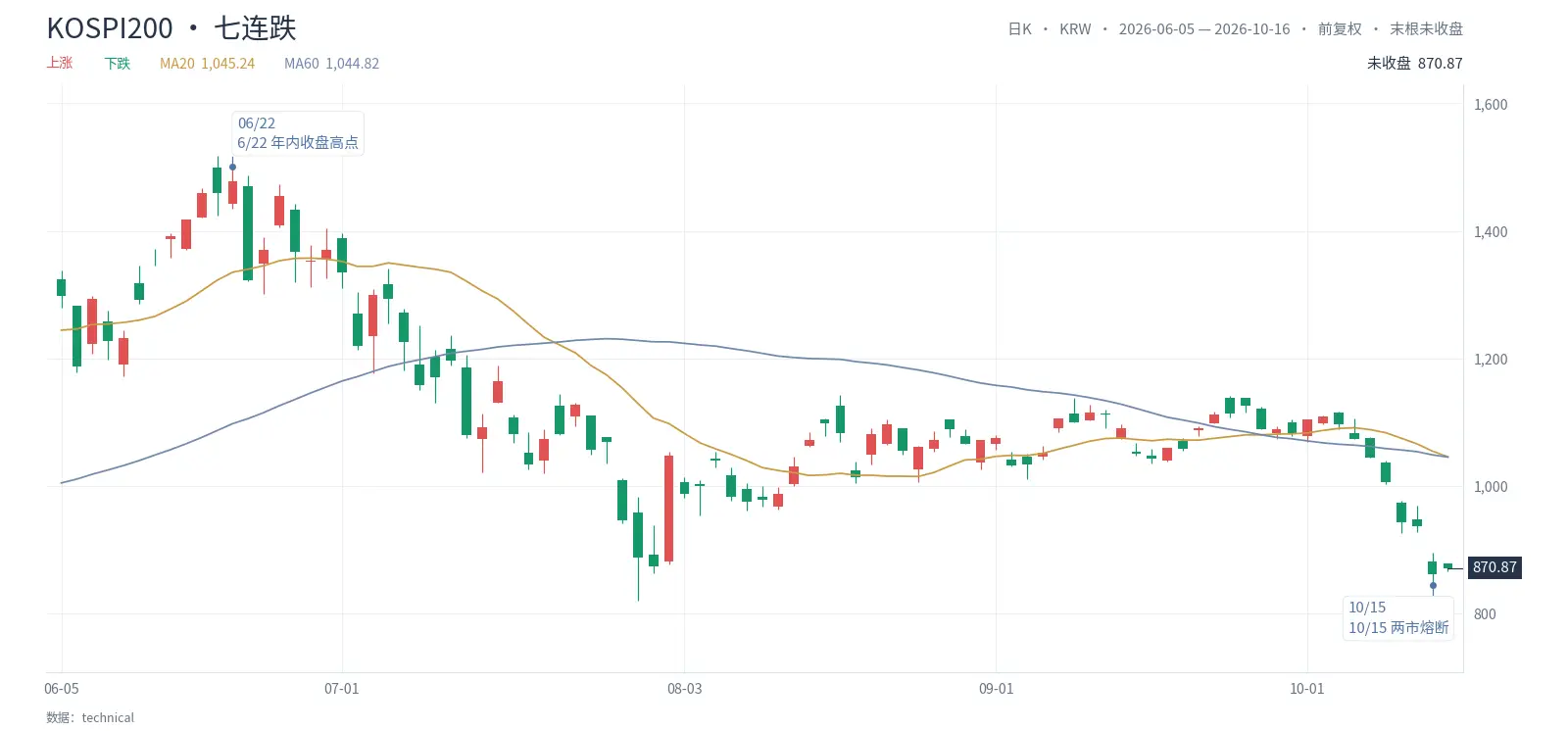
The daily declines were all concentrated in blue-chip stocks. Samsung Electronics closed down 9.48% at 210,000 won, SK Hynix closed down 11.06%, and Samsung Electro-Mechanics closed down 15.36% (data verified). According to data from the Korea Exchange cited by the Chinese version of Newsweek, on that day, individual investors net bought 12.886 trillion won, institutions net bought 16.93 trillion won, and foreign investors net sold 36.241 trillion won, which was the main force behind the index decline (another statistic indicated a net sell of about 29 trillion won in the KOSPI market). During the opening phase, algorithmic selling first triggered a pause on the sell-side Sidecar, and in the afternoon, both major markets triggered trading halts and paused for 20 minutes, resuming only to decline again at the close.
2. Foreign capital withdrawal is clear, while the end of buybacks is a variable
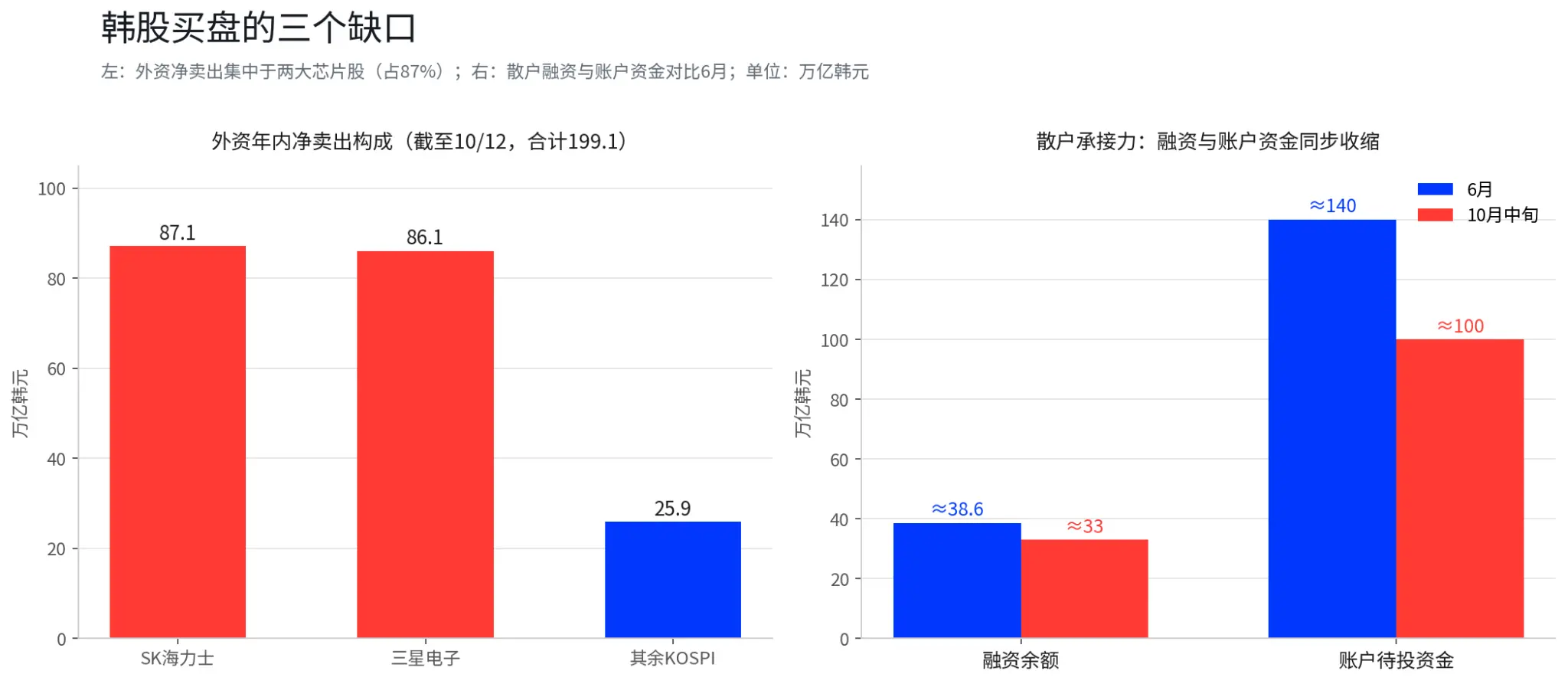
The gap in buying appeared before the macroeconomic negatives. Data compiled by Bloomberg shows that foreign capital has withdrawn about $131 billion from the South Korean stock market this year, the largest scale among major Asian markets, with net sales exceeding $6 billion in October alone. Data from the Korea Exchange (as cited by the Chosun Ilbo, as of October 12) shows that foreign investors have net sold 199.1 trillion won in the KOSPI this year, with Samsung Electronics at 86.06 trillion won and SK Hynix at 87.14 trillion won, totaling 173.2 trillion won, accounting for 87% of the total net sales. The proportion of foreign ownership in Samsung Electronics has dropped to about 46.4%, the lowest since January 2008, and SK Hynix's ownership ratio has also fallen below 50%.
The timeline for buybacks is equally clear. The two companies have a combined buyback plan of about 55 trillion won (approximately $4.1 billion), with Samsung Electronics' buyback of about 15 trillion won (for employee performance and special bonuses) initiated in August having been substantially completed by early October. According to researchers at Eugene Investment & Securities, Samsung's buyback ended on October 6. SK Hynix's buyback of about 40 trillion won, aimed at canceling shares, was about 80% complete by early October, with daily buying slowing down. JPMorgan estimates that of the approximately $23 billion in buy orders in the South Korean stock market last month, the buybacks from the two companies contributed the vast majority. The largest marginal buyer in the market is about to leave or has already left.
Retail investors are also contracting. The balance of margin loans has dropped from a peak of 38.6 trillion won in June to about 33 trillion, and the funds waiting to be invested in brokerage accounts have decreased from nearly 140 trillion won to about 100 trillion (according to Bloomberg and exchange data, as reported by the media). The liquidation of financing positions and the depletion of account funds are occurring simultaneously, indicating a lack of natural support during the decline.
From the timeline perspective, the accelerated withdrawal of foreign capital and the end of buybacks occurred from September to early October, while the macro triggers for this round of decline (U.S. CPI, rising interest rate expectations) only materialized after October 14. One verifiable interpretation is that this round of decline is driven by the chip structure, with macro data acting as an amplifier. If subsequent foreign net sales fall below 1 trillion won in a single day and new corporate-level buying appears, this interpretation would need to be revised; if foreign capital maintains the current pace, regulatory statements are unlikely to fill the gap left by buybacks.
3. Profits are still hitting new highs, but the market no longer prices based on growth stocks
Current profits and stock price trends are rarely diverging. Samsung Electronics' earnings forecast released on October 8 shows that consolidated revenue for the third quarter is about 195 trillion won, a year-on-year increase of 126.6%, with consolidated operating profit of about 107.4 trillion won, a year-on-year increase of 782.5%, and an operating profit margin of about 55%. This is the first time quarterly profit has exceeded 100 trillion won, also higher than the brokerage's expected 105.75 trillion (as reported by Yonhap News). Since the forecast was released, the stock price has not risen but has instead fallen, dropping another 9.48% on October 15.
Two backgrounds complicate this set of numbers. First, according to public reports, the president of ChangXin Memory stated on October 10 at a semiconductor forum in Shanghai that significant progress has been made in the development of 4F² architecture DRAM, with plans to launch DDR5 server memory modules by the end of 2026. Data from Counterpoint Research shows that ChangXin's share of the global DRAM market has risen from 4% in the second quarter of 2025 to 10% in the second quarter of 2026. SK Group Chairman Chey Tae-won subsequently stated that China is "catching up at an astonishing speed." Second, Bloomberg's compilation shows that the combined weight of Samsung Electronics and SK Hynix in the South Korean stock market has exceeded half, making the index's rise and fall highly dependent on the pricing of these two companies' memory products.
KB Securities analyst Mingyu Kim's judgment is that market concerns about the sustainability of AI investments are driving investors to price semiconductors according to the logic of cyclical stocks (as reported). Considering this information, a more likely interpretation is that the market is not questioning current profits but is questioning the sustainability of profits and the shelf life of technological leadership. If fourth-quarter memory contract prices and order data continue to strengthen, and ChangXin's mass production timeline is not validated, the "cyclical stock pricing" framework may need to be re-evaluated.
4. Transmission in Asia-Pacific and buffering in Hong Kong stocks
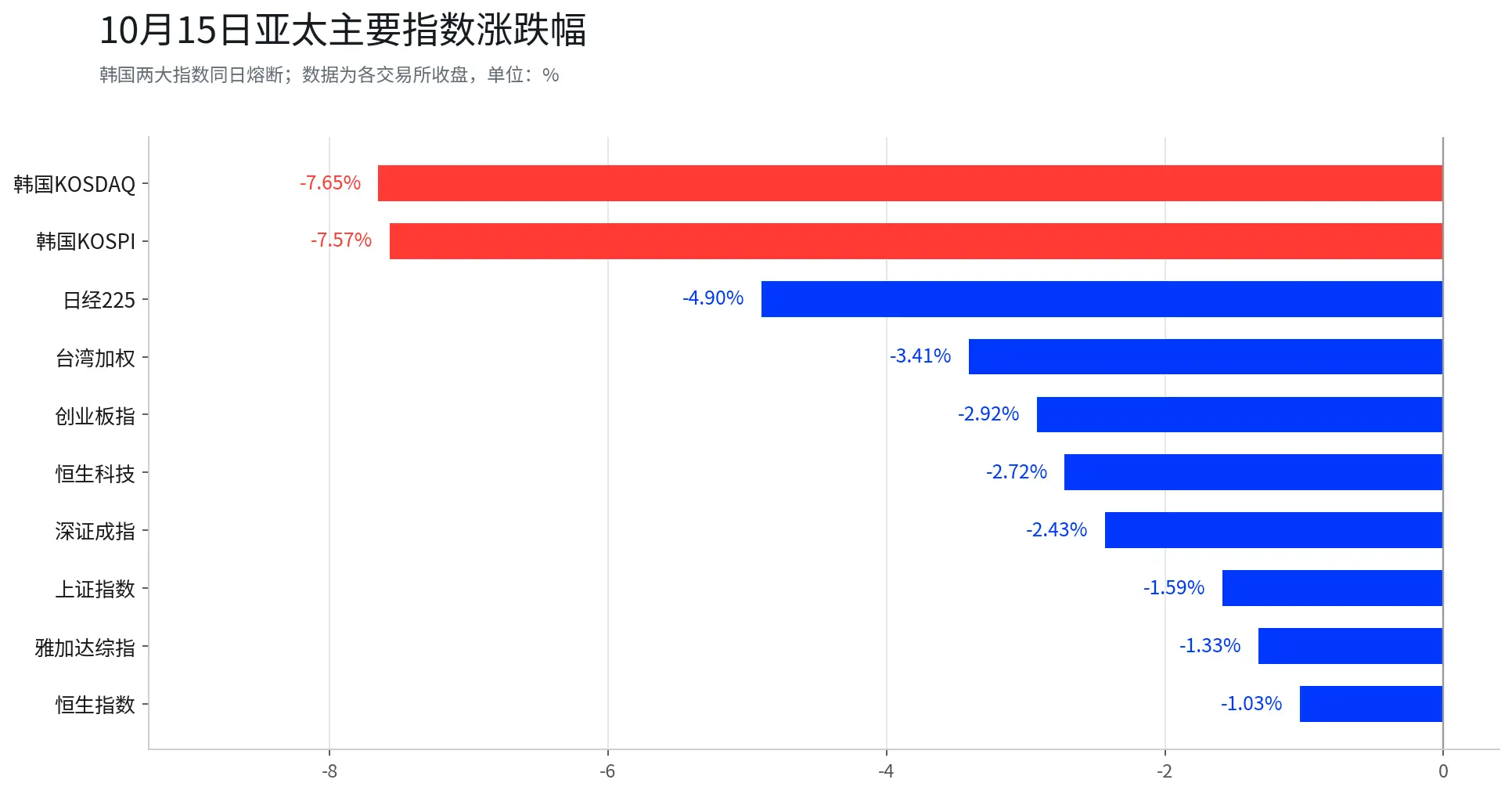
On the same night in Asia, the declines varied by seven times. The Nikkei 225 index closed down 4.90% at 64,425.95 points, a drop of 3,318.34 points, marking the sixth consecutive trading day of decline (reported as the largest single-day drop since April 2025). The Taiwan Weighted Index fell 3.41% to 46,969.87 points, with the closing drop being the sixth largest in history, and TSMC's stock price in Taipei fell 2.01%. The Jakarta Composite Index fell 1.33%, and the Shanghai Composite Index fell 1.59%, briefly dipping below 3,700 points before recovering at the close, with the liquor and brokerage sectors going against the trend.
Hong Kong stocks provided a contrasting group. The Hang Seng Index closed down 1.03% at 24,062.72 points, and the Hang Seng Tech Index fell 2.72%, with total main board turnover of about 224.2 billion Hong Kong dollars. The significantly smaller decline compared to the South Korean stock market is structurally due to the fact that the Korean market's ups and downs are dominated by two memory companies, while the main weighted constituents of the Hang Seng Tech Index are still platform companies like Tencent, Alibaba, and Meituan, with a limited share of AI hardware manufacturing. However, AI hardware stocks were also under pressure that day, with Lenovo Group falling 14.54% to close at 25.98 Hong Kong dollars, making it the worst-performing blue-chip stock, while Hua Hong Semiconductor fell 7.8% and SMIC fell 3.96%.
The direction of southbound capital is a finer observation. On October 15, southbound capital had a net sell of 5.08 billion Hong Kong dollars, but net bought Tencent Holdings 852 million Hong Kong dollars and China National Offshore Oil Corporation 331 million Hong Kong dollars, while net selling Longi Green Energy 931 million Hong Kong dollars, Hua Hong Semiconductor 800 million Hong Kong dollars, and SMIC 774 million Hong Kong dollars (Wind data, as reported by financial media). SMIC has been net sold for 13 consecutive trading days, totaling about 6.92 billion Hong Kong dollars. Funds are flowing out of AI hardware manufacturing and relatively staying in platform companies, consistent with the relatively resilient performance of Hong Kong stocks. If the pace of reduction in hardware manufacturing by southbound capital slows down, the buffering interpretation of Hong Kong stocks needs to be re-evaluated.
Considering the market and public information, a more likely interpretation is that this round of decline in the South Korean stock market is driven by chip structure, with rising interest rates and fractures in the AI narrative acting as amplifiers. The South Korean regulatory authorities, after an emergency meeting, believe that the market has overreacted to a certain extent, with fundamental indicators (foreign exchange reserves, current accounts, financial institution stability) generally stable, but the market lacks buying power rather than reasons. For the rebound at the beginning of trading on October 16 to continue, we need to see a narrowing of foreign net sales or new corporate actions; otherwise, the pricing pressure from the vacuum left by buybacks may continue.
Disclaimer: The content of this article is for general information and market commentary purposes only, compiled based on publicly available information as of the time mentioned in the article. Relevant market data, expectations, and probabilities may change with market conditions. The views and investment strategies cited from third-party institutions, analysts, or other individuals represent the views of the relevant third parties at a specific time and do not represent the views or recommendations of BIT. This article does not constitute investment advice, investment research, solicitation, or recommendation for any securities, investment products, or trading strategies, nor should it be used as the basis for any investment decision. Financial markets carry risks, and securities prices and market performance may fluctuate; past performance and historical market trends do not represent or guarantee future results. Margin trading can amplify losses, and losses may exceed the principal; investors should independently assess the relevant risks based on their circumstances and seek professional advice when necessary. BIT's Hong Kong stock trading services are not provided to Hong Kong residents or users in other restricted jurisdictions.
 Risk warning



Popular articles





