








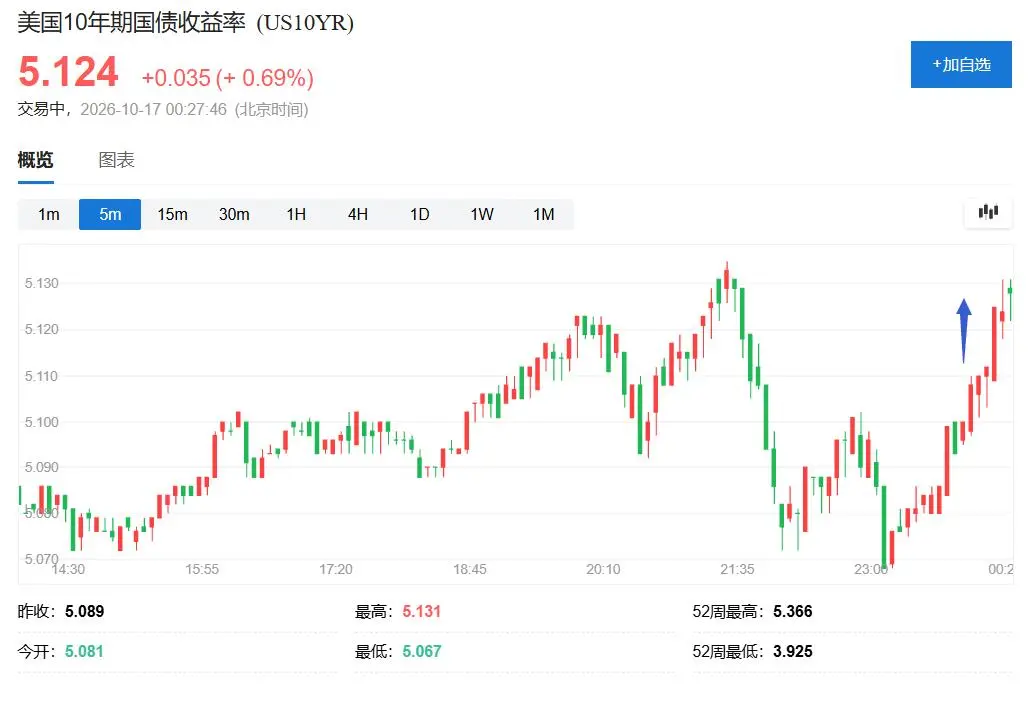
The U.S. Treasury Department's investigation has not released any signals for reducing bond issuance, U.S. Treasury yields have risen, and the 10-year yield has climbed back to 5.12%
 Core Viewpoint

 In a survey consulting primary dealers, the Ministry of Finance asked about the repurchase plan for long-term government bonds, how to improve repurchase efficiency, the timing of short-term bond issuance, and the economic and financing outlook, but did not directly address the issue of reducing the supply of long-term bonds. Some investors originally expected that the Ministry of Finance would use this questionnaire to more clearly hint at considering a reduction in the scale of long-term bond auctions, or even stopping the issuance of 20-year government bonds. The refinancing announcement released by the Ministry of Finance on November 4 became the next observation point. Citigroup expects that at that time, the auction scale for 20-year and 30-year U.S. Treasury bonds will each be reduced by $3 billion, believing that this survey indicates the Ministry of Finance is considering a reduction in the issuance of long-term bonds.
Author: Wall Street Insights
The latest primary dealer survey from the U.S. Treasury did not release a clear signal regarding an imminent reduction in the scale of long-term Treasury bond auctions, disappointing investors betting on government intervention to lower long-term interest rates. As a result, U.S. Treasury prices fell, and yields overall rose.
This survey is part of the Treasury's preparation for the quarterly refinancing plan to be announced on November 4. The market had hoped to find clues in the questionnaire about whether Treasury Secretary Janet Yellen might adjust the issuance scale of long-term Treasury bonds, especially regarding the recent discussions about the possibility of reducing or even halting the issuance of 20-year bonds. However, the Treasury only broadly inquired about what auction scale adjustments should be considered in the future, without explicitly hinting that a reduction in long-term bond supply is imminent.
On Friday, October 16, during the midday trading session, after the details of the Treasury's survey were released, U.S. Treasury yields rose across the board. The yield on the benchmark 10-year Treasury bond climbed back above 5.12%, nearing the intraday high of 5.1315% set before the stock market opened, with the intraday increase expanding to 6.5 basis points; the yield on the 20-year Treasury bond rose by 5.4 basis points, and the yield on the 30-year Treasury bond's intraday increase expanded to about 5 basis points, while the yield on the 2-year Treasury bond reversed its earlier decline.
Meanwhile, oil prices had accelerated their rise shortly before the survey was released, adding upward pressure to Treasury yields. Therefore, the rise in yields on Friday reflected both the market's disappointment at the Treasury not releasing a signal for supply reduction and the influence of changes in energy prices.
What Did the Treasury Ask, and What Is the Market Waiting For
In this survey, the Treasury solicited opinions from primary dealers, focusing on what adjustments should be considered for Treasury bond auction sizes in light of structural changes in investor demand and the potential evolution of mid-term demand expectations in the future.
Such surveys are a routine preparatory work for the Treasury's quarterly refinancing decisions, aimed at understanding the judgments of major dealers regarding government financing needs, investor demand, and market conditions, providing a reference for determining the scale and structure of Treasury bond issuance. The survey itself is not a bond issuance plan and does not imply that the Treasury has decided to adjust the issuance scale for any maturity.
According to reports, this questionnaire also involved several debt management issues:
Long-term Treasury bond repurchase plan: The Treasury inquired whether expanding the scale of long-term Treasury bond repurchases has improved market liquidity and trading operations; how larger repurchases affect dealers' ability to handle customer buy and sell orders, and the willingness of customers to participate directly or indirectly in repurchases.
How to further improve repurchase efficiency: The Treasury solicited dealers' opinions on what adjustments could be made to the repurchase plan.
Timing of Treasury bill and floating-rate bond issuances: The Treasury asked whether it should adjust the current practice of avoiding issuing Treasury bills and floating-rate bonds on Federal Open Market Committee (FOMC) meeting days.
Economic and financing outlook: Dealers were also required to provide forecasts on the economy, fiscal policy, monetary policy, and the Treasury's financing needs for the upcoming fiscal years.
What truly disappointed the market was that the Treasury did not directly address the issue of reducing long-term Treasury bond supply. Some investors had originally hoped that the Treasury would use this questionnaire to more clearly indicate that it was considering reducing the scale of long-term bond auctions or even halting the issuance of 20-year bonds in response to the Trump administration's efforts to lower financing costs.
Blake Gwinn, head of U.S. interest rate strategy at RBC Capital Markets, stated that if the Treasury wanted to signal or influence yields through the questionnaire, it could have posed more direct questions. He believes that this survey did not convey any substantive signals; considering that some investors were expecting significant adjustments, such as halting the issuance of 20-year bonds, this outcome may disappoint the market.
20-Year Treasury Bonds Become the Focus, Wall Street Bets on Treasury Adjusting Bond Issuance Structure
The market is particularly sensitive to the survey, which is related to the recent high levels of long-term U.S. Treasury yields. As the U.S. fiscal deficit continues and interest payments on existing debt increase, government financing needs are rising, making the pressure on long-term Treasury bond supply a core issue of concern for investors.
Bloomberg reported that some Wall Street institutions had previously bet that the Treasury might alleviate the pressure on long-term bond supply by adjusting the bond issuance structure. Market discussions have particularly focused on the 20-year Treasury bond: whether the Treasury will reduce its issuance scale or even completely cancel the issuance of this maturity.
From a financing mechanism perspective, the Treasury needs to meet the overall borrowing needs of the government, but it does not mean that it must issue bonds of each maturity in fixed proportions. If the demand for short-term financing tools and the market's capacity to absorb them allow, the Treasury could theoretically increase short-term debt issuance to reduce pressure on the long-term bond market. However, adjusting the maturity structure would also change the government's future refinancing arrangements and cannot be simply understood as reducing total borrowing needs.
Molly Brooks, U.S. interest rate strategist at TD Securities, stated that the Treasury's question setting remains too broad and does not clearly inquire about reducing long-term bond supply, leading to market disappointment. She expects that the scale of long-term Treasury bond auctions may not be adjusted until at least February 2027.
This judgment implies that the optimistic scenario some investors had previously bet on—namely, that the Treasury would announce a reduction in long-term issuance scale in the November quarterly refinancing plan, or even cancel the 20-year Treasury bond—may not materialize quickly. The questionnaire did not provide a clear signal for supply reduction, nor does it mean that relevant adjustments have been ruled out.
However, Citigroup strategists maintain their prediction, believing that the U.S. Treasury will reduce the issuance volume of long-term bonds in the November quarterly refinancing announcement, expecting a reduction of $3 billion each for the 20-year and 30-year U.S. Treasury bond auctions. They pointed out that the relevant questions in the survey indicate that Treasury officials are considering taking this action.
Citigroup's report stated that since the last refinancing announcement, there has been a significant sell-off in long-term U.S. Treasury bonds, and in several long-bond repurchase operations following the Treasury's announcement to raise the repurchase limit, the market has performed relatively weakly, which will prompt the Treasury to shift long-bond issuance towards short bonds.
Failed Bond Issuance Signals Combined with Rising Oil Prices Pressure Long-Term Yields
In addition to the Treasury survey, rising oil prices have also increased the upward pressure on U.S. Treasury yields. Higher energy prices may reignite market concerns about inflation and affect investors' judgments regarding the Federal Reserve's future interest rate path. For longer-term Treasury bonds, inflation expectations, future short-term rates, and the term premium demanded by investors all influence yield pricing.
This also explains why the market reaction this time is concentrated on long-term U.S. Treasury bonds. Long-term Treasury bond prices are particularly sensitive to changes in supply expectations: if the market originally expected the Treasury to reduce long-term bond issuance, once the relevant signals are absent, investors may reassess the necessary long-term bond supply they need to hold and the returns required to bear interest rate risks.
However, the rise in yields on Friday cannot be entirely attributed to the Treasury survey. Changes in oil prices are also mentioned as a driving factor, and the survey results merely disappointed the market's previous expectations for policy adjustments without directly proving that the future scale of long-term Treasury bond issuance will remain unchanged.
The November 4 Refinancing Announcement Becomes the Next Observation Point
The Treasury will announce the next quarterly refinancing plan on November 4, at which point the market can further assess the government's specific considerations regarding borrowing needs, issuance scales of different maturities, and repurchase arrangements.
The U.S. government faces a persistent fiscal deficit, and interest payments on existing debt are also increasing, which forces the Treasury to weigh financing costs, market demand, and debt maturity structure. Reducing long-term bond supply to lower long-term yields is one possible path of market concern, but it is not without constraints.
Before the official announcement is made, the dealer survey provides a solicitation of market opinions rather than a policy commitment. The decline in long-term U.S. Treasury bonds and the renewed rise in yields on Friday reflect that the market had originally expected the Treasury to release a more proactive signal for supply reduction, but did not receive sufficiently clear evidence from this questionnaire. Moving forward, investors will continue to pay attention to whether the Treasury will adjust the issuance arrangements for long-term Treasury bonds in the November refinancing plan and whether related measures can truly alleviate the supply pressure on long-term U.S. Treasury bonds.

 Risk warning




Popular articles





