Meta's Q3 revenue and Q4 guidance both exceeded expectations, raising the lower limit of AI capital expenditure, and plans to issue non-voting new shares | Financial Report Insights
 Core Viewpoint


 Meta's Q3 revenue was $64.6 billion, a year-on-year increase of 26%. Q4 revenue is expected to be between $73 billion and $76 billion. Free cash flow was negative $2.2 billion, marking the first negative figure since going public, but better than the market expectation of negative $9.4 billion. The company raised the lower limit of its 2026 capital expenditure guidance from the previous $130 billion to $135 billion, while also announcing the creation of a new Class C common stock without voting rights in exchange for Mark Zuckerberg's commitment to remain in California. Meta's stock rose by 6% in after-hours trading.
Meta's third-quarter revenue reached a historic high, while announcing the issuance of a new class of non-voting stock to prevent Mark Zuckerberg from leaving the jurisdiction of the company's headquarters due to California's wealth tax, while also opening up financing channels for its large-scale artificial intelligence investment plans.
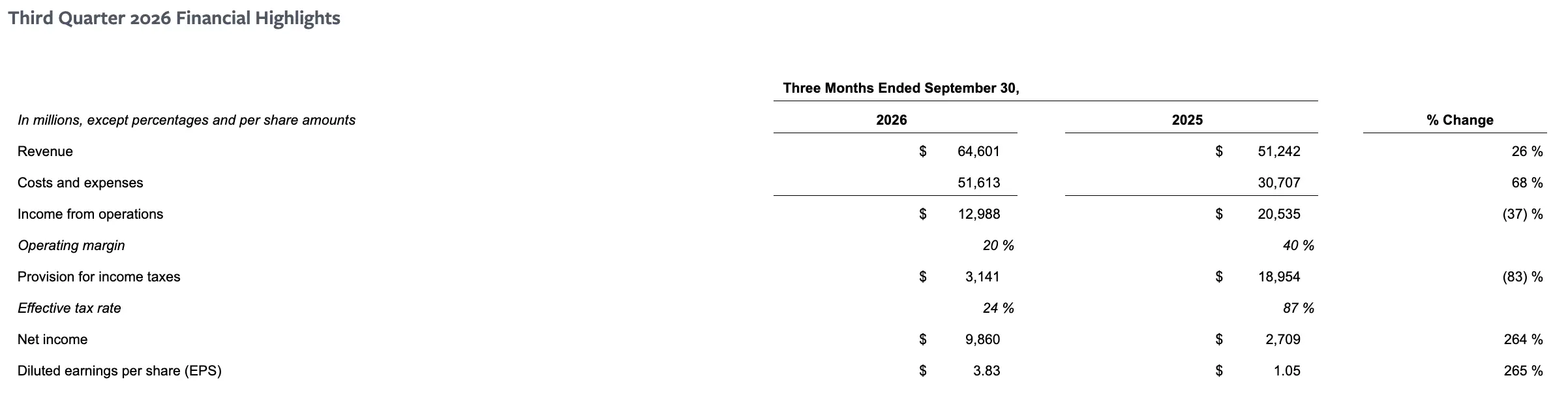
Meta announced on Wednesday that its third-quarter revenue reached $64.6 billion, a year-on-year increase of 26%, exceeding analysts' expectations of $63.3 billion. The company expects fourth-quarter revenue to reach between $73 billion and $76 billion, with the midpoint higher than market expectations.
Profit performance was significantly impacted by one-time legal settlement costs. Meta's diluted earnings per share for the third quarter were $3.83, below analysts' expectations of about $6.54. The company accounted for $9.89 billion in legal settlement costs, and excluding this expense, earnings per share were $7.40.
Meanwhile, Meta raised the lower limit of its 2026 capital expenditure guidance from the previous $130 billion to $135 billion, while keeping the upper limit unchanged at $145 billion.
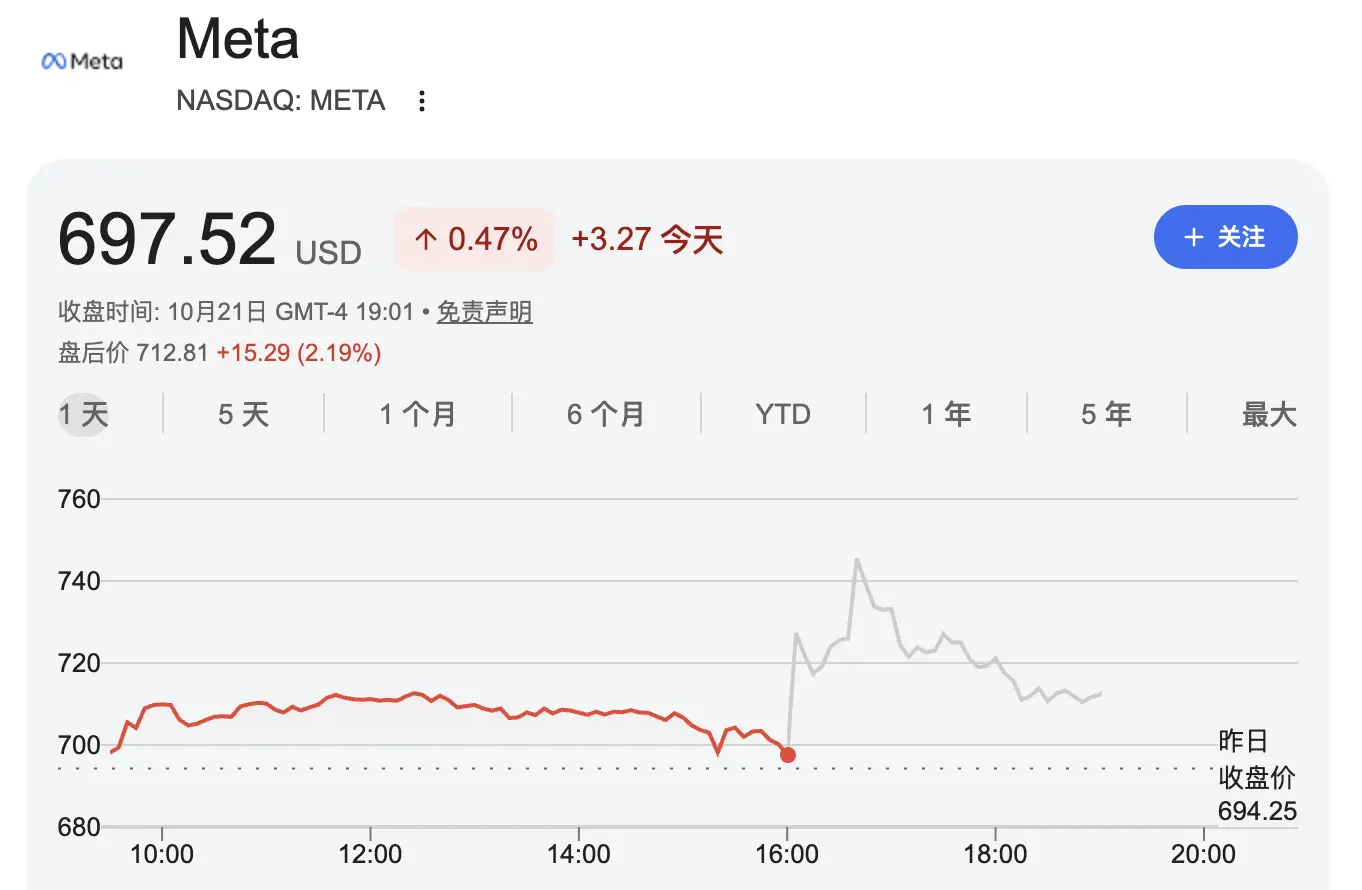
Meta's stock rose by as much as 6% after hours, but later retreated, rising 2.2% as of the time of writing.
Free Cash Flow Turns Negative, Capital Expenditure Lower Limit Raised, New Stock Financing Supports AI Arms Race
Meta's free cash flow turned negative for the first time since its IPO, reporting a negative $2.2 billion during the reporting period, but better than analysts' previous expectations of negative $9.4 billion.
The company is investing tens of billions of dollars into chip and data center construction in hopes of gaining a more advantageous position in competition with OpenAI and Anthropic, which continues to consume its historically ample cash flow.
In the third quarter, Meta's capital expenditures (including principal repayments on finance leases) reached $34.91 billion. The company adjusted its full-year capital expenditure guidance to $135 billion to $145 billion, up from a previous lower limit of $130 billion, reflecting its continued investment of significant funds in AI infrastructure expansion.
The company announced the establishment of a new class of non-voting Class C common stock, set to take effect in January 2027. This arrangement aims to provide more funding sources for the company's AI investments while avoiding dilution of CEO Mark Zuckerberg's voting control.
At the same time, this new class of stock will be distributed to existing investors in the form of stock dividends. Meta stated that for every share held, shareholders will receive one new share, which is essentially equivalent to a "two-for-one" stock split.
Meta Issues Non-Voting New Shares in Exchange for Zuckerberg's Commitment to Stay in California
Meta reached an agreement with Zuckerberg to issue him non-voting Class C shares. In exchange, Zuckerberg committed to continue residing in California or another jurisdiction where Meta's headquarters is located for the next eight years.
This arrangement is also related to California's proposed billionaire wealth tax. Zuckerberg has stated that the relevant tax could force him to sell his Class B shares with voting rights to raise tax funds, reducing his voting power in the company to below 53%.
Under the agreement, Zuckerberg can immediately sell 20% of the Class C shares he receives, equivalent to 10% of his overall economic interest, with restrictions on the sale of the remaining shares gradually lifted over eight years.
Meta's special committee stated that ensuring Zuckerberg's presence at the company's headquarters is crucial, especially as the company closely collaborates with Meta Superintelligence Labs amid increasing competition in AI.
Meta's Chief Financial Officer Susan Li stated that Class C shares are primarily a financing tool, helping the company raise funds for its AI business more flexibly while avoiding dilution of existing shareholders' voting rights.
Advertising Business Continues to Grow, Fourth Quarter Revenue Guidance Exceeds Expectations
The advertising business remains the main support for Meta's performance growth. In the third quarter, the company saw a 10% year-on-year increase in ad impressions, with average ad prices rising by 14%. Daily active users across its family of apps reached 3.64 billion, a year-on-year increase of 3%.
Meta expects fourth-quarter revenue to be between $73 billion and $76 billion, with a midpoint of $74.5 billion, representing an approximate 24% increase compared to the same period last year. This guidance is higher than the average analyst expectation of around $73 billion compiled by LSEG, indicating the company's confidence in year-end advertising demand and business growth.
The growth of the advertising business also provides important support for AI investments. Meta is applying AI in areas such as ad placement and targeting while attempting to expand revenue sources beyond advertising through new AI products. However, whether the commercialization progress of new businesses can match the infrastructure investments remains to be seen in future performance.
AI Assistant Muse Becomes Core of Commercialization, But Obstacles Remain
Meta positions its consumer AI assistant Muse as the core of its overall strategy and is restructuring the company around the Meta Superintelligence Labs responsible for the product, while announcing the launch of a new business line selling AI tools to enterprise customers.
According to market intelligence firm SensorTower, Muse has surpassed 10 million downloads since its launch in September, offering subscription plans at $20 and $100 per month.
In the first month after Muse's debut, Meta's stock price rose nearly 20%. An estimate from Truist Securities suggests that Muse could bring about $28.5 billion in incremental revenue to Meta by 2030.
However, Muse still faces multiple obstacles: polls show that public acceptance of AI assistants is generally low; additionally, dozens of websites, including Amazon, have blocked access to Muse, and some businesses have restricted its access due to security concerns, limiting the product's practicality in shopping and other scenarios.
Legal Settlement Costs Weigh on Profits, Cost Growth Worth Monitoring
Meta's net profit for the third quarter was $9.86 billion, with diluted earnings per share of $3.83. The company accounted for $9.89 billion in legal settlement costs, leading to a significant discrepancy between reported profits and earnings levels after excluding one-time expenses.
Third-quarter revenue exceeded market expectations, but reported earnings per share fell short of analysts' expectations. Excluding the aforementioned legal settlement costs, earnings per share reached $7.40, surpassing market expectations.
In August of this year, Meta reached a settlement with nearly 48 states in the U.S., agreeing to pay up to $18 billion over ten years and committing to impose a series of restrictions on how underage users use Facebook and Instagram, with allegations that Meta's platforms were intentionally designed to make children addicted.
On the day of the quarterly earnings report, a judge in New Mexico ruled that Meta must pay a $25 billion fine, with a jury finding that Meta engaged in misleading behavior regarding its sharing of user data with third parties and the enforcement of its platform's hate speech and misinformation policies, a case involving the British political consulting firm Cambridge Analytica.
However, the cost pressures do not stem solely from a single legal matter. Meta's total costs and expenses in the third quarter grew by 68% year-on-year, reaching $51.61 billion, significantly outpacing the 26% revenue growth. Operating profit margins fell from 40% in the same period last year to 20%, reflecting the company's profitability being squeezed while expanding AI investments.
Meta expects total expenses for the full year of 2026 to reach between $175 billion and $179 billion. As AI-related spending continues to grow, investors need to assess the growth of the advertising business, the pace of cost expansion, and changes in cash flow, rather than relying solely on earnings per share after excluding one-time expenses to gauge operational performance.
 Risk warning




Popular articles