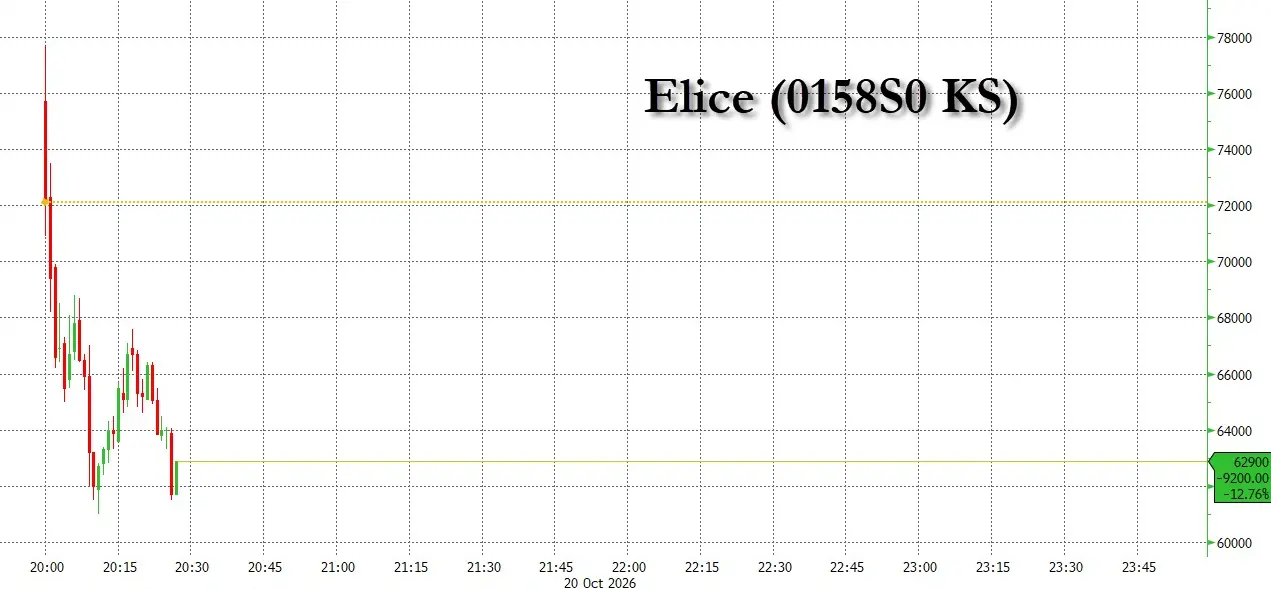
Goldman Sachs lowered the target price for Korean stocks by 25%, but believes that "the storage valuation is overly pessimistic," and the valuation of Korean stocks has become "the lowest in the world."
 Core Viewpoint


 Goldman Sachs has cut the KOSPI target price from 12,000 points to 9,000 points, clearly stating that "the market is pricing in an overly pessimistic fundamental outlook." It believes that the current semiconductor valuations imply an extreme expectation of a 65% profit drop by 2027, which is severely detached from the fundamentals. Dragged down by the AI retreat, the forward P/E ratio of the KOSPI is only about 4 times, marking a historical extreme among 18 trillion-dollar markets since 2006, and is even less than half of Indonesia's.
Goldman Sachs significantly lowered its target price for the South Korean stock market, while simultaneously warning that the market's pessimistic pricing of the semiconductor industry has severely deviated from fundamental realities.
According to news from the Wind Trading Desk, Goldman Sachs' strategist team stated in a research report on October 25 that it has reduced the 12-month target price for the Korea Composite Stock Price Index (KOSPI) from 12,000 points to 9,000 points, a decrease of 25%. This adjustment comes against the backdrop of the KOSPI having fallen nearly 40% since its peak in June. Nevertheless, Goldman Sachs maintains a positive stance on the South Korean stock market, pointing out that the revised target price still implies over 60% upside potential from current levels, and clearly stating that "the market is pricing in an overly pessimistic fundamental outlook."
The sell-off in tech stocks triggered by the retreat of AI trading has dragged South Korea from being one of the hottest major markets globally this year into the depths of the lowest valuations. According to Bloomberg compiled data, the KOSPI's 12-month forward price-to-earnings ratio has fallen to about 4 times (3 standard deviations below the historical average), an extreme low not seen among 18 trillion-dollar markets since 2006, with a valuation about half that of Indonesia's Jakarta Composite Index (8 times price-to-earnings ratio). Meanwhile, some investors believe that this sell-off has created a rare buying opportunity.
AI Trading Retreat Hits Korean Stocks Hard, Goldman Sachs Forced to Significantly Lower Targets
The report states that the reason Goldman Sachs' strategist team lowered the target for the KOSPI index is that after the benchmark index plummeted over 35% from its June peak, a "more conservative valuation assumption" is needed.
It is noteworthy that Goldman Sachs has raised this target price multiple times this year, with the most recent increase occurring in June, and it maintained the 12,000-point target during the subsequent global AI stock sell-off. This downgrade marks a significant shift in Goldman Sachs' judgment of the South Korean market. Goldman Sachs also lowered the target price for the Asia-Pacific MXAPJ index from 1,120 to 1,040.
Chip giants like Samsung Electronics and SK Hynix have made the KOSPI a barometer for AI trading. Investor concerns about the sustainability of large-scale spending on AI infrastructure, combined with rising financing costs and insufficient return signals, have spread the selling pressure from the tech sector to the entire South Korean market.
It is worth noting that this round of declines occurs against the backdrop of South Korean corporate profits reaching record highs, further highlighting the severe divergence between market pricing and fundamentals. Additionally, the large-scale de-risking operations by retail investors in leveraged ETFs have amplified the declines—the size of related leveraged ETFs has shrunk from a peak of $53 billion in June to the current $16 billion.
Storage Chip Valuation Implies "65% Profit Plunge," Goldman Sachs Believes Pricing is Too Extreme
Despite the significant reduction in target price, Goldman Sachs' strategists clearly pointed out that the current market pricing of the semiconductor sector has severely deviated from reasonable ranges.
Goldman Sachs estimates that the current valuation level of the semiconductor sector implies an expectation that the industry's profits will decline by 65% by 2027—this scenario is considered "too pessimistic" by Goldman Sachs. The report notes that the market is pricing in an "overly negative fundamental outlook," and the revised target price is merely to incorporate more conservative market pricing assumptions, not to reflect Goldman Sachs' substantive bearish view on fundamentals.
Goldman Sachs pointed out that both Samsung Electronics and SK Hynix are currently trading at about 3 times forward price-to-earnings ratio, the lowest levels in history. Based on the high fit (R²) of 72% between price-to-book ratio and return on equity revealed by monthly data over the past 20 years, the current 2.6 times sector price-to-book ratio implies a 2027 ROE of only 23%, while the market consensus predicts an ROE as high as 45%.
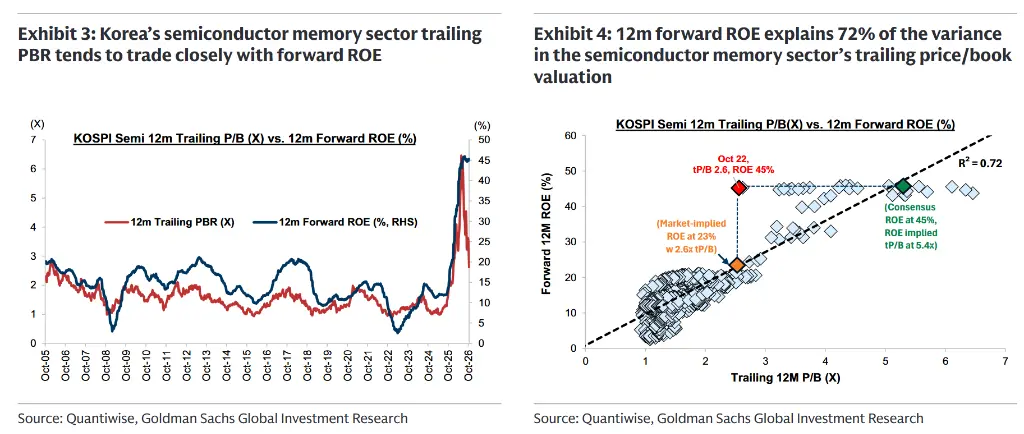
The report also states that if the market regains confidence in the outlook, the potential return space at current valuation levels is extremely attractive—the dual drivers of price-to-book ratio recovery and book value growth suggest that the sector has the potential to double. Additionally, both major storage chip manufacturers have committed to returning at least 50% of their free cash flow to shareholders through dividends and buybacks, further supporting the current risk-return judgment.
Outside the storage chip sector, other stocks that account for about half of the index weight are currently trading at a forward price-to-earnings ratio of 7.6 times, also at historical lows. Goldman Sachs noted that the consensus forecast for the non-storage sector's earnings per share growth in 2026 has been raised to 84%, with further expected growth of 16% and 11% in 2027 and 2028, respectively; the current 14.2% ROE and 1.1x price-to-book ratio historical relationship shows that the current valuation is undervalued by over 30% compared to reasonable levels. Goldman Sachs stated that at current levels, the South Korean market still offers "attractive risk-return."
Goldman Sachs continues to favor stocks related to electricity, industry, and corporate governance improvements, as well as companies benefiting from domestic re-inflation and the Korean Wave culture.
Valuations Drop to "Globally Lowest," Korean Stocks Are Half as Cheap as Indonesia
According to Bloomberg compiled data, the KOSPI's 12-month forward price-to-earnings ratio has fallen to about 4 times, an extreme low not seen since 2006 among all 18 major markets with a market capitalization exceeding $1 trillion at the beginning of the year.
In contrast, the Jakarta Composite Index in Indonesia, which also faces the possibility of a two-tier downgrade by MSCI and doubts about market investability, still maintains a forward price-to-earnings ratio of around 8 times. The valuation of the South Korean stock market is now less than half that of Indonesia.
This valuation collapse occurs against a backdrop where South Korea's macro fundamentals are not pessimistic. South Korea's exports are expected to exceed $1 trillion this year, with strong chip demand; the Bank of Korea has also stated that economic growth in the next two years should be "significantly higher" than previously predicted. However, market concerns about the storage chip cycle, the outlook for AI capital expenditures, and rising borrowing costs have kept investor sentiment low.
The report states that the recent sharp rise in volatility (the 60-day annualized volatility once exceeded 80%, significantly deviating from the normal range of 10%-30% over the past five years, creating an extreme reading of nearly 4 standard deviations) has led to an increase in equity risk premium of about 2 percentage points, equivalent to a price-to-book ratio reduction of about 20%, which can explain about half of the KOSPI's 40% decline since its June peak.
Additionally, the slowdown in the momentum of upward revisions to earnings forecasts has also put pressure on valuations—despite continuous upward revisions to annual earnings forecasts, the pace of increases has noticeably slowed in recent months, highly coinciding with the timing of the rise in equity risk premium. Looking ahead, Goldman Sachs expects annual earnings growth to slow from over 300% this year to 38% in 2027 and 12% in 2028, a trend that is likely to continue to constrain valuation expansion.
Hui Ling Loh, Managing Director of ACG Management, stated,
"Concerns about aggressive AI investments to date have further expanded, enough to offset solid earnings and performance guidance. Investors are also weighing the impact of rising borrowing costs on AI-related stocks and the demand for safe-haven assets."
Some Investors View Sell-off as Buying Opportunity, but Disagreements Remain
Despite the low market sentiment, some investors have begun to see this round of sell-off as a window for bargain hunting.
The KOSPI has cumulatively fallen about 40% since its June peak, but during the same period, the 12-month forward earnings forecast has risen by 22%, further highlighting the extreme cheapness of valuations in the divergence between stock prices and earnings expectations. The index is still up 31% year-to-date.
Mark Matthews, Head of Asian Research at Julius Baer, stated that AI demand "still significantly exceeds supply," "therefore when we see such a large correction recently, especially the overnight plunge in semiconductor stocks, it presents a great buying opportunity."
However, opinions vary on when market sentiment will truly bottom out and whether valuations can become a reliable reversal signal. This round of sell-off has also sparked deeper discussions: in an era of technological transformation bringing deep uncertainty, whether traditional valuation metrics can still provide reliable investment guidance.
Goldman Sachs believes that foreign capital has net sold $140 billion this year, and market sentiment remains under significant pressure, but this also means that once market confidence is restored, the rebound potential will be extremely considerable.
Risk Warning and Disclaimer
The market has risks, and investment should be cautious. This article does not constitute personal investment advice and does not take into account individual users' specific investment goals, financial situations, or needs. Users should consider whether any opinions, views, or conclusions in this article align with their specific circumstances. Investing based on this is at one's own risk.
 Risk warning Risk warning