








The collapse of Asian tech stocks is evolving into a full-blown panic
 Core Viewpoint

 The sell-off of Asian tech stocks continues to escalate, with the South Korea Composite Stock Price Index plunging 7.6% in a single day, reaching a new high in oversold levels since October 2022, and volatility surging sharply. The divergence in performance between South Korea and the Philadelphia Semiconductor Index in the United States has widened, and the Taiwan stock market has also begun to weaken. As concerns about AI capital expenditure prospects arise and related long positions become highly crowded, the market fears that panic will spread from South Korea to the entire Asian semiconductor sector, with the Taiwan stock market's decline synchronizing with the downward risks of U.S. semiconductor stocks.
Author: Bu Shuqing, Wallstreet News
The wave of sell-offs in Asian tech stocks is spiraling out of control. The South Korean stock market has plummeted, volatility has surged sharply, and the level of overselling has reached a multi-year extreme, while selling pressure shows no signs of abating------this tech stock meltdown that began in South Korea is rapidly evolving into a widespread panic sweeping the entire Asian semiconductor sector.
The Korea Composite Stock Price Index (KOSPI) fell sharply by 7.6% on the latest trading day, breaking its long-term trend line, with the index dropping significantly below the 200-day moving average. Meanwhile, the Taiwan stock market, which previously seemed immune to this turmoil, has also begun to show signs of weakening, raising concerns about a broader collapse in AI-related trades.
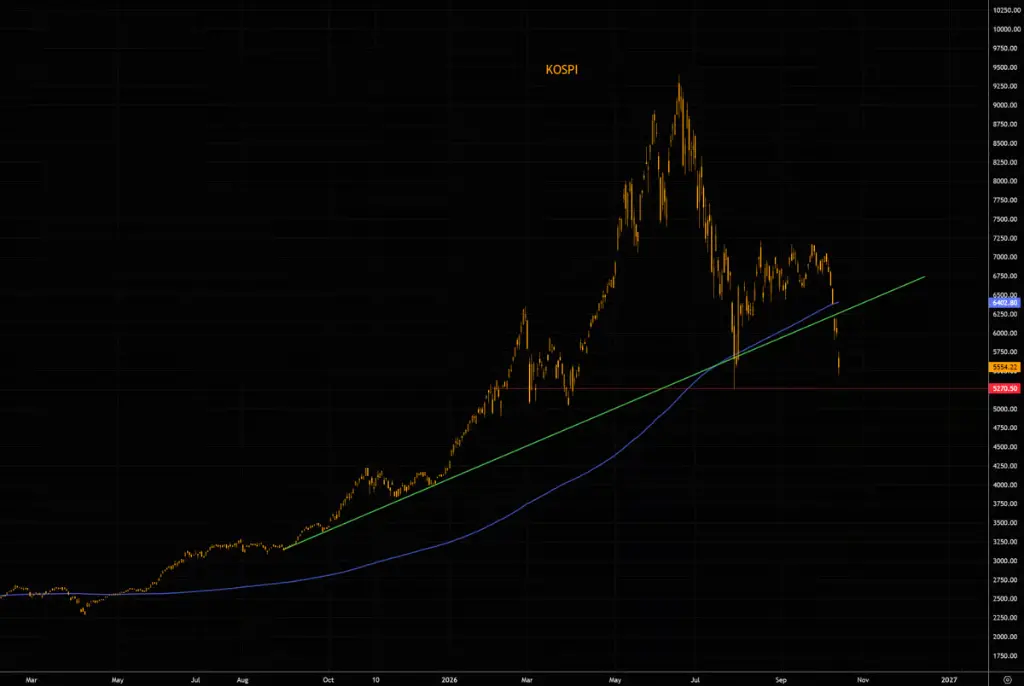
The core contradiction of the current situation is : the divergence between South Korea and the Philadelphia Semiconductor Index (SOX) has expanded to extreme levels, and the market is betting on how this gap will be bridged------whether it will be through a stabilization and rebound in South Korea or a follow-up decline in U.S. semiconductor stocks. As the outlook for AI capital expenditures comes under scrutiny and market positions remain crowded, the risk of broader deleveraging is rising.
KOSPI Plummets: Overselling at Highest Level Since 2022
The collapse of KOSPI has entered an accelerated phase. The index closed down 7.6% on the latest trading day, completely breaking through its long-term support trend line, with the current level far below the 200-day moving average.
According to The Market Ear data, the current level of overselling in KOSPI is the most extreme since October 2022. At that time, the index had bottomed out before most global investors had taken notice.
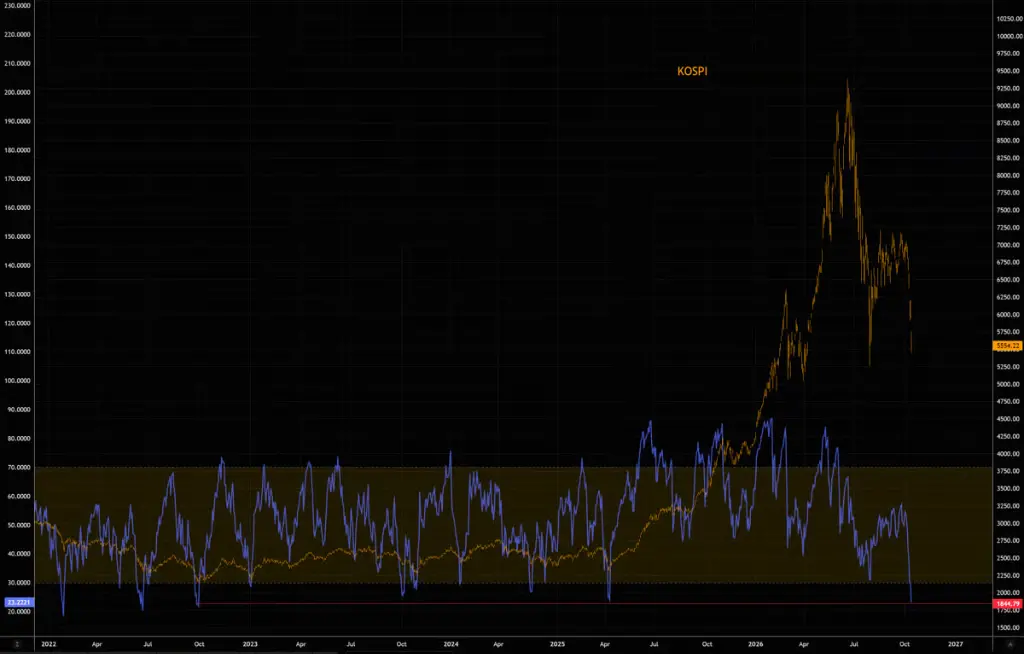
From a technical perspective, the sell-off in late July of this year found support just below the current level, which is viewed as KOSPI's last line of defense. If this support is breached, the downside potential will further open up.
Meanwhile, the volatility indicator has exploded upwards simultaneously. The implied volatility of KOSPI had already shown an abnormal structure of "stock prices rising, volatility also rising" during the previous upward phase, indicating severe distortion within the market. Now this dynamic has completely reversed------with stock prices plummeting and volatility surging sharply, the market has entered a pure panic mode.
The Gap Between South Korea and U.S. Semiconductors Continues to Widen
The performance divergence between KOSPI and SOX is reaching extreme levels, and this gap continues to widen even as SOX itself experiences a pullback.
This divergence has sparked intense discussions in the market about two scenarios: first, that the South Korean stock market has been excessively oversold and has room for a mean reversion rebound; second, that U.S. semiconductor stocks have not fully digested the downside risks and still face follow-up pressure.
Currently, both scenarios have supporters, but in the context of increasing doubts about the sustainability of AI capital expenditures, the probability of the latter scenario is rising.
The Last Bastion of AI Trading Begins to Shake
Previously, the Taiwan stock market maintained relative resilience during this wave of Asian tech stock sell-offs due to its core position in the AI supply chain, creating a significant performance gap with KOSPI. However, this "immunity" status is beginning to crumble.
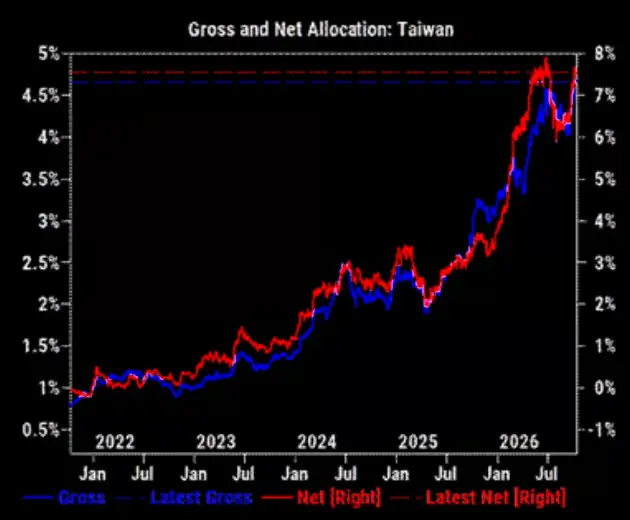
According to The Market Ear, the Taiwan stock market has begun to show obvious signs of retreat, raising questions about whether the significant performance gap with KOSPI can be sustained. It remains uncertain whether this narrowing gap will be realized through a decline in Taiwan or a rebound in South Korea, but the risks of the former are being repriced by the market.
From a positioning perspective, long positions in Taiwan's AI-related trades remain at historical highs, making them extremely vulnerable to short-term downward shocks. Concerns about inflation, uncertainty regarding AI capital expenditure prospects, and the ongoing rise of Chinese competitors are compounding pressures.
Crowded Positions and Eroding AI Narrative, Downside Hedging Value Becomes Apparent
This round of systematic sell-offs in Asian tech stocks reflects a deep reassessment of the AI investment theme by the market.
In the past year and more of the AI boom, a large amount of capital has flowed into semiconductor and related tech stocks, creating highly crowded long positions. Once the narrative shows cracks, the speed of deleveraging often exceeds expectations------the sharp decline in KOSPI is a concentrated manifestation of this mechanism.
The Market Ear points out that while the long-term logic of Taiwan's AI-related assets may still hold, the tactical appeal of downside hedging is significantly increasing in the current context of extremely crowded positions and heightened market expectations.
For investors, the most critical question now is no longer "Is AI sustainable in the long term?" but rather "Who will become the next target of sell-offs in the short term?"

 Risk warning




Popular articles





