OpenAI's mid-range model starts a price war, "tool person" GPT-6.1 Terra goes live
 Core Viewpoint


 OpenAI released the mid-range model GPT-6.1 Terra: significant improvements in visual understanding and computer operation speed, with a single token price about one-tenth of GPT-6 Astra, but real-world reviews are polarized.

OpenAI CEO Sam Altman. Image processed by AI
Written by | Su Yang
Editor | Xu Qingyang
OpenAI has launched a new model focused on cost-effectiveness.
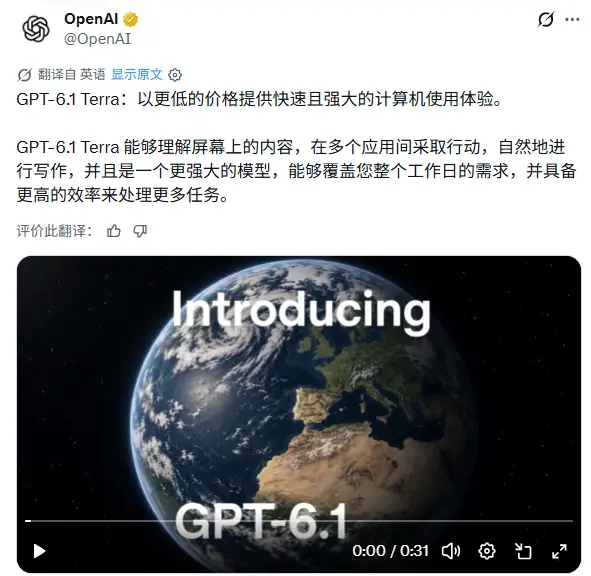
On October 26, local time in the United States, OpenAI released a new version of its mid-range model, GPT-6.1 Terra. Compared to the previous generation GPT-5.6 Terra, the new model emphasizes improvements in visual understanding, computer operations, factual accuracy, and programming capabilities, with standard API input and output prices reduced by 50%.
In OpenAI's own tests, Terra completed computer operation tasks at a speed more than three times that of GPT-6 Astra and GPT-6.1 Sol, with performance on some tasks already approaching that of flagship models.
This model is aimed at everyday office work and high-frequency automation tasks, capable of recognizing screen content, executing operations across multiple applications, and handling technical drawings, filling out forms, editing videos, and more.
For developers, another attractive feature is the cost: $1 per million input tokens, $5 per output token, and only $0.05 for cached input tokens.
However, the advantages in speed and price have not satisfied all users. Third-party tests show that while Terra can generate visual works at a lower cost for complex scenes, some users still believe it falls short in image quality, design aesthetics, and handling complex tasks.
01 Office Automation is the Main Focus
The focus of GPT-6.1 Terra is to enable AI to complete a full set of computer operation tasks more quickly.
The AI assistant can generate text, code, or operation suggestions based on user requests, but when tasks involve multiple software applications, the model also needs to understand interfaces, recognize controls, and execute steps accordingly. OpenAI hopes Terra will further reduce the execution costs of such tasks, allowing the model to take on more repetitive work.
For example, businesses can have it read received invoices and input information such as amounts, dates, and suppliers into accounting software; it can also understand architectural technical drawings or complete a series of operations in desktop applications.
In OpenAI's official demonstration, GPT-6.1 Terra directly operated Blender to build a 3D model of a yellow tram from scratch, gradually completing details such as the body, windows, roof pantograph, and chassis.

In the computer operation benchmark test Agents' Last Exam, GPT-6.1 Terra scored 15 percentage points higher than GPT-5.6 Terra in medium reasoning mode, with the cost of individual tasks being about one-third of the latter.
Compared to GPT-6 Astra, Terra's price per token is about one-tenth of its counterpart, with task performance at a similar level.
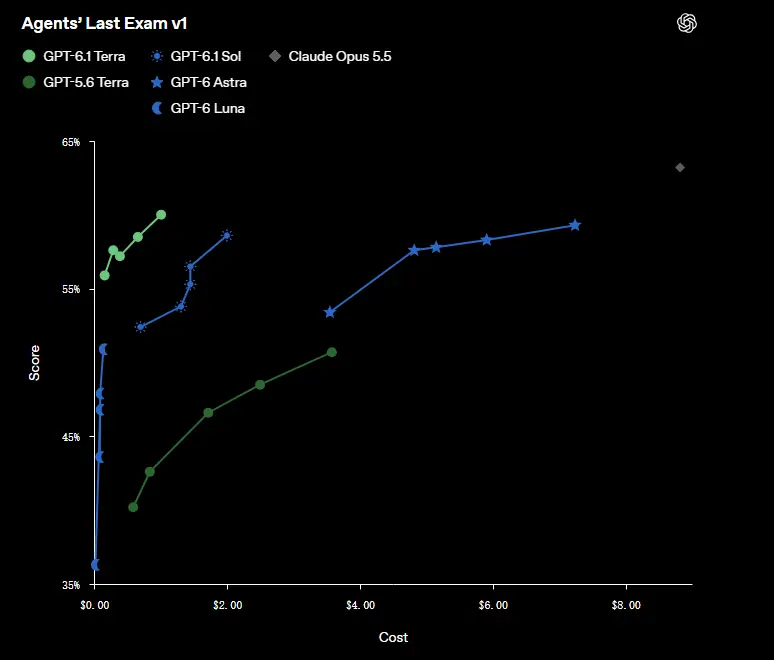
In the highest reasoning mode, OpenAI claims that Terra's token usage efficiency exceeds that of Claude Opus 5.5 by three times, with a price per token about one-fourth of the latter, resulting in an overall task cost reduction of about 90%. The speed of task completion also exceeds that of GPT-6 Astra and GPT-6.1 Sol by three times.
You can understand that when a task requires a certain level of reasoning but does not need to utilize the strongest model, speed and cost may become more important selection criteria, which is the "sweet spot" for Terra as a mid-range model.
However, benchmark test results cannot be directly equated with efficiency in all real-world tasks. The number of steps in different tasks, the way tools are called, and the intensity of reasoning can all affect time consumption, and actual performance still depends on specific scenarios.
02 Reduced Hallucination Rate, Doubled Programming Performance
In addition to computer operations, Terra has also shown significant improvements in factual accuracy and programming.
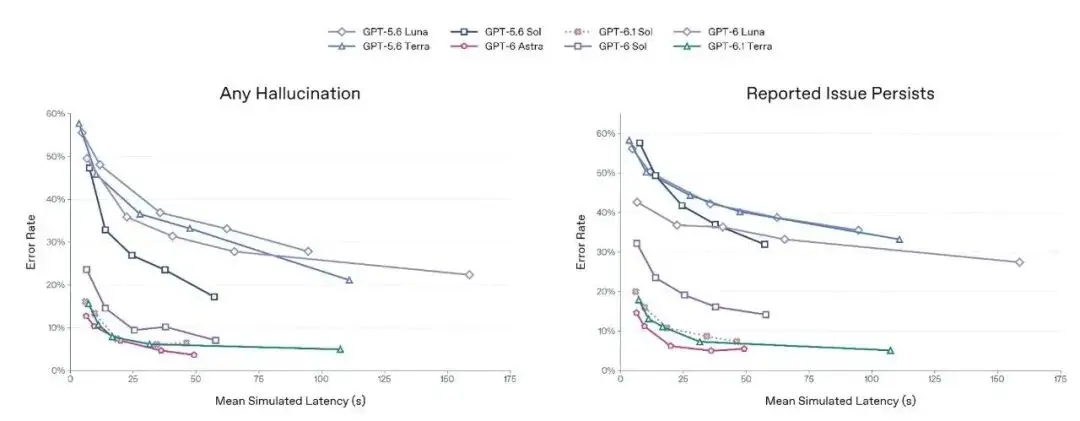
OpenAI tested using internally designed high-error-inducing prompts. In low reasoning mode, the factual error rate of GPT-5.6 Terra was 53.6%, while GPT-6.1 Terra dropped to 16.7%, a decrease of 36.9 percentage points. In the highest reasoning mode, the new model's error rate further decreased to 4.3%, 18 percentage points lower than its predecessor, approaching the levels of GPT-6 Astra and GPT-6.1 Sol.
Third-party evaluation agency Artificial Analysis also observed similar changes. Their proprietary AA-Omniscience knowledge and hallucination benchmark tests showed that when the model did not know the answer to a question, GPT-6.1 Terra guessed the answer 38% of the time, compared to 88% for GPT-5.6 Terra. Meanwhile, the accuracy of the new model improved by 2 percentage points.
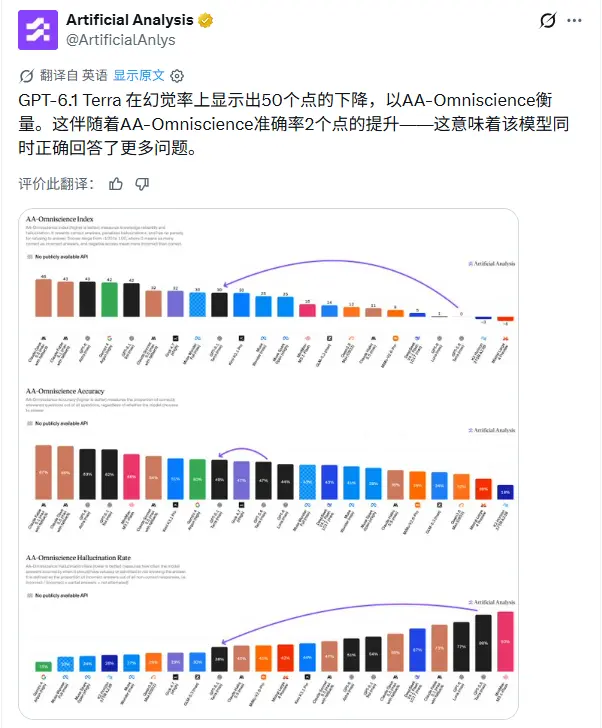
However, this result comes from a specific test set and cannot be directly extrapolated to the model's error rate in all real-world scenarios.
In programming, Terra's improvements are also evident.
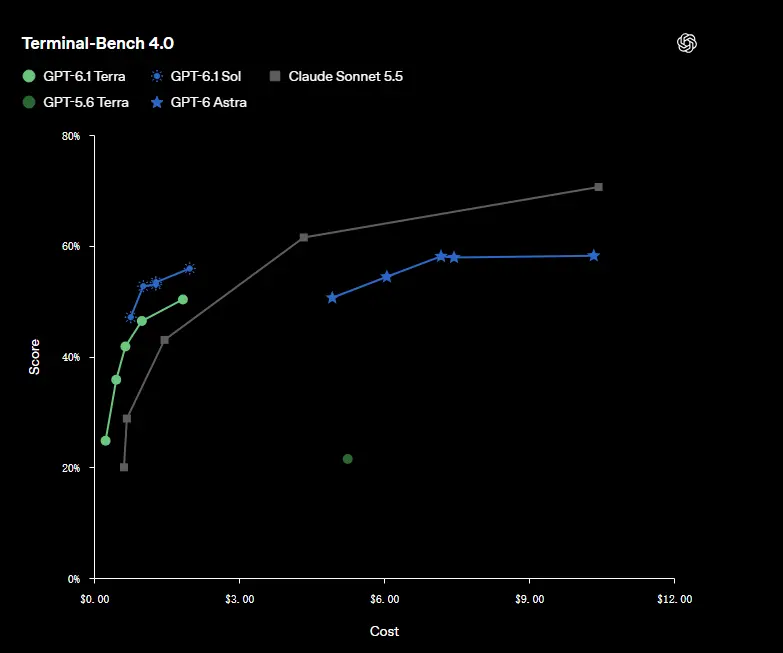
In Terminal-Bench 4.0, the model was required to complete software engineering tasks via command line, such as fixing layout issues during webpage loading. In the highest reasoning intensity, GPT-6.1 Terra achieved a task resolution rate of 50.3%, surpassing the previously reported 21.5% for GPT-5.6 Terra, more than doubling the increase.
Artificial Analysis's Coding Agent Index v2.0 rated Terra at 48 points, lower than GPT-6.1 Sol's 54 points but higher than GPT-6 Luna's 31 points. The agency believes that Terra demonstrates good cost efficiency under low and ultra-high reasoning intensity settings.
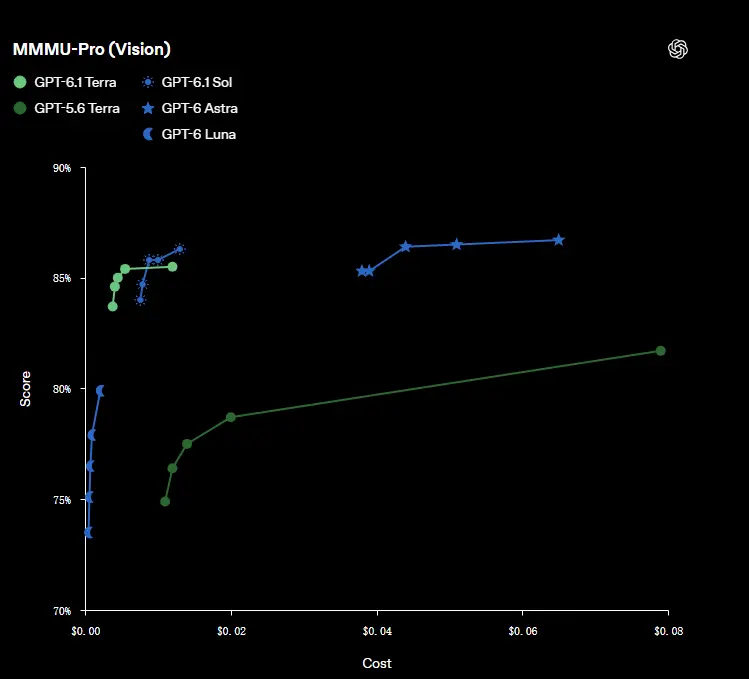
Visual understanding tests MMMU-Pro and desktop operation tests OSWorld 2.1 also showed that Terra overall outperformed GPT-5.6 Terra. For users who need to understand images, operate software, and complete multi-step tasks, these capabilities can complement each other.
However, OpenAI also acknowledges that for the most complex programming tasks, GPT-6.1 Sol and GPT-6 Astra remain more suitable choices. Terra's advantages are mainly concentrated in cost-sensitive, high-volume tasks with relatively clear operational processes.
03 Real "Buyer Show"
From feedback on social platforms, developers have shown significant divergence in their evaluations of Terra.
The design review platform @DesignArena chose the Belem Tower in Lisbon as the test subject, asking GPT-6.1 Terra and GPT-5.6 Terra to recreate this 16th-century limestone building during the golden hour, adding seagulls, sailboats, and a distant bridge.
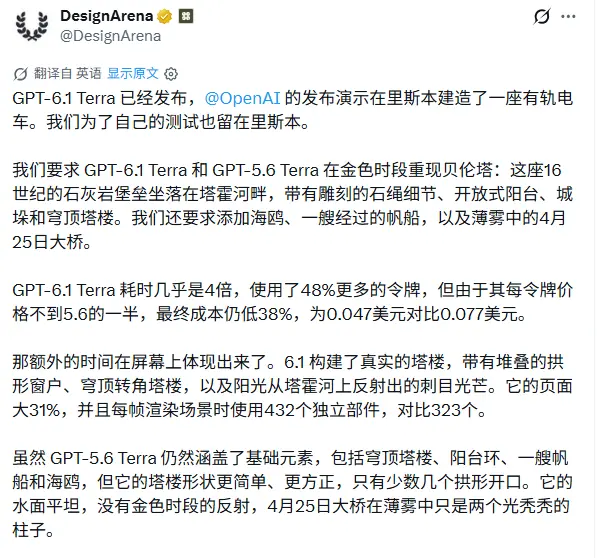
The test results showed that GPT-6.1 Terra took nearly four times longer than its predecessor and used 48% more tokens. However, due to the significant reduction in the price per token, the final cost decreased by 38%, from $0.077 for GPT-5.6 Terra to $0.047.
From the actual demo, there were also differences in the images generated by the two models.
DesignArena believes that GPT-6.1 Terra restored a more complex architectural structure, including layered arched windows, dome corner towers, and sunlight reflections on the Tagus River. The generated page size was 31% larger, with each frame using 432 independent components, compared to 323 for the previous generation.
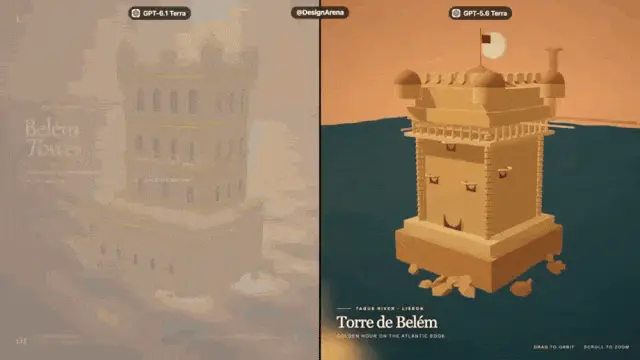
In contrast, while GPT-5.6 Terra also generated domes, balconies, sailboats, and seagulls, the architectural shapes were simpler, the water surface lacked significant light and shadow variations, and the distant bridge did not present the same level of detail.
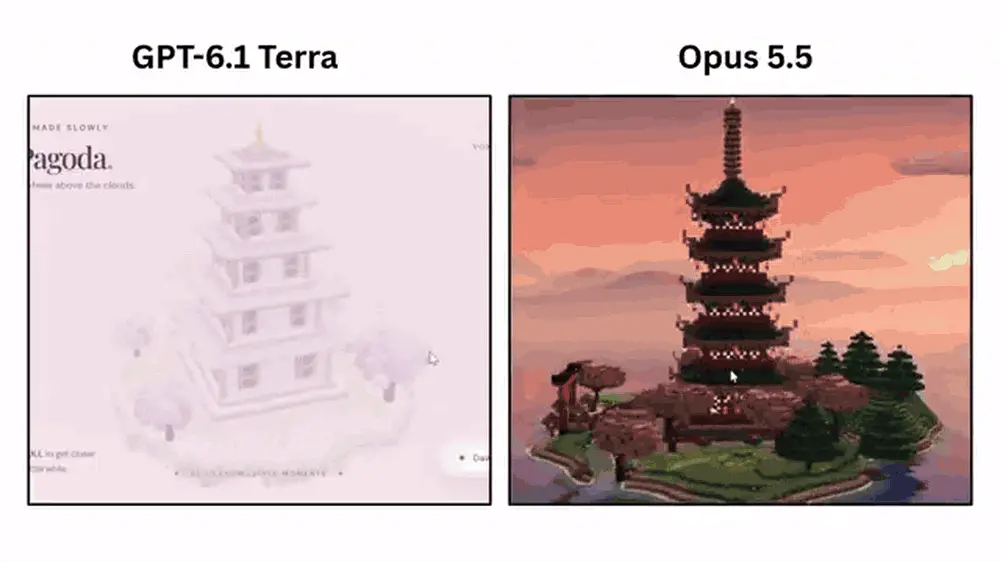
The AI model testing account @N1njaCodex compared the performances of GPT-6.1 Terra and Claude Opus 5.5 in generating pixel art style Roman Colosseum.
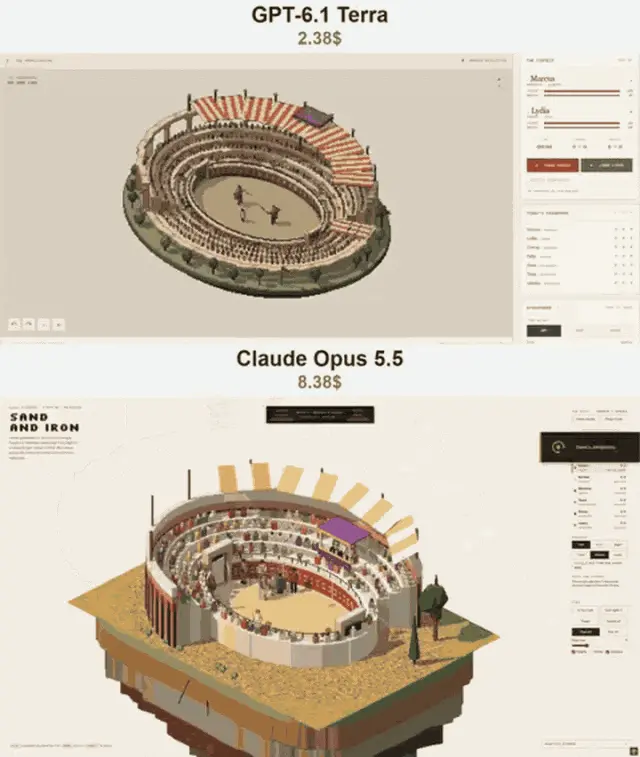
The costs for both models to complete the same task were $2.38 and $8.38, respectively. NinjaCodex believes that Terra performed well at this price point, but the arena generated by Opus was brighter and had richer layers, thus still preferring the latter.
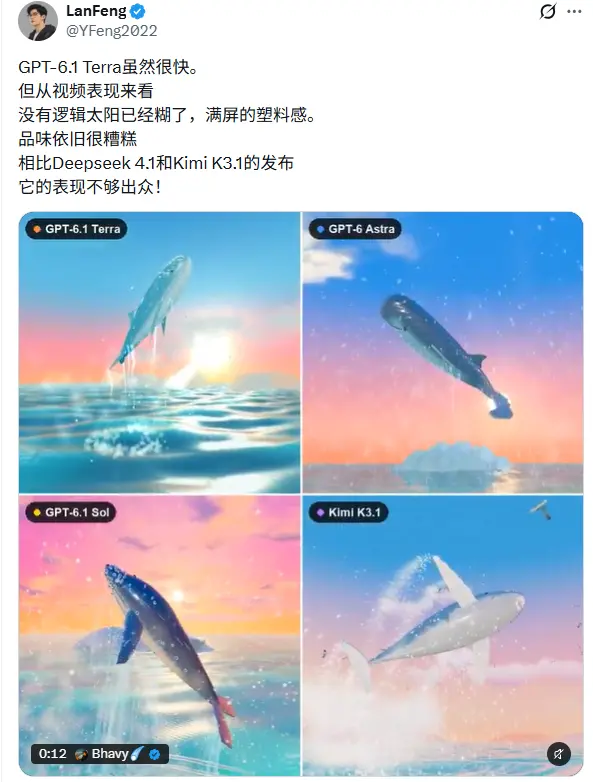
AI independent developer @YFeng2022 also raised questions about Terra's visual performance. He noted that from the video demonstration, the images generated by the model had a plastic feel, and the aesthetic performance was still not ideal, believing its overall effect was inferior to the models recently released by DeepSeek and Kimi.
Another model tracking account @Mr_Salio held a negative view of Terra's overall performance. He believed that while the model's speed was outstanding, the overall experience did not meet expectations, even suggesting that GPT-5.6 performed better in some tests.
04 When Mid-range Models Start to Count
After the release of Terra, discussions surrounding it quickly extended to competition in the model market.
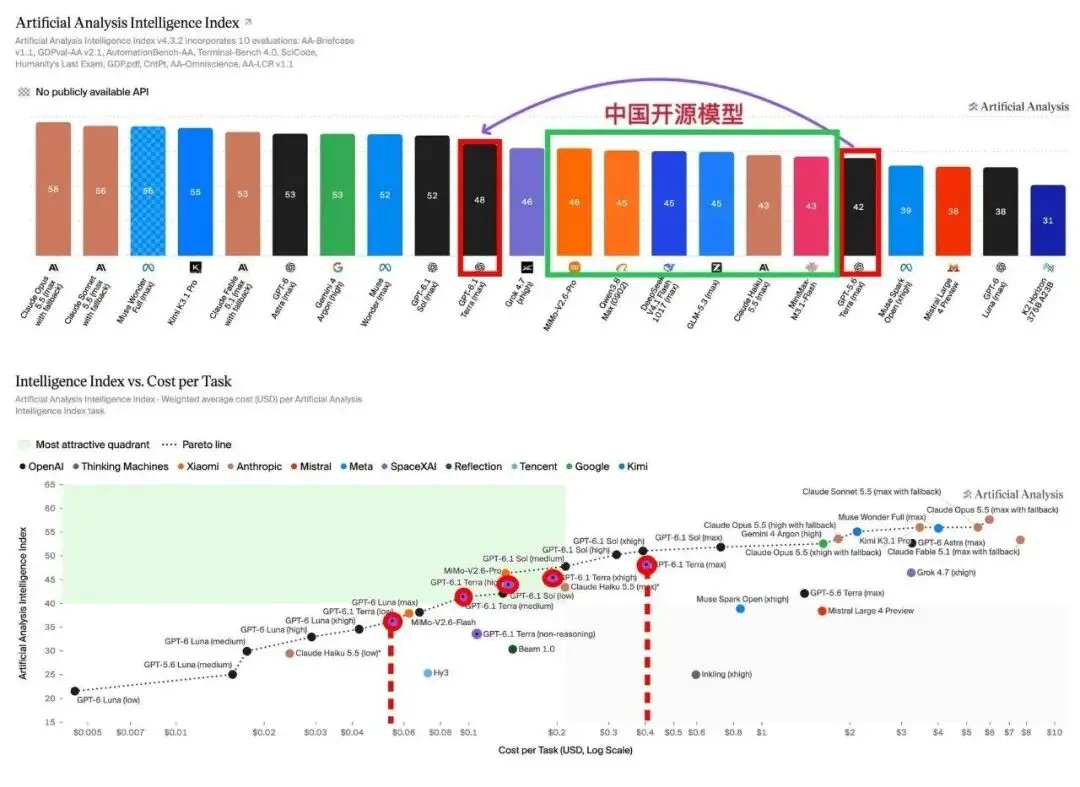
AI developer @NFT_Chen cited the smart index data from Artificial Analysis, emphasizing that GPT-6.1 Terra scored 48 points under maximum inference intensity, higher than several Chinese models.
Although this does not directly equate to product competitiveness, it reflects a reality: competition between models has extended to costs, speed, and task completion quality under different inference intensities.
@NFT_Chen believes that if users require in-depth judgment, complex architectural design, and high-quality creation, they should prioritize Claude Opus 5.5; if the work mainly involves development with clear specifications, documentation, and terminal operations, Sonnet 5.5 is also competitive; while Terra is more suitable for high-frequency office tasks, cross-application operations, and cost-sensitive automation tasks.
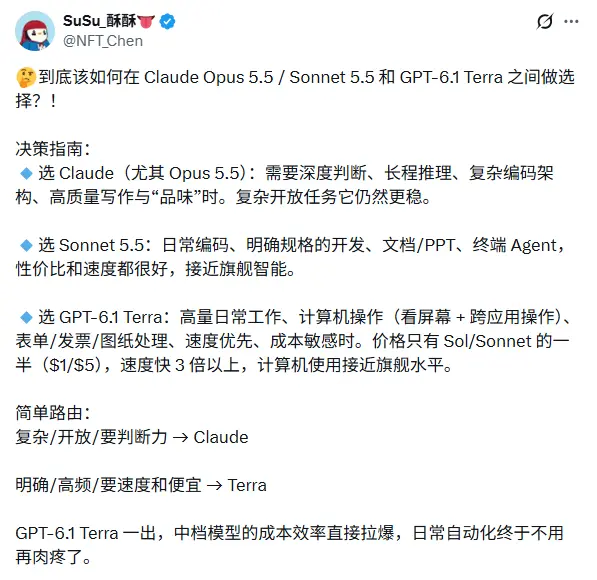
This selection method is also consistent with OpenAI's positioning of Terra. The official recommendation clearly states that in-depth research and complex programming should still prioritize GPT-6.1 Sol or GPT-6 Astra. Terra aims to cover a large amount of daily work at a lower price.
Currently, GPT-6.1 Terra has been made available to Plus, Pro, Enterprise, and Edu users in ChatGPT Work and Codex, and developers can also call it through the OpenAI API. The standard price is $1 per million input tokens, $0.05 per cached input token, and $5 per output token.
For enterprises and developers that require extensive model calls, the price drop can directly impact the costs of automation projects. However, if a task has high demands for visual quality, complex reasoning, or code reliability, the model still needs to undergo practical testing, rather than just looking at the single token price.
 Risk warning Risk warning