After reading the prospectus, I finally understand why Anthropic doesn't care about users anymore
 Core Viewpoint


 The prospectus reveals: 80% of revenue comes from enterprises billed by usage. Enterprise users of Claude Code spend 20 times more than regular users, with 11,900 enterprise clients supporting billions in revenue. Free users are classified financially as "sales and marketing" costs—essentially a customer acquisition strategy, aimed at getting developers to use it first before promoting enterprise purchases. With a shortage of computing power, resources are fully tilted towards enterprise agents that spend 20 times more.
Author: Wildcard, Geek Park
Editor: Jingyu, Geek Park
It's finally here.
On October 26, Anthropic publicly submitted its S-1 prospectus to the U.S. Securities and Exchange Commission, preparing to list on the Nasdaq Global Select Market, with the stock ticker set as ANT. Media reports indicate that the valuation discussion range for this company has reached between $1.5 trillion and $2 trillion, while the price range for the offering has not yet been disclosed.
Within 24 hours, this 300-page prospectus has been thoroughly examined by the tech and finance circles, and the most eye-catching numbers have been noted: revenue of $16.286 billion in the first half of 2026, compared to only $1.163 billion in the same period last year; a second-quarter operating profit of $974 million, marking the company's first profitable quarter in history; as for the staggering net loss of $80.7 billion on the books, the bulk comes from $72.388 billion in convertible debt, derivative liabilities, and changes in the fair value of SAFE, which are non-cash accounting expenses.
However, beyond the Wall Street narrative, domestic developers and everyday users have a different sense of disconnection. In the eyes of users in mainland China, Claude is probably the AI product with the most account bans, the strictest risk control, and the most frustrating user experience on the market.
Why does a company that produces top-tier large models always seem so indifferent when facing ordinary individual users?
After going through the financial notes and risk warnings in the prospectus, the answer is actually written in the books. In Anthropic's business landscape, the contribution of individual users in terms of real revenue is very small.
01 Less than 20% of Individual Users
To understand who a company truly cares about, the most direct way is to look at its revenue composition. In Note 2 of the financial statements in the prospectus, Anthropic breaks down its revenue into two major parts: usage-based revenue and subscription revenue.
The data comparison is stark. For the entire year of 2025, usage-based revenue is $3.796 billion, while subscription revenue is only $789 million, with a ratio of about 83% to 17%. By the first half of 2026, usage-based revenue skyrocketed to $13.064 billion, while subscription revenue was $3.222 billion, with the former still accounting for about 80%, and subscription revenue only about 20%.
The more critical detail lies in the composition of subscription revenue. Within this 20%, there are both individual users' Claude Pro and Claude Max, as well as enterprise-level Team and Enterprise packages, and the prospectus does not separately disclose individual subscriptions. This means that the revenue contribution from individual users purchasing memberships is definitely less than 20% of Anthropic's total revenue, and it may be much lower.
So, where does the 80% of usage-based revenue come from? The answer is cloud vendor channels and thousands of enterprises.
Revenue sold to customers through major cloud vendors like Amazon, Google, and Microsoft has been skyrocketing: about 11% in 2023, about 32% in 2024, about 47% in 2025, and about 48% in the first half of 2026. Almost half of the revenue is supported by the distribution channels of the three major cloud giants.
Supporting this money-printing machine is a rapidly expanding group of institutional clients. As of September 30, 2026, the number of clients contributing over $100,000 in revenue in the past 12 months (according to independent organization statistics) has surged from over 950 a year ago to over 11,900. The client structure is also very healthy, with no single client's revenue accounting for more than 10% in the first nine months of 2026, and the top five clients combined accounting for about 25%.
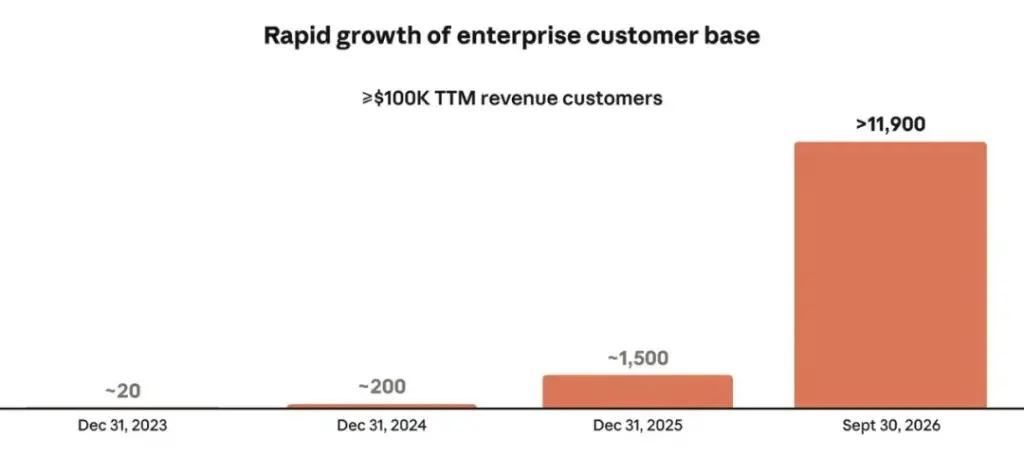
The corporate client growth chart in the prospectus: the number of clients contributing over $100,000 in revenue in the past 12 months grew from about 20 at the end of 2023 to over 11,900 at the end of September 2026 | Image source: Anthropic
The prospectus uses a specific term for individual paying users called "prosumers," defined as individual users who subscribe to AI tools for knowledge work, such as researchers, developers, analysts, and writers. The title sounds very professional, but this group still remains marginal in the face of core financial metrics.
The entire 300-page prospectus does not disclose daily active and monthly active user numbers, nor does it mention the number of paid subscribers.
The most telling indicator of this attitude is the net revenue retention rate.
As of September 30, 2026, Anthropic's net revenue retention rate is as high as about 900%, a number that makes all software companies envious. However, in calculating this core metric, individual subscription users of Claude Pro and Max are excluded, on the grounds that fixed-price subscriptions do not reflect the expansion and contraction behaviors that this metric is meant to measure.
What a company cares about most is reflected in the metrics it reports to investors. When a company does not show daily active and monthly active users and excludes individual subscribers from calculating core retention rates, the weight of ordinary individual users in its eyes is already self-evident.
02 Money is Earned by Claude Code and Enterprises
Since the bulk of revenue comes from usage-based billing, what are enterprise clients spending money on? The prospectus shines a spotlight on Claude Code, describing it as the product that "most specifically defines what autonomous AI work looks like."
An ordinary chat box does not consume much token; what truly drinks up computing power like water are intelligent agents that can write code, run tests, and fix bugs. The prospectus provides a comparison: in the third quarter of 2026, Claude Enterprise users who did not use Claude Code spent an average of less than $75 per month; while the top 5% of Claude Enterprise users using Claude Code spent about 20 times more than the former.
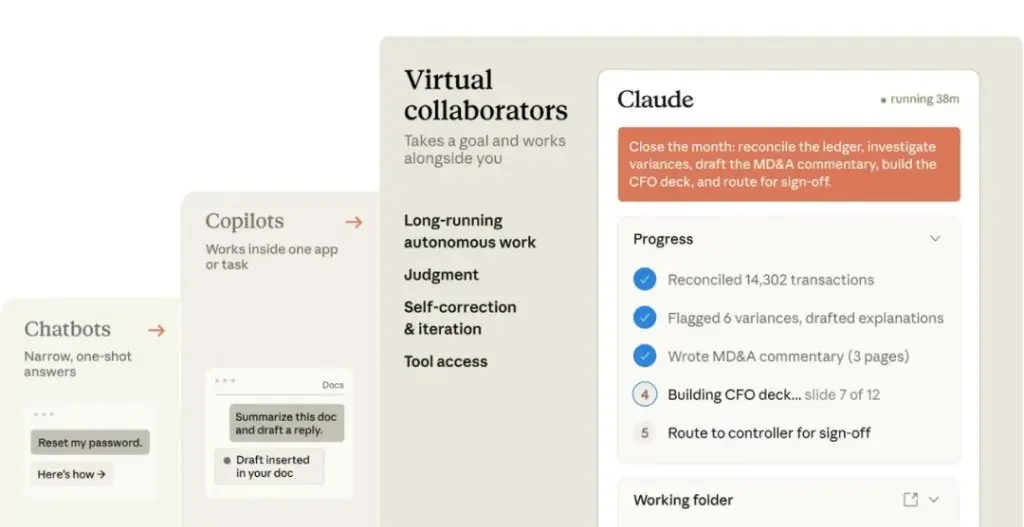
The prospectus categorizes product forms into three generations: chatbots, copilots embedded in individual applications, and "virtual collaborators" that can take on goals and work autonomously for extended periods | Image source: Anthropic
This is also why Anthropic can leverage a streamlined team to achieve billions in revenue. As of September 30, 2026, the company had about 5,300 employees, with average revenue per employee exceeding $6.6 million in the past 12 months, up from $1.4 million a year ago.
Understanding the operational logic of this money-making machine sheds light on how it treats free users.
In financial accounting, the computing power consumed by free users is categorized as "sales and marketing" expenses. The financial statement notes clearly state that this expense includes channel partner fees, marketing and advertising, personnel costs, and "the cost of computing power and infrastructure provided for free access." In the first half of 2026, sales and marketing expenses amounted to $3.808 billion. In other words, free users are accounted for as a customer acquisition cost.
The risk factors section makes this clearer. The company admits that providing free access is largely to build awareness and usage habits, reaching individuals engaged in knowledge work outside of corporate organizations, hoping to gradually convert them into paying customers; however, conversion may not be successful, and the free tier may also eat into paid subscriptions.
The prospectus also emphasizes twice that the company "has always operated in a computing power-constrained environment, with customer demand exceeding available computing power." The prospectus does not specify how computing power is allocated among different clients, but under the premise that computing power is always insufficient, one side has fixed monthly fee individual subscribers, while the other side has Claude Code enterprise users spending 20 times more, the math is not difficult to figure out.
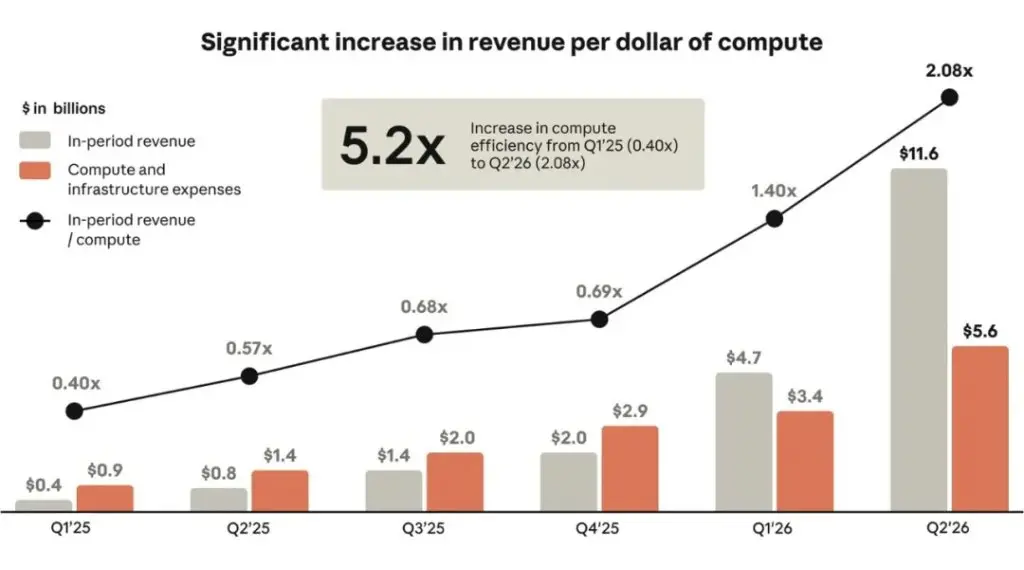
The prospectus includes a chart showing "revenue generated per $1 of computing power": growing from $0.40 in the first quarter of 2025 to $2.08 in the second quarter of 2026 | Image source: Anthropic
Pro and Max users around the world are experiencing changes in quotas and throttling. In this regard, Anthropic candidly states in the risk factors: We have changed, and may change in the future, usage limits, rate limits, or model and product capabilities, which may damage our reputation and the perceived value of our products among users; some of these changes have already triggered, and may trigger, accusations that our disclosures regarding model access or capabilities are insufficient or misleading.
Knowing that changing quotas will attract criticism and harm reputation, Anthropic still included this point in the prospectus, giving investors a heads-up.
03 Users as "Igniters"
Since individual users contribute so little revenue and consume limited computing power, why doesn’t Anthropic simply shut down the individual side and become a backend API supplier?
This is precisely the subtlety in the prospectus. Individual users carry little weight in the revenue ledger, but they have irreplaceable strategic value in the chain of business expansion.
They are the igniters that help Anthropic penetrate into enterprises.
The prospectus reviews this growth flywheel. So far, the diffusion of Claude has largely been spontaneous, driven by software developers and professional individual users. These individuals first use Claude themselves and then promote broader adoption within their organizations, avoiding the hassle of building a large direct sales team. The official statement makes it clear that this approach allows them to scale with a smaller team than other large tech companies.
Software developers are the most core group among them. The prospectus believes that they understand how systems operate, have credibility in evaluating technological tools, and often drive the adoption of new technologies internally; winning their trust is the foundation for Claude's broader diffusion among enterprise employees.
Understanding this logic clarifies why free computing power is recorded under "sales and marketing." Providing services to individual users is essentially Anthropic's customer acquisition strategy: a programmer uses it first, then persuades the team at their company to purchase the Enterprise package, ultimately integrating the entire R&D process into the usage-based Claude Code.
However, this model has a soft spot. The prospectus admits that it assumes individual adoption will continue to translate into organizational-level adoption. In the risk factors, Anthropic warns investors that companies with stronger consumer businesses, larger user bases, and more established brands may increase their investment in enterprise clients; if these competitors capture "the starting point of our enterprise adoption" through consumer applications or other means, i.e., individual users, the company's business may be adversely affected.
This creates a twisted situation. Anthropic needs individual users to help it build reputation and act as internal promoters, fearing that competitors will snatch this group away; meanwhile, the prospectus clearly states that the company's research priorities, product roadmap, and marketing team are all organized around enterprise use cases.
It needs you to be the spark, but the core resources are all dedicated to serving enterprises. When large orders from enterprises flood in and computing power becomes tight, the first to have their oxygen supply restricted will ironically be the spark itself.
04 A To B Company Dressed in Consumer Clothing
Closing this prospectus, Anthropic's true nature has become very clear: it is essentially a To B company. To acquire customers and build an ecosystem, it has turned its product into a chat interface that anyone can use, while the real business is selling on-demand computing power and autonomous agents to tens of thousands of enterprises.
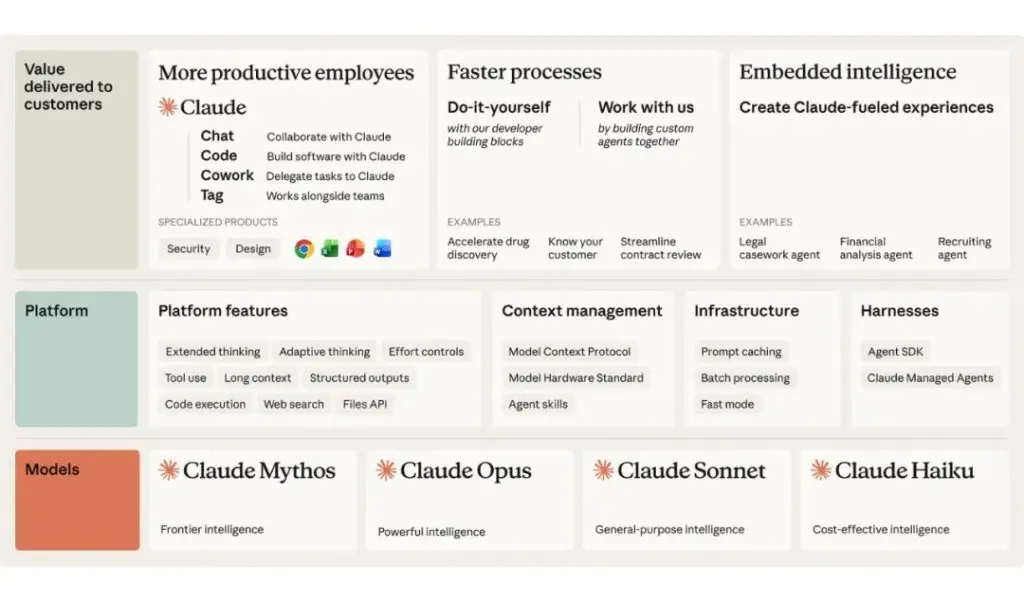
Product structure diagram in the prospectus: at the bottom are the four model series Mythos, Opus, Sonnet, and Haiku, in the middle is the developer platform, and at the top is the value delivered to enterprise clients | Image source: Anthropic
As for the account suspension issue that domestic users are most sensitive about, the prospectus also provides a regulatory explanation: the company has "support for regional policies" and implements IP-based geographic blocking to restrict access to its models, platforms, and applications from specific regions. Mainland China is not within its service area.
When a company valued at nearly two trillion dollars places all its chips on enterprise workflows and code agents, the position of individual users in its eyes will only become less significant.
It remains to be seen whether, as more and more developers who have been turned away turn to other competitors, Anthropic can still maintain its proud starting point for enterprise adoption.
 Risk warning
 Risk warning