USDC circulation is under pressure, while trading volume has surged: Circle Q3 financial report reflects the stablecoin "traffic first" logic
 Core Viewpoint


 Future revenue growth will rely more on the monetization advancement of CPN, the integration implementation of Tazapay, and the commercialization progress after Arc's transition to PoS.
Author: Zhou, ChainCatcher
Circle released its Q3 2026 financial report before the US stock market opened on November 4, with revenue and earnings per share both exceeding market expectations. This marks the first time the company has delivered a seemingly good report after two consecutive quarters of disappointing revenue.
However, the main driver of the better-than-expected results was a one-time revenue from the presale of its public chain Arc's native token ARC. Meanwhile, the company disclosed it has laid off about 5% of its employees.
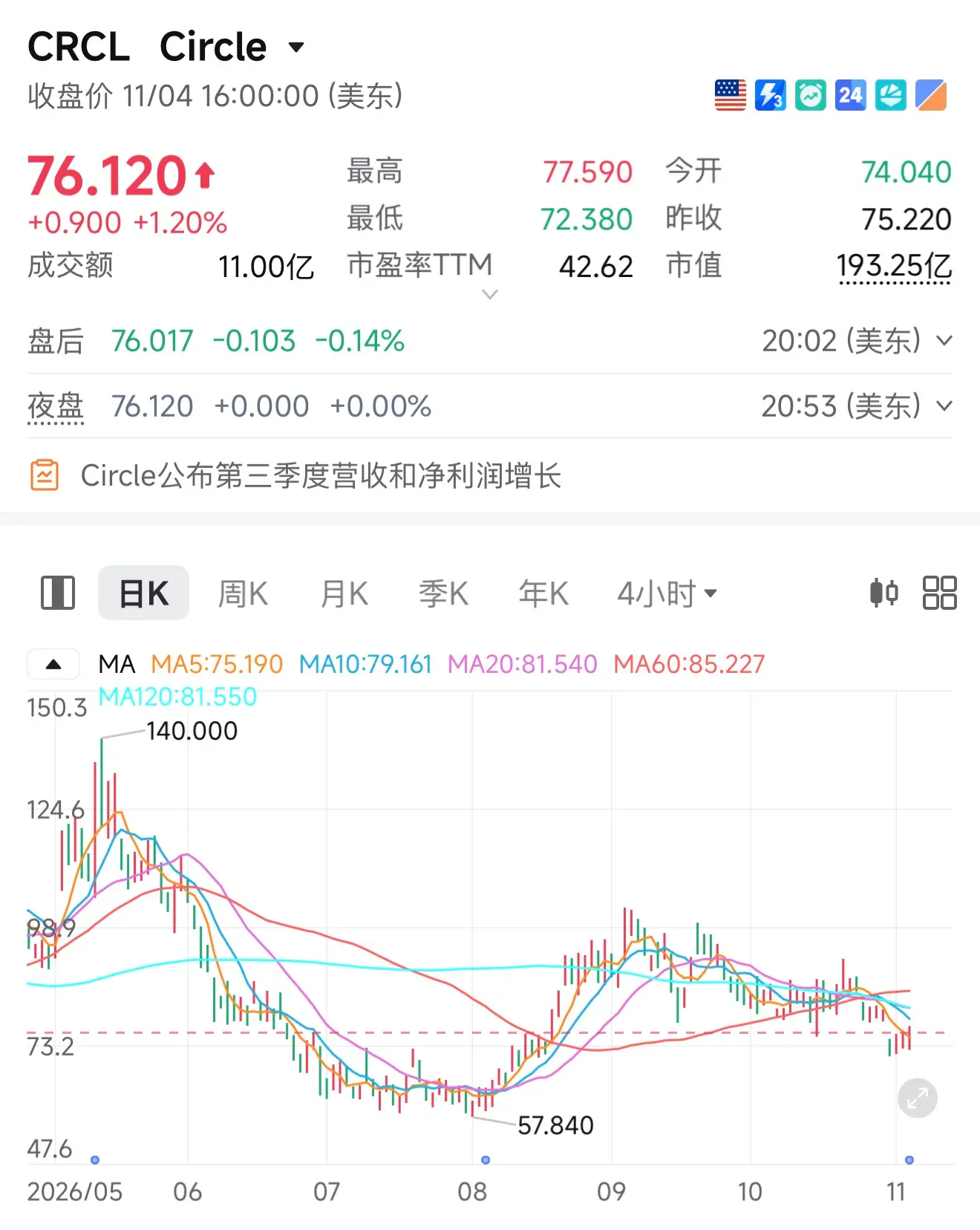
After the financial report was released, Circle's stock price initially rose and then fell in pre-market trading, ultimately closing slightly up at $76.12, with a total market capitalization approaching $20 billion.
1. The better-than-expected results mainly rely on the ARC presale
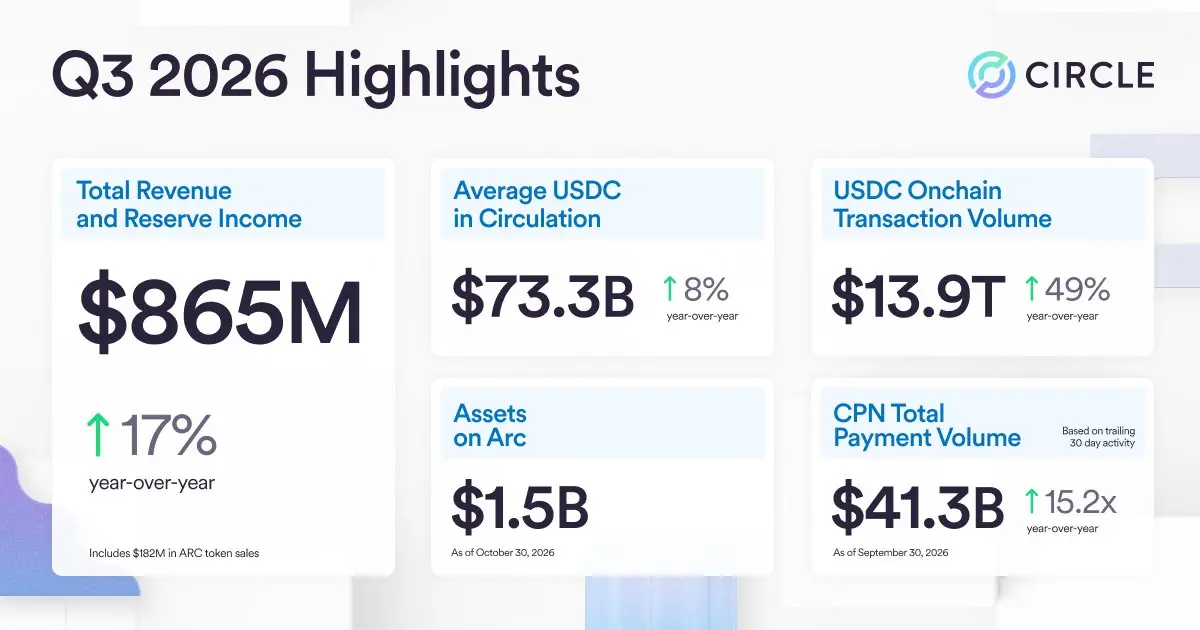
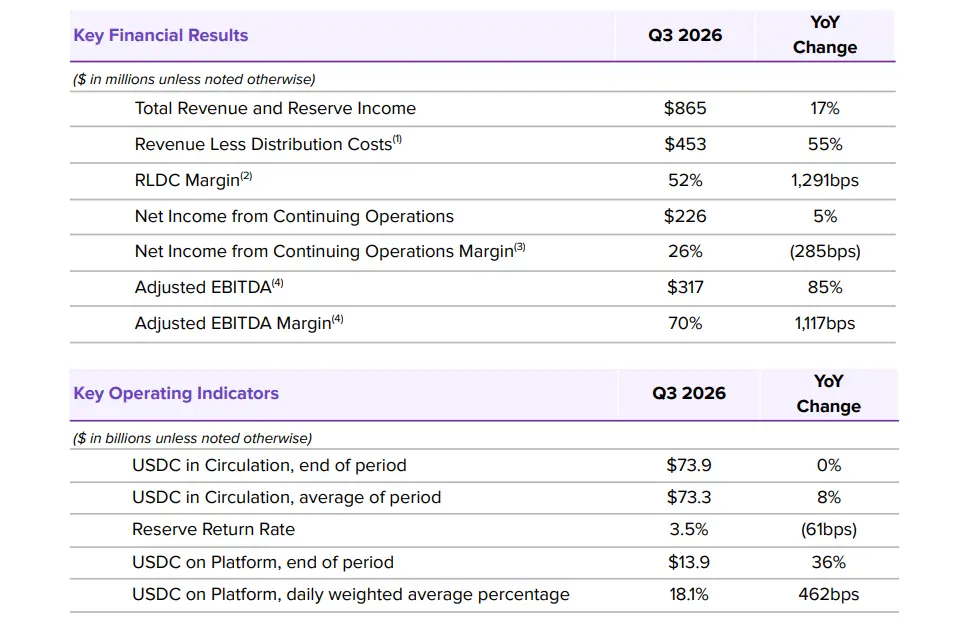
Circle's total revenue and reserve income for Q3 was $865 million, a year-on-year increase of 17%. The net profit from continuing operations was $226 million, a year-on-year increase of 5%. Adjusted EBITDA was $317 million, a year-on-year increase of 85%. The diluted earnings per share was $0.84, while the market had previously expected revenue of $802 million and earnings per share of $0.40.
The better-than-expected results mainly came from other income. Other income for the quarter was $207 million, a year-on-year increase of 627%, of which $182 million came from the ARC token presale.
The ARC presale was completed in two rounds, raising a total of about $242 million. CFO Jeremy Fox-Geen explained on a conference call that the presale revenue is recognized based on performance milestones, with about 75% recognized in Q3 as the tokens were delivered and the Arc mainnet went live.
This revenue had no corresponding distribution costs, making its impact on profit more pronounced. The revenue after deducting distribution costs, known as RLDC, reached $453 million, a year-on-year increase of 55%, with the RLDC profit margin rising from 41% in Q2 to 52%. The adjusted EBITDA profit margin was 70%, and 50% when excluding ARC.
2. Excluding ARC, core revenue and profit declined year-on-year
According to the financial report data, excluding presale revenue, Circle's Q3 revenue was about $683 million, a year-on-year decrease of about 8%, and also lower than the previous two quarters. Adjusted EBITDA was about $135 million, a year-on-year decrease of about 21%, with a pre-tax profit of about $46 million, the lowest since the beginning of the year.
The main reason was the decline in reserve income. Reserve income for Q3 was $658 million, a year-on-year decrease of 8%, with the reserve return rate declining by 61 basis points year-on-year to 3.54%. The average circulation growth of 8% only offset part of this decline.
Other businesses also failed to fill the gap. Excluding the presale, other income was only $25 million, a year-on-year decrease of 11%, which Fox-Geen attributed to a decrease in blockchain integration projects that were monetized during the quarter.
Profit margins were similarly under pressure. The RLDC profit margin after excluding the presale was 39.7%, down about 150 basis points from Q2. The net reserve profit margin decreased by about 80 basis points to 37.8%. According to Fox-Geen, this was the first full quarter under the revenue-sharing arrangement with Hyperliquid.
Even when including presale revenue, net profit only grew by 5% year-on-year, mainly because there was about $61.3 million in income tax benefits in the same period last year, creating a high base.
3. USDC circulation stagnates, Circle increases distribution to cope with competition
The reserve return rate follows interest rate trends, and what Circle can actively pursue is the scale of circulation, but this metric is also weak. At the end of Q3, the USDC circulation was $73.9 billion, unchanged from the same period last year, and the average circulation for the quarter was also lower than in Q2.
During the same period, the total supply of stablecoins grew by 8% year-on-year to about $274 billion, while USDC's market share fell to 27%, a year-on-year decrease of 183 basis points, with the decline significantly widening compared to Q2.
At the end of June, Open Standard, along with Visa, Mastercard, Stripe, and over 140 other institutions, announced the launch of the revenue-sharing stablecoin Open USD, raising concerns in the market about USDC's distribution advantages.
CEO Jeremy Allaire stated on the conference call that Circle will continue to increase its distribution investments, and he acknowledged that there is a trade-off between incentives given to partners and the growth of circulation.
Binance is the latest example. The two parties signed a new five-year agreement, with Binance also investing $100 million in Circle. Specific economic terms were not disclosed, and Fox-Geen stated that the renewal does not involve upfront costs. Regarding recent security incidents at Binance, Allaire mentioned that Binance recorded about $2.5 billion in net inflows in the past 24 hours.
As for the stagnation in circulation, Allaire attributed it to the weak crypto market, emphasizing that usage is still growing. He noted that USDC, with about 27% of the supply share, accounted for 79% of the trading volume of stablecoins, compared to 66% in the same period last year. The on-chain transaction volume for the quarter was $13.9 trillion, a year-on-year increase of 49%, with a total of $208 billion in minting and redemption, setting a quarterly record.
Circle still maintains its long-term target of a 40% compound annual growth rate in circulation, and Fox-Geen expects that growth in usage will drive a rebound in circulation in the long term.
4. Approximately 5% layoffs, CFO to step down by year-end
In the same quarter where core revenue declined, Circle conducted layoffs. The company disclosed in the financial report notes that it laid off about 5% of its workforce in Q3, incurring restructuring costs of $9.1 million, mainly for severance and other cash expenditures.
The official statement indicated that this adjustment aims to align the organizational structure with the company's operational model and strategic focus. According to Circle's annual report, the company had about 1,100 employees as of the end of 2025, estimating that this layoff affected about 55 positions.
The layoffs did not lead to a reduction in costs. Fox-Geen stated that adjusted operating expenses increased year-on-year, mainly due to investments in Arc and AI-related infrastructure, as well as marketing expenses, including sponsorships for Chelsea. Marketing expenses in Q3 doubled year-on-year to $11.3 million, while IT infrastructure costs increased by about 90% year-on-year.
Circle announced in September that CFO Jeremy Fox-Geen would step down by the end of the year, and the company is seeking a successor.
5. Arc completes the genesis minting of 10 billion ARC, transitioning to PoS to monetize through staking
Among the new businesses, Allaire stated that Arc is Circle's largest platform bet since USDC. The Arc mainnet went live on September 16, operated by 11 founding validator nodes, with over 100 institutions and applications connected, including financial institutions like BNY, HSBC, and Visa, as well as DeFi protocols like Aave and Uniswap. As of late October, on-chain assets were approximately $1.5 billion.
In Q3, Circle completed the genesis minting of 10 billion ARC, becoming the first publicly traded company to mint network tokens for a new L1 blockchain. Circle holds 25% of these tokens, and Arc plans to transition to PoS by 2027.
Fox-Geen outlined three monetization methods for Arc, with related income included in other income. Staking rewards are expected to be the main recurring revenue, as Circle will stake its held ARC after the transition to PoS and earn rewards as a validator. The company may also selectively sell ARC, with proceeds directly counted as profit. ARC distributed to ecosystem participants will be accounted for at market value as income, while also being counted as an equivalent distribution cost.
He also pointed out that under US accounting standards, the value of ARC held by Circle will only be recognized upon sale or distribution, and it is currently not reflected in the financial statements.
According to documents Circle submitted to the SEC, the lock-up period for ARC for second-round presale investors will be at least one year after Arc transitions to PoS, with the earliest possible transfer being in 2028. Risk warnings also indicate that if key milestones are not met, Circle may need to refund presale funds.
In the context of the recent theft at Binance, Allaire also highlighted security as a selling point for Arc. He believes that Arc, operated by known institutions, can better meet the security requirements of financial institutions compared to permissionless public chains.
6. CPN payment volume nearly triples in three months, expected to contribute significant revenue in 2027
The annualized payment volume of CPN, calculated over the past 30 days, reached $41 billion at the end of Q3, a year-on-year increase of over 15 times, nearly tripling since the end of June. As of October 30, this figure has exceeded $58 billion.
In September, Circle announced the acquisition of Singapore's cross-border payment platform Tazapay for $400 million in Class A shares, with the transaction expected to be completed in 2027. Tazapay has an annualized payment volume exceeding $25 billion, with about 60% already involving stablecoins.
Allaire stated that Asia is the most active region on the Circle platform, and the company is in contact with the Hong Kong government, expressing confidence in entering Hong Kong's offshore stablecoin regulatory framework.
Fox-Geen revealed that the company has begun charging fees on a portion of CPN traffic, and expects that after Tazapay is integrated, CPN will contribute significant revenue in 2027. However, Allaire emphasized that Circle's goal is to lower the unit cost of payments and will not replicate the fee structures of traditional payment industries.
7. Guidance remains unchanged, Q4 profit margins expected to decline due to Binance incentives
Circle maintains its guidance for the year unchanged. The full-year other income guidance is set at $310 million to $330 million, with an RLDC profit margin of 41.7% to 43.7%, both including confirmed ARC presale revenue.
Based on this calculation, the other income for Q4, excluding ARC, is expected to be about $30 million to $50 million, higher than Q3's $25 million. Fox-Geen anticipates a rebound as blockchain integrations increase.
In terms of profit margin, the profit margin of RLDC for the first three quarters is approximately 45.5%. If the full year falls within the guidance range, roughly estimating the fourth quarter revenue at about 700 million USD, the profit margin for RLDC in the fourth quarter is expected to be around 29% to 38%, lower than the previous quarters' level of about 40%.
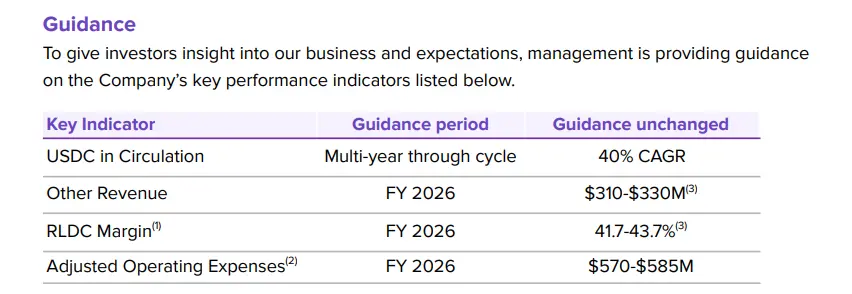
Fox-Geen confirmed the decline in profit margin for the fourth quarter in response to a question from a Goldman Sachs analyst. He stated that excluding ARC, the full-year profit margin for RLDC will be close to the midpoint of the original guidance of 38% to 40%. This can be inferred to show the decline in the fourth quarter, as Binance's incentive arrangements will be fully accounted for in a single quarter for the first time.
The fourth quarter is also the first quarter where the Hyperliquid revenue-sharing arrangement and the renewed cooperation with Binance are fully accounted for. Fox-Geen referred to these two collaborations as investments in distribution, aimed at promoting the circulation of USDC and the growth of RLDC in the long term.
On the expense side, the full-year adjusted operating expense guidance remains at 570 million to 585 million USD, still trending towards the high end of the range. Based on this, the adjusted operating expenses for the fourth quarter are estimated to be about 149 million to 164 million USD, higher than the 139 million USD in the third quarter.
It is worth mentioning that a retail shareholder asked about the rapid adoption of USDC, which is clearly outpacing revenue and profit growth, and when non-interest income will become a significant contribution. Allaire responded that the monetization of CPN, the integration of Tazapay, and Arc's transition to PoS will collectively drive revenue diversification.
 Risk warning
 Risk warning