Interpreting the State Council Financial Work Report: Is RWA illegal financial activity?
 Core Viewpoint


 The Governor of the Central Bank, Pan Gongsheng, presented a financial work report to the Standing Committee of the National People's Congress, mentioning "strengthening the regulation of real-world asset (RWA) tokenization." Lawyer Liu Honglin interpreted: does this mean that RWA is classified as illegal financial activity?
Author: Liu Honglin
According to news reports, on November 3, the Governor of the People's Bank of China, Pan Gongsheng, reported to the 25th meeting of the Standing Committee of the 14th National People's Congress on the financial work situation since October 2025, as entrusted by the State Council. The report typically covers monetary policy, financial reform, and risk disposal, but there is a section regarding virtual currency and RWA that needs to be examined word by word:
Improve the regulatory policy framework for virtual currencies, strengthen the analysis of clues related to underground banks involved in virtual currencies, establish a normalized mechanism for the comprehensive rectification of virtual currency "mining," and enhance the regulation of the tokenization of real-world assets (RWA).
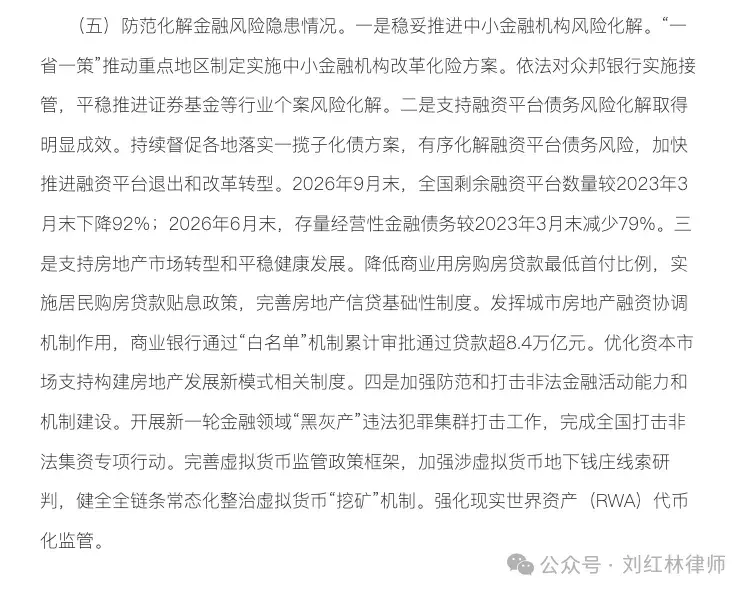
Figure: The State Council's report on financial work, reprinted from the People's Bank of China
RWA (Real World Assets) refers to the business model of mapping real-world assets such as real estate, bonds, and carbon assets onto the blockchain for issuance and circulation. It has been a cautiously used term in regulatory language over the past few years.
This time, it was included in the State Council's financial work report, leading to two interpretations in the market: some interpret it as tightening, believing that regulation will be intensified; others interpret it in the opposite direction, thinking that being included in such a formal document indicates that rules are being established and a path is being provided.
Both interpretations may overlook the same underlying fact: the real change this time is who manages RWA and how it is managed.
First, let's discuss where this statement is located.
In the first part of the report titled "Main Progress and Achievements in Financial Work," there is a section called "Preventing and Mitigating Financial Risk Hazards," where this statement is included. In the same paragraph, there are mentions of combating illegal criminal clusters in the financial sector and a nationwide special action against illegal fundraising, with a subheading titled "Strengthening the Capacity and Mechanism for Preventing and Combating Illegal Financial Activities."
The chapter's position itself is a classification of regulation: RWA is categorized as a risk of illegal financial activities to be prevented and combated, rather than being included in the agenda of financial innovation and opening up.
How RWA Entered Daily Regulatory Practices
RWA is not the first time it has been named by regulators. In February of this year, the People's Bank of China and eight other departments jointly issued a notice titled "Further Preventing and Dealing with Risks Related to Virtual Currencies" (Yin Fa [2026] No. 42), which for the first time listed RWA tokenization alongside virtual currencies as objects of risk disposal. In the report implementing the review opinions, the State Council summarized this stance as "strictly prohibited domestically and strictly regulated abroad."
In terms of implementation: the names and business scopes of enterprises and individual businesses must no longer include terms like "RWA" or "tokenization of real-world assets"; internet platforms are prohibited from providing business venues, displays, marketing, and traffic diversion for related businesses; financial institutions and payment institutions are not allowed to provide account opening, fund transfer, and clearing services.
That notice addressed the issue of "blocking," shutting down domestic business channels one by one.
The change in the November report is that RWA is mentioned alongside the analysis of clues related to underground banks and the comprehensive rectification of mining, included in the annual work report from the State Council to the National People's Congress, and it is written in the section summarizing the work of the past year. For regulators, this has already become part of their daily execution.
In other words, RWA is no longer just a new term in a special notice but has been incorporated into the routine agenda of financial regulation. Future constraints on such businesses will not require special documents to signal, as daily regulatory and enforcement actions will cover them.
Technical Services No Longer Just Neutral?
The practical impact of this change on practitioners lies in regulatory attribution.
Over the past year, many clients have inquired about RWA, with most proposals being similar: the underlying assets are real estate, debts, carbon assets, or equipment income rights, layered with a structure of technical services or data on the blockchain, attempting to define the entire matter as a technical or data business to circumvent financial regulation.
This packaging has already become quite tenuous after Document No. 42, and this report has eliminated the remaining space for imagination.
The issuance, trading, and settlement of assets on the blockchain are clearly regulated within the financial framework, with the judgment criteria returning to the most basic matters: where the money comes from, where it goes, who promises the returns, and who the promotion is aimed at. No matter how sophisticated the structure is, as long as these matters point to public fundraising and return promises, the claim of "we are just doing technology" will not help.
Another detail in the report that is easy to overlook is: strengthening the analysis of clues related to underground banks involved in virtual currencies.
This statement targets the capital return channels. Some teams place issuance offshore, believing that an offshore structure isolates them from domestic regulation, but as long as the promotion is aimed at domestic users and returns flow back domestically through exchange channels, it falls precisely within this line.
The strict regulation abroad is not about the place of registration but about where the users are and how the money flows.
In the same report, there is another statement that should be viewed in conjunction. In the section on "Financial Reform and Opening Up," alongside cross-border payment channels, RMB swap arrangements, and panda bonds, is this statement: the positioning of the digital RMB has smoothly transitioned from cash to deposit currency.
One is written in "Preventing and Combating Illegal Financial Activities," and the other in "Financial Reform and Opening Up," with the chapter positions themselves categorizing regulatory paths on the two chains.
This transition was completed earlier this year, and Pan Gongsheng publicly confirmed it at the Financial Street Forum annual meeting in October. Its inclusion in this report means it has shifted from a pilot arrangement to an established framework.
This matter seems unrelated to RWA, but in reality, it is part of the same chess game.
The original positioning of the digital RMB was as a digital substitute for cash, non-interest-bearing, and not entering the credit creation system, primarily used for small payments. After switching to deposit currency, digital RMB held by banking institutions is included in reserve management, and the balance of real-name wallets can earn interest. Commercial banks can incorporate it into full-scenario services of deposit, loan, remittance, and investment.
The digital RMB International Operation Center is already exploring the on-chain issuance, registration, custody, and fund settlement of assets such as bills, trade financing tools, and carbon emission rights, which are precisely the application stories that the RWA industry has repeatedly discussed over the past few years.
When looking at the two lines together, the direction becomes clearer: regulation has not denied the act of asset tokenization itself. Strictly prohibited domestically is aimed at spontaneous, public-facing token issuance; the digital RMB system is building an officially recognized on-chain asset track.
For private RWA, this is a dual squeeze: on one side is prohibitive disposal, and on the other is the official infrastructure as a substitute. Expecting regulation to first block and then open up for private issuance finds no basis in this report.
How Should RWA Business Teams View This?
For teams currently engaged in or preparing to engage in RWA-related businesses, Lawyer Honglin's judgment has three layers.
For domestic business, do not package issuance and fundraising actions under the guise of technical services or data on the blockchain. Regulation has clearly viewed such businesses as financial activities, and packaging will only increase the cost of explanation afterward, without changing the qualitative assessment.
For offshore issuance, first, understand how it is regulated. Article 14 of Document No. 42 delineates a regulated path: based on domestic asset ownership and income rights, engaging in asset securitization-like tokenization businesses abroad must be strictly regulated by the National Development and Reform Commission, the China Securities Regulatory Commission, and the State Administration of Foreign Exchange according to the principle of "same business, same risk, same rules." The regulatory guidelines issued by the China Securities Regulatory Commission on the same day require domestic enterprises holding the underlying assets to file with the commission, and intermediary institutions providing services must also seek approval or file. In other words, going offshore is not prohibited, but it must follow the filing route. Circumventing this path, promoting to domestic users, and having returns flow back through exchange channels fall precisely within the analysis of clues related to underground banks; a structure built offshore has never been a safety net.
In terms of pace, there is no need to panic, but planning should be done according to direction. The report is currently a policy statement, and there are no accompanying specific rules and effective dates yet, so existing business processes do not need to be adjusted immediately based on this. However, if your business model is based on the assumption that "regulation will eventually relax restrictions on domestic token issuance," this report indicates that this assumption does not hold in the foreseeable future. The real opportunities lie in areas that do not touch funds or issuance: technical services, compliance tools, custody audits, data services, and directions that connect to official tracks.
Conclusion
The story of RWA is not over; it has merely changed narrators. Over the past few years, the industry has been accustomed to framing tokenization as a transformation of the financial system through technology; this report provides the answer that, within China's framework, asset tokenization must either follow a regulated track or it has no track at all.
 Risk warning Risk warning



Popular articles