High interest rates reshape the global asset allocation logic: Huobi HTX Chief Analyst Cloud analyzes U.S. Treasury bonds, gold, and BTC

 Huobi HTX Chief Analyst Cloud compared U.S. Treasury bonds, gold, and BTC to wages, insurance, and options in the "Big Shot Lecture," and analyzed their allocation value and risk boundaries under four macro scenarios: soft landing, stagflation, recession, and inflation.
On November 12, the Huobi Expert Forum held a session themed "Global Asset Revaluation: New Wealth Logic in a High-Interest Rate Era," inviting Huobi HTX Chief Analyst Cloud to conduct an in-depth analysis of the global macro environment, U.S. Treasury yields, gold pricing mechanisms, and the institutionalization trend of BTC. Through four macroeconomic scenarios, the discussion explored the allocation value and risk boundaries of different assets.
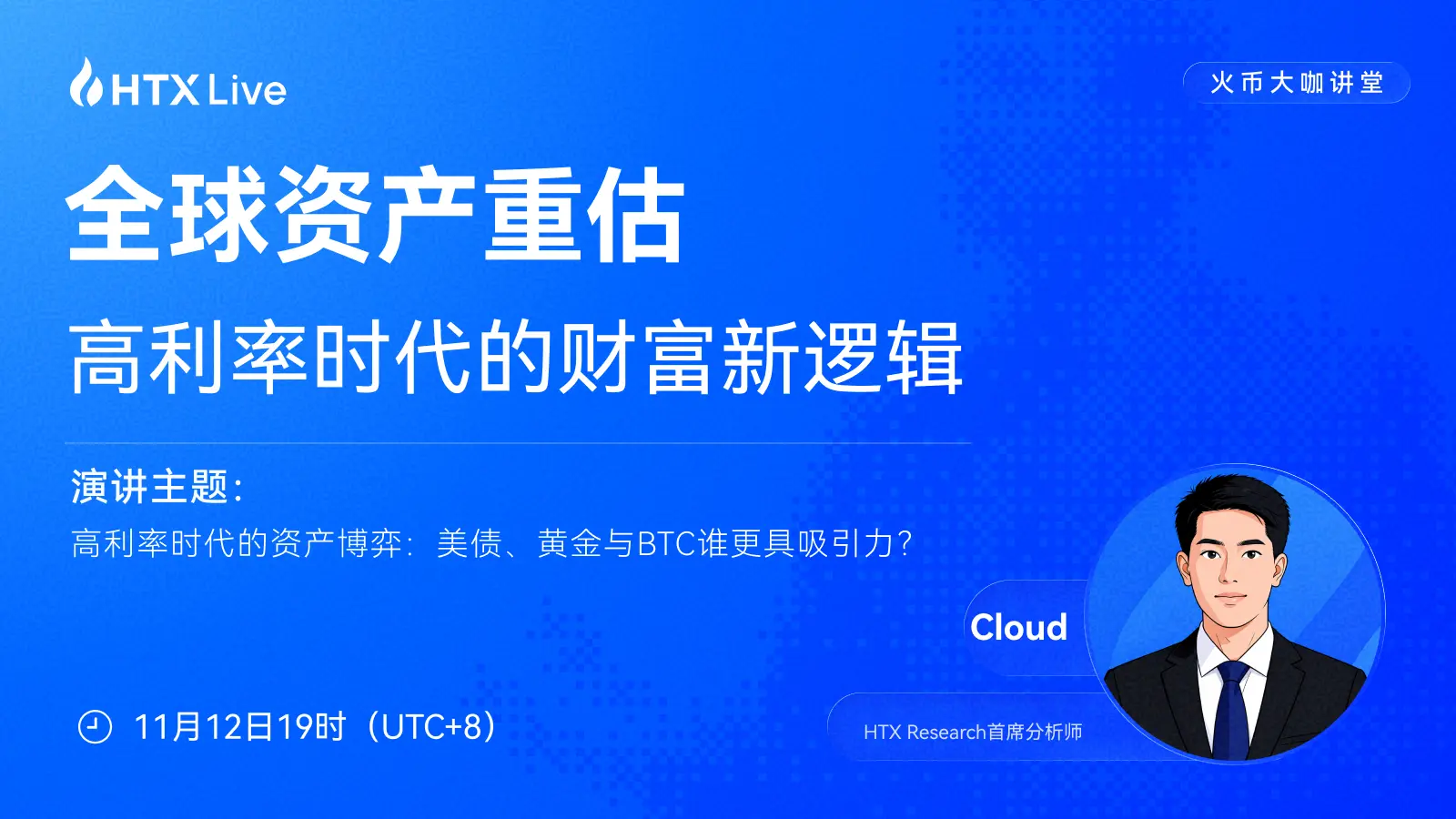
Cloud pointed out that high interest rates are redefining the comparative benchmarks for global assets. "There is no universal asset, only different roles and divisions of labor." In the current market environment, investors need to shift from expectations of single asset returns to a more risk-reward ratio and portfolio allocation-focused investment framework.
High Interest Rates Reshape Asset Pricing: Risk Assets Need to Answer New Questions
Cloud first approached the topic by analyzing the changes faced by the current global asset pricing system through the lens of the Federal Reserve's monetary policy and the U.S. fiscal environment.
In September 2026, the Federal Reserve raised interest rates by 25 basis points, increasing the target range for the federal funds rate to 3.75% - 4.00%. Meanwhile, factors such as resilient inflation, fiscal deficits, and the supply of government bonds continue to influence the market's judgment on future interest rate paths.
Cloud believes that the persistence of a high-interest rate environment not only means rising capital costs but also that risk assets must face higher return comparison thresholds. When investors can obtain relatively stable coupon income through short-term U.S. Treasuries, holding assets like gold and BTC, which do not generate cash flow, requires more substantial risk compensation justification.
This change is reshaping the attractiveness of different assets.
For high-volatility assets like BTC, while long-term growth narratives and scarcity are important, macro liquidity, market risk appetite, and institutional capital flows are becoming significant variables affecting price performance.
U.S. Treasuries, Gold, and BTC: Three Assets, Three Pricing Logics
For the three most Attention ed asset classes, Cloud provided an intuitive analogy: "U.S. Treasuries are wages, gold is insurance, and BTC is an option."
First, the core value of U.S. Treasuries lies in their coupon income and cash flow certainty. In a high-interest rate environment, short-term U.S. Treasuries can provide a relatively stable source of income, making them suitable as defensive allocation tools. However, while long-term U.S. Treasuries also have coupon income, their prices are more sensitive to interest rate changes, and investors must also bear duration risk and price volatility.
Secondly, the value of gold does not lie in generating cash flow but in hedging credit risk and asset diversification. In recent years, global central bank purchases of gold, adjustments in reserve structures, and geopolitical uncertainties have provided long-term demand support for gold.
However, Cloud cautioned that gold does not necessarily rise in all market environments. Factors such as rising real interest rates and a strengthening dollar may still suppress gold price performance. Central bank purchases of gold help provide long-term support but do not guarantee short-term price increases. Therefore, gold is more suitable as a risk-hedging tool in a portfolio rather than merely chasing higher returns.
For BTC, Cloud focused on the dual impact of institutionalization.
As spot ETFs, institutional custody, and investment product systems gradually mature, BTC's connection to traditional financial markets deepens. On one hand, institutionalization expands the potential investor base for BTC; on the other hand, it also makes BTC more susceptible to macro liquidity, equity market volatility, and changes in institutional capital allocation.
Cloud pointed out that while BTC has scarcity and long-term growth potential, scarcity does not equate to downside protection, and "digital gold" does not mean BTC can serve as a safe haven at all times.
Especially in a market environment where risk appetite declines and capital continues to flow out, BTC may still exhibit strong characteristics of high beta risk assets.
In Four Macro Scenarios, Who is More Attractive?
During the live broadcast, Cloud further constructed four macro scenarios: soft landing, stagflation, recession, and recurring inflation, to conduct a horizontal comparison of U.S. Treasuries, gold, and BTC.
In a soft landing scenario, if inflation gradually recedes and economic growth remains resilient, a moderate decline in interest rates may bring price recovery opportunities for long-term U.S. Treasuries, which would also benefit the performance of gold and BTC.
In a stagflation scenario, the coexistence of slowing economic growth and persistent inflation may highlight gold's credit hedging and asset diversification functions, while long-term bonds and high-valuation risk assets may face certain pressures.
In an economic recession scenario, if the economy slows significantly and prompts a shift towards accommodative monetary policy, long-term U.S. Treasuries may gain capital gains due to falling yields, and gold may also benefit from safe-haven demand. BTC, however, still needs to observe changes in market risk appetite and liquidity conditions.
In a scenario of recurring inflation and renewed tightening of monetary policy, the relative defensive value of short-term U.S. Treasuries may become more apparent, while long-term bonds, gold, and BTC may face varying degrees of valuation pressure.
Cloud emphasized that macro scenarios are not singular market predictions but analytical tools to help investors identify risks and test portfolio resilience.
From Pursuing Returns to Managing Risks: High-Interest Rate Era Requires More Patience
In terms of asset allocation, Cloud believes that investors should not simply view U.S. Treasuries, gold, and BTC as three interchangeable options, but should clarify the functions of different assets in their portfolios based on their risk tolerance, investment horizon, and capital needs.
Among them, U.S. Treasuries can play a relatively stable foundational role, gold can be used for risk diversification and credit hedging, while BTC can serve as an aggressive allocation with higher volatility and potential return elasticity.
Regarding the future trend of BTC, Cloud suggested closely monitoring changes in macro monetary policy, market risk appetite, and institutional capital flows, avoiding judgments about market direction based solely on price corrections or halving cycles.
He emphasized at the end of the live broadcast: "In a high-interest rate era, the most expensive thing is not the yield, but patience."
When relatively stable assets can also provide attractive returns, every time investors take on additional risk, they need to reassess whether the potential returns are sufficient to cover the corresponding uncertainties.
From the coupon logic of U.S. Treasuries to the credit hedging of gold, and the institutionalization and risk asset attributes of BTC, this session of the Huobi Expert Forum not only showcased the changes in global asset pricing logic but also provided investors with a more comprehensive macro analysis framework.
As a long-term investor education program of Huobi HTX, the "Expert Forum" continues to invite industry experts, researchers, and seasoned practitioners to share insights on global macroeconomics, digital assets, blockchain technology, and industry development trends, helping users enhance market awareness, risk consciousness, and independent judgment capabilities.
Note: The above represents the market views shared by the guest during the live broadcast and does not constitute any investment advice.
 Risk warning Risk warning