NVIDIA's explosive performance still couldn't dispel doubts, and short seller Burry is focused on the delayed release of the 10-Q report
 Core Viewpoint


 NVIDIA Corporation announced that it will submit its formal 10-Q quarterly report in the coming weeks, raising alarms for major short seller Michael Burry: Why does a company that was once valued at $5 trillion need to first disclose its performance to reassure investors before taking weeks to reveal complete financial information?
Author: Bu Shuqing, Wall Street Journal
NVIDIA delivered an impressive quarterly report, but market concerns have not dissipated.
NVIDIA announced its third-quarter results after the market closed on Tuesday, with revenue doubling year-on-year to $115.8 billion, significantly exceeding Wall Street expectations. The guidance for the fourth quarter also surpassed analyst predictions, and the company announced a $150 billion stock buyback plan, leading to a pre-market stock price increase of over 3%. However, a 10-Q document that was not disclosed alongside the earnings report quickly drew market attention—well-known short seller Michael Burry publicly expressed his concerns, viewing it as a warning sign.
Meanwhile, the controversy surrounding the former CEO Jensen Huang's future continues to brew. The board has clearly stated that it will not reinstate Huang as CEO, but according to Semafor, some board members are privately pushing for his return, leaving uncertainty in corporate governance unresolved.
Earnings Data Exceeds Expectations, Buyback Plan Boosts Sentiment
NVIDIA's third-quarter earnings per share were $2.68, higher than Bloomberg's consensus estimate of $2.47; revenue was $115.8 billion, exceeding the expected $109.3 billion. The data center business generated revenue of $107.6 billion, a year-on-year increase of 110%, also above the market expectation of $101.9 billion; the edge computing business generated $8.2 billion, surpassing the expected $7.49 billion.
For the current quarter, NVIDIA expects revenue in the range of $127.4 billion to $132.6 billion, with a midpoint of about $130 billion, approximately 4% higher than Wall Street's expectation of $125.3 billion. According to The Wall Street Journal, the company also raised its revenue growth forecast for fiscal year 2028 from 70% to 75%.
The company announced a $150 billion stock buyback plan, further boosting market sentiment, and NVIDIA's stock price rose about 3.6% in pre-market trading.
10-Q Delayed Disclosure, Burry Publicly Questions
In the CFO's commentary footnote of this earnings report, NVIDIA stated that it will submit the 10-Q document "in the coming weeks." The 10-Q is a formal quarterly report submitted by the company to the U.S. Securities and Exchange Commission (SEC), typically disclosed on the same day as the earnings report or within a few days after, containing standardized complete financial statements and regulatory disclosures.
This unusual delay quickly sparked external reactions. Michael Burry retweeted a post from a user claiming to be a lawyer on the X platform and replied "exactly." The user wrote: "First release Huang's data to appease investors, then carefully examine the content behind these numbers? Why would a company that once had a market value of $5 trillion take weeks to submit a 10-Q, as if it were a suspicious company that just changed auditors (like SMCI)?"
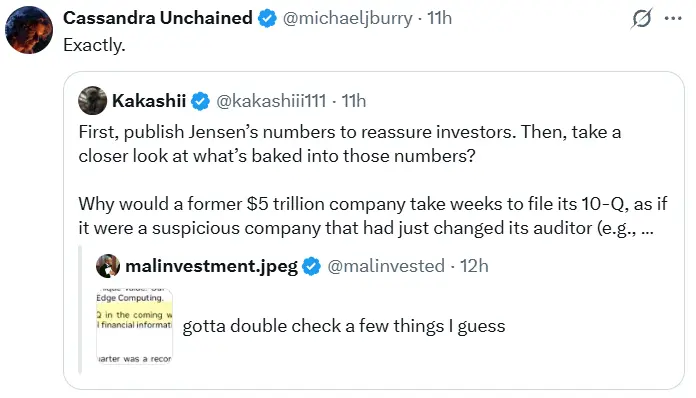
Ed Zitron, CEO of EZ Primary Research and AI critic, also called this move "strange." There was also a lot of discussion on the social trading platform Stocktwits, with some traders linking the delayed submission of the 10-Q to events such as SEC investigations, stock buybacks, and the CEO's departure.
Board Clearly Rejects Huang's Return, But Internal Divisions Emerge
This is NVIDIA's first quarterly report since CFO Colette Kress took over as interim CEO last week. Huang resigned due to a series of extramarital affair issues that were exposed.
Huang himself broke his silence on Tuesday, stating that if the board believes it is in the best interest of shareholders, employees, and the United States, he would be "honored" to return.
However, new board chairman Harvey C. Jones clearly stated during the analyst conference call that the board "has no intention of reinstating Huang as CEO" and declined to answer further questions on the matter. Kress later reiterated in an interview with CNBC: "The board has decided not to reinstate Huang's position; this is our statement and the board's decision. We should now focus on developing the business—creating value for employees, customers, and shareholders is our priority."
Nevertheless, Semafor cited anonymous insiders reporting that some members of the board are still pushing for Huang's return, and Huang has met with several tech executives and communicated with at least one board member about the possibility of his return.
Burry Doubles Down on Shorting, Betting on AI Hype Repeating the Internet Bubble
Notably, Burry's shorting strategy has quietly adjusted over the past few months. According to his October disclosure, his short positions have shifted from precise targeting of individual stocks like NVIDIA and Palantir to a more macro approach focused on index levels—primarily concentrated on put options for the VanEck Semiconductor ETF.
Burry previously wrote on his Substack, comparing the peak reached by the Nasdaq 100 index on October 6 this year to the top just before the internet bubble burst in March 2000, warning that the market has quietly reached its peak under the title "Witnessing the Bull Market Trap."
Burry disclosed that on November 12, as the index rebounded to 27,000 points, he doubled his position in put options for the Nasdaq 100 index, with an expiration date set for early 2027 and a current out-of-the-money margin of about 20%; he also re-established previously closed positions in put options for the VanEck Semiconductor Index. His core judgment is that chip stocks and the overall tech sector will face significant corrections by mid-2027, and Huang's sudden departure further reinforces his bearish logic.
While NVIDIA's earnings data is indeed strong, the delayed disclosure of the 10-Q, internal divisions regarding the CEO's future, and Burry's public questioning collectively constitute variables that cannot be ignored beyond this impressive performance.
 Risk warning
 Risk warning

Popular articles