Cryptocurrency welcomes a "Black Weekend," who pressed the sell button?
 Core Viewpoint


 This round of decline is not only a price correction but also a reshuffling of market narratives and capital logic.
Author: Nancy, PANews
The weekend market closure has subjected the cryptocurrency market to a new round of severe price and sentiment shocks.
In just two days, Bitcoin has consecutively lost key support levels, dropping from $69,000 on Saturday to a low of $62,000 this morning, erasing nearly all gains from the past three months. Panic sentiment in the market has spread rapidly, and selling pressure continues to intensify. The large-scale liquidations that have occurred further amplified the downward trend, severely impacting leveraged traders, and even many experienced market veterans are struggling to withstand this sudden shock.
This round of significant correction has left the entire cryptocurrency market feeling chilly. Since reaching a historical high of approximately $4.37 trillion in October 2025, the total market capitalization of global cryptocurrencies has shrunk by nearly half, with a cumulative evaporation of over $2.1 trillion. Currently, the cryptocurrency market is undergoing a severe pressure test.
The cryptocurrency market faces a rare sell-off, primarily driven by the U.S.
A new wave of selling has swept through the cryptocurrency market. Despite a temporary rebound in U.S. stocks, it has failed to reverse the ongoing downward trend of crypto assets.
According to CoinGecko data, Bitcoin briefly fell below $63,000 on the morning of November 15, with a low of $62,000 on OKX, down approximately 28.7% from the peak of $87,000 on September 8, with a weekly decline of 14.5%.
Notable trader Flood stated on November 15 that this is one of the most aggressive and price-agnostic BTC sell-offs he has ever seen. Observing such capital flows raises suspicions about whether large sellers possess certain information or if hidden leveraged positions are being forced to liquidate; he cautioned that in such situations, blindly placing buy orders without judgment can easily lead to being harvested.
Flood further listed several possibilities: whether sellers had advance knowledge of certain geopolitical events, with BTC being the most liquid trading target over the weekend; whether they had information regarding quantum computing; whether they were preemptively exiting before larger forced sellers; or whether the sell-off itself was due to liquidations. For the last scenario, Flood believes it may actually indicate an opportunity to place buy orders and absorb selling pressure. He also specifically pointed out that almost all sell-offs occurred on Coinbase and were mainly concentrated over the weekend.
As prices continue to decline, the market has not seen a strong rebound amid the deep correction, and investor confidence has plummeted. PANews' cryptocurrency market data and cycle indicators platform PAData shows that the cryptocurrency fear and greed index has fallen to 10, with the market trapped in the "extreme fear" range for several consecutive days.
David Lawant, research director at Anchorage Digital, also believes that the selling pressure on Bitcoin primarily comes from the U.S. The chart he shared shows that from November 9 to 14 UTC, the cumulative volume difference (CVD) for major BTC spot trading pairs on Coinbase dropped to about -8,900 BTC, indicating that the volume of active selling exceeded that of active buying by about 8,900 BTC, with the selling pressure most evident among the four trading platforms shown. In contrast, during the same period, the CVD for Binance and Bybit was approximately -3,100 and -700 BTC, respectively, while OKX was about 1,400 BTC.
The continued decline in Bitcoin has also increased the holding pressure on Strategy, the world's largest Bitcoin DAT company, which has now incurred an overall floating loss of over $10.7 billion.
In comparison, Ethereum's decline has been even more severe, with a drop significantly exceeding that of Bitcoin. The price of ETH has briefly fallen below $1,800, with a weekly decline of about 22.5%. In the global asset market capitalization rankings, Ethereum has dropped to 98th place, just $1.92 billion away from falling out of the top 100. The floating loss for BitMine, the world's largest Ethereum DAT company, has reached $9.65 billion, nearly half of its total holding cost.
The impact of this round of selling has rapidly shrunk the total market capitalization of the entire cryptocurrency market, with the scale of evaporation continuing to expand. According to CoinGecko data, as of November 15, the total market capitalization of global cryptocurrencies has fallen to $2.23 trillion, with a cumulative evaporation of over $55.4 billion in the past 10 days, making it one of the largest sell-off waves in history. Historically, only four periods have seen a continuous 10-day market capitalization shrinkage exceeding this round, occurring in May 2021, October and November 2025, and February 2026.
From macro tightening to ETF withdrawals, the cryptocurrency market faces multiple pressures
Behind this round of correction, multiple negative factors have continuously hit the cryptocurrency market, intensifying selling pressure.
· Rising expectations for Fed interest rate hikes, macro liquidity remains under pressure
The shift in the macro environment is weakening the appeal of risk assets. October's U.S. inflation data exceeded expectations, coupled with a strong performance in the job market, leading to a rapid increase in market expectations for the Fed to continue tightening monetary policy this year.
According to CME FedWatch data, as of November 10, the market's expectation probability for a 25 basis point rate hike by the Fed in December has risen to 88.5%, a significant increase from about 76.3% a week earlier. Meanwhile, the yield on the U.S. 10-year Treasury bond has risen to about 5.16%, and the strengthening dollar further suppresses the performance of risk assets.
The appeal of allocating to high-volatility assets like cryptocurrencies has also diminished. Bitcoin, as a risk asset that does not generate interest income, faces higher holding costs in a high-interest-rate environment, leading to a higher opportunity cost. When U.S. Treasuries can offer more attractive yields, some funds may shift towards fixed-income assets, thereby reducing the willingness to allocate to high-volatility assets.
· Continuous net outflows from ETFs, spot demand remains weak
ETFs have long been an important engine for institutional funds flowing into the cryptocurrency market, but the tide has turned, becoming a significant source of ongoing market blood loss.
According to SoSoValue data, U.S. spot Bitcoin ETFs have recorded net outflows for three consecutive weeks, with a cumulative scale exceeding $2.55 billion, and over $1.07 billion in net outflows just last week. Among these, BlackRock's IBIT is the main source of outflows, with a net outflow of $2.12 billion since November, accounting for about 90.2% of the total net outflow from U.S. spot Bitcoin ETFs during the same period.
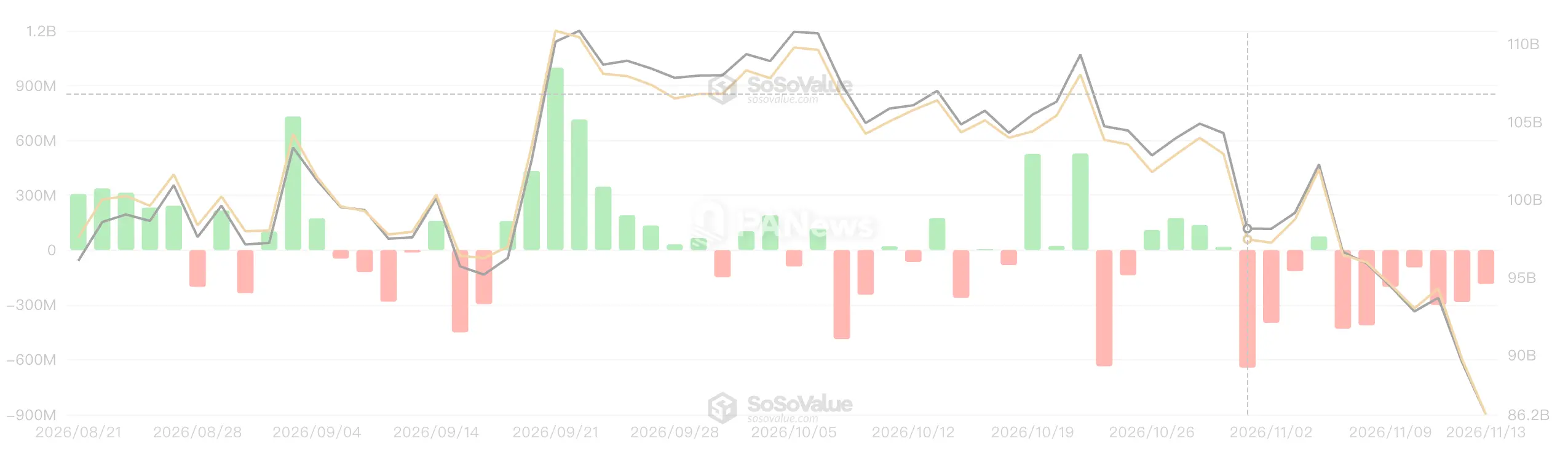
The outflow situation for Ethereum spot ETFs is even more severe. Since its launch in July 2024, it is currently experiencing the most serious phase of capital outflow, having recorded net outflows for seven consecutive weeks, with a cumulative outflow exceeding $2.41 billion, surpassing both the outflow scale and duration of Bitcoin ETFs. Notably, the net outflow in October alone reached $1.61 billion, setting a historical record, with BlackRock's ETHA also being a major outflow channel.
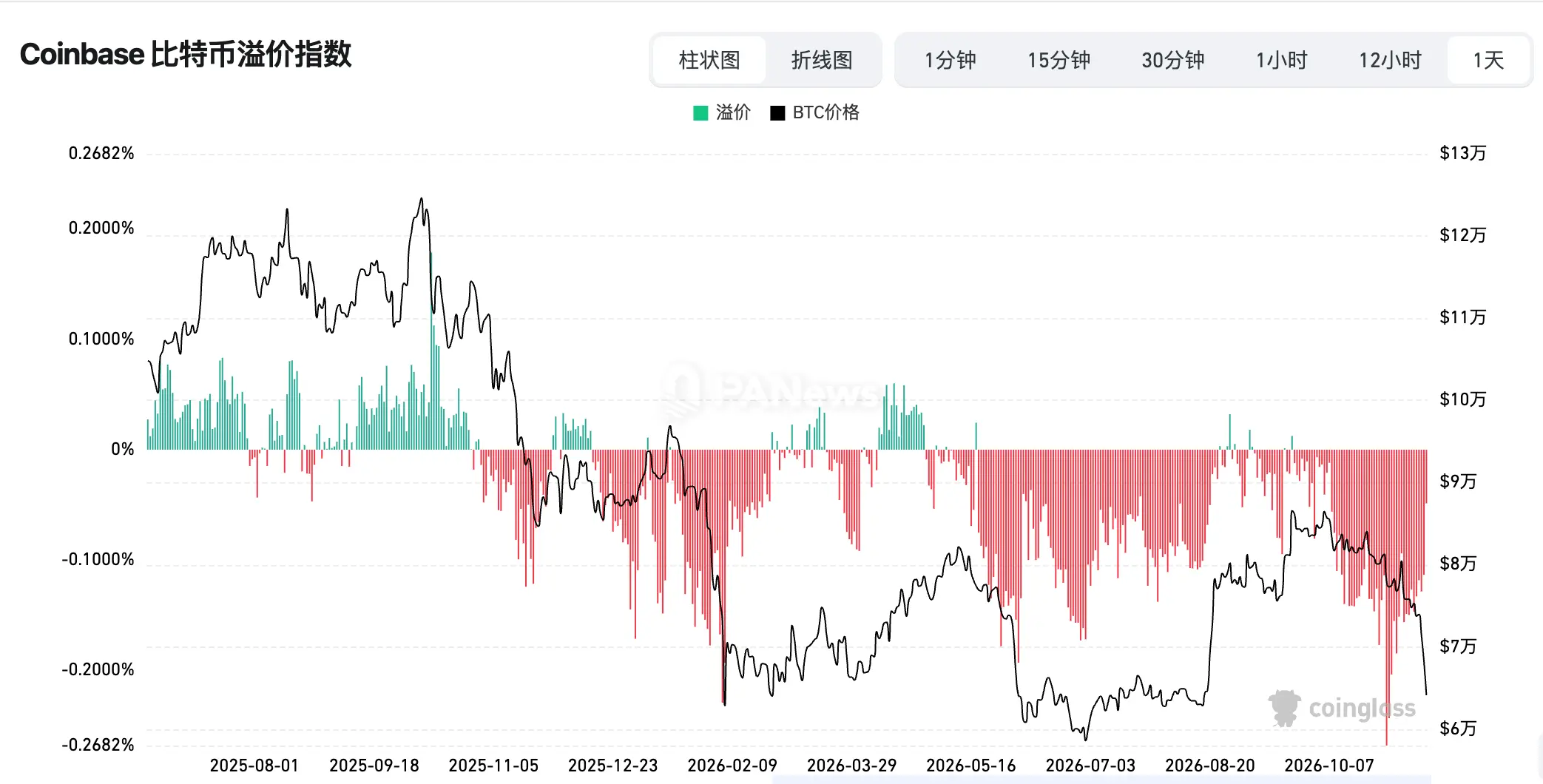
Moreover, the willingness to buy in the U.S. spot market is also insufficient. CoinGlass data shows that the Coinbase Bitcoin premium index has remained in negative territory for 53 consecutive days, with the latest reading at -0.07%, reflecting the ongoing weakness in buying demand in the U.S. market. It is worth noting that this index had previously turned positive for the first time since May 19 on August 24, reporting 0.0052%, ending a continuous 97-day negative premium state.
· Turmoil in Nvidia's leadership impacts tech stocks, risk appetite further cools
On November 12, Nvidia announced that founder Jensen Huang resigned as CEO and director of the company, ending a 33-year leadership tenure since founding the company in 1993. The company's CFO Colette Kress has taken over as interim CEO, and the board has initiated the process of selecting a new CEO.
As a core enterprise in the global AI supply chain, the leadership change at Nvidia has quickly attracted market attention. Huang has long dominated the company's strategic direction and business development, and his departure not only brings new uncertainties to Nvidia's future operations but also prompts investors to reassess the growth prospects, valuation levels, and financing models of the AI industry. Against the backdrop of already pressured AI tech stocks, this news further exacerbated market volatility.
At the same time, Anthropic has submitted its IPO prospectus and plans to advance its listing process. The IPOs of large tech companies typically attract market funds and investor attention, and in the current environment of weakened risk appetite, some investors are prompted to readjust their positions to reserve funds for potential IPO subscriptions.
· U.S. midterm elections change congressional dynamics, crypto regulation faces uncertainty
The changes in the policy environment add another layer of uncertainty to the cryptocurrency market. After the U.S. midterm elections, the Democratic Party won control of both the House and Senate, ending the previous situation where the Republican Party simultaneously controlled both chambers of Congress.
It is well known that the Trump administration's relatively supportive policy orientation towards the development of the cryptocurrency industry provided a certain degree of optimistic expectations for the market. However, with the shift in congressional control, the Democratic Party will regain control over the agenda-setting and oversight of key committees, thereby influencing the review and advancement of important legislation such as the cryptocurrency market structure bill. In particular, the leadership of key institutions like the Senate Banking Committee may change, prompting the market to reassess the future direction of U.S. cryptocurrency regulatory policies.
It should be noted that the change in the U.S. congressional landscape does not necessarily mean that U.S. cryptocurrency policies will inevitably shift towards comprehensive tightening, but the uncertainty in policy advancement has already become one of the factors affecting market sentiment.
· Key support levels consecutively lost, leveraged liquidations further amplify the downward trend
The market decline has not stopped at spot sell-offs; the concentrated liquidation of leveraged positions has further accelerated the downward trend. Especially during weekend trading hours, market liquidity is relatively thin, making large sell orders more likely to trigger severe price fluctuations.
After Bitcoin consecutively broke through important support levels, a large number of high-leverage long positions faced forced liquidation. The selling pressure triggered by liquidations further suppressed prices and triggered more positions to be liquidated, creating a chain reaction that accelerated the market decline.
CoinGlass data shows that in the past 24 hours, the total liquidation across the network reached $2.024 billion, with over 318,000 people liquidated. Among these, long positions accounted for $1.753 billion in liquidations, while short positions accounted for $271 million, with longs being the main victims of this round of liquidations.
It can be said that this round of decline is not only a price pullback but also a reshuffling of market narratives and capital logic. When the cryptocurrency market will stabilize and whether it can regain an upward trend remains to be observed. However, for the market, the greater test right now may be how to regain buying support and investor confidence.
 Risk warning Risk warning





Popular articles