Cryptocurrency card spending surges, but users are unwilling to spend money: The bustling surface hides a profit deadlock
 Core Viewpoint


 The consumption of crypto cards is growing rapidly, but 86% of the spending in the past 30 days is concentrated on the top five projects. After recharging, users spend an average of only $0.65–$0.75, treating the new banks more as savings gateways. Cashback often erodes profits, while long-term advantages lie in converting cryptocurrencies to local currencies, multi-currency settlements, as well as issuing stablecoins, lending, and high-profit functions like perpetual trading.
Author: DWF Ventures
Compiled by: Gu Yu, ChainCatcher
Key Points:
The growth of crypto card spending is rapid but concentrated in a few projects. In the 20 largest projects, the top 5 account for 86% of spending in the past 30 days.
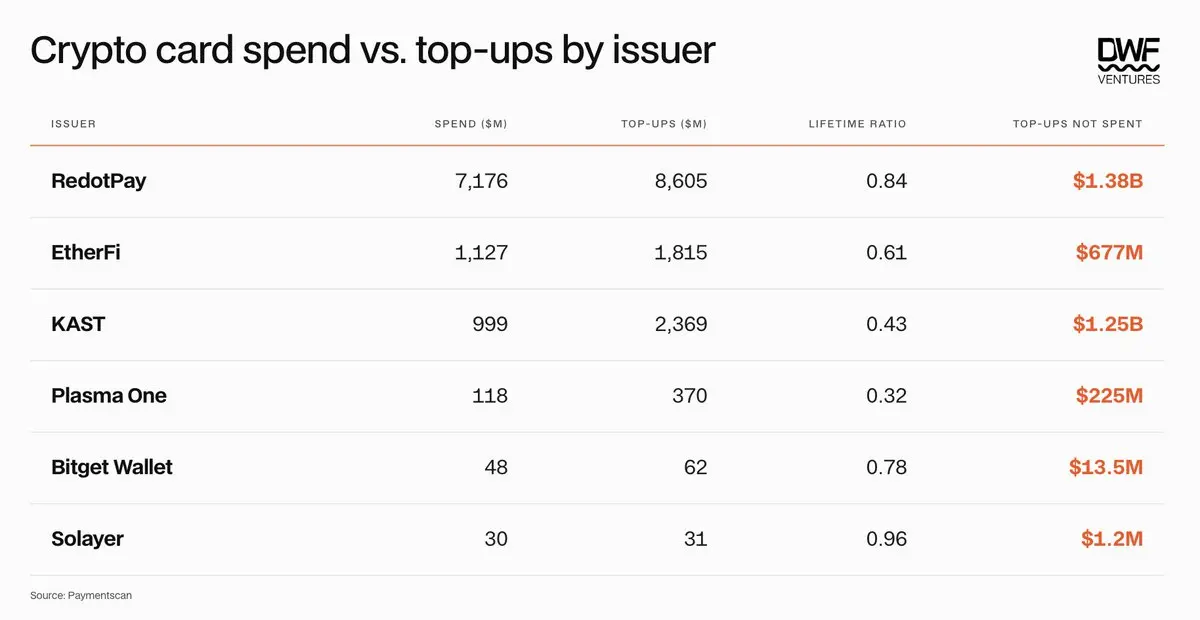
Beyond spending, users are increasingly viewing neobanks as a way to grow their savings. On average, for every $1 recharged, only $0.65 to $0.75 is spent.
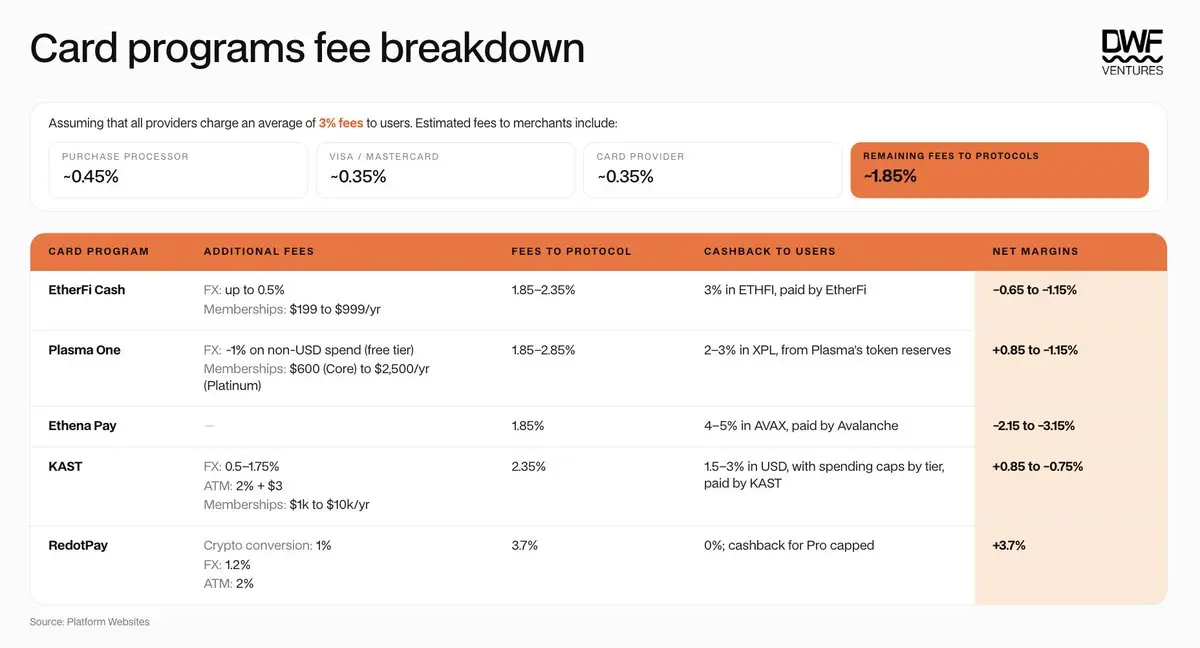
Cashback often comes at the expense of the card project's costs. Long-term moats can only be established by enabling non-commoditized features, such as strong local payment rails and multi-currency settlements.
On-chain capabilities allow neobanks to experiment and become super applications for storing, growing, and connecting funds. Growth bets include operating stablecoins to retain balance interest, lending through Aave or Morpho, and trading features like perpetual contracts.
Stablecoins have reached their moment in the spotlight: they transfer funds globally at low cost and high efficiency, with far fewer intermediaries than traditional banks. Traditional banks are hampered by legacy infrastructure and multi-day settlements, making it difficult to compete.
The emergence of neobanks aims to fix the inefficiencies of traditional banks. The first wave of neobanks, such as Revolut and Nubank, won tens of millions of customers with cheaper cross-border payments, faster transfers, and mobile-first designs. However, they still operate on the same settlement rails as banks and are slowed down by the need for licenses in each market, affecting every expansion.
Stablecoin neobanks represent the next iteration. They settle on stablecoin rails and utilize payment infrastructure from providers like Bridge and Rain, allowing them to launch in dozens of markets from day one. They also target the most underserved users of banking services: cross-border earners, small and medium enterprises, and populations in economies where acquiring US dollars is scarce. They can also offer on-chain yields and self-custody options, which are difficult for fiat neobanks to match easily.
This report examines who is leading in this space, analyzes the different components of the tech stack, and explores new products that could change the market landscape.
Market Status
The sector is still relatively small but growing rapidly, with crypto card spending now exceeding $300 million weekly, a year-on-year increase of nearly 200%. Despite a steady increase in the number of crypto neobanks, over 86% of spending is still concentrated in the top 5 card projects. The leading project, RedotPay, alone accounts for over 46% of transaction volume.
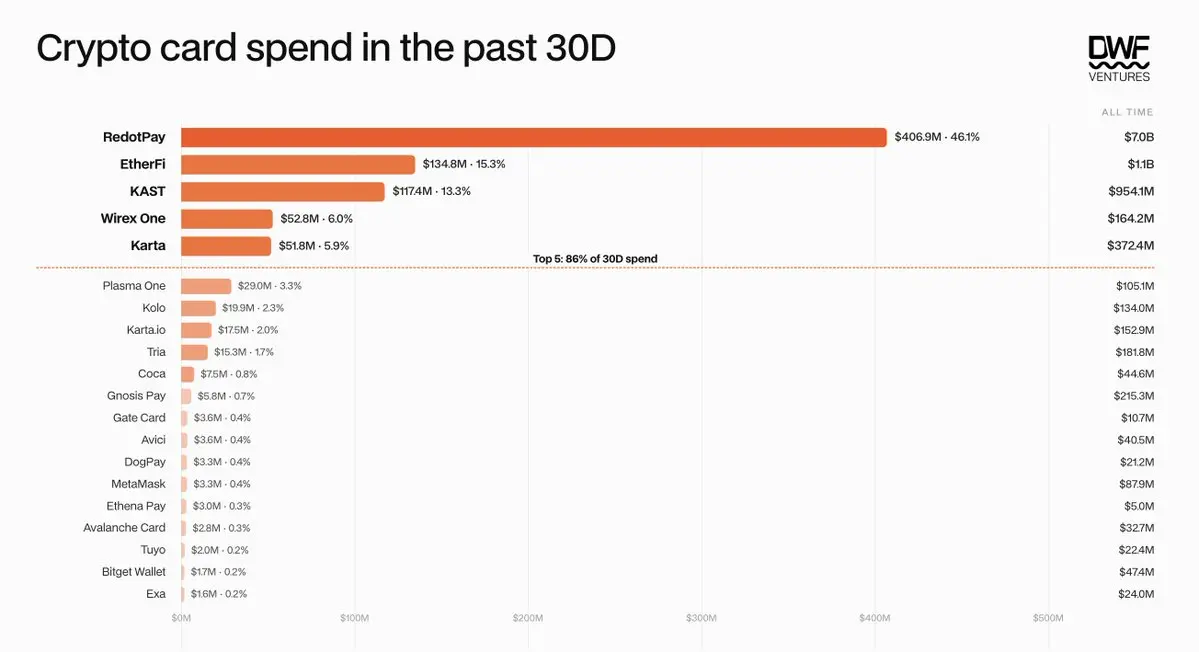
Source: PaymentScan
Note: Data is based on information available on PaymentScan. Metrics for some other card projects are not publicly disclosed.
This concentration indicates that users value more than just functionality when choosing projects. Trust in the issuer, brand, and early distribution are equally important. Leaders are built for everyday spending and are strongest in emerging markets in the Asia-Pacific and Latin America where demand for US dollars is high. Users are also increasingly viewing these applications as places to hold savings and earn yields. On average, for every $1 recharged, only $0.65 to $0.75 is spent. Projects with lower user spending ratios, such as EtherFi and KAST, offer 7% to 9% APY on US dollar stablecoin deposits. This is far higher than what traditional banks pay. This indicates that yields, like crypto spending, are a major attraction.
The infrastructure behind these neobanks has largely been commoditized. A few card issuers, such as Rain, support many of the leading projects. Therefore, these card projects primarily compete on distribution and functionality. Cashback and yields are now widely offered, while converting cryptocurrency to local currency and non-USD balances remains rare. Most card spending is also settled in USD, so users spending in other currencies face foreign exchange fees of 0.5% to 2%, which can offset much of their cashback. Thus, we believe localization and multi-currency settlements are the clearest areas for growth.
What Makes Neobanks Profitable?
Today, card project revenues come from three sources: interchange fees from card spending, foreign exchange/crypto conversion fees, and fees for converting cryptocurrency to local currency. Profitability remains uncertain. This is because a large portion of the revenue is returned to users in the form of cashback, which essentially acts as customer acquisition cost (CAC). After deducting cashback, most projects earn less than 1% of card spending, and may pay up to 2-3% for every dollar spent. Cashback has limits, which helps to contain customer acquisition costs, but clearly incentivizing growth remains crucial, potentially at the expense of profitability. This report from Blockworks covers the actual cashback amount paid for every dollar spent on card projects, most of which remain negative.
RedotPay is an exception, competing on coverage rather than rewards. It holds licenses in Hong Kong, the US, Canada, and Argentina, and supports payments in over 35 currencies through local partners. It provides a cheaper and viable alternative to traditional remittances in regions like Africa and Latin America, allowing it to capture market share despite higher fees.
As card functionalities are now widely available, neobanks are turning their attention to other areas like savings and investments. Building on-chain enables experimentation with new revenue sources, some of which can be shared with users. Examples include:
Issuing proprietary stablecoins: Card projects earn interest on users' idle balances instead of letting them flow to providers like Circle or Tether. KAST issues its own stablecoin through M0, while EtherFi has launched ether.fi USD through Ethena. EtherFi users hold about 48 million dollars in idle user deposits, which at a 4% yield could generate about 2 million dollars annually.
Lending: Users can borrow against assets held in-app, using third-party protocols like Aave and Morpho, rather than the neobank's own balance sheet. ether.fi Cash operates its credit business on the Aave V4 instance, with loans exceeding 47 million dollars.
Perpetual contracts: This is a newer experiment aimed at on-chain users and is part of the push to become a super application. Phantom has integrated perpetual contract trading within its wallet through Hyperliquid, earning over 20 million dollars in builder fees since its launch. Combined with its card product, this brings Phantom closer to being a super application where users can spend, save, and trade in one place.
Maintaining Growth
Returning to user demand, it can be broken down into three main categories: savings, yields, and connectivity.
Savings are the easiest feature to offer but the hardest to win, as it relies on trust. Trust is built slowly through licensing, regulatory protections, and a proven track record over a considerable time span. Once trust is earned, it becomes the foundation for growth, especially in countries with weak local currencies, where the demand to hold savings in USD is a clear upgrade over local alternatives.
Yields are the next battleground. As yields become standardized, users will flock to providers that offer both attractive and sustainable returns. The advantage will belong to those with their own sources of yield. Ethena Pay is an early example: deposits earn yields from Ethena's own strategies, and every dollar deposited increases demand for USDe, bringing more revenue to the protocol. This flywheel allows yields to expand with the user base rather than renting from third parties. The type of yield is also important, as USD yields have more intrinsic value than token yields, which have lower appeal to a broad user base.
Connectivity is where most neobanks currently fall short, namely enabling users to convert cryptocurrency to local currency and access the accounts they actually use. Establishing a moat here is strong, as few competitors have comprehensive local withdrawal paths, and catching up takes a long time.
What’s Next for the Market?
It is clear that merely spending cryptocurrency and earning cashback is no longer enough to stand out from the crowd. The next step is higher-margin products, with each application becoming a super application for users to manage, grow, and invest their funds. Features like multi-currency settlements and access to local payment rails are difficult to provide, but that is precisely how an application can win in specific regions. Building these takes time, but neobanks that can scale this effectively will reap the greatest rewards.
ChainCatcher reminds readers to view blockchain rationally, enhance risk awareness, and be cautious of various virtual token issuances and speculations. All content on this site is solely market information or related party opinions, and does not constitute any form of investment advice. If you find sensitive information in the content, please click , and we will handle it promptly.





Popular articles