Goldman Sachs trader: The market is waiting for "Warren's market rescue"
 Core Viewpoint


 Goldman Sachs stated that the first two paths to the bottom (liquidation of positions, clear prospects for profits and monetization) have basically been exhausted, and macro policies have become the last hope. However, Wosh clearly stated that tightening financial conditions "is precisely the sign that the policy is taking effect." Analysts warned: if Wosh does not define the "bottom line for market rescue," the market will seek it out itself — the ghost of December 2018 is reappearing.
Author: Dong Jing, Wall Street Insight
Goldman Sachs' macro strategy team pointed out in their latest report that the market is "looking for an anchor." The three major supports previously seen as sufficient to halt the decline—significant valuation downgrades, hedge fund deleveraging, and strong earnings growth—have all been in place, yet they have still failed to support the market. Investors are eagerly searching for macro-level support, known as the "Warsh Put."
Goldman Sachs macro strategists Cosimo Codacci-Pisanelli and Rikin Shah wrote in the latest "Macro Roadmap" report released before the half-day trading on Friday (November 27) that the decline that began in October was initially explained as a position and technical adjustment, a "healthy pullback" before the midterm elections, but has now evolved into a deeper debate about AI trading. The forward price-to-earnings ratio of the S&P 500 has been downgraded by 25% this year to 16 times, with earnings per share in the third quarter growing by more than 30% year-on-year. The growth backdrop is solid, and seasonal factors at the end of the year are also somewhat favorable, but these supports "still exist, just not sufficiently."
The adjustment of market structure shows obvious differentiation and competition. The Wall Street Insight article stated that Tony Pasquariello, head of Goldman Sachs' global hedge fund business, described it as "one of the largest liquidations of his career." Despite hedge funds' net leverage dropping to a multi-year low and their net exposure to AI stocks significantly decreasing, retail funds continue to flow in, with $150 billion flowing into U.S. stock funds over the past month, leading to an overall market position that has not been thoroughly washed out.
Goldman Sachs' macro strategy team summarized the current situation as "micro driving macro," and listed three paths to the bottom: position clearing, clarity on earnings and monetization prospects, and macro policy support. The first two have basically been exhausted, prompting the market to turn its attention to the Federal Reserve, waiting for Fed Chair Warsh to provide a "market rescue signal." However, the recent significant tightening of financial conditions has not only failed to raise concerns at the Fed but is seen as a sign of policy effectiveness, causing the market to be filled with anxiety and uncertainty ahead of the upcoming December interest rate meeting.
Three Paths to Finding the Market Bottom
Goldman Sachs listed three potential factors that could support the market in finding a bottom: position clearing, increased confidence in earnings and monetization, and macro support (a dovish Federal Reserve). Scoring each item, the results can at best be described as mixed.
In terms of positions, the market structure "is indeed cleaner": hedge fund net leverage is at its lowest since April 2025, the net exposure of prime brokers to AI stocks is at its lowest since September 2025, and AI shorts are at multi-year highs. However, Goldman pointed out that broader positions are far from cleared—$150 billion flowed into U.S. stock funds over the past month, and futures positions remain at the 82nd percentile. This is precisely the differentiation mentioned by Goldman’s Lee Coppersmith in "Panic Without Clearing": professional funds are selling, while slow money continues to buy.
Regarding earnings, key questions remain unanswered: export controls, licensing approvals, capital expenditure returns, token trends, financing under higher capital costs, and the sustainability of earnings after capital expenditure growth peaks. Goldman believes that clear answers and the resulting visibility on earnings for 2028 "are unlikely to appear in the short term, which widens the distribution range." Their scenario matrix extends from a bearish scenario of 5,800 points (with trend earnings per share of $340 and a 30-year average P/E ratio of 17 times) to a bullish scenario of 8,100 points, with the current scenario range being 6,800 to 7,300 points.
The $300 Billion Question
The core of the market's doubts about AI trading lies in whether massive capital expenditures can be converted into actual revenue. Goldman’s framework provides the numbers:
Hyperscale cloud providers need about $300 billion in annualized AI revenue to break even on capital expenditures from 2026 to 2027.
To achieve a 15% return on invested capital, they need approximately $1.42 trillion in cumulative revenue from 2028 to 2030 (about $11.6 billion per gigawatt).
This again requires about $1 trillion in annual AI application end-user spending.
As the AI boom has pushed S&P 500 earnings 25% above trend levels, earnings in 2028 "depend on a chain": AI revenue from hyperscale providers comes from application layer revenue, and application layer revenue comes from enterprise adoption. Goldman provides four tracking indicators.
First, cloud revenue and order backlog: The three major cloud providers saw their cloud business growth accelerate to a year-on-year increase of 54% in the third quarter, with order backlog nearing $1.8 trillion. The focus of debate is on the speed at which contracted demand converts to revenue.
Second, U.S. enterprise adoption rates, which are not very optimistic: 68% of S&P 500 companies mentioned AI in their third-quarter earnings calls, but only 13% provided specific impact numbers for a particular use case, and only 3% provided impacts on earnings. "Bridging this gap is the signal for 2028."
Third, AI SaaS monetization: Products like Copilot and model companies currently make up the majority of the application layer's annual recurring revenue. Epoch AI's summary shows that Anthropic surpassed OpenAI earlier this year, with the two combined generating annualized revenue of about $100 billion. This is about one-third of the number needed for hyperscale providers to break even, while the market "has begun to punish existing firms whose AI revenue cannot offset declines in core business."
Fourth, token usage: Usage growth must outpace token price deflation. Ramp (around 85,000 companies primarily small and medium-sized) and OpenRouter (leaning towards open source) are "useful parts of the puzzle, but not the whole picture."
The question lies in timing: "Capital expenditures are happening now, but it will take time to be sure that investments can yield returns… The question is how patient the market will be with these indicators next year." Over the past eight weeks, the answer has been "not very patient."
Only the Third Path Remains: Waiting for "Warsh to Rescue the Market"
In the absence of micro catalysts, macro policy has become the last hope. As Goldman Sachs stated, only the third path remains:
"With micro catalysts fading and positions and prices themselves insufficient to provide support, macro may need to play a role."
Goldman Sachs' U.S. Financial Conditions Index is currently about 95 basis points tighter than its low point in early September, with about 50 basis points occurring after the October FOMC meeting. Goldman’s chief U.S. economist David Mericle quantified this in a report on Wednesday, with the macro team reaching the same conclusion: this is the tightening the Fed wants.
Warsh stated in October: "The main way this policy is being implemented is that we are tightening financial conditions… This is not something we are uncomfortable with. It tells me that the policy is working."
Breaking it down, since the October meeting, the tightening has been driven by stocks (+42 basis points), not interest rates (long-term rates -9 basis points). The data has not provided the FOMC committee with reasons to back off: two consecutive broad core inflation data, resilient growth, a robust labor market, and Fed officials generally leaning hawkish, with meeting minutes showing that almost all members believe further rate hikes are necessary.
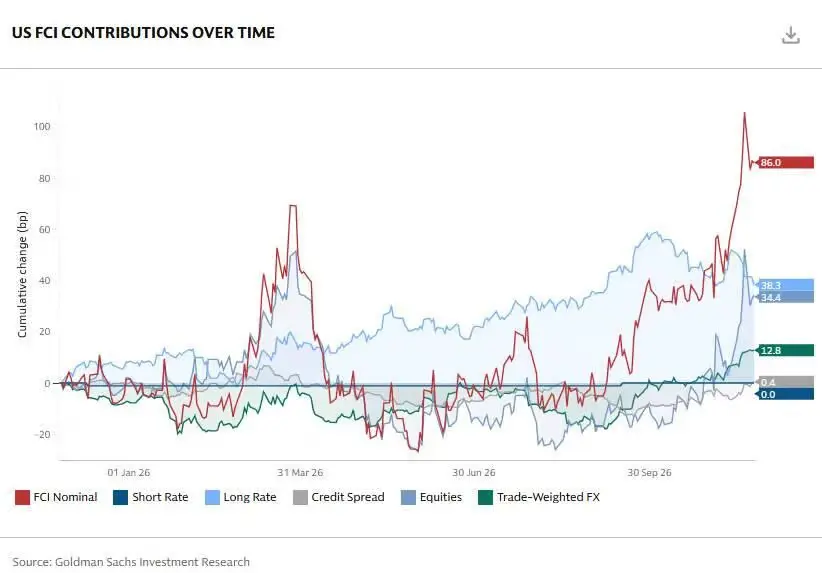
The rule of thumb suggests that a 100 basis point tightening of financial conditions would lower growth by about 1 percentage point over the next year, but Goldman estimates that if this trend continues, the drag on growth in 2027 would be only about 0.5 percentage points, which Mericle states is "roughly in line with the 75 to 100 basis points hike that most FOMC members might hope to implement."
In other words, the market has done the Fed's work for it, and the Fed is grateful for that.
The Ghosts of December 2015 and 2018
So what would make the Fed pivot? Goldman sees two paths: one is that tightening becomes "disproportionate," more aggressively depressing forward growth ("if the stock market pullback continues, this is a real risk"); the other is a change in the inflation outlook. The timing of the latter is quite awkward—November CPI will be released on December 10, the day after the FOMC meeting, and the committee will enter the meeting in a "blind flying" state.
Thus, a significant pivot on December 9 seems unlikely, but the tone of rate hikes is very important. Goldman macro strategists cited two traders' memories of past lessons: in December 2015 and December 2018, both Yellen and Powell did not show sensitivity to the then-current credit spreads and stock market volatility when raising rates, leading to financial conditions tightening by about 75 basis points and 35 basis points, respectively, within weeks, forcing the Fed to pivot early the following year. Given the low confidence in Warsh's reaction function, it is reasonable for the market to feel nervous before the meeting.
But this time the situation is worse: inflation was lower in 2015 and 2018, and the Fed was only normalizing; now inflation is high, and the Fed is tightening to curb inflation, which means "there is lower confidence in the position of the Fed's put option." The report stated: "The data suggests we are some distance from the strike point, but it would help for the market to have a rough idea of where the Fed's put option lies. If Warsh does not define it, the market may seek it out on its own."
Bonds Reemerge as a Hedging Tool
In the face of extremely pessimistic market sentiment and high stock market volatility, Goldman proposed a clear trading strategy in the report: increase long-duration positions. As the correlation between stocks and bonds has shifted from deep negative values earlier in the year back to positive, bonds have once again played a hedging role. Against the backdrop of a 6% drop in the S&P 500 index, the yield on 5-year U.S. Treasuries has fallen by more than 40 basis points.
Goldman pointed out that given that the 5-year U.S. Treasury yield is currently in the highest decile range since 2000, and the base effect of inflation will turn favorable in 2027, the risk of U.S. interest rates is tilted downward. Despite headwinds such as fiscal expansion and AI-related credit supply, as risk-adjusted stock returns turn negative, the rationale for increasing 5-year duration allocation in portfolios is strengthening. As Goldman warned, the AI boom is built on debt, and when the stock story wobbles, volatility in the credit market won't be far behind.
The report's conclusion is refreshingly straightforward:
"This remains an extremely difficult trading environment. The core is the terminal value of AI. The distribution of outcomes remains wide and may continue to do so, as it will take another 12 months to clarify the income needed to justify capital expenditures… We are not yet at the position of the Fed's put option, but having a rough idea of where it is would be helpful. Sentiment is absolutely key, and current sentiment could hardly be worse."
ChainCatcher reminds readers to view blockchain rationally, enhance risk awareness, and be cautious of various virtual token issuances and speculations. All content on this site is solely market information or related party opinions, and does not constitute any form of investment advice. If you find sensitive information in the content, please click , and we will handle it promptly.


Popular articles