BTC $81,224.53 -3.79%
ETH $2,381.55 -4.09%
BNB $730.60 -2.42%
XRP $1.31 -4.86%
SOL $103.20 -3.94%
TRX $0.3277 -0.96%
DOGE $0.0786 -4.33%
ADA $0.2115 -6.58%
BCH $274.16 -4.72%
LINK $11.91 -5.24%
HYPE $77.11 -4.92%
AAVE $146.43 -6.02%
SUI $0.9724 -5.93%
XLM $0.1749 -5.04%
ZEC $1,208.58 -9.90%
AAPL $348.72 +1.37%
AMZN $251.52 -3.91%
GOOGL $325.08 -2.82%
MSFT $521.73 -1.86%
META $647.34 -9.09%
NVDA $213.19 -3.46%
TSLA $373.93 -0.37%
SNDK $1,234.30 -9.26%
INTC $85.23 -6.94%
SPCX $147.44 -5.93%
MU $847.19 -6.45%
AMD $508.42 -6.97%

ecdsa

All
Article
Flash

Vitalik Buterin: AI may weaken cryptography within two years and put ECDSA at risk, suggesting a priority on hash cryptography

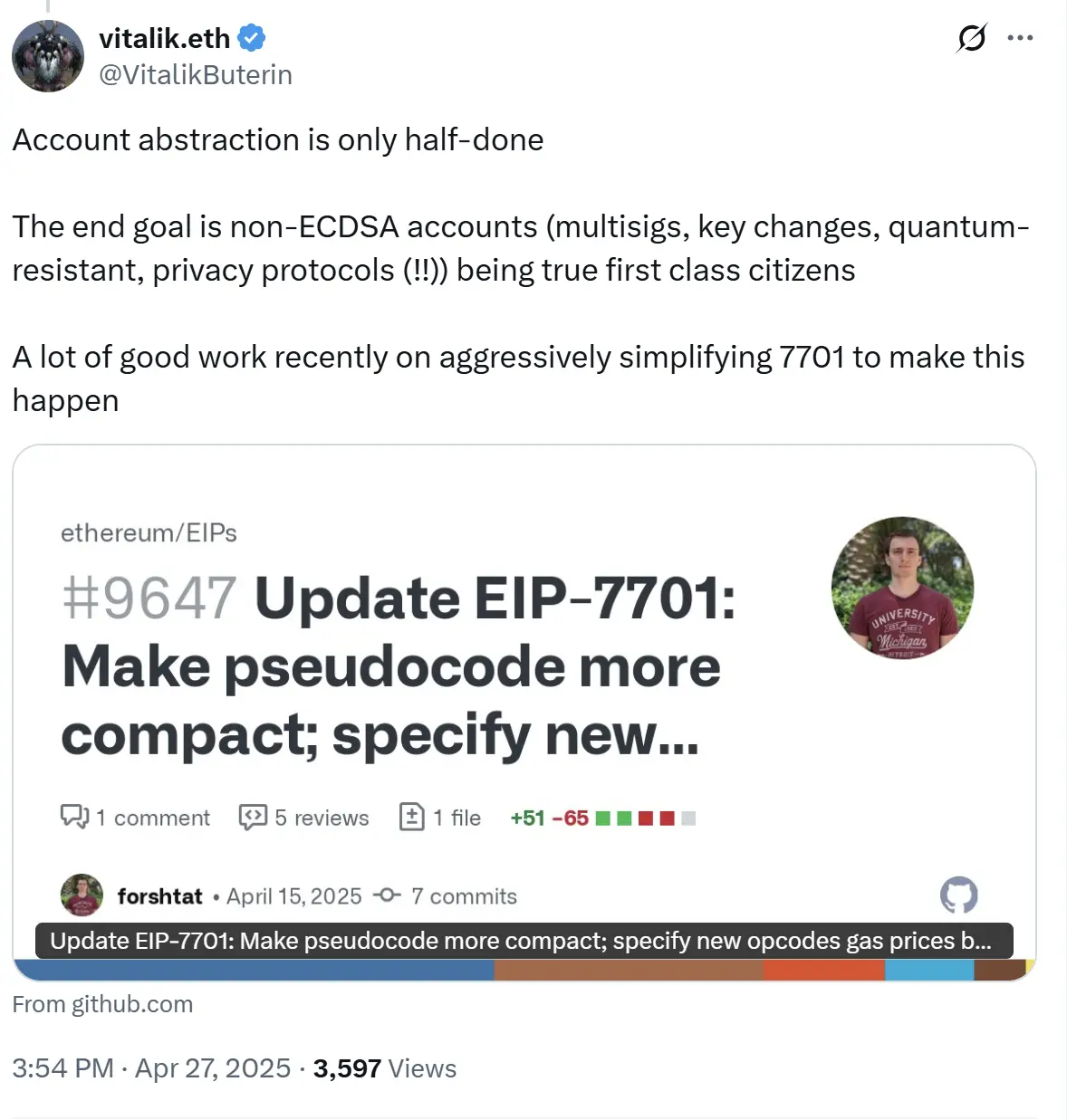
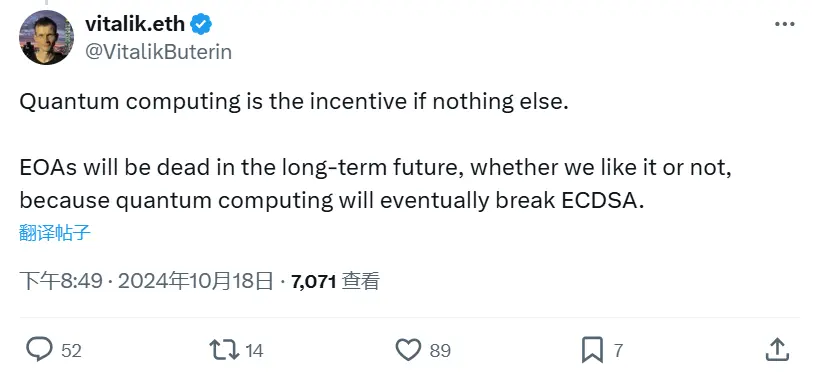
Ethereum co-founder Vitalik Buterin posted on the X platform, stating that AI-accelerated mathematical research may pose new security threats to existing cryptographic systems, especially lattice-based cryptographic schemes, including ML-DSA and fully homomorphic encryption (FHE). He believes that advancements in AI in the field of mathematics over the next two years could significantly undermine the practical security of lattice cryptography, and ECDSA may face the risk of being compromised sooner than expected.Vitalik pointed out that over the past year, the Ethereum Lean roadmap has gradually shifted towards pure hash cryptographic schemes, avoiding the use of lattice-based signatures and related zero-knowledge proof structures. He suggested prioritizing the use of hash cryptography whenever feasible and adopting more conservative security parameters for lattice cryptography; privacy protocols should avoid storing encrypted information directly on-chain, and multi-signature wallets should prioritize off-chain signature confirmations. Additionally, Vitalik advised users, when operationally convenient, to store funds in addresses that have not initiated transactions to reduce potential risks, but he does not recommend users immediately migrate assets on a large scale. He emphasized that the migration process itself also carries risks, and his own losses due to migration errors have even exceeded the losses from past hacking attacks.

Jim Cramer said he will liquidate his Bitcoin holdings, concerned about the threat of quantum computing to its security

Former hedge fund manager and CNBC host Jim Cramer stated that due to concerns about quantum computing threatening Bitcoin's security, he plans to sell all of his BTC holdings. His statement stems from an interview with IBM Chairman and CEO Arvind Krishna, who said that investors should be wary of the challenges quantum computing may pose to modern cryptography in the next 3 to 4 years. Cramer believes that quantum computing could threaten the Bitcoin network in a similar timeframe. However, no one has independently confirmed how much BTC he holds or whether he has completed the sale.After his statement, Bitcoin continued to trade normally around $63,764, with some market participants viewing his comments as a "reverse Cramer" signal. Bitcoin uses the ECDSA signature mechanism based on the secp256k1 curve, and theoretically, a sufficiently powerful quantum computer could use Shor's algorithm to derive the private key from the public key. The risk is mainly concentrated on addresses with exposed public keys, including reused addresses, early wallet formats, and the brief time window after a transaction is broadcast but not yet confirmed. Researchers estimate that about 6 to 7 million BTC, accounting for approximately 30% of the supply, may fall into this category. Google Quantum AI estimated in March this year that breaking the relevant cryptographic mechanisms could require fewer than 500,000 physical qubits, reducing the previous estimate by about 20 times. However, current quantum systems typically only have hundreds to thousands of physical qubits, with even fewer logical qubits that have higher reliability. Most researchers expect that truly capable quantum computers for cryptographic breaking may not appear until the 2030s or even 2040s, making Cramer's 3-year prediction significantly earlier than most technological expectations.
app_icon
ChainCatcher Building the Web3 world with innovations.