Scan to download
BTC $70,604.78 +1.83%
ETH $2,047.49 +0.97%
BNB $645.59 +1.23%
XRP $1.42 -4.56%
SOL $81.67 -4.53%
TRX $0.2795 -0.47%
DOGE $0.0974 -3.83%
ADA $0.2735 -4.22%
BCH $447.87 -0.35%
LINK $8.64 -2.97%
HYPE $28.98 -1.81%
AAVE $122.61 -3.42%
SUI $0.9138 -6.63%
XLM $0.1605 -4.62%
ZEC $260.31 -8.86%
BTC $70,604.78 +1.83%
ETH $2,047.49 +0.97%
BNB $645.59 +1.23%
XRP $1.42 -4.56%
SOL $81.67 -4.53%
TRX $0.2795 -0.47%
DOGE $0.0974 -3.83%
ADA $0.2735 -4.22%
BCH $447.87 -0.35%
LINK $8.64 -2.97%
HYPE $28.98 -1.81%
AAVE $122.61 -3.42%
SUI $0.9138 -6.63%
XLM $0.1605 -4.62%
ZEC $260.31 -8.86%

fdi

The FDIC proposed to establish rules related to the stablecoin application framework to advance the implementation of the GENIUS Act

According to The Block, the Federal Deposit Insurance Corporation (FDIC) is moving forward with implementing parts of the stablecoin legislation that became law this summer.On Tuesday, the FDIC board approved a proposed rulemaking notice that sets an application process for institutions to issue payment stablecoins through subsidiaries. The agency is soliciting public comments on this proposed rule. During the board meeting, FDIC legal counsel Nicholas Simons stated that the application must clearly outline the scope of the proposed activities, provide a description of the "subsidiary ownership and control structure," and include "a letter of engagement with a registered public accounting firm." Simons said, "In summary, the proposed rule will enable the FDIC to assess the safety and soundness of the proposed payment stablecoin activities while minimizing the regulatory burden on applicants."This summer, President Trump signed the GENIUS Act, which created a federal regulatory framework for stablecoins. Earlier this month, FDIC Acting Chair Travis Hill informed lawmakers that the agency plans to release the implementation framework for the GENIUS Act in the coming weeks. On Tuesday, he also stated that the agency plans to issue a proposed rule in the coming months to establish capital, liquidity, and risk management requirements for approved subsidiary stablecoin issuers.

The Federal Reserve and the FDIC will advance the implementation of the GENIUS Act, with the first set of regulatory rules for stablecoin issuers expected to be announced in December

The acting chairman of the Federal Deposit Insurance Corporation (FDIC), Travis Hill, stated in testimony submitted to the House Financial Services Committee that the FDIC expects to launch its first set of regulatory proposals for stablecoin issuers to implement the "Generating Environments Needed for Innovation in US Stablecoins Act" (GENIUS Act). The initial rules will clarify the process for stablecoin issuers to apply for federal regulation, followed by the release of prudential requirements for FDIC-regulated payment stablecoin issuers early next year, including capital standards, liquidity requirements, and reserve asset quality supervision.The FDIC, along with the Treasury Department and other agencies, is advancing relevant regulatory responsibilities under the GENIUS Act. The rules will undergo a public comment phase and will only take effect after review. Hill also mentioned that the FDIC is developing further guidance on the regulatory status of "tokenized deposits" based on recommendations from the President's Working Group on Digital Assets. It is reported that this hearing will also hear testimonies from other financial regulatory agencies, including the Federal Reserve. Federal Reserve Vice Chair Michelle Bowman also stated that the Fed is developing a regulatory framework for stablecoin issuers regarding capital, liquidity, and risk diversification as required by the GENIUS Act.

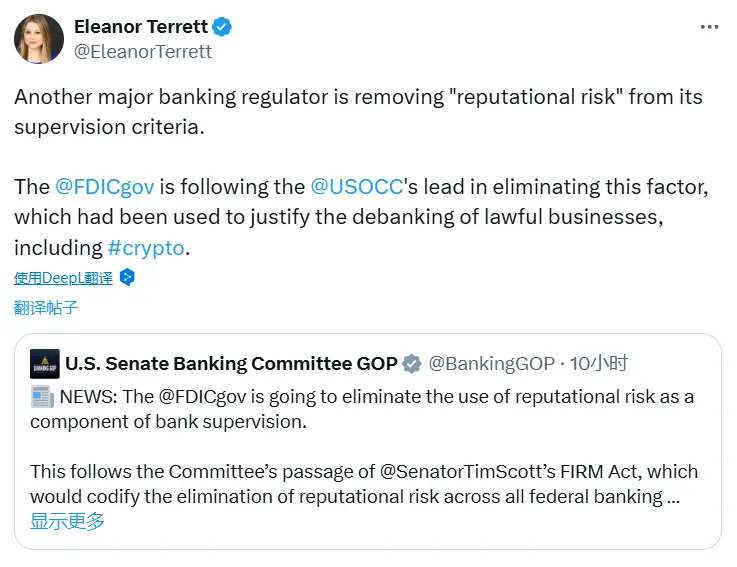
Coinbase's legal chief: FDIC still trying to obstruct the release of documents on cryptocurrency de-banking

ChainCatcher news, according to Decrypt, Coinbase Chief Legal Officer Paul Grewal disclosed that a motion has been filed in federal court, accusing the Federal Deposit Insurance Corporation (FDIC) of systematically obstructing the disclosure of documents related to "Operation Chokepoint 2.0."Court documents show that after being ordered to comply four times, the FDIC still refused to fully submit the "cease and desist letters" requiring banks to suspend cryptocurrency-related transactions from 2020 to 2024.Internal policy documents confirm that the FDIC instructed employees to "withhold all documents" covered by the exemption under Section 8 of the Freedom of Information Act, without distinguishing between factual content and analytical materials. Coinbase accuses the agency of using an "extremely narrow interpretation," only searching for documents submitted to the Office of the Inspector General, resulting in the omission of numerous key records.During the January hearing, the FDIC admitted it had not established a record-keeping system for FOIA litigation. This legal battle has forced the FDIC to disclose hundreds of pages of documents, showing that banks "generally faced resistance" when engaging in cryptocurrency business. As the Trump administration pushed for crypto-friendly policies, Coinbase stated that investigating these "historical misconducts" is to ensure they do not happen again.

The FDIC is accused of omitting multiple crypto-related "cease and desist" letters in the lawsuit supported by Coinbase

ChainCatcher news, according to Cointelegraph, the Federal Deposit Insurance Corporation (FDIC) has been accused of omitting multiple cryptocurrency-related "suspension letters" sent to banks in a Coinbase-supported Freedom of Information Act (FOIA) lawsuit. A report submitted by History Associates to the federal court in Washington, D.C. on January 17 indicated that the FDIC "may have overlooked other suspension letters" and plans to update the lawsuit based on this. Public reports have claimed that the FDIC is "systematically obstructing FOIA requests," resulting in at least 150 related documents not being released. The 25 FDIC letters that have been made public suggest that financial institutions should suspend cryptocurrency operations until regulatory reviews are completed, which the cryptocurrency industry views as an action to cut off banking services to related businesses ("Operation Chokepoint 2.0").Coinbase Chief Legal Officer Paul Grewal stated on January 16 that the lawsuit seeks to obtain all suspension letters confirmed by the Office of the Inspector General, but accused the FDIC of limiting its search to the letters in the report, potentially overlooking others. Grewal added that when asked to correct and stop the wordplay, the FDIC claimed it would take at least a year.In a status report on January 17, the FDIC responded that it has provided all relevant documents and conducted a search of letters shared with the Office of the Inspector General from March 2022 to May 2023, in accordance with the FOIA request. The agency stated that History Associates has no reasonable basis to believe that letters beyond this scope and timeframe belong to the original FOIA request and added that these letter requests are being processed as separate FOIA requests for expedited review.
app_icon
ChainCatcher Building the Web3 world with innovations.