BTC $79,471.53 -0.41%
ETH $2,504.83 +0.52%
BNB $746.94 -0.60%
XRP $1.41 -0.50%
SOL $105.17 -0.87%
TRX $0.3353 +0.08%
DOGE $0.0910 +1.94%
ADA $0.2234 +2.41%
BCH $261.23 +1.12%
LINK $13.23 +7.86%
HYPE $87.72 -1.05%
AAVE $133.80 -1.00%
SUI $0.8313 +4.65%
XLM $0.1937 +4.51%
ZEC $1,186.32 +0.11%
BTC $79,471.53 -0.41%
ETH $2,504.83 +0.52%
BNB $746.94 -0.60%
XRP $1.41 -0.50%
SOL $105.17 -0.87%
TRX $0.3353 +0.08%
DOGE $0.0910 +1.94%
ADA $0.2234 +2.41%
BCH $261.23 +1.12%
LINK $13.23 +7.86%
HYPE $87.72 -1.05%
AAVE $133.80 -1.00%
SUI $0.8313 +4.65%
XLM $0.1937 +4.51%
ZEC $1,186.32 +0.11%

graph

Все
Статьи
Новости

first_img Social Graph VC: капитальные расходы на центры обработки данных в 2026 году превысят 1 триллион долларов США

Венчурная компания Social Graph VC недавно опубликовала статью о входе на рынок, в которой говорится, что капитальные расходы на центры обработки данных в 2026 году превысят 1 триллион долларов, что примерно в два раза больше, чем расходы четырех крупнейших облачных провайдеров в 2025 году. Хуан Жэньсюн ожидает, что к концу этого десятилетия они могут достигнуть 3-4 триллионов долларов в год, а к 2031 году — 10 триллионов долларов. Инвестиции в ИИ составляют около 0,9% мирового ВВП и к 2028 году вырастут примерно до 1,4%.В статье говорится, что Fable 5 и GPT-5.6 имеют потребление энергии для обучения менее 2 ГВт и стоимость около 120 миллиардов долларов. Каждое поколение моделей может окупить себя, а убытки лаборатории связаны с увеличением масштабов обучения следующего поколения моделей в 10 раз. Вычисления нельзя закупать по единой цене, аренда H100 на рынке составляет около 1,95 доллара/час, а для крупных облачных провайдеров — 8-9 долларов/час, ставка аренды может колебаться на 137% в течение года, а в глобальных центрах обработки данных к 2028 году будет дефицит финансирования в 1,5 триллиона долларов из 3 триллионов долларов расходов.В статье также говорится, что CME планирует запустить в торговлю на NYMEX 5 октября 2026 года фьючерсы на аренду H100 и B200 с расчетом наличными, ожидая одобрения регуляторов, с расчетом по индексу Silicon Data; ICE также объявила о фьючерсах на GPU на основе индекса Ornn.

Компания GraphAI завершила финансирование раунда A на сумму 12 миллионов долларов, возглавляемое K2 Investment Partners

Сообщение ChainCatcher, корейская компания в области инфраструктуры данных для корпоративного AI GraphAI объявила о завершении раунда финансирования A на сумму 12 миллионов долларов, в котором основным инвестором выступила K2 Investment Partners, а также приняли участие A-Ventures и Jiyu Investment, а также ранее участвовавшие в раунде Pre-A Quad Ventures, Kiwoom Investment и We Ventures. На данный момент общий объем финансирования компании достиг 14,7 миллиона долларов.GraphAI была основана в 2022 году профессором кафедры компьютерных наук KAIST Мин-Су Кимом с целью предоставить следующее поколение инфраструктуры данных для корпоративных AI приложений, объединяя возможности графовых баз данных, векторных баз данных и реляционных баз данных. Платформа Akasic предлагает интегрированное решение, охватывающее подключение, сбор, преобразование данных, AI выводы и среду выполнения интеллектуальных агентов.

Cointelegraph беседа с CEO Gate Europe: делится планом соблюдения MiCA, продолжает углублять развитие европейского рынка

Сообщение ChainCatcher, генеральный директор Gate Europe д-р Джованни Кунти был приглашен на прямое интервью Cointelegraph X Space, где он поделился мнениями о тенденциях регулирования цифровых активов в Европе, рамках соблюдения MiCA и стратегии развития Gate Europe в Европе. Д-р Джованни Кунти отметил, что внедрение MiCA является важным шагом к унификации европейского рынка: "Унифицированное регулирование обеспечивает более широкий доступ к рынку, а доступ к рынку будет способствовать дальнейшему принятию со стороны учреждений". Он считает, что после корректировки рамок MiCA участники рынка смогут вести бизнес в более ясной и прозрачной среде правил, что особенно обеспечит более высокий уровень безопасности и доверия для институциональных инвесторов.В ходе прямого эфира д-р Джованни Кунти также представил последние стратегические достижения Gate Europe в европейском регионе. Он подчеркнул, что Gate Europe еще в начале 2021 года активно начала процесс соблюдения норм в рамках MiCA. Опираясь на преимущества двойной лицензии MiCA и платежных учреждений (PI), Gate Europe, укрепляя соблюдение норм, управление рисками и операционное управление, продолжает расширять услуги по торговле цифровыми активами, управлению активами и локализованным сервисам, стремясь предоставить европейским пользователям более безопасные, прозрачные и эффективные услуги в области цифровых активов.С развитием глобальной системы регулирования цифровых активов соблюдение норм становится важной основой для долгосрочного развития отрасли. В настоящее время Gate завершила регистрацию в нескольких юрисдикциях, включая Европу, США, Японию, Дубай, Австралию и Багамы, а также подала заявки на лицензии или получила разрешения и одобрения, продолжая продвигать глобальную стратегию соблюдения норм. В будущем Gate будет настаивать на параллельном соблюдении норм и инновациях, постоянно повышая свои глобальные возможности обслуживания, способствуя устойчивому развитию отрасли цифровых активов и предоставляя пользователям по всему миру более безопасные, эффективные и надежные продукты и услуги.

BSC releases a report on quantum-resistant cryptography migration: transaction signatures have switched to ML-DSA-44, TPS testing has decreased by about 40%-50%

On May 14, BNB Chain released the "BSC Post-Quantum Cryptography Migration Report," stating that it has completed the migration testing for quantum-resistant cryptography for transaction signatures and the consensus layer, using the NIST standardized post-quantum signature algorithm ML-DSA-44 (Dilithium) and the pqSTARK aggregation scheme.The report shows that BSC has replaced transaction signatures from ECDSA to ML-DSA-44 and switched consensus voting aggregation from BLS12-381 to pqSTARK to address the potential threats posed by future quantum computing to the existing elliptic curve cryptography system. However, post-quantum signatures also significantly increase the on-chain data volume: the size of a single transaction has increased from about 110 bytes to approximately 2.5KB; the block size in a 2000 TPS scenario has increased from about 130KB to around 2MB; and the TPS in the testing environment has decreased by about 40%-50%.BSC stated that the current network bottleneck mainly comes from the larger transaction data propagation, rather than the consensus protocol itself. Meanwhile, the consensus layer aggregation still maintains high efficiency, with pqSTARK achieving a signature compression ratio of about 43:1, and the additional burden on validators remains within a controllable range. The report concludes that existing technology can achieve "quantum-resistant" deployment for blockchain, but future issues related to network bandwidth and data scalability still need to be addressed.

Ethereum Foundation releases Q1 funding list: Continuing support for ZK, cryptography, and protocol infrastructure

The Ethereum Foundation has announced the list of grants and ecosystem support projects for the first quarter of 2026, focusing on cryptography, zero-knowledge proofs (ZK), protocol security, and core infrastructure development, continuously strengthening the Ethereum underlying technology stack and long-term scalability.This quarter's funding covers several key areas. At the protocol and client level, projects include optimizations for the Geth and Erigon clients, upgrades to the Lighthouse client, and the development of network monitoring tools after the Pectra upgrade, with a focus on improving network performance and attack resistance. Additionally, projects such as HSM key management, the validator security tool Vero, and the DISC-NG node discovery mechanism have also received support to enhance node-level reliability and institutional compliance capabilities.In the areas of cryptography and ZK, the foundation continues to invest in projects such as the analysis of the Poseidon hash function, research on Gröbner basis attacks, exploration of quantum-resistant and homomorphic mixed encryption, and formal verification of RISC-V zkVM, further strengthening the security boundaries of zero-knowledge proofs and cryptographic infrastructure.In terms of the developer ecosystem, the BuidlGuidl education system upgrade, ERC standard community building, WalletConnect clear signature library, and Open Creator Rails toolchain are continuously advancing to lower development barriers and enhance user interaction security. Meanwhile, L2BEAT continues to provide transparency analysis for Layer 2, strengthening the data infrastructure for scaling ecosystems.Furthermore, the foundation supports privacy technologies (such as Tor integration and Privacy Pool SDK), decentralized identity (did:ethr standard upgrade), DAO governance research, and public goods experimental projects, covering a complete ecological structure from the protocol layer to the application layer. Overall, this round of funding continues Ethereum's long-term investment in the three core directions of "cryptography + ZK + protocol engineering," emphasizing the support for future multi-layer scaling and institutional-level application implementation through infrastructure and standardization development.

Lotus Technology CFO Dr. Daxue Wang: Cryptographic technology empowers smart mobility, promoting the credible circulation of RWA and carbon assets

At the "Crypto 2026: From Cryptocurrency to Smart Economy" themed forum held in Hong Kong, Dr. Daxue Wang, CFO of Lotus Technology Inc., delivered a keynote speech titled "Crypto Links to the Physical Industry, Smart Mobility Running on the Chain."Dr. Daxue Wang stated that smart mobility is the pioneering carrier of the smart economy. Lotus, a luxury electric vehicle brand with a 78-year history, has been listed on NASDAQ and is actively exploring the deep integration of crypto technology with the physical industry. He proposed three major integration directions:First, safeguarding data value by utilizing the immutable nature of blockchain and privacy computing, allowing users to have absolute control over their personal data, achieving credible data circulation and value flow. Second, releasing asset value by exploring efficient circulation and fair trading of assets such as vehicle sales, brand value, autonomous driving technology patents, and global sales networks through RWA, while promoting credible traceability of carbon assets in green mobility. Third, co-creating ecological value by recording data on driving, charging, and maintenance through on-chain smart nodes, allowing users to upgrade from "car owners" to "participants in the brand ecosystem" through on-chain rights confirmation.Dr. Daxue Wang pointed out that the current challenges include compliance implementation, technology adaptation, and ecological co-construction, but the opportunities lie in open cooperation, promoting smart mobility as a practical landing scenario of the smart economy. Lotus hopes to work hand in hand with the crypto ecosystem to realize the vision of "from buying a Lotus car to sharing the growth value of Lotus technology."

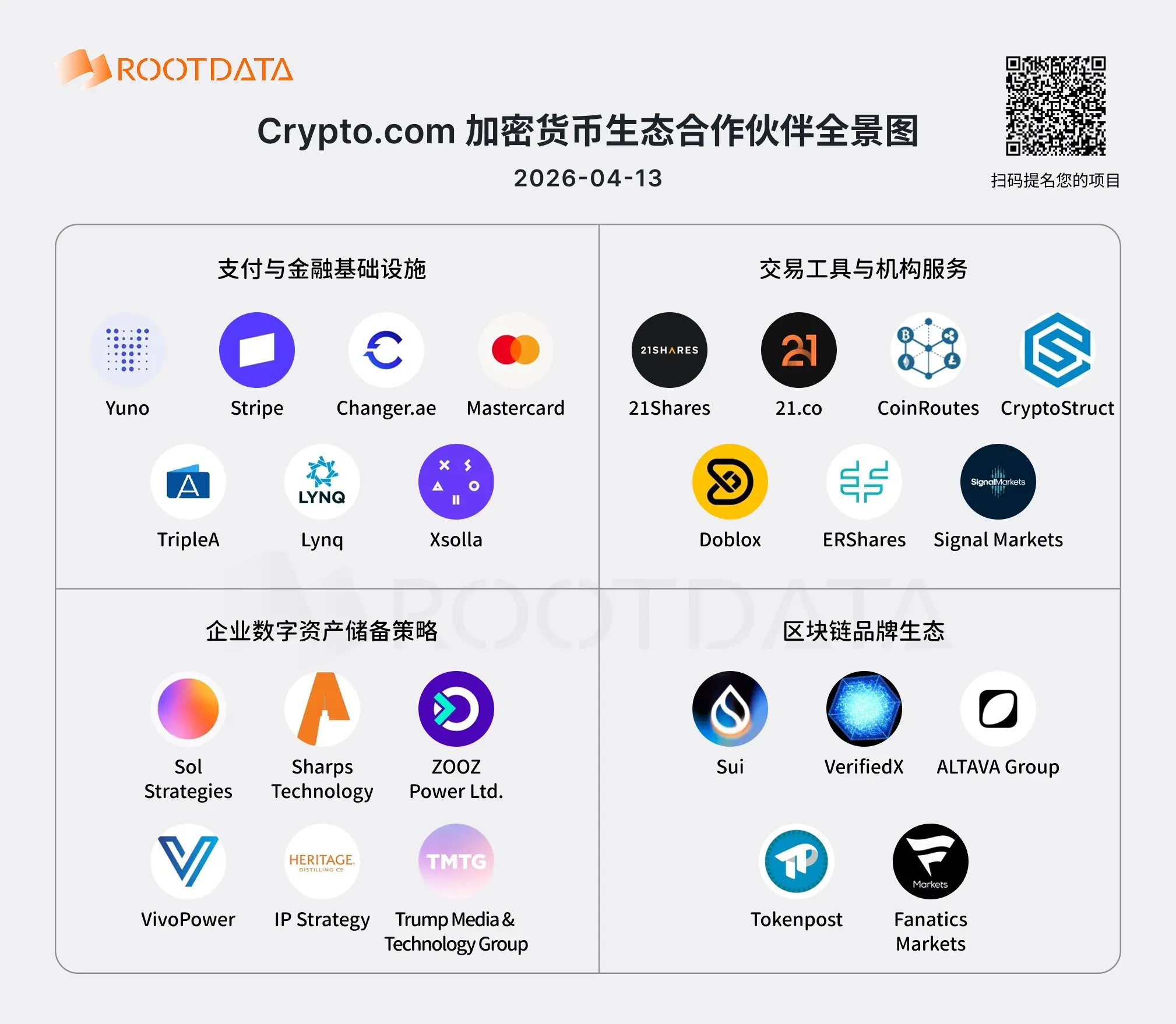
Infographic: Crypto.com’s 25 Web3 Business Partners: Full-stack Expansion from Payment Infrastructure to Brand Ecosystem

The Web3 asset data platform RootData has outlined the business partners of Crypto.com. Its strategy goes beyond exchange expansion, advancing through multiple paths such as payments, custody, and brand collaborations, aiming to create a comprehensive digital asset platform covering both institutional and consumer ends. * **Payment Infrastructure**: Crypto.com has integrated with Stripe, Mastercard, Yuno, TripleA, Lynq, etc., covering the complete link from checkout crypto payments to institutional-level real-time clearing. * **Institutional Trading and Custody**: VerifiedX has entrusted Crypto.com with institutional custody for its $1.5 billion digital assets; CoinRoutes provides smart order routing, CryptoStruct connects high-frequency trading, and Doblox offers AI trading terminals. * **Corporate Crypto Treasury**: Crypto.com collaborates with several Nasdaq-listed companies executing treasury strategies, including SOL Strategies, Sharps Technology, and IP Strategy. On the brand side, Crypto.com has formed deep ties with top sports IPs—renewing its partnership with **F1** until 2030 and sponsoring the Miami Grand Prix, as well as **UEFA Champions League**, **UFC**, **NBA Philadelphia 76ers**, **AFL**, and South American CONMEBOL; the long-term partnership with the LeBron James Family Foundation marks an extension of its brand collaboration into the celebrity family philanthropy sector. Additionally, Crypto.com has signed collaborations in the Middle East with Dubai Islamic Bank, DMCC, e& money, Tawasal Al Khaleej super app, and Emarat gas station network, becoming an important participant in the local digital asset compliance ecosystem. Related compilation: 【[Crypto.com Web3 Partner Network Compilation (Continuously Updated)](https://cn.rootdata.com/Archives/detail/Crypto.com%20Crypto%20Business%20Partner?k=NDc0MTU3)】 Cryptocurrency projects actively showcasing their partner networks have become a key way to enhance transparency and market trust. It is reported that RootData welcomes Web3 project parties to [claim data](https://www.rootdata.com/Projects/submit?ft=claimApply) and continues to track and open more project business relationship disclosure channels. The platform has continuously released multiple issues of the cryptocurrency project ecosystem map, nominating Web3 ecosystem partners for upstream clients such as Visa, Stripe, and Coinbase. **If you wish to nominate your project in future ecosystem maps, please fill out the 【[RootData 2026 Industry Ecosystem Mapping](https://forms.gle/tWArmXcpSfZJkh1r8)】 form to supplement your important clients and partners.**
Infographic: Crypto.com’s 25 Web3 Business Partners: Full-stack Expansion from Payment Infrastructure to Brand Ecosystem

Circle's Arc public chain releases a post-quantum cryptography roadmap, covering full-stack upgrades from wallets to validators

According to the official blog, Circle's institutional-grade blockchain Arc has released a phased upgrade roadmap for post-quantum cryptography (PQ), planning to introduce post-quantum signature schemes at the launch of the mainnet, gradually covering full-stack layers such as private state protection, infrastructure hardening, and validator authentication.The Arc mainnet will support post-quantum signatures from the outset, using an opt-in mechanism that does not require mandatory migration or a full network reset, allowing users to independently create wallets with long-term security. The recent goal is to extend quantum resistance to the private virtual machine (VM) layer, protecting private balances, private transactions, and private payees, with public keys additionally encapsulated in a symmetric encryption layer under privacy mode.The mid-term plan is to advance the upgrade of the infrastructure layer, aligning with industry standards such as TLS 1.3, covering access control, cloud environments, and hardware security modules (HSM). The long-term goal is to complete the hardening of validator signatures. Given that Arc's block finalization time is less than 1 second, the current assessment considers the risk of quantum attacks in this phase to be relatively limited, and it will be steadily advanced after the post-quantum consensus toolchain matures.Circle also warns that attackers may adopt a "collect now, decrypt later" strategy, and institutions should plan their cryptographic migration paths as early as possible.
app_icon
ChainCatcher Building the Web3 world with innovations.