BTC $79,167.47 -0.77%
ETH $2,494.69 +0.07%
BNB $740.71 -0.98%
XRP $1.40 -0.79%
SOL $103.94 -2.19%
TRX $0.3340 -0.34%
DOGE $0.0898 +0.95%
ADA $0.2207 +1.03%
BCH $259.98 +1.30%
LINK $12.90 +4.88%
HYPE $85.01 -3.63%
AAVE $132.36 -0.73%
SUI $0.8193 +2.95%
XLM $0.1908 +3.82%
ZEC $1,165.88 -3.60%
BTC $79,167.47 -0.77%
ETH $2,494.69 +0.07%
BNB $740.71 -0.98%
XRP $1.40 -0.79%
SOL $103.94 -2.19%
TRX $0.3340 -0.34%
DOGE $0.0898 +0.95%
ADA $0.2207 +1.03%
BCH $259.98 +1.30%
LINK $12.90 +4.88%
HYPE $85.01 -3.63%
AAVE $132.36 -0.73%
SUI $0.8193 +2.95%
XLM $0.1908 +3.82%
ZEC $1,165.88 -3.60%

graph

Tất cả
Bài viết
Tin nhanh

first_img Social Graph VC: Chi tiêu vốn cho trung tâm dữ liệu sẽ vượt qua 1 nghìn tỷ USD vào năm 2026

Cơ quan đầu tư mạo hiểm Social Graph VC gần đây đã phát hành bài viết về thị trường, cho biết chi tiêu vốn cho trung tâm dữ liệu sẽ vượt qua 1 nghìn tỷ USD vào năm 2026, gấp đôi chi tiêu của bốn nhà cung cấp đám mây siêu lớn vào năm 2025. Huang Renxun dự đoán đến cuối thập kỷ này, mỗi năm có thể đạt từ 3 đến 4 nghìn tỷ USD, và đến năm 2031 có thể đạt 10 nghìn tỷ USD. Đầu tư vào AI chiếm khoảng 0,9% GDP toàn cầu, và sẽ tăng lên khoảng 1,4% vào năm 2028.Bài viết cho biết, Fable 5 và GPT-5.6 đều có công suất tiêu thụ trong quá trình đào tạo dưới 2GW, với chi phí khoảng 120 tỷ USD. Các thế hệ mô hình có thể tự hoàn vốn, thua lỗ của phòng thí nghiệm đến từ việc mở rộng quy mô đào tạo liên tục gấp 10 lần cho thế hệ mô hình tiếp theo. Việc tính toán không thể mua theo giá đơn lẻ, tiền thuê H100 trên thị trường khoảng 1,95 USD/giờ, trong khi đám mây siêu lớn là 8-9 USD/giờ, tỷ lệ phí theo giờ có thể dao động 137% trong một năm, và toàn cầu trung tâm dữ liệu sẽ có khoảng 3 nghìn tỷ USD chi tiêu vào năm 2028 với khoảng trống tài chính 1,5 nghìn tỷ USD.Bài viết cũng cho biết, CME dự kiến sẽ niêm yết H100 và B200 hợp đồng tương lai thuê tháng thanh toán bằng tiền mặt trên NYMEX vào ngày 5 tháng 10 năm 2026, chờ phê duyệt của cơ quan quản lý, với tham chiếu thanh toán là chỉ số Silicon Data; ICE cũng đã công bố hợp đồng tương lai GPU dựa trên chỉ số Ornn.

Cointelegraph đối thoại với CEO của Gate Europe: chia sẻ kế hoạch tuân thủ MiCA, tiếp tục sâu sắc hóa phát triển thị trường châu Âu

Tin tức từ ChainCatcher, Giám đốc điều hành Gate Europe, Dr. Giovanni Cunti, đã được mời tham gia phỏng vấn trực tiếp trên Cointelegraph X Space, chia sẻ về xu hướng quản lý tài sản kỹ thuật số ở châu Âu, khung tuân thủ MiCA và chiến lược phát triển của Gate Europe tại châu Âu. Dr. Giovanni Cunti cho biết, việc thực hiện MiCA là một bước quan trọng để thúc đẩy sự thống nhất của thị trường châu Âu, "quản lý thống nhất mang lại khả năng tiếp cận thị trường rộng rãi hơn, và khả năng tiếp cận thị trường sẽ thúc đẩy việc áp dụng của các tổ chức". Ông tin rằng, sau khi điều chỉnh theo khung MiCA, các bên tham gia thị trường có thể hoạt động trong một môi trường quy tắc rõ ràng và minh bạch hơn, đặc biệt cung cấp cho các nhà đầu tư tổ chức một mức độ an toàn và nền tảng tin cậy cao hơn.Trong buổi phát trực tiếp, Dr. Giovanni Cunti cũng đã giới thiệu về những tiến triển chiến lược mới nhất của Gate Europe trong khu vực châu Âu. Ông nhấn mạnh rằng Gate Europe đã chủ động bắt đầu việc tuân thủ từ giai đoạn đầu của khung MiCA vào năm 2021. Dựa vào lợi thế của giấy phép kép MiCA và tổ chức thanh toán (PI), Gate Europe đã không ngừng củng cố tuân thủ, quản lý rủi ro và quản trị hoạt động, đồng thời mở rộng giao dịch tài sản kỹ thuật số, quản lý tài chính và dịch vụ địa phương, nhằm cung cấp cho người dùng châu Âu dịch vụ tài sản kỹ thuật số an toàn, minh bạch và hiệu quả hơn.Khi hệ thống quản lý tài sản kỹ thuật số toàn cầu ngày càng hoàn thiện, việc tuân thủ đang trở thành nền tảng quan trọng cho sự phát triển lâu dài của ngành. Hiện tại, Gate đã hoàn thành việc đăng ký quản lý, xin cấp giấy phép hoặc nhận được sự ủy quyền và phê duyệt tại nhiều khu vực pháp lý như châu Âu, Mỹ, Nhật Bản, Dubai, Úc, Bahamas, và tiếp tục thúc đẩy chiến lược tuân thủ toàn cầu. Trong tương lai, Gate sẽ kiên định với việc tuân thủ và đổi mới song song, không ngừng nâng cao khả năng phục vụ toàn cầu, thúc đẩy sự phát triển ổn định của ngành tài sản kỹ thuật số, cung cấp cho người dùng toàn cầu những sản phẩm và dịch vụ an toàn, hiệu quả và đáng tin cậy hơn.

BSC releases a report on quantum-resistant cryptography migration: transaction signatures have switched to ML-DSA-44, TPS testing has decreased by about 40%-50%

On May 14, BNB Chain released the "BSC Post-Quantum Cryptography Migration Report," stating that it has completed the migration testing for quantum-resistant cryptography for transaction signatures and the consensus layer, using the NIST standardized post-quantum signature algorithm ML-DSA-44 (Dilithium) and the pqSTARK aggregation scheme.The report shows that BSC has replaced transaction signatures from ECDSA to ML-DSA-44 and switched consensus voting aggregation from BLS12-381 to pqSTARK to address the potential threats posed by future quantum computing to the existing elliptic curve cryptography system. However, post-quantum signatures also significantly increase the on-chain data volume: the size of a single transaction has increased from about 110 bytes to approximately 2.5KB; the block size in a 2000 TPS scenario has increased from about 130KB to around 2MB; and the TPS in the testing environment has decreased by about 40%-50%.BSC stated that the current network bottleneck mainly comes from the larger transaction data propagation, rather than the consensus protocol itself. Meanwhile, the consensus layer aggregation still maintains high efficiency, with pqSTARK achieving a signature compression ratio of about 43:1, and the additional burden on validators remains within a controllable range. The report concludes that existing technology can achieve "quantum-resistant" deployment for blockchain, but future issues related to network bandwidth and data scalability still need to be addressed.

Ethereum Foundation releases Q1 funding list: Continuing support for ZK, cryptography, and protocol infrastructure

The Ethereum Foundation has announced the list of grants and ecosystem support projects for the first quarter of 2026, focusing on cryptography, zero-knowledge proofs (ZK), protocol security, and core infrastructure development, continuously strengthening the Ethereum underlying technology stack and long-term scalability.This quarter's funding covers several key areas. At the protocol and client level, projects include optimizations for the Geth and Erigon clients, upgrades to the Lighthouse client, and the development of network monitoring tools after the Pectra upgrade, with a focus on improving network performance and attack resistance. Additionally, projects such as HSM key management, the validator security tool Vero, and the DISC-NG node discovery mechanism have also received support to enhance node-level reliability and institutional compliance capabilities.In the areas of cryptography and ZK, the foundation continues to invest in projects such as the analysis of the Poseidon hash function, research on Gröbner basis attacks, exploration of quantum-resistant and homomorphic mixed encryption, and formal verification of RISC-V zkVM, further strengthening the security boundaries of zero-knowledge proofs and cryptographic infrastructure.In terms of the developer ecosystem, the BuidlGuidl education system upgrade, ERC standard community building, WalletConnect clear signature library, and Open Creator Rails toolchain are continuously advancing to lower development barriers and enhance user interaction security. Meanwhile, L2BEAT continues to provide transparency analysis for Layer 2, strengthening the data infrastructure for scaling ecosystems.Furthermore, the foundation supports privacy technologies (such as Tor integration and Privacy Pool SDK), decentralized identity (did:ethr standard upgrade), DAO governance research, and public goods experimental projects, covering a complete ecological structure from the protocol layer to the application layer. Overall, this round of funding continues Ethereum's long-term investment in the three core directions of "cryptography + ZK + protocol engineering," emphasizing the support for future multi-layer scaling and institutional-level application implementation through infrastructure and standardization development.

Lotus Technology CFO Dr. Daxue Wang: Cryptographic technology empowers smart mobility, promoting the credible circulation of RWA and carbon assets

At the "Crypto 2026: From Cryptocurrency to Smart Economy" themed forum held in Hong Kong, Dr. Daxue Wang, CFO of Lotus Technology Inc., delivered a keynote speech titled "Crypto Links to the Physical Industry, Smart Mobility Running on the Chain."Dr. Daxue Wang stated that smart mobility is the pioneering carrier of the smart economy. Lotus, a luxury electric vehicle brand with a 78-year history, has been listed on NASDAQ and is actively exploring the deep integration of crypto technology with the physical industry. He proposed three major integration directions:First, safeguarding data value by utilizing the immutable nature of blockchain and privacy computing, allowing users to have absolute control over their personal data, achieving credible data circulation and value flow. Second, releasing asset value by exploring efficient circulation and fair trading of assets such as vehicle sales, brand value, autonomous driving technology patents, and global sales networks through RWA, while promoting credible traceability of carbon assets in green mobility. Third, co-creating ecological value by recording data on driving, charging, and maintenance through on-chain smart nodes, allowing users to upgrade from "car owners" to "participants in the brand ecosystem" through on-chain rights confirmation.Dr. Daxue Wang pointed out that the current challenges include compliance implementation, technology adaptation, and ecological co-construction, but the opportunities lie in open cooperation, promoting smart mobility as a practical landing scenario of the smart economy. Lotus hopes to work hand in hand with the crypto ecosystem to realize the vision of "from buying a Lotus car to sharing the growth value of Lotus technology."

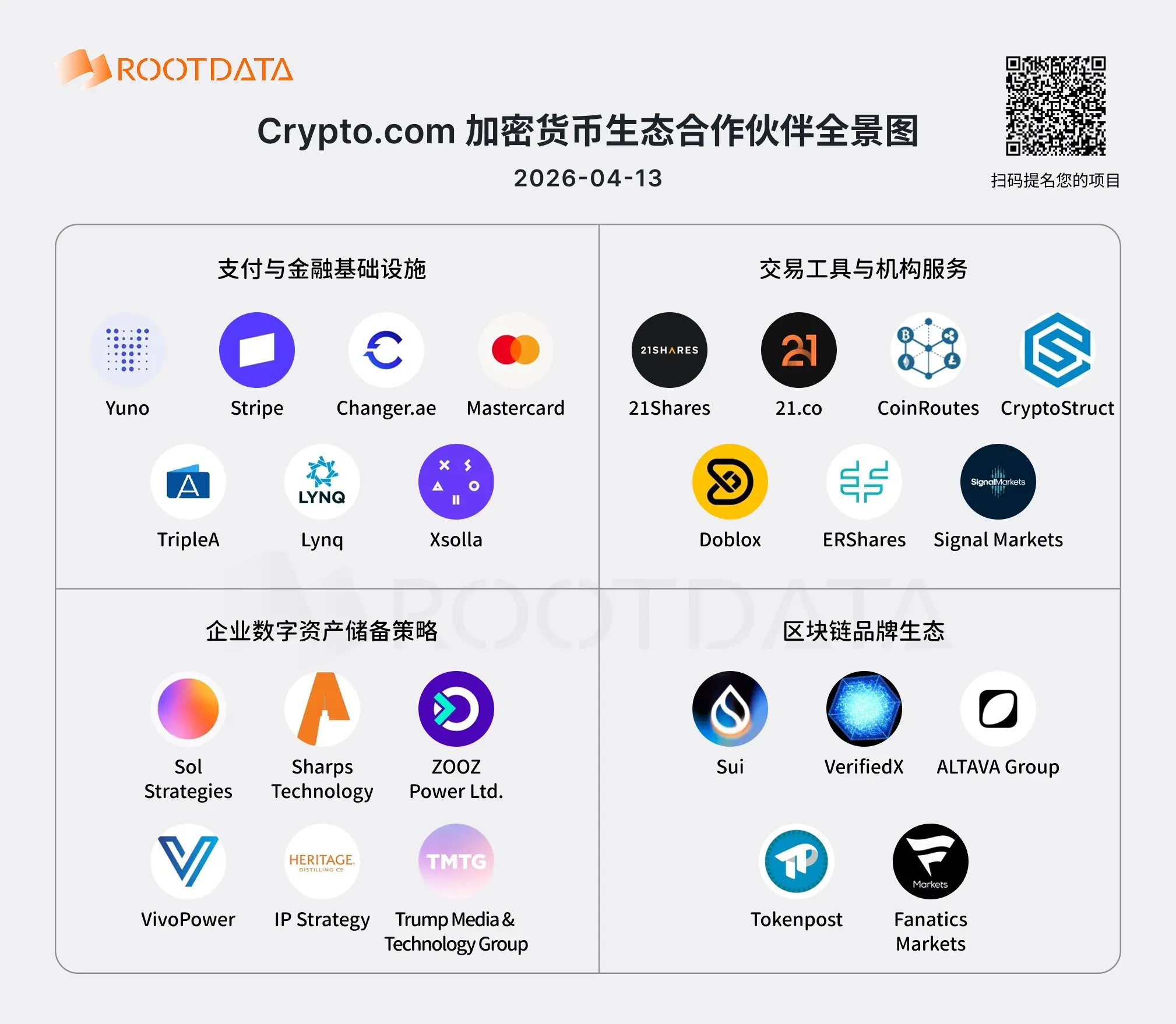
Infographic: Crypto.com’s 25 Web3 Business Partners: Full-stack Expansion from Payment Infrastructure to Brand Ecosystem

The Web3 asset data platform RootData has outlined the business partners of Crypto.com. Its strategy goes beyond exchange expansion, advancing through multiple paths such as payments, custody, and brand collaborations, aiming to create a comprehensive digital asset platform covering both institutional and consumer ends. * **Payment Infrastructure**: Crypto.com has integrated with Stripe, Mastercard, Yuno, TripleA, Lynq, etc., covering the complete link from checkout crypto payments to institutional-level real-time clearing. * **Institutional Trading and Custody**: VerifiedX has entrusted Crypto.com with institutional custody for its $1.5 billion digital assets; CoinRoutes provides smart order routing, CryptoStruct connects high-frequency trading, and Doblox offers AI trading terminals. * **Corporate Crypto Treasury**: Crypto.com collaborates with several Nasdaq-listed companies executing treasury strategies, including SOL Strategies, Sharps Technology, and IP Strategy. On the brand side, Crypto.com has formed deep ties with top sports IPs—renewing its partnership with **F1** until 2030 and sponsoring the Miami Grand Prix, as well as **UEFA Champions League**, **UFC**, **NBA Philadelphia 76ers**, **AFL**, and South American CONMEBOL; the long-term partnership with the LeBron James Family Foundation marks an extension of its brand collaboration into the celebrity family philanthropy sector. Additionally, Crypto.com has signed collaborations in the Middle East with Dubai Islamic Bank, DMCC, e& money, Tawasal Al Khaleej super app, and Emarat gas station network, becoming an important participant in the local digital asset compliance ecosystem. Related compilation: 【[Crypto.com Web3 Partner Network Compilation (Continuously Updated)](https://cn.rootdata.com/Archives/detail/Crypto.com%20Crypto%20Business%20Partner?k=NDc0MTU3)】 Cryptocurrency projects actively showcasing their partner networks have become a key way to enhance transparency and market trust. It is reported that RootData welcomes Web3 project parties to [claim data](https://www.rootdata.com/Projects/submit?ft=claimApply) and continues to track and open more project business relationship disclosure channels. The platform has continuously released multiple issues of the cryptocurrency project ecosystem map, nominating Web3 ecosystem partners for upstream clients such as Visa, Stripe, and Coinbase. **If you wish to nominate your project in future ecosystem maps, please fill out the 【[RootData 2026 Industry Ecosystem Mapping](https://forms.gle/tWArmXcpSfZJkh1r8)】 form to supplement your important clients and partners.**
Infographic: Crypto.com’s 25 Web3 Business Partners: Full-stack Expansion from Payment Infrastructure to Brand Ecosystem

Circle's Arc public chain releases a post-quantum cryptography roadmap, covering full-stack upgrades from wallets to validators

According to the official blog, Circle's institutional-grade blockchain Arc has released a phased upgrade roadmap for post-quantum cryptography (PQ), planning to introduce post-quantum signature schemes at the launch of the mainnet, gradually covering full-stack layers such as private state protection, infrastructure hardening, and validator authentication.The Arc mainnet will support post-quantum signatures from the outset, using an opt-in mechanism that does not require mandatory migration or a full network reset, allowing users to independently create wallets with long-term security. The recent goal is to extend quantum resistance to the private virtual machine (VM) layer, protecting private balances, private transactions, and private payees, with public keys additionally encapsulated in a symmetric encryption layer under privacy mode.The mid-term plan is to advance the upgrade of the infrastructure layer, aligning with industry standards such as TLS 1.3, covering access control, cloud environments, and hardware security modules (HSM). The long-term goal is to complete the hardening of validator signatures. Given that Arc's block finalization time is less than 1 second, the current assessment considers the risk of quantum attacks in this phase to be relatively limited, and it will be steadily advanced after the post-quantum consensus toolchain matures.Circle also warns that attackers may adopt a "collect now, decrypt later" strategy, and institutions should plan their cryptographic migration paths as early as possible.
app_icon
ChainCatcher Building the Web3 world with innovations.