



Binance and Huobi are in dispute again, behind which is a deep anxiety about compliance

 A report from Forbes has once again stirred up a storm in the exchange industry, with Binance's He Yi and several Huobi individuals engaging in heated disputes and even a "war of words" in their social circles and communities over Forbes' claim that "Binance may be under FBI investigation."
This article was first published on October 30, 2020, on the Chain Catcher WeChat public account, by authors Echo and Gong Quanyu.
1. Reasons and Process of the Dispute
In the early hours of October 30, Forbes published an investigative article titled "Leaked 'Taiji' Documents Reveal Binance's Elaborate Schemes to Evade Bitcoin Regulators," claiming that Binance had designed a series of detailed strategies in 2018 to divert the attention of U.S. regulatory agencies in order to avoid scrutiny and speculating that Binance might be under investigation by the FBI.
One hour after the article was published, Zhao Changpeng urgently posted seven tweets denying the allegations made by Forbes, stating that "the statements and accusations in the article are incorrect," "Binance has always operated within the legal framework," and "anyone can create strategic documents, but that does not mean Binance will follow them."
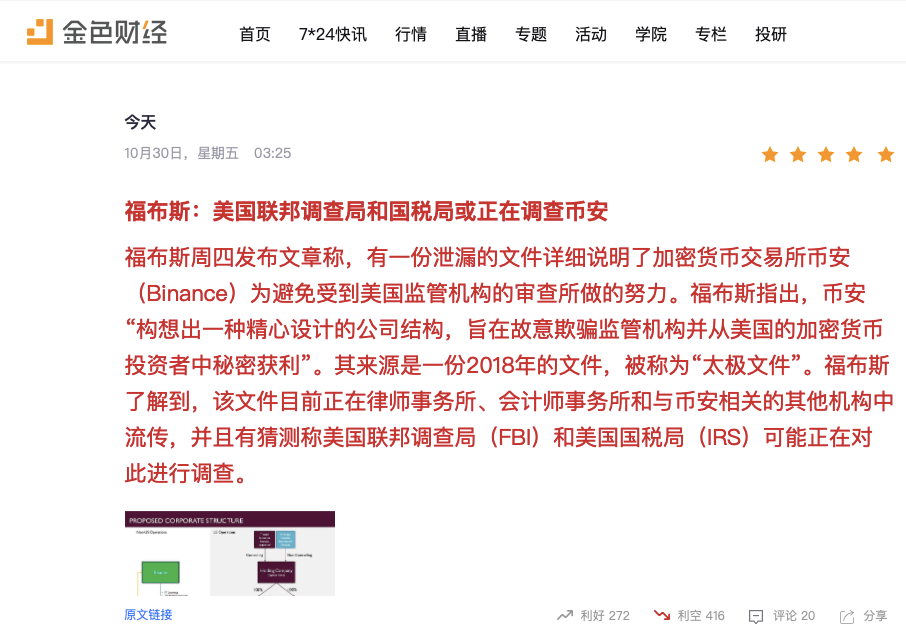
However, a few hours later, breaking news images from media outlets like Jinse Finance continued to spread rapidly in the Chinese community, featuring prominent headlines such as "The FBI and IRS May Be Investigating Binance," triggering a crisis of trust among many users regarding Binance.
Due to the close ties between Jinse Finance founder Du Jun and Huobi, Binance's dissatisfaction with the dissemination of "false" information by media like Jinse Finance was quickly redirected towards Huobi. He Yi first accused the media of being irresponsible and talking nonsense in a WeChat group, directly pointing out that Du Jun from Jinse Finance was deliberately smearing Binance. Subsequently, he refuted the investigation claims in several communities, while also engaging in numerous disputes and conflicts with Huobi.
For example, after He Yi's refutation, a Huobi-related person quickly questioned, "Then there is also an obligation to remind users how far Binance is from being investigated and how great the risks are, rather than deceiving users by saying that Binance is fine." He Yi claimed that Huobi had also been investigated by the Shanxi police and hoped Huobi would cooperate with the investigation of OKEx. Huobi responded, "Huobi operates in a legitimate manner; where are the 800+ people from Binance operating in China?"
Both sides shifted topics during their disputes, hitting each other's sore spots, resulting in a series of "verbal battles."
At the same time, Binance issued a statement formally responding to the Forbes report, claiming that the "Binance PPT" mentioned in the article was a proposal from a third-party law firm and not created by Binance employees, and it was ultimately not adopted. Binance has always strictly complied with the laws and regulations of various countries and regions, closely cooperating with law enforcement agencies to promote the positive development of the industry. Meanwhile, the related reports were distorted in the Chinese community to suggest that Binance was "being investigated by the FBI and IRS," which was completely false and severely damaged Binance's brand and reputation.
However, the dispute between both parties has evolved to the point where the discussions stemming from the Forbes report have transcended the question of whether the facts are true, becoming an important tool and material in the game between Huobi and Binance.
2. A Detailed Examination of Binance's Compliance Strategy in the U.S.
At first glance, Binance has seized upon the arguments that the document was drafted by a law firm, was not actually implemented, and that they themselves are not under investigation to repeatedly articulate their points in order to alleviate external concerns, which is quite logical and persuasive. However, these statements are ultimately one-sided claims from Binance, and assessing the true situation of Binance in the U.S. requires a comparative analysis of the details in Forbes' report on Binance.
In the Forbes report, the author Castillo pointed out in the first paragraph that a document believed to be created by senior Binance executives and obtained by Forbes shows that the world's largest cryptocurrency exchange, Binance Holdings Limited, conceived a carefully designed corporate structure aimed at deliberately deceiving regulatory agencies and secretly profiting from U.S. cryptocurrency investors.
The document was created in 2018 and detailed Binance's plans for an unnamed entity described as a "Taiji entity" in the U.S., which would establish operational facilities in the U.S., pretend to be interested in compliance to divert regulatory attention, but would take measures to transfer income to Binance in the form of licensing fees.
More specific strategies included advocating participation in the U.S. Department of Homeland Security (DHS) cornerstone program to identify weaknesses in the financial system; being willing to "accept nominal fines in exchange for leniency from law enforcement"; key Binance personnel conducting business outside the U.S. to avoid enforcement risks; and calling for the "strategic" use of virtual private networks (VPNs) to hide traders' locations to evade SEC and NYDFS regulatory scrutiny.
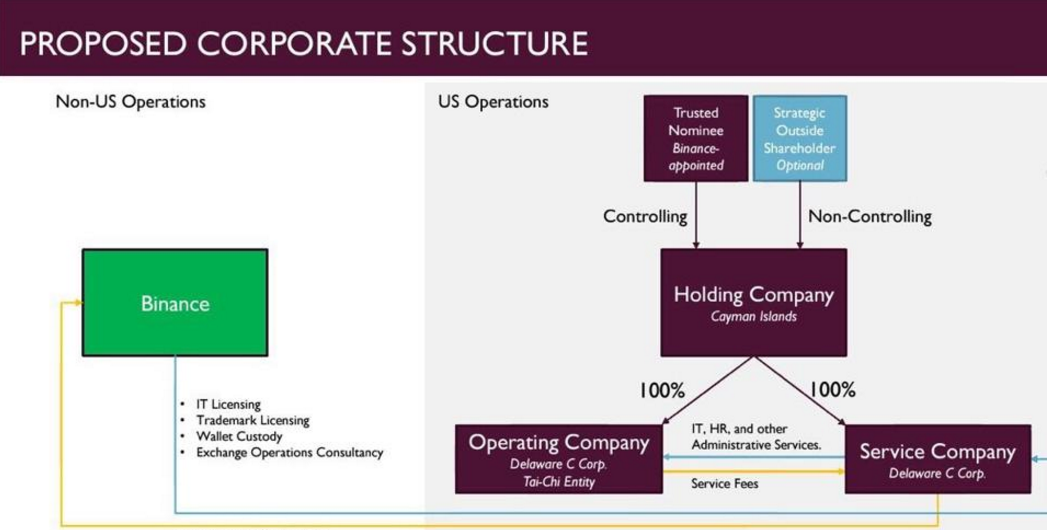
The PPT document obtained by Forbes
Zhao Changpeng and other Binance executives labeled the article as false reporting, asserting that the document was not created by former or current Binance employees but was a proposal from law firm personnel that was ultimately not adopted. The author Castillo also mentioned in the article that the obtained document was titled "Presentation 2," indicating that Binance might be considering other strategies, but he still believed that the analysis of the document showed that many of the details described had been implemented.
In June 2019, the second year after the aforementioned secret document was created, Binance announced that it would cease providing services to individual and corporate clients in the U.S., while also announcing a partnership with BAM Trading Services to launch Binance US. This platform is operated by BAM (reported to be fully named Binance America, which has ties to Binance) and will use Binance's wallet and matching engine technology to provide services to the U.S. market in full compliance.
This action aligns closely with the plan mentioned in the document, establishing an independent operational entity responsible for Binance's expansion in the U.S. market, with Binance primarily responsible for technology output. The intention may be to minimize the connection between Binance and Binance US, so that if Binance US were to be investigated for violating anti-money laundering rules in the highly regulated U.S. market, it would not adversely affect the operations of Binance itself.
Castillo also analyzed that if Binance US were merely a practical subsidiary, its parent company could potentially bear responsibility for regulatory violations by the subsidiary. However, if Binance US only has a contractual relationship with Binance, it would not need to bear such responsibility. BAM Trading CEO Catherine Coley also told Castillo that the company has no ownership relationship with Binance or Zhao Changpeng.
However, aside from this point of verification, there is no actual evidence to support the other specific measures to divert regulatory attention mentioned in the secret document. As for the strategy of entering the U.S. market through partnerships, this is not unique to Binance; Huobi previously adopted a similar strategy in the U.S. market, emphasizing that HBUS is not "Huobi America," and that Huobi is not a parent-subsidiary relationship, but merely an "exclusive strategic partner."
It can be considered that this strategy is a compromise for exchanges that are reluctant to easily give up the highly influential U.S. market, yet are concerned that high compliance costs and stringent compliance procedures may affect their market competitiveness. For instance, aggressive market promotion and listing mechanisms may be difficult to sustain. Therefore, reducing operational risks and costs may be the primary motivation for exchanges to adopt this strategy.
However, the exchanges' evasion of regulation also indirectly indicates that their customer identity verification and other compliance mechanisms cannot meet the strictest regulatory standards, especially since some exchanges allow trading and withdrawals without KYC, which may facilitate money laundering and other illegal activities in the eyes of regulators, necessitating severe crackdowns. Castillo pointed out in the article that there are speculations that the FBI and IRS may be investigating Binance, but again, there is no evidence to support this.
3. Compliance Anxiety of Exchanges
Although many speculations lack evidence, in the current unique atmosphere and context of the exchange industry, those seemingly credible documents and speculations are enough to capture many people's attention and even become important material in the exchanges' public relations battles.
In fact, since the recent detention of OKEx founder Xu Mingxing by the police, there have been multiple targeted public relations battles between Huobi and Binance. Various communities have circulated rumors that Huobi's legal team was taken away by the police, prompting Huobi to issue a notice offering a reward of 1 million USDT for evidence of the rumors, directing the blame towards Binance.
When Binance's "dirt" emerged and was widely disseminated by Jinse Finance, He Yi immediately pointed the finger at Huobi, resulting in disputes with Huobi in multiple communities, with Huobi's Du Jun and Qi Ye also getting involved, highlighting the intensity of the public relations battle between the exchanges.
Looking at the situation now, compliance has become the most sensitive pain point for mainstream exchanges. Even if trading operations reach the level of BitMEX and OKEx, they cannot escape the "iron fist" of regulatory agencies, which has a significant negative impact on the competitiveness of exchanges. This has led to a sharp increase in compliance anxiety for both Huobi and Binance, making them particularly sensitive to related rumors.
Undoubtedly, Binance has been thriving in trading operations this year, capitalizing on the early layout of DeFi tokens and benefiting from the detentions of executives from competitors like BitMEX and OKEx. A large number of investors and quantitative institutions have shifted their trading focus to Binance, resulting in significant breakthroughs in the Chinese market, achieving impressive results in spot, futures, and platform tokens since the third quarter of this year.
However, in terms of compliance, despite Binance's continuous promotion of obtaining fiat licenses in multiple countries and maintaining close cooperation with law enforcement agencies worldwide, it has yet to obtain any formal exchange licenses from major countries and has faced warnings from regulatory agencies in Japan, Malta, and other countries, leaving it without a definite "home." Compliance issues are akin to a sword of Damocles hanging over Binance's head.
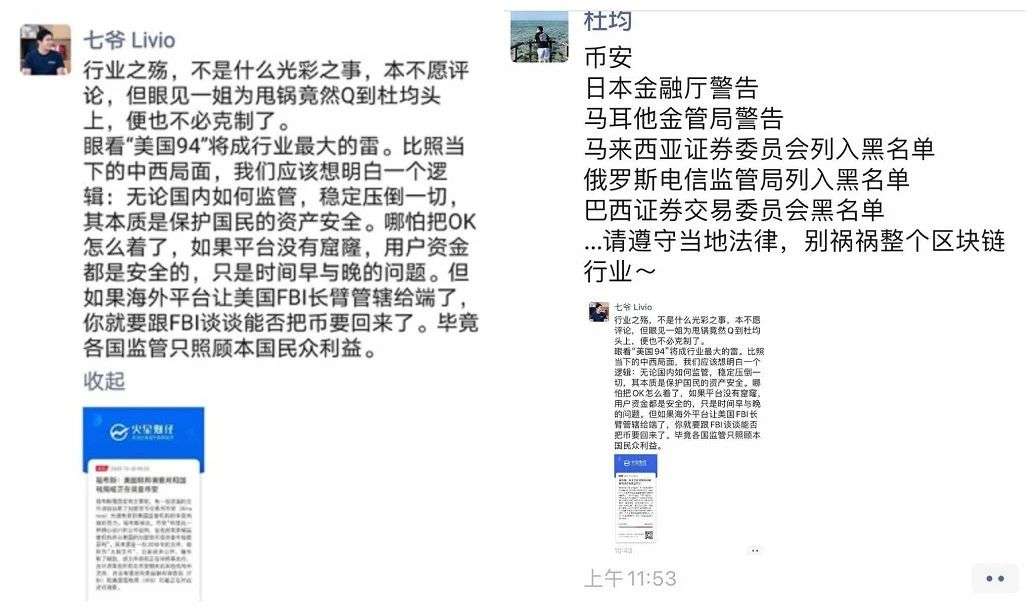
Huobi believes that its reliance on domestic operations and regulatory logic is a significant advantage and that it will not cause substantial losses to user assets. However, based on the recent incidents faced by OKEx, aside from extreme possibilities, different types of regulatory crackdowns could also occur, and even a temporary suspension of withdrawals in the short to medium term could lead to significant panic and losses for users, severely weakening the platform's competitiveness.
Limited by the developmental stage of the industry, compliance is inevitably a long-term proposition for exchanges. Currently, mainstream exchanges are seizing each other's pain points to attack and harm one another, reflecting the fierce nature of vicious competition in the exchange industry. However, this does not solve the problem; ultimately, it must return to the level of products and services, as doing no harm is the greatest premise for compliance.
 Risk warning
 Risk warning
Popular articles