The current status, challenges, and imaginative space of the NFT ecosystem development on BSC

 NFT is leading the cryptocurrency industry from a niche circle to a broader general audience.
This article is an original piece by Chain Catcher, authored by Hu Tao.
In 2021, NFTs, a novel form of cryptocurrency, seemingly became a hot topic overnight, with "Everything is NFT" becoming a symbolic slogan in the crypto community.
As a form of cryptocurrency that can connect with the real world, NFTs have experienced rapid growth by effectively combining with DeFi and riding the wave of the cryptocurrency bull market.
From NBA star LeBron James' classic dunk moments to Twitter founder Jack Dorsey's historic first tweet, and to crypto artist Beeple's digital artwork "Everydays: The First 5000 Days" selling for a staggering $69.34 million, it is evident that NFTs are leading the cryptocurrency industry from niche circles to a broader general audience. According to data from NonFungible.com, from 2017 to 2020, the total market value of NFTs skyrocketed from $31 million to $320 million, with a growth rate exceeding 9 times and an average growth rate of 300%. Additionally, a recent report from Protos indicated that the peak daily trading volume of NFTs reached an astonishing record of $102 million this year, with some industry insiders even predicting that the total market value of NFTs could surpass $700 million this year.
It can be said that 2021 is undoubtedly the "Year of NFTs."
1. In the explosive growth of the industry, which public chain will become the first choice for NFT projects?
On April 16, according to Coingecko data, the total market value of NFTs surpassed $30 billion for the first time, setting a historical record. Although the entire cryptocurrency market faced a "Black May" in May this year, causing the NFT market value to be halved, as the market gradually recovers, the NFT industry is also slowly bouncing back. As of the time of writing this article (June 15), the total market value of NFTs has rebounded to $17.9 billion.
However, while the overall market is improving, some issues have emerged one after another.
At this stage, most NFT projects are still running on the Ethereum network, but many users are still troubled by its limitations. It is not an exaggeration to say that improving Ethereum's performance has always been a goal for NFTs and the entire cryptocurrency industry. However, to this day, the high gas fees and network capacity issues have not been fully resolved, and the impact of this on the cryptocurrency market is greater than initially imagined.
On the other hand, although the Beacon Chain has successfully launched, it will still take a long time for Ethereum 2.0 to complete its deployment. In this context, some DeFi and NFT projects have begun to explore migrating to other blockchains, including exchange public chains like Binance Smart Chain (BSC) and public chains like FLOW that are specifically aimed at the NFT market.
To give everyone a more intuitive understanding of Ethereum, BSC, and FLOW public chains, let's let the data speak for itself and compare these three most important public chain infrastructures for the NFT market (data sourced from the internet, data extraction date June 15, 2021):
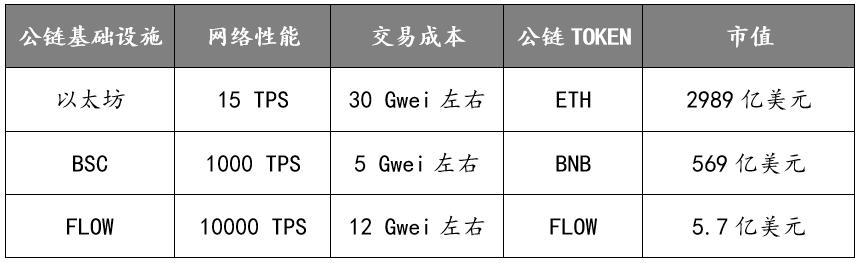
Overall, BSC leads Ethereum in performance and transaction costs, with the current block time averaging around 3 seconds and a daily transaction volume consistently exceeding 5 million. Recently, the number of unique active wallets on BSC reached a peak of 1,293,686, which is 1.77 times that of Ethereum during the same period. Additionally, compared to other similar exchange public chain products on the market, BSC miners are rewarded with gas, which is distributed according to the miners' staking ratios.
In contrast, while there are 11 crypto projects on Ethereum with locked amounts exceeding $1 billion, it is worth noting that these projects have been online for almost three years, highlighting BSC's unique advantages in supporting DeFi and NFTs; otherwise, it would be difficult to attract such a large amount of locked value in just a few months.
Recently, Binance also launched the second phase of the Most Valuable Builder (MVB) accelerator program, with the theme "NFT Explosion," focusing on the NFT ecosystem on BSC, innovative NFT+DeFi development, and high-performance infrastructure construction. The selected project teams will have the opportunity to receive incentives such as bonuses, community support, and investment from Binance, contributing to the development of the BSC ecosystem. As of early June 2021, the number of registered MVB projects reached 356, with a total locked value of $1.8 billion.
In fact, beyond stronger network performance and lower fees, BSC also performs well in infrastructure— including extensive wallet support, fiat on-ramp channels and payments, NFT bridges, APIs, and more. The BSC ecosystem is largely composed of infrastructure and tooling projects, bridges that enable cross-chain interoperability, APIs that facilitate seamless data sharing and processing, and security projects that analyze networks and provide risk assessments.
In terms of user experience, many well-known wallets currently support the ERC721 standard on BSC and maintain good security records, such as Trust Wallet, MetaMask, Math Wallet, SafePal, and Binance Extension Wallet.
By partnering with TransakFinance, BSC has established its own fiat on-ramp channel, allowing users to purchase BEP-20 assets with fiat without going through a trading platform. BSC is also compatible with Binance Pay, Binance Card, and other payment products, enabling users to receive and spend supported tokens.
2. Current Status and Challenges of the NFT Ecosystem on BSC
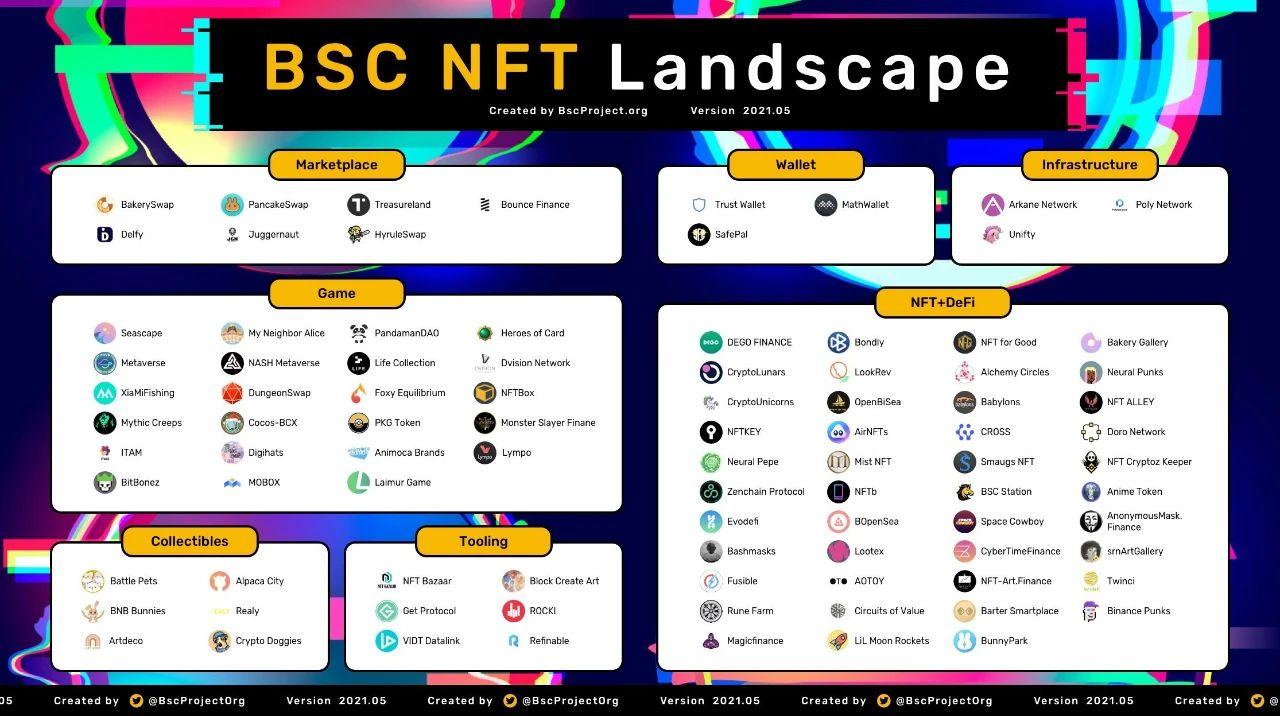
Data Source: BSCProjectorg
Although it has been less than a year since its launch, the diversity of NFTs on BSC is already relatively high. According to BSCProject data, as of the time of writing this article, BSC has launched a total of 650 projects, with NFTs primarily covering six vertical ecological areas: digital art, gaming, metaverse, social media, NFT+DeFi, and infrastructure, including star projects from various NFT tracks, such as:
BakerySwap, as a member of the Marketplace track in the BSC NFT ecosystem, is a decentralized exchange (DEX). Unlike many DeFi projects, BakerySwap is built on BSC and adopts an automated market maker (AMM) model, making it the first AMM and NFT platform on BSC.
Notably, Elon Musk's mother, Maye Musk, recently revealed that she will launch her #DiamondsAreForever NFT blind box series in collaboration with Koda on June 18, with the series going live on BakerySwap on June 24.
Dego, as a member of the DeFi+NFT track in the BSC NFT ecosystem, brings a new concept for a sustainable DeFi ecosystem. It adopts a modular combination design concept, integrating different products into one system to achieve a 1+1>2 effect, and can be used for governance, collateral, fees, and other scenarios in the NFT ecosystem.
Moreover, there are currently six crypto projects on BSC with locked amounts exceeding $1 billion, namely: PancakeSwap ($7.68 billion), Venus ($2.66 billion), Belt Finance ($1.77 billion), MDEX ($1.54 billion), Pancake Bunny ($1.08 billion), and Ellipsis ($1.04 billion).
In contrast, while there are 11 crypto projects on Ethereum with locked amounts exceeding $1 billion, it is important to note that these projects have been online for almost three years, highlighting BSC's unique advantages in supporting DeFi and NFTs; otherwise, it would be difficult to attract such a large amount of locked value in just a few months.
As more and more NFT players attempt to enter BSC, competition is bound to increase. In the long run, the current dominant NFT ecosystem categories and use cases led by Marketplace, gaming, DeFi+NFT, and artworks will also change, with other more sustainable NFT ecosystem categories and use cases entering BSC.
However, due to BSC's compatibility with EVM (Ethereum Virtual Machine), it is easy to create BSC clone versions of Ethereum dApps and NFTs, which has drawn criticism from the crypto community. For example, Binance Punks (Bunks) is very similar to CryptoPunks on the Ethereum blockchain, Bashmasks is considered a "copy" of the Ethereum NFT art project Hashmasks, and Musical Beats also seems to be "replicating" EulerBeats.
To some extent, we can consider BSC as a community-driven public chain where anyone can deploy projects. In the context of an ecosystem explosion, there will inevitably be a mix of project quality, with both innovation and imitation. In fact, the BSC community has been advocating for innovation, such as Cybertino in the NFT direction, which is the world's first interactive NFT marketplace for influencers and their fans, signing contracts with numerous top influencers with over 200 million followers.
In the short term, BSC will still face criticism from some crypto fundamentalists regarding its "copying," coupled with the fact that Ethereum has been running for eight years and has undergone multiple market tests. BSC will need to continuously break through in terms of security, developer reputation, and performance stability in the future.
3. What kind of public chain is needed for the explosive growth of NFTs in the next 3 to 5 years?
Frankly speaking, the cryptocurrency industry may hope to see further innovations in NFTs on a macro level, such as:
Partial ownership of real assets: Imagine if a certain crypto artist's next real work could allow people to own a portion of it, enabling NFT investors to gain returns upon resale;
Derivatives: NFT collateral, meaning that after purchasing an NFT, people can use it as collateral (to borrow) and utilize it to purchase other assets;
Interoperability across all platforms: NFTs can be used across different ecosystems. Imagine a scenario where BSC, Ethereum, and FLOW, and even other exchange public chains interact seamlessly— in fact, Binance's NFT trading platform MarketPlace is set to launch on June 24, focusing on supporting the BSC ecosystem.
It is understood that the platform will collaborate with several well-known figures, including Lewis Capaldi, a Brit Award winner, visual artist Trevor Jones, esports team eStarPro, basketball star Kyrie Irving, and Alphonso Davies, to launch their NFT works.
To achieve the above effects, the NFT industry may impose higher requirements on public chains in terms of performance and thresholds. Compared to Ethereum, NFTs based on the BSC ecosystem do have certain advantages.
Undoubtedly, the NFT world is vibrant and full of potential, and more and more NFT projects are eager to accelerate the mainstreaming and breaking of NFTs. As the infrastructure of exchange public chains continues to improve, many new ideas and projects related to NFTs will accelerate their implementation.
NFTs reveal infinite possibilities. If Bitcoin brought about a revolution in financial sovereignty, then NFTs bring a revolution in digital asset ownership, which may push the entire blockchain ecosystem development to incredible heights and dimensions. Today, NFTs are no longer a "pure" digital asset but have become a symbol of ownership, meaning that having an NFT signifies a claim to the ownership of the underlying asset.
As the development of Ethereum 2.0 accelerates and vertical NFT public chains like FLOW create better user experiences and richer application scenarios for consumers, the competitive landscape for NFTs may be variable. However, it is undeniable that BSC's advantages are further expanding, which will inevitably have a more profound impact on the NFT ecosystem. It is worth paying attention to who is most likely to become the primary public chain for NFTs.
For the crypto community, being in the NFT year is fortunate. Who will become the "Next Big Thing" in this field? We shall see.
 Risk warning Risk warning