








Morning News | AEON completes $8 million Pre-Seed round financing led by YZi Labs; Goldman Sachs liquidates XRP and Solana ETF holdings in Q1; Strategy increased its holdings by 24,869 BTC last week
 Overview of Important Market Events on May 18
整理:ChainCatcher
Important News:
- Tom Lee: The selling pressure on Ethereum mainly comes from rising oil prices; if oil prices fall, Ethereum will rebound
- Goldman Sachs liquidated its holdings in XRP and Solana ETFs in Q1, still holding over $700 million in Bitcoin ETFs
- Tether announces investment in cross-border financial platform LemFi
- AI settlement layer AEON completes $8 million Pre-Seed funding round, led by YZi Labs
- Bitwise announces it will allocate 10% of Hyperliquid ETF management fees to hold and support HYPE
- Strategy spent $2.01 billion last week to increase its holdings by 24,869 BTC
- Kraken's parent company Payward reports a 3% year-on-year revenue increase in Q1, with derivatives business surging 51%
What important events occurred in the past 24 hours?
Kraken's parent company Payward reports a 3% year-on-year revenue increase in Q1, with derivatives business surging 51%
According to ChainCatcher, Payward, the parent company of Kraken, announced its Q1 2026 performance, showing an adjusted revenue of $507 million, a 3% year-on-year increase, achieving growth despite the overall downturn in the crypto market.
The report indicates that Payward's futures business performed strongly, with daily average revenue trades (DARTs) increasing by 51%, mainly benefiting from the expansion of NinjaTrader, Breakout, and derivatives business.
However, the company's adjusted EBITDA fell to $18 million. Payward stated that it continues to invest in mergers and acquisitions, product development, and regulatory infrastructure rather than prioritizing short-term profits.
Data shows that during Q1 2026, Bitcoin fell by 22%, the total crypto market cap shrank by 23%, and industry spot trading volume decreased by 38%. In contrast, Kraken's performance during the bear market remained relatively stable.
Payward co-CEO Arjun Sethi stated, "While other companies choose to contract, we choose to continue investing."
Additionally, the company disclosed that Kraken's spot market share has increased from about 3.5% in mid-2025 to 5.2% in March 2026; the number of funded accounts on the platform grew by 47% year-on-year to 6.1 million, and the platform's asset scale rose to $40 billion.
According to ChainCatcher, Bitmine Immersion Technologies (NYSE: BMNR) announced that its ETH holdings have increased to 5.28 million, with a total value of approximately $12.6 billion, accounting for 4.37% of the current total supply of 120.7 million ETH, achieving about 87% of its goal to hold 5% of ETH supply.
The announcement showed that Bitmine currently has 4.7129 million ETH staked, valued at approximately $10.3 billion based on an ETH price of $2,191. In addition to ETH, the company also holds approximately $685 million in cash and other crypto assets and disclosed its holdings of about $83 million in Nasdaq-listed Eightco (NASDAQ: ORBS), making it one of the few publicly traded companies that can indirectly provide investors with exposure to OpenAI.
Bitmine stated that Ethereum continues to benefit from two major trends: "Wall Street asset tokenization" and the growing demand for open, neutral public blockchains from AI systems. The company also mentioned that its MAVAN (Made in America Validator Network) is an Ethereum staking platform aimed at institutional investors, focusing on security, yield, and network resilience.
In terms of market performance, Bitmine stated that BMNR has now become the 133rd stock by trading volume in the U.S., with an average daily trading volume of approximately $857 million over the past five days. The company has also received support from institutions and investors such as ARK founder Cathie Wood, Founders Fund, Pantera, Kraken, DCG, Galaxy Digital, and Tom Lee.
Bloomberg: Iran launches "Bitcoin-backed" shipping insurance mechanism for the Strait of Hormuz
According to ChainCatcher, Bloomberg reported that Iran has begun to introduce Bitcoin-based shipping insurance arrangements for the Strait of Hormuz to address the current high-risk navigation environment in the strait.
Recently, Iran has launched a maritime insurance platform named "Hormuz Safe," providing digital insurance services for vessels passing through the Strait of Hormuz and allowing payments in cryptocurrencies, including Bitcoin.
Amid escalating U.S.-Iran tensions and risks in the Strait of Hormuz, the cost of marine war insurance has surged significantly. Bloomberg previously reported that the insurance cost for some vessels crossing the Strait of Hormuz has risen to about 5% of the vessel's value.
Strategy spent $2.01 billion last week to increase its holdings by 24,869 BTC
According to ChainCatcher, Michael Saylor posted on the X platform that Strategy bought 24,869 Bitcoin last week for approximately $2.01 billion, with an average price of about $80,985.
As of May 17, 2026, Strategy has accumulated a total of 843,738 Bitcoin, with a total holding cost of approximately $63.87 billion, an average price of about $75,700, and a BTC return of 12.6% year-to-date in 2026.
Tether announces investment in cross-border financial platform LemFi
According to ChainCatcher, Tether announced its investment in cross-border financial platform LemFi to promote the use of stablecoins in remittance scenarios in emerging markets and expand the coverage of borderless financial infrastructure.
LemFi primarily serves cross-border users living and working in the UK, US, Canada, and Europe, providing financial services for remittances to Africa and Asia. Tether stated that this investment will support LemFi in introducing USD₮ as a settlement layer in major cross-border corridors, replacing traditional SWIFT multi-day settlement processes to achieve lower costs and near-instant cross-border transfers.
Both parties also plan to further expand the stablecoin infrastructure, gradually integrating USD₮ into LemFi's broader product system to provide more stable, transparent, and convenient financial services.
Tether CEO Paolo Ardoino stated that the company hopes to promote global financial inclusion by supporting scalable financial solutions and believes that cross-border payments should focus more on speed, cost, and transparency.
Delphi Digital: Aave's three core markets have structural issues, losing about $52 million annually
According to ChainCatcher, Delphi Digital pointed out in a recent article that WETH, USDT, and USDC are the three largest lending markets on Aave's Ethereum market, accounting for 89% of total borrowing. The supply interest rates in these three markets are about 25%-35% lower than the borrowing rates, resulting in an annual loss of about $52 million, nearly half of Aave's annualized revenue for the first quarter. Even if the reserve factor is completely eliminated, there would still be a loss of about $36 million.
Delphi believes that Aave's peer-to-pool model has significant structural flaws. The KelpDAO bridge attack on April 18 further exposed this issue. The attacker leveraged $292 million in rsETH to engage in leveraged borrowing on Aave, leading to nearly $200 million in bad debts for Aave, with WETH and other major markets experiencing 100% utilization rates frozen for up to 5 days.
Bitwise announces it will allocate 10% of Hyperliquid ETF management fees to hold and support HYPE
According to ChainCatcher, Bitwise tweeted that it will allocate 10% of the management fees from its Hyperliquid ETF ($BHYP) to hold HYPE on the company's balance sheet, taking concrete action to support the development of the Hyperliquid ecosystem.
Bitwise emphasized that Hyperliquid adopts a community-first model, with 99% of blockchain revenue used for repurchasing and burning HYPE, stating, "If the protocol succeeds, the community should succeed." Bitwise's decision to hold HYPE is based on this principle.
AI settlement layer AEON completes $8 million Pre-Seed funding round, led by YZi Labs
According to ChainCatcher, The Block reported that AI settlement layer AEON has completed an $8 million Pre-Seed funding round, led by YZi Labs, with participation from IDG Capital, HashKey Capital, Stanford Blockchain Builders Fund, and Oak Grove Ventures. The structure of this funding round and post-investment valuation have not been disclosed. AEON plans to use this funding to develop a settlement layer aimed at supporting interactions between AI agents.
AEON launched its first AI payment product in May, enabling AI agents to connect with over 50 million physical merchants worldwide. Additionally, AEON has partnered with BNB Chain to launch a product natively built on BNB Chain infrastructure called x402 Facilitator, providing verifiable transactions, on-chain settlements, and immutable receipts for service providers within the BNB ecosystem.
Standard Chartered to acquire crypto custody business of its subsidiary Zodia Custody
According to ChainCatcher, Bloomberg reported that Standard Chartered will acquire the crypto asset custody business of its subsidiary Zodia Custody, with its non-binding acquisition offer accepted by other shareholders and noteholders of Zodia Custody. Margaret Harwood-Jones, Global Head of Financing and Securities Services at Standard Chartered, stated that this merger will pave the way for Standard Chartered to launch crypto custody services in new markets such as the UK and Australia.
After the acquisition is completed, Zodia Custody's infrastructure business will continue to operate as an independent software-as-a-service company, renamed Zodia Solutions, led by current CEO Julian Sawyer, with Standard Chartered's venture capital department holding a majority stake in Zodia Solutions. Existing shareholders of Zodia Custody include Northern Trust, Emirates NBD, National Australia Bank, and SBI Holdings, and discussions are ongoing regarding whether they will continue to hold shares in Zodia Solutions.
According to ChainCatcher, during the recent market volatility, two major institutional market makers on the Hyperliquid platform significantly reduced their positions simultaneously. Over the past 2 hours, Auros Global's market-making address closed all positions on the platform and withdrew approximately $6 million to Binance. Previously, this market maker had provided liquidity for 175 cryptocurrencies, with a market-making scale of $45 million for BTC alone.
At the same time, Wintermute also significantly reduced its market-making exposure on Hyperliquid. According to Hyperinsight data, its liquidity provided for BTC and ETH has decreased by about 90%, with the combined market-making scale for the two major cryptocurrencies dropping from about $40 million to $4 million. Although Wintermute still holds positions in 111 cryptocurrencies and maintains high-frequency orders, its total position size has decreased from nearly $80 million to $41 million. The total estimated reduction in positions by the two market makers could reach $100 million.
Tom Lee: The selling pressure on Ethereum mainly comes from rising oil prices; if oil prices fall, Ethereum will rebound
According to ChainCatcher, Tom Lee, co-founder of Fundstrat and chairman of BitMine, stated on the X platform that Ethereum is currently facing selling pressure, primarily due to rising oil prices, with the negative correlation between ETH and oil prices at an all-time high.
During the past six weeks of rising oil prices, the price of Ethereum has fallen; if oil prices decline, Ethereum is expected to recover. Lee believes this is a short-term tactical fluctuation, with the larger driving forces for Ethereum coming from tokenization and AI agents, as these structural factors are already in place, and it is expected that Ethereum's price will strengthen in 2026.
Arkham: Over 90% of the supply of the $4 billion LAB token is suspected to be controlled by a single entity
According to ChainCatcher, Arkham has issued a warning regarding the concentration of tokens in the $4 billion crypto project LAB. On-chain analysis published on X suggests that a single entity may control over 90% of the token's supply, with on-chain analyst ZachXBT indicating that the internal holding ratio could be as high as 95%.
Aave updates rsETH technical recovery plan; WETH LTV has returned to pre-incident levels
According to ChainCatcher, Aave founder Stani Kulechov stated on the X platform that the next step of the rsETH technical recovery plan has been completed, and the loan-to-value (LTV) ratios for WETH across all affected networks have returned to pre-incident levels. Users can now again borrow on Aave using WETH as collateral, including through collateral and debt swaps.
According to Aave's announcement, this recovery involves deployments on Aave V3 Ethereum Core, Ethereum Prime, Arbitrum, Base, Mantle, and Linea networks.
According to ChainCatcher, Ethereum co-founder Vitalik Buterin commented on the issue of Ethereum state storage, stating that even if users store data themselves, the blockchain only stores hashes and transactions only contain proofs, there is still a need to store and update the data used for verification, and this data ultimately becomes almost as large as the state itself; Vitalik noted that there are solutions to the relevant issues, but they involve many components and require trade-offs compared to the current Ethereum.
Previously, DeFi content writer marilyn100x.eth stated that Ethereum has a state storage problem, where developers pay a one-time fee to write data, while nodes bear long-term storage costs, but EIP-8037 does not impose time-weighted rent or ongoing fees, instead significantly increasing the upfront gas costs for new contracts, accounts, and storage slots to control state growth during scaling.
Data: Verus Ethereum cross-chain bridge attacked, resulting in losses of approximately $11.58 million
According to ChainCatcher, Blockaid's monitoring system detected that the Verus Ethereum cross-chain bridge (verus.io) is currently under attack, resulting in losses of approximately $11.58 million.
Goldman Sachs liquidated its holdings in XRP and Solana ETFs in Q1, still holding over $700 million in Bitcoin ETFs
According to ChainCatcher, Goldman Sachs significantly reduced its exposure to crypto ETFs in Q1 2026 and has completely liquidated its holdings in XRP and Solana-related ETFs. Documents show that Goldman Sachs held approximately $154 million in XRP-related ETFs in Q4 2025, including products from Bitwise, Franklin Templeton, Grayscale, and 21Shares, making it one of the largest institutional holders of XRP ETFs at that time. Additionally, it previously held Grayscale Solana Trust ETF, Bitwise Solana Staking ETF, and Fidelity Solana Fund, all of which have now been exited.
However, Goldman Sachs still retains a significant position in BTC and ETH ETFs. It holds approximately $690 million in BlackRock's IBIT and about $25 million in Fidelity's FBTC, although both positions have decreased by about 10% compared to the previous quarter. Meanwhile, its position in BlackRock's ETHA has shrunk by about 70%, leaving approximately 7.2 million shares valued at about $114 million. Furthermore, Goldman Sachs has increased its holdings in crypto-related stocks such as Circle, Galaxy Digital, Coinbase, Robinhood, and PayPal, while reducing positions in mining and infrastructure companies like Strategy, Bit Digital, Riot Platforms, and IREN.
Korea's FSC is reviewing whether Hana Bank's acquisition of Dunamu shares violates regulatory rules
According to ChainCatcher, iNews24 reported that the Financial Services Commission (FSC) of South Korea is reviewing whether Hana Bank's acquisition of Dunamu shares violates the "separation of finance and virtual assets" regulatory rules. The virtual asset department of the FSC stated that Hana Bank indirectly holds shares in Dunamu through its acquisition of Kakao Investment shares, which is essentially an investment in a virtual asset exchange and will be examined under the same standards.
Since 2017, the South Korean government has prohibited financial institutions from holding, purchasing virtual assets, or making equity investments through administrative guidance. If found in violation, Hana Bank may not be able to complete the transaction. Future Asset Consulting is advancing the acquisition of Kobit’s operating rights, and Korea Investment Securities is also taking a cautious approach. Hana Bank previously announced its acquisition of a 6.55% stake in Dunamu but did not consult with authorities beforehand.
Currently, the "separation of finance and virtual assets" regulation has not been formally legislated, and it is uncertain whether relevant provisions will be included in the digital asset bill, with legislative discussions potentially advancing after the National Assembly reconvenes in September.
Meme Popularity Rankings
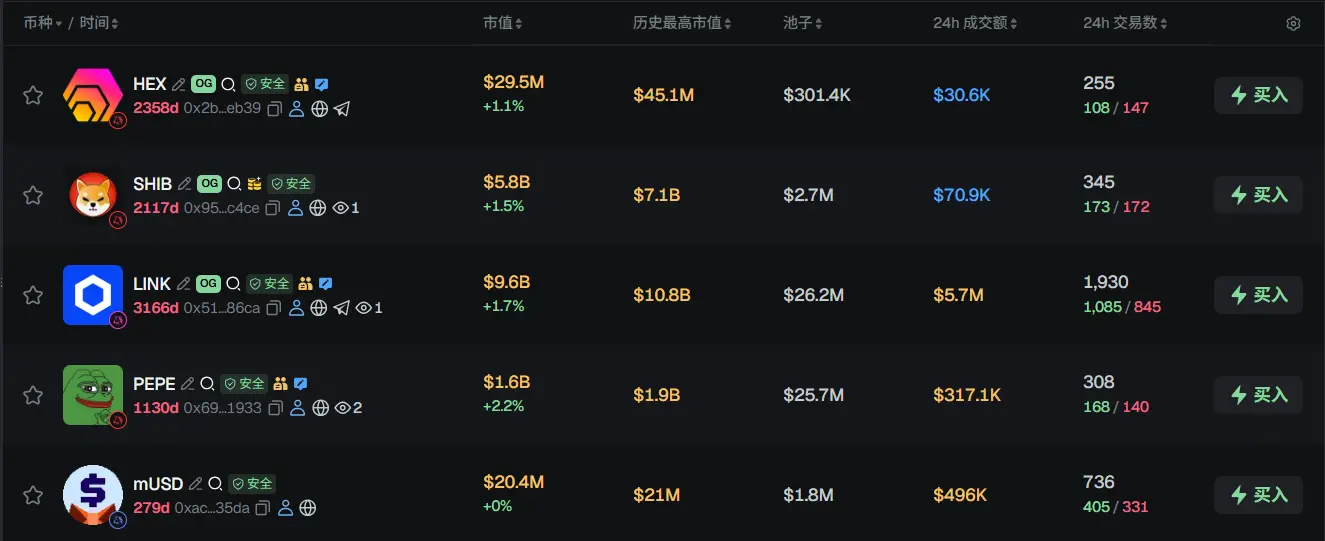
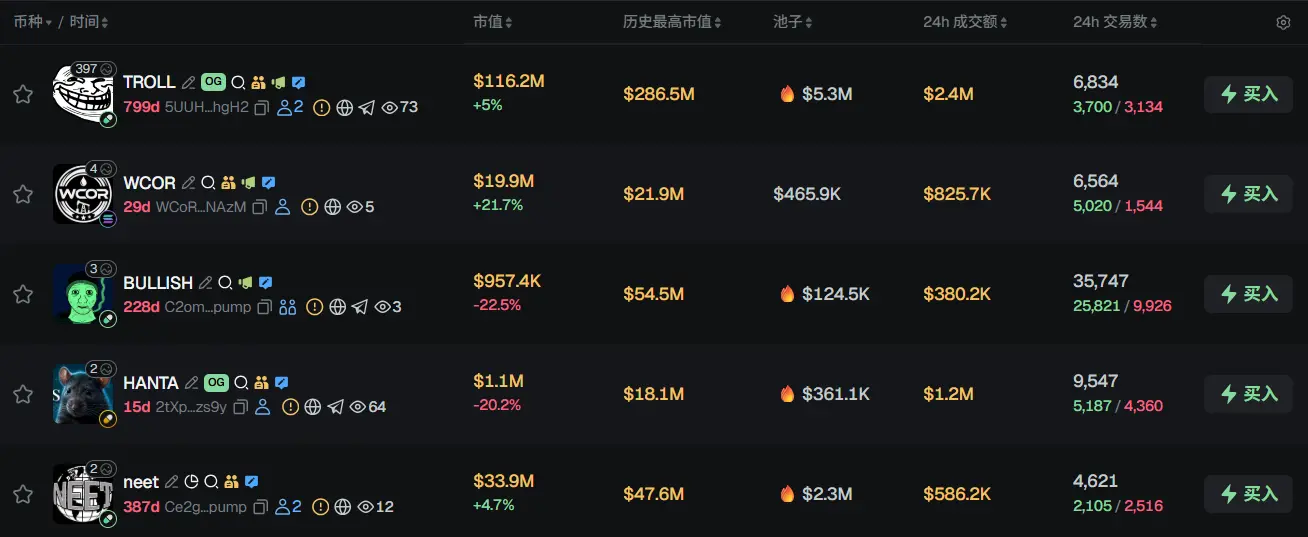
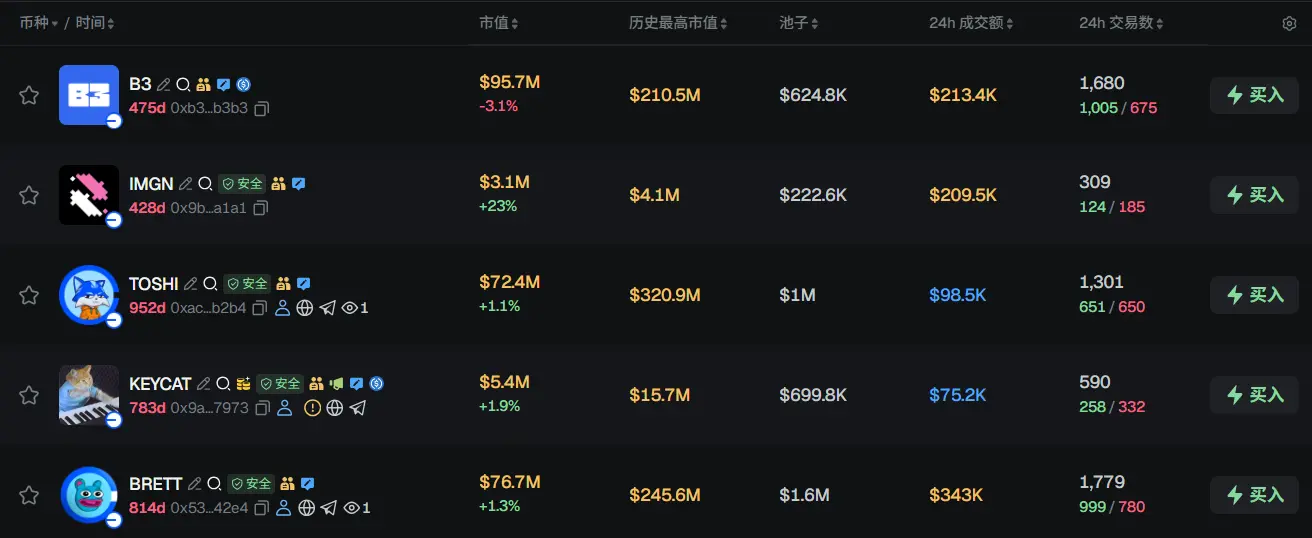
According to the meme token tracking and analysis platform GMGN, as of May 19, 09:00,
The top five popular tokens on ETH in the past 24 hours are: HEX, SHIB, LINK, PEPE, mUSD
The top five popular tokens on Solana in the past 24 hours are: TROLL, WCOR, BULLISH, HANTA, neet
The top five popular tokens on Base in the past 24 hours are: B3, IMGN, TOSHI, TOSHI, KEYCAT, BRETT
What are some interesting articles worth reading in the past 24 hours?
Blockchain Capital Partner: Most people's understanding of the on-chain economy is narrow
Most people view on-chain technology as a faster, more efficient version of existing technology: faster payments, lower settlement costs, and more efficient capital markets. Their perspective is not wrong. This alone holds immense opportunities and will spawn numerous venture-scale outcomes over the next decade.
But I believe this is only a small part of the story.
When I examine this technology and the various possibilities that can be achieved in a global, composable, always-online environment using programmable assets, I think we have only scratched the surface. The most astonishing things have yet to be created. The reason they have not been created is not that the technology is not mature, but that we have yet to fully conceive them.
When computing power is commoditized, how long will it take for the GPU futures market?
At Variant, we are passionate about exploring emerging markets. Emerging asset classes, financial products, asset issuance, market access expansion, and novel participation methods are deeply rooted in our founding DNA.
Recently, we have been thinking about the market built around computing power.
Acquiring computing power is a vast and growing field, which can be said to have the conditions for further financialization.
However, the supply and demand dynamics of computing power are highly complex, opaque, and constantly evolving. There are still many unanswered questions about market timing, structure, and even what the specific assets being traded are.
In the process of debating and discussing these issues, we hope to share an emerging analytical framework as a window to think about the computing power market.
Last weekend, Harvard Management Company (HMC) submitted its latest 13F holdings report to the U.S. Securities and Exchange Commission, revealing that its position in BlackRock's Bitcoin spot ETF (IBIT) has shrunk by another 43% compared to the previous quarter, while its holdings in Ethereum ETF (ETHA) have been completely liquidated.
In just two quarters, Harvard's public holdings in crypto assets have dropped from a peak of $443 million to about $117 million. As one of the top institutions managing the largest endowment funds in the world, this move has raised market questions: can even top talent escape the trap of buying high and selling low?
In fact, Harvard's ties to cryptocurrency go far beyond this. As early as 2018, several Ivy League endowment funds showed a strong interest in blockchain technology through venture capital funds focused on cryptocurrency. Reports indicate that Harvard, Yale, Brown, and the University of Michigan began quietly purchasing Bitcoin through exchanges like Coinbase around 2019.
 Risk warning


Popular articles





