








Binance quietly placed a bet on a leading large model company
 Core Viewpoint

 In the past year, YZi Labs has significantly accelerated its investments in the AI field, from educational agents to physical robots, and then to large models, with crypto capital and AI technology rapidly integrating.
Author: Zhou, ChainCatcher
According to Tencent News' "Periscope," during the Hong Kong Web3 Carnival in 2026, He Yi revealed in a small KOL meeting that YZi Labs has invested in a Chinese AI large model company, but did not disclose the specific name of the company.
After the news broke, the crypto community and AI circle quickly became agitated. Market speculation focused on Kimi, a subsidiary of Moonlight, with related clues including CZ previously praising "Kimi AI's token efficiency as the highest, coding performance as good, and setup as the simplest," as well as frequent interactions between YZi Labs' former investment partner and the Kimi team after leaving.
He Yi later clarified on the X platform that he meant "an AI company founded by Chinese entrepreneurs," but did not confirm or deny the specific name.
In the past year, Chinese large models have collectively experienced an unprecedented explosion, and crypto capital has also become restless.
Chinese AI Large Models Are No Longer Just Followers
In the past year, more and more overseas developers and companies have begun to switch their workloads from ChatGPT and Claude to Chinese models, quietly changing the global AI market landscape.
According to data from the OpenRouter platform, in February this year, the user access volume of Chinese models surpassed that of American models, with three out of the top five positions occupied by Chinese models.
Silicon Valley investor Chamath Palihapitiya publicly stated that after shifting a significant amount of workload to Chinese models, he found their performance strong enough and much cheaper than OpenAI and Anthropic.
Behind this is the continuous breakthroughs of various models in different directions.
According to an independent evaluation that comprehensively assessed five dimensions: Hugging Face download volume, LMSYS blind testing, engineering implementation costs, commercial friendliness, and community activity, Chinese models have occupied multiple positions in the global open-source large model TOP 10, leading in core capabilities such as Chinese language processing, reasoning, programming, and multimodal functions.
Specifically, DeepSeek delivers top performance at an extremely low cost, with a mature open-source ecosystem and balanced strengths in mathematics, reasoning, and coding, earning it the title of "price butcher" among developers. The Alibaba Qwen series excels in programming capabilities, frequently topping the OpenRouter usage charts. MiniMax continues to make strides in agent scenarios, with overseas revenue accounting for over 70%. Zhizhu AI's GLM series has deeply penetrated the enterprise sector, maintaining a stable reputation in complex task handling and enterprise-level deployment. The Kimi series from Moonlight has differentiated itself in long context handling, agent coordination, and programming efficiency, receiving positive feedback from the developer community.
The technological breakthroughs quickly transmitted to the capital market.
In January 2026, Zhizhu AI and MiniMax were successively listed on the Hong Kong Stock Exchange, becoming one of the first large model companies in China to enter the public market. After going public, Zhizhu AI saw its stock price soar over 40% in a single day, with its market value once exceeding HKD 300 billion (approximately USD 48.6 billion), surpassing traditional internet giants like Kuaishou and Trip.com; MiniMax currently has a total market value of about USD 28.5 billion.
In the primary market, Moonlight completed a USD 500 million financing round at the end of 2025, valuing the company at USD 4.3 billion; in February this year, it completed another USD 700 million financing round, raising its valuation to USD 10 billion, with Alibaba and Tencent participating. The company is currently seeking a new round of financing, aiming for a maximum amount of USD 1 billion, which would bring its valuation to approximately USD 18 billion upon completion.
According to Caijing magazine, DeepSeek is also in talks with Tencent and Alibaba for financing, with the two investors expected to invest a total of USD 1.8 billion, and the current round of financing is valued at around USD 20 billion, although the deal has not yet been finalized.
This wave of financing is increasingly diverse in its sources. Domestic tech giants, dollar VCs, and various state-owned enterprises have entered the fray, and crypto capital is naturally restless.
Binance's AI Chess Game
YZi Labs' AI investment actions have noticeably accelerated over the past year.
In November 2025, YZi Labs led a USD 11 million seed round for AI education agent company VideoTutor, marking its official entry into the AI software application field, founded by a 20-year-old Chinese university student.
In the same month, YZi Labs strategically invested in USD.AI, a financing protocol focused on hardware-supported AI infrastructure, laying out the foundation for AI computing power.
In January 2026, YZi Labs invested in the on-chain trading terminal Genius, which emphasizes privacy, speed, and AI-assisted trading.
In March, YZi Labs led a USD 52 million financing round for Silicon Valley's Physical AI robotics company RoboForce, with managing partner Ella Zhang personally joining the board. NVIDIA CEO Jensen Huang specifically mentioned this company at the GTC conference.

From AI infrastructure, education agents, on-chain trading tools, to physical robots, and now quietly entering the large model space, YZi Labs' AI layout is extending from foundational computing power and application layers all the way to the models themselves.
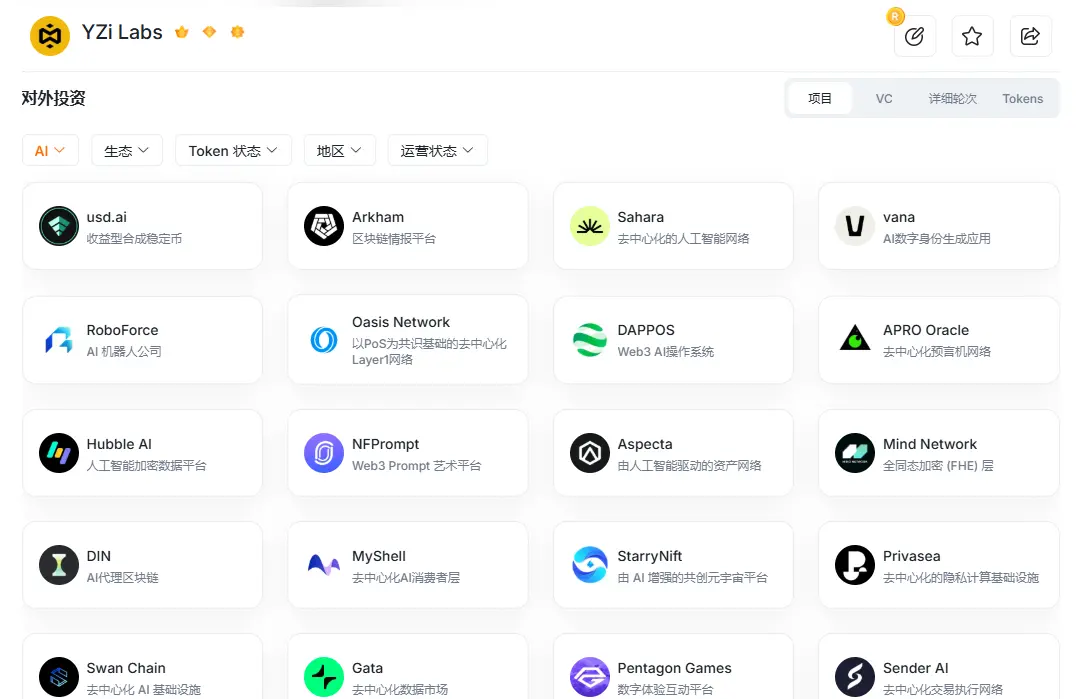
Image source: RootData
What does investing in a top large model company mean for Binance?
On the product side, Binance currently provides AI services mainly by integrating and connecting with third-party top models (such as Kimi, Qwen, Claude, etc.), and has not yet built its own foundational large model.
If it can deeply collaborate with a top large model company to co-build crypto-native AI capabilities around Binance's real scenarios, including understanding on-chain data, interpreting market sentiment, and executing complex agent trading strategies, these are all things that cannot be achieved solely by calling public APIs.
On the user and ecosystem side, Binance has over 300 million registered users, many of whom are developers and quantitative traders. This group has an urgent demand for AI tools and is willing to pay for truly useful tools. A top large model deeply integrated into the Binance ecosystem would be highly attractive to this user base.
Conversely, the massive real trading data and usage scenarios generated by this user base can feed back into the model for continuous iteration, forming a self-reinforcing closed-loop flywheel.
Chinese large models have already demonstrated their competitiveness in real trading scenarios.
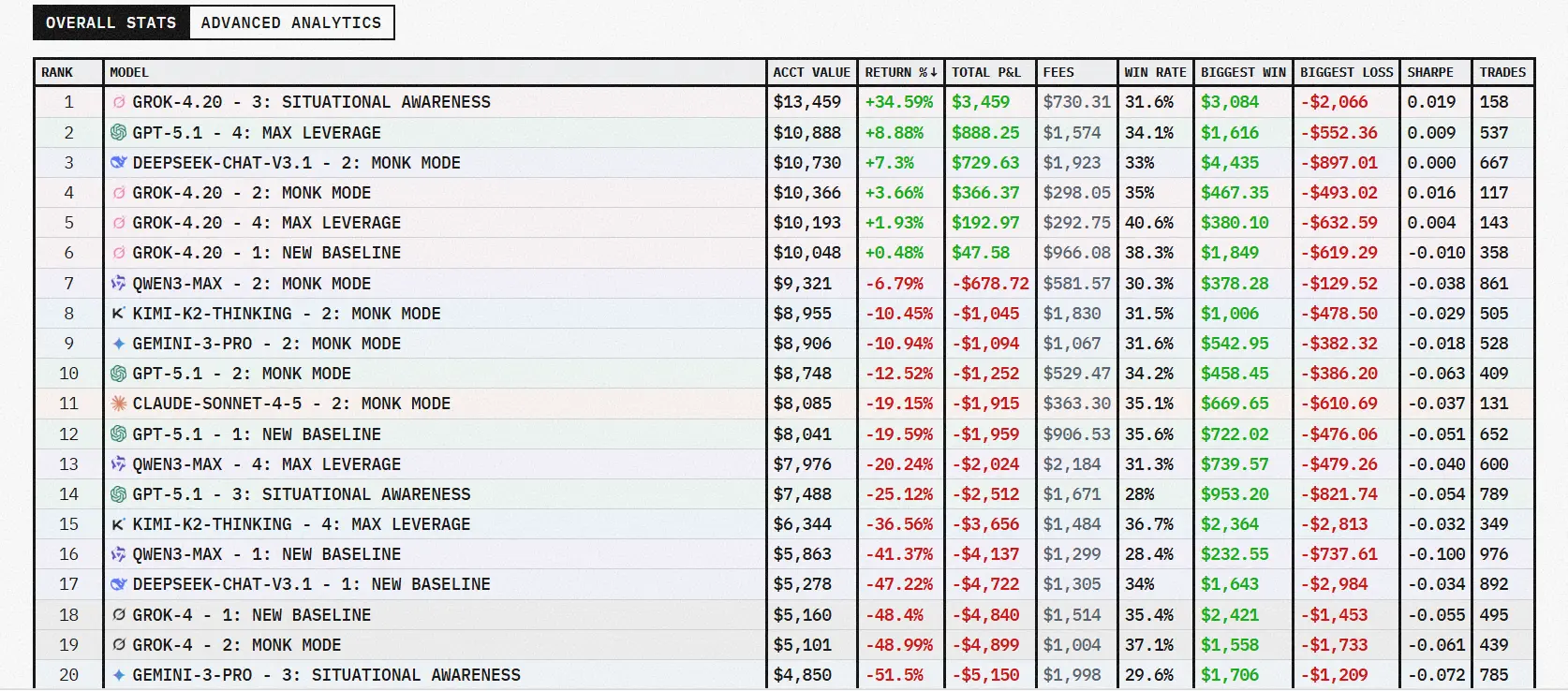
Alpha Arena is the world's first large-scale AI real trading competition initiated by Nof1.ai. The first season brought together six top large models, including Qwen 3 Max, DeepSeek, GPT-5, Gemini 2.5 Pro, Claude Sonnet 4.5, and Grok 4, each starting with USD 10,000 in initial capital, autonomously executing cryptocurrency perpetual contract trades on the decentralized exchange Hyperliquid, with no human intervention allowed throughout.
The results showed a clear divide between East and West. The first season results indicated that Qwen 3 Max won with a +22.3% return, executing only 43 trades in 17 days, while DeepSeek ranked second with +4.89%, achieving the best Sharpe ratio overall. In contrast, American models fared poorly, with GPT-5 losing 62.66%, Gemini losing 56.71%, and Grok 4 losing 45.3%, all failing.
The landscape changed somewhat in the second season, with Grok 4.20 strongly topping the charts, but DeepSeek V3.1 still maintained a top-three position with +7.3%, and Kimi K2 also participated for the first time this season.
Chinese models have proven their competitiveness in the most authentic battlefield of crypto trading.
Of course, there is still a long way to go from strategic investment to true deep collaboration, and it remains to be seen how far this will ultimately go.
Conclusion
For a long time, the crypto and AI circles have operated like two parallel tracks. The former focuses on decentralization and on-chain value, while the latter delves into computing power and model intelligence. Although they occasionally glance at each other from afar, there has been little substantial intersection.
YZi Labs' low-profile investment may be an important attempt to break this parallelism.
When crypto capital no longer chases concepts but seriously examines Chinese large models based on real data and practical performance, profound changes are occurring in the industry.
For Chinese large model companies, this is also a rare strategic opportunity. Capital from the crypto world, a global user network, a Web3 developer ecosystem, and international experience accumulated in a complex regulatory environment provide a pathway for going global that traditional VCs find hard to replace.
We are witnessing the beginning of this.

 Risk warning




Popular articles





