Solana was down for 30 hours, and its on-chain TVL dropped to 6th place

 In the past few months, this public chain has experienced multiple outages and congestion issues. As a result, its on-chain TVL ranking has been surpassed by public chains such as Terra and Fantom, dropping from third to sixth place. Network stability has become a major challenge faced by Solana during its development.
Author: Kyle, Wen Dao
From January 21 to 22, the cryptocurrency market experienced a significant decline, with BTC and ETH dropping by 23.78% and 33.7% respectively. As a result, on-chain value faced massive liquidations, creating arbitrage opportunities, and various blockchain networks became more congested than usual.
Among the public chains, Solana was thrust into the spotlight due to a 30-hour outage. Subsequent reports indicated that the network interruption was caused by the collapse of the cryptocurrency market, which created numerous arbitrage opportunities, leading liquidation and arbitrage bots to submit a large number of transactions, resulting in severe network load.
On January 23, the network gradually returned to normal, but this outage had a significant negative impact on Solana. In fact, over the past few months, the so-called "high-performance" Solana has experienced multiple outages and network congestion. In September last year, Solana suffered a 17-hour outage due to insufficient memory among validators; in December last year and January this year, it faced network congestion due to DDoS attacks.
The lack of network performance and stability has begun to put Solana at a disadvantage in the competition among public chains. According to data from Defi Llama on January 25, Solana's on-chain TVL (Total Value Locked) has dropped to $7.52 billion, a decrease of 38.62% over the past month, causing its TVL ranking among public chains to fall from third to sixth, the largest decline among the top 10 public chains.
In the secondary market, Solana's native token SOL has fallen from a historical high of $259.69 to $91, a decline of 65%, making it the native token with the largest drop among emerging public chains. In the fiercely competitive public chain market, Solana is experiencing growing pains.
Massive Liquidations Lead to 30-Hour Outage of Solana Network
The Solana public chain, which boasts high TPS (transactions per second), has once again fallen into outage troubles.
During the decline of the cryptocurrency market from January 21 to 22, the Solana network experienced its largest network interruption ever, preventing users from completing on-chain operations in real-time, and affecting some projects when deploying on-chain contracts. This outage lasted nearly 30 hours, exposing the emerging public chain's shortcomings in performance and stability.
On January 23, Chase Barker, head of developer relations at Solana Labs, tweeted that Solana had released a new version with performance optimizations. As more validators began to upgrade, performance should continue to improve.
On January 24, Solana's lending protocol Solend released an analysis report on the network interruption. It was reported that the fundamental cause of the network outage was the collapse of the cryptocurrency market, which created numerous arbitrage opportunities, leading liquidation and arbitrage bots to continuously submit a large number of transactions to quickly complete liquidations and trades, resulting in a significant amount of spam being sent to the Solana network, causing severe load.
Between January 21 and 22, BTC fell from $43,300 to $33,000, a drop of 23.78%, while ETH fell from $3,260 to $2,160, a decline of 33.7%. Affected by the market, on-chain cryptocurrencies also faced massive liquidations, challenging Solana's performance.
The report released by Solend also mentioned that the Solana blockchain itself has some issues, such as its inability to filter duplicate transactions, leading to thousands of bots repeating transactions and overwhelming normal user transactions.
In the Solana community and on social media, many users complained about network lag and service interruptions. There were voices stating that transactions on the network often took much longer than usual to complete or simply showed as failed.
This significant outage incident has drawn the attention of the Solana official team. Although co-founder Anatoly Yakovenko disputed the characterization of the network paralysis, he acknowledged that "the user experience should not be like this today."
He believes that network congestion is related to the increasingly complex nature of transactions. As Solana's DeFi market grows larger, more users are submitting complex transactions that require additional resources. For example, a user might borrow from the lending protocol Solend and then use Raydium's automated market maker. As these complex transactions increase, Solana validators are struggling to meet user demands, stating, "this network is experiencing growing pains."
On January 25, Solana's network issues were mostly resolved. The on-chain automation platform Snowflake Network stated that, through collaborative repair work between the Solana Labs team and the validator community, the newly released Solana mainnet v1.8.14 has resolved the network congestion caused by spam from arbitrage bots.
Solana's On-Chain TVL Drops to 6th Place
Although Solana's outage issues have been resolved, the repeated occurrences of network interruptions or congestion have led to doubts about this public chain, which has always touted high performance as its hallmark.
In September last year, Solana experienced a 17-hour outage, attributing the downtime to the overflow of bot trading following the launch of the initial decentralized trading product by the on-chain DEX Raydium. Solana stated that resource-intensive blocks caused insufficient memory among validators, resulting in network failures. Subsequently, network engineers initiated a hard fork with over 1,000 validators, gaining approval from 80% of stakeholders.
On the day of that outage, Solana's native token SOL dropped over 13%.
On December 9, Solana experienced another failure, with the network's transaction processing speed becoming extremely slow. It was later determined that the public chain had suffered a DDoS attack (Distributed Denial of Service attack). In early January this year, Solana again experienced a decline in network performance due to a DDoS attack.
At the beginning of the Solana mainnet launch, it frequently promoted its TPS as reaching 50,000, a transaction processing capability that ranked among the top in the blockchain space. In its early ecological development, due to the relatively few on-chain projects and users, Solana indeed demonstrated efficient on-chain processing speed. However, as the ecosystem expanded, on-chain congestion and slow transactions gradually became the norm. Developers observed that when there were too many on-chain transactions, Solana's TPS would drop to four-digit levels.
If network congestion occurs on Ethereum, it would not surprise people, but when Solana repeatedly experiences congestion or even outages, its touted greatest advantage begins to be questioned. Some on-chain users believe that Solana's insufficient network stability has led to its gradual decline in competition with various emerging public chains.
On-chain data reflects Solana's declining performance over the past few months. Data from Defi Llama on January 25 shows that Solana's on-chain TVL (Total Value Locked) has dropped to $7.52 billion, ranking 6th among public chains. Over the past month, its TVL has decreased by 38.62%, the largest decline among the top ten public chains.
In mid-November last year, Solana's TVL exceeded $12 billion, ranking third among all public chains, behind only Ethereum and BSC. Now, it has been surpassed by Terra, Fantom, and Avalanche.
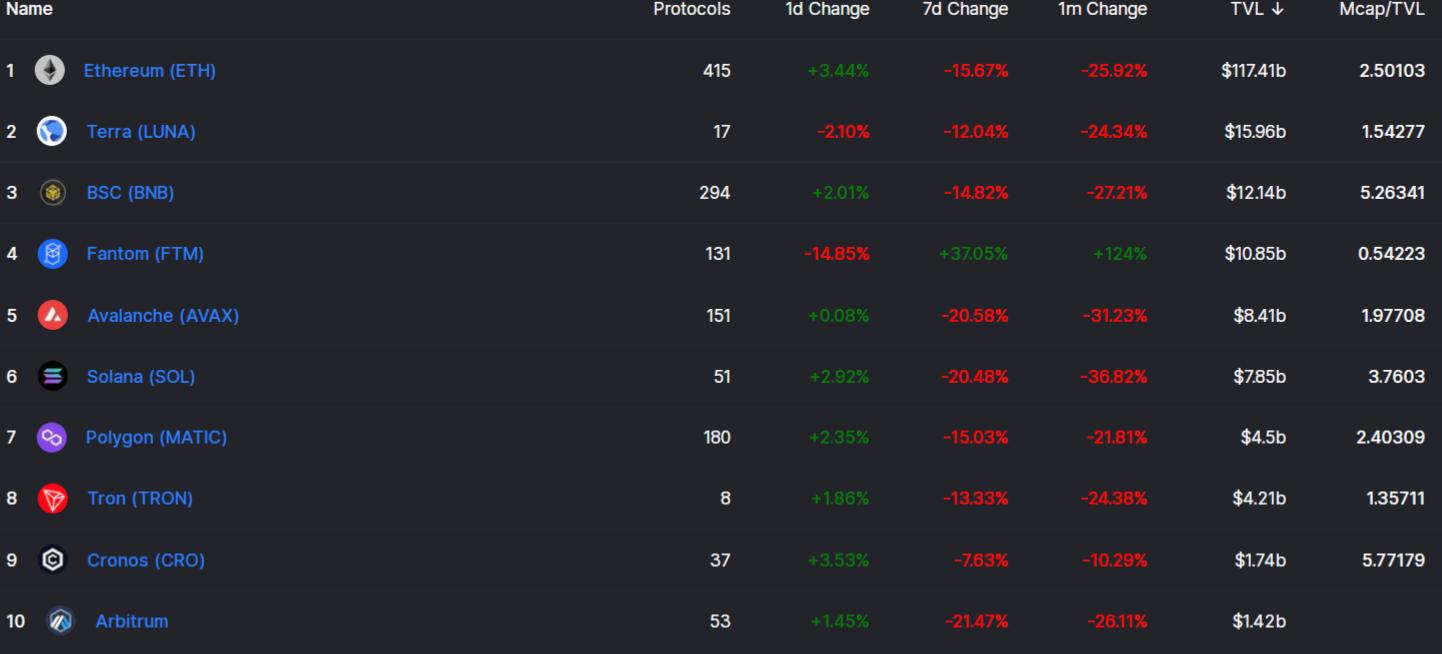
Solana's TVL has dropped to 6th place among public chains
Due to the decline in on-chain value, SOL has also faced sell-offs in the secondary market. As of January 25, SOL has fallen from a historical high of $259.69 to $91, a decline of 65%. In comparison, Fantom's native token FTM has dropped 34% from its peak, and Avalanche's ecological token AVAX has dropped 57% from its peak.
After experiencing rapid ecological growth, Solana has gradually exposed issues of insufficient performance and stability, forcing it to slow down its development pace. For Solana, while continuing to expand its on-chain ecosystem, it clearly needs to ensure network stability to gradually regain trust.
 Risk warning
 Risk warning