Aave V3 is officially launched, a quick overview of its main features and functions
 The launch of Aave V3 will further enhance capital efficiency, security, and cross-chain functionality.
整理:麟奇,链捕手
The decentralized lending protocol Aave announced the official launch of Aave V3 on the evening of March 16, Beijing time, and stated that it has gone live on Polygon, Arbitrum, Avalanche, Fantom, Harmony, and Optimism.
In addition, the launch date on the Ethereum mainnet has yet to be determined, and the proposal for deployment to Starknet developed by Starkware has recently passed, while the proposal for deployment to IoTeX has been initiated in the governance forum.
This means that Aave V3 may be deployed on at least nine blockchain networks, becoming the most widely covered DeFi lending protocol. In contrast, the other two DeFi lending giants, MakerDAO and Compound, currently only support the Ethereum mainnet, highlighting Aave's firm multi-chain development strategy.
In this V3 update, Aave also introduced multi-chain liquidity as a major highlight, allowing users to conduct cross-chain lending. "This means users can deposit funds on the Ethereum mainnet, but can borrow from Polygon and repay on Avalanche," said Aave founder Kulechov.
Additionally, the highlights of Aave V3 include capital efficiency, isolation mode, new risk control strategies, and reduced gas fees. According to the official introduction, the launch of Aave V3 will further enhance capital efficiency, security, and cross-chain functionality, promoting the development of the entire protocol ecosystem and enhancing decentralization.
Below is a detailed overview and introduction of the features of this version by Chain Catcher.
Asset Cross-Chain Flow (Portal)
The portal feature introduced in Aave V3 supports the seamless movement of user assets between Aave V3 markets across different networks. Its core functionality is to allow users to destroy aTokens on the original network (e.g., Ethereum) and mint them on the target network (e.g., Polygon), thus transferring the liquidity provided by users from one network to another. The network interconnection built around this feature is called Port.
This cross-chain functionality maintains accounting between different chains while supporting users in pursuing yield arbitrage and other strategies. Currently, Aave supports operations on Avalanche, Ethereum, and Polygon, with dozens of assets featuring variable lending and interest rate characteristics on each chain. Besides interest rates, liquidity demands between chains may vary significantly. Aave founder Kulechov expects that with the launch of the new cross-chain portal feature, these returns and demand fluctuations will "tend to stabilize."
The Portal will be able to bridge Connext, Hop Protocol, Anyswap, xPollinate, and other solutions that utilize Aave protocol liquidity to facilitate cross-chain interactions. Aave governance will be able to grant access to any cross-chain protocol to the portal upon receiving proposals.
An Aave spokesperson stated, "The cross-chain portal will allow users to decide for themselves to transfer their liquidity from one network to another. It supports the protocol's rapid expansion with each iteration across various networks as capital depth increases."
Efficient Mode (eMode)
The efficient mode allows borrowers to ensure they can obtain the highest borrowing capacity with their collateral. The efficient mode, or "eMode," supports users in utilizing extremely high loan-to-value ratios as long as they borrow against the same asset they have deposited as collateral— in some cases, the LTV can be as high as 98%. "The main idea here is that once we have different kinds of stablecoins, such as euro stablecoins and pound stablecoins, you can basically trade forex on-chain," Kulechov said.
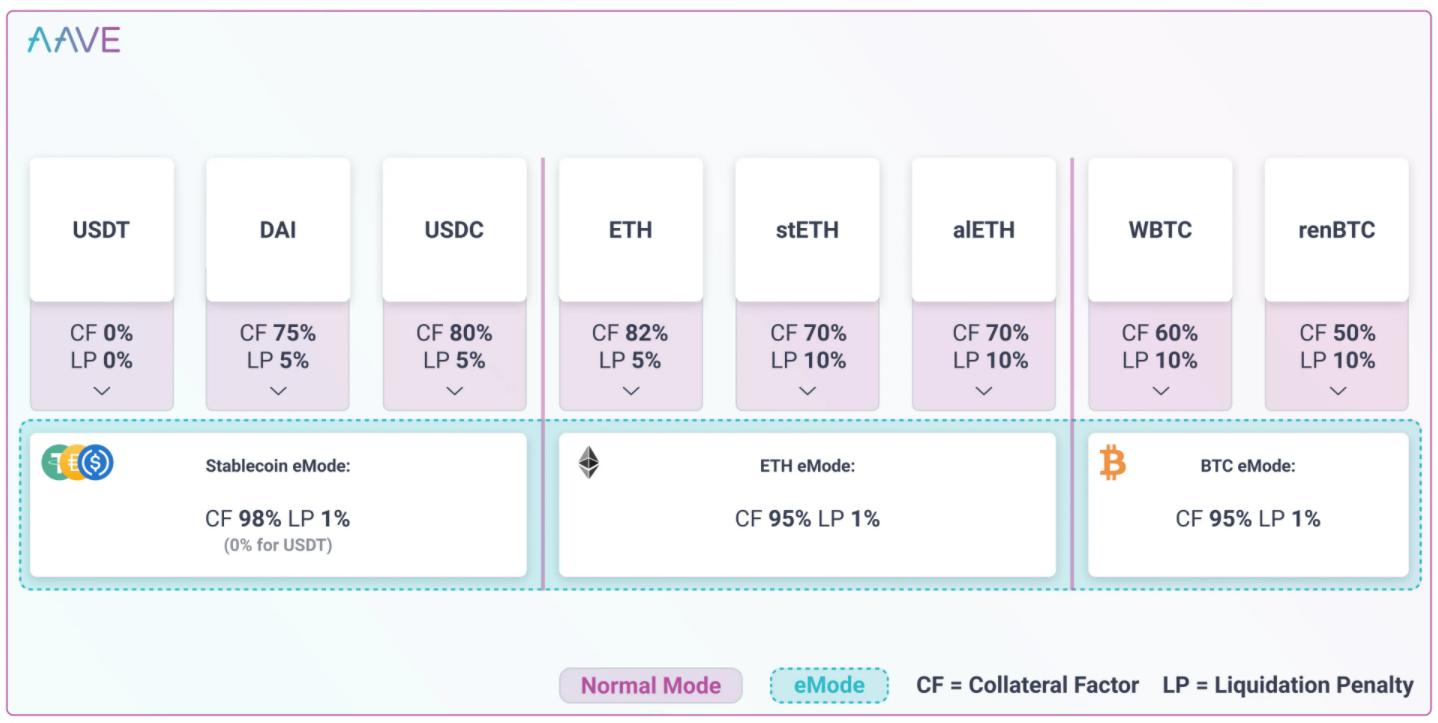
The code supports Aave Governance in "categorizing" assets based on lifecycle value, liquidation thresholds, liquidation bonuses, and custom price oracles (optional) parameters. These factors will set each different asset in V3 to a specific category. If borrowers limit the assets they borrow by category, eMode provides more avenues for capital acquisition. In other words, in eMode, borrowers can choose the asset categories they want to borrow from. "Categories" typically refer to a set of assets pegged to the same underlying asset. For example, stablecoins pegged to the US dollar, assets pegged to ETH, etc.
If users choose to use the Aave protocol in eMode, when the user provides assets of the same category as their collateral, the borrowing capacity (LTV) and maintenance margin (liquidation threshold) will be overridden by the eMode category configuration to allow for higher capital efficiency.
For example:
The protocol defines eMode category 1 (stablecoins): 97% lifecycle value; 98% liquidation threshold; 2% liquidation bonus; no custom price oracle.
- Karen chooses eMode category 1 (stablecoins);
- Karen provides DAI (which typically has a 75% LTV);
- Karen can borrow other stablecoins within category 1 (including DAI), with her borrowing capacity defined by the eMode category (97%);
- Therefore, Karen's capital efficiency increases by 22%.
Note: In this example, Karen can provide other non-category 1 assets as collateral; however, only assets belonging to the same eMode category chosen by the user will have enhanced category-specific risk parameters. V3 eMode can support up to 255 categories.
Isolation Mode
The isolation mode is designed to allow Aave governance to establish risk mitigation features when creating new asset markets on the protocol.
In addition to stronger capital liquidity, v3 greatly simplifies the introduction of new forms of collateral, even though their utility has been stripped. "V3 is primarily about two things: risk awareness/mitigation and capital efficiency," Kulechov said. "In terms of risk awareness, we can actually reduce the risk of new collateral entering the ecosystem while still allowing it, but limiting exposure."
Aave is facing increasing pressure from lending platforms such as Euler, Kashi, and Rari, which can better meet the demand for long-tail or exotic assets through permissionless lending pools. Therefore, v3 introduces "isolation markets," which effectively serve as a fast track that allows Aave governance to list assets as collateral more quickly than currently possible, but only as a single source of collateral rather than a power bundle. Additionally, isolation markets will have a supply cap controlled by DAO governance.
"Over time, as assets mature, the cap can be raised, ultimately closing the isolation model for specific assets. Thus, it supports asset scalability," Kulechov added.
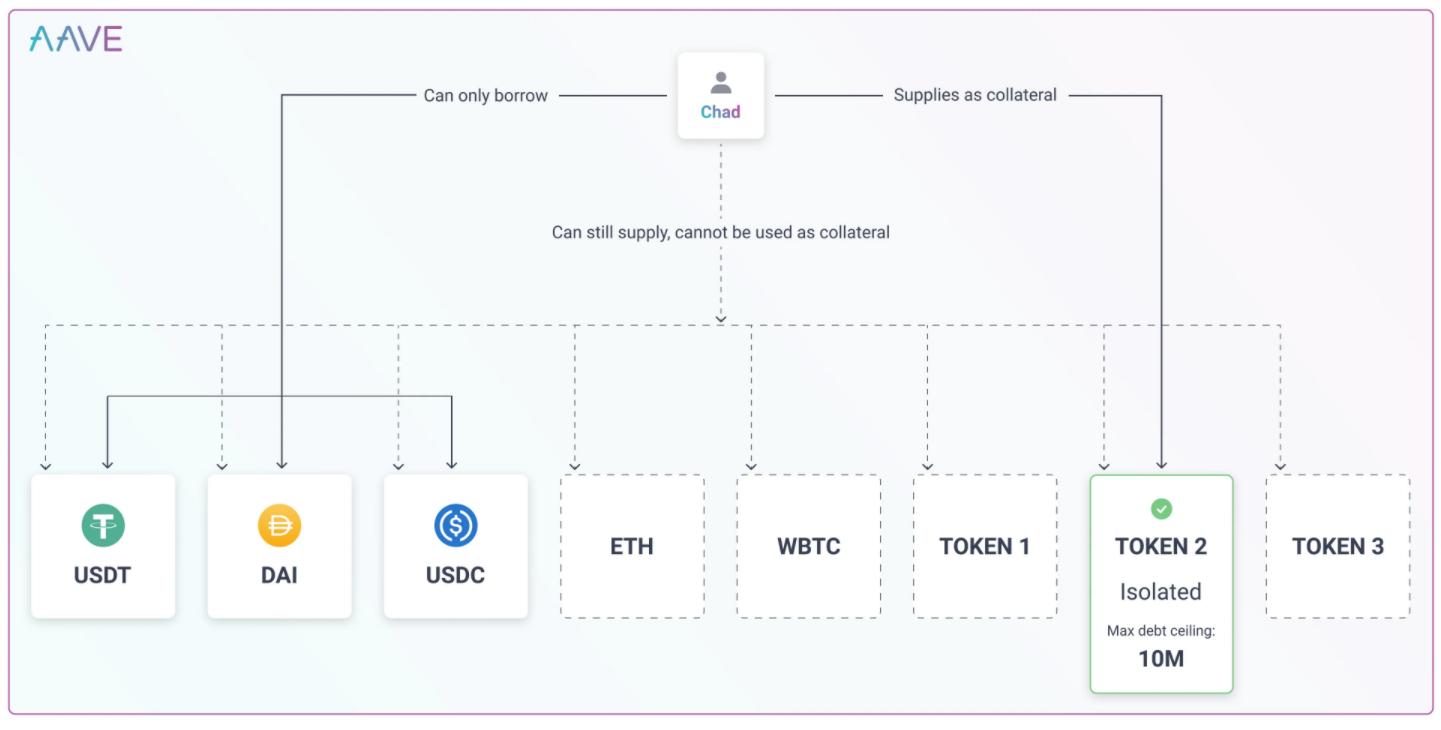
When community members submit governance proposals to create new asset markets on V3, the proposal can seek to list the asset as "isolated collateral," so that users providing these "isolated" assets can only borrow stablecoins that Aave Governance has "approved" in isolation mode, up to a specified debt limit. When users provide "isolated assets" as collateral, they can only use that asset as collateral; even if users provide other assets to the protocol, they can only earn yields on those assets and cannot use them as collateral.
For example:
Chad provides TOKEN2 as collateral. TOKEN2 is an isolated asset with a maximum debt limit of $10 million, with USDT, DAI, and USDC as "borrowable" assets. After providing TOKEN2 as collateral, Chad will be able to borrow up to $10 million in USDT, DAI, and USDC. Even if Chad provides another asset, say ETH, the V3 smart contract will not allow Chad to borrow against those assets as collateral. However, Chad will still earn yields through the provided ETH. If Chad wishes to use all assets as collateral and exit isolation mode, he simply needs to perform a transaction to disable TOKEN2 as collateral (subject to all usual restrictions regarding collateral ratios, liquidation, etc., in the smart contract).
When Aave Governance votes on a proposal to remove the debt limit associated with that asset, TOKEN2 can also exit isolation mode.
Risk Management Features
V3 technology provides Aave Governance with further enhanced risk management mechanisms to prevent protocol insolvency. The measures are as follows:
- Supply and Borrow Caps: Aave Governance will be able to configure borrowing and supply caps. Borrowing caps can minimize the risk of insolvency in liquidity pools, while supply caps can reduce the protocol's risk on specific assets and help prevent attacks such as infinite minting or price oracle manipulation.
- Granular Borrowing Power Control: Aave Governance will be able to change collateral factors for future borrowing transactions without affecting existing borrowing positions or triggering liquidations.
- Risk Admins: V3 introduces the ability for Aave Governance to register entities on a "whitelist," allowing these entities to change certain risk parameters without requiring governance votes.
- Price Oracle Sentinel: The Sentinel feature is designed specifically for L2 protocols to handle final downtime of sorters (it can also be extended to L1 to handle other events). It introduces liquidation grace periods and prohibits borrowing in specific circumstances.
Decentralized New Asset Addition Process
V3 also introduces the new concept of "Asset Listing Admins." With this feature, Aave Governance can create and grant rights to any entity (including smart contracts) to implement new strategies for adding assets to the Aave protocol, rather than through on-chain voting.
Other Features
Functions involving token transfers (e.g., supply, repayment) support EIP 2612 permits, which are critical for L2 deployments; users can use aTokens instead of the underlying assets originally borrowed to repay borrowed positions; Aave Governance can "allow" entities to gain instant liquidity; specific designs for L2 networks to improve user experience and reliability; promoting and incentivizing community usage through modularization; and gas costs for all features have been reduced by approximately 20-25%.
Additionally, it is officially stated that the V3 codebase is a set of independent smart contracts that are not compatible with V2 smart contracts. Once all audits are completed and further testing is conducted, the V3 code will be open-sourced alongside the main V3 repository for deployment on Ethereum, Avalanche, and Polygon networks.
 Risk warning
 Risk warning


Popular articles