Why must DeFi choose AMM instead of order books?

 In addition to lacking the typical advantages of DeFi, they also cannot operate like DeFi solutions—opening the doors of the market maker club to the people on the street, allowing them to participate and share in the profits. Due to the massive trading volume of dYdX, it generates huge profits for its market makers every day, but this has nothing to do with you and me outside the aristocratic club.
Author: 0xAlpha
Editor: Guo Qianwen, Chain Catcher
0xAlpha
There are many discussions about AMM and order books, most of which focus on the technical aspects: capital efficiency, price discovery, etc. However, it seems that few people realize that the debate between AMM and order books is far more than just a technical choice in financial trading. The order book is a technology adopted by the "financial aristocracy" (i.e., Wall Street) to dominate and expand their financial empire. In contrast, AMM is a financial technology that is owned, governed, and enjoyed by the people!
Let’s take a look at the trading scenarios of three types of exchanges, which provide liquidity in different ways.
Traditional Method:
This is common in traditional finance: the liquidity traded on exchanges is usually provided by a privileged class, known as designated market makers. The privileged class typically holds market maker licenses, which closely ties them to the exchange. Because they have licenses, they usually enjoy a range of privileges and advantages:
Information: They can view the order book in greater depth (although most people can only see the best bid and ask prices, and need to pay extra to see more).
Technology: They can run their trading programs on servers with extremely low latency (the so-called "co-location"), allowing them to stay ahead of most others.
Financial: Their trading costs are usually significantly lower than those of ordinary people (sometimes even negative).
Centralized Cryptocurrency Exchanges:
While many centralized cryptocurrency exchanges still follow the old traditions of Wall Street, there are some new changes. For example, Bitmex distinguishes between two parties in a trade: the maker and the taker. The taker pays a taker fee (e.g., 0.075%), while the maker receives a portion of the fee (e.g., 0.01%) as a "maker rebate."
Moreover, everyone can see the entire order book on Bitmex. Bitmex essentially lowers the identity threshold, significantly democratizing market-making activities. Therefore, anyone who quotes on the order book is part of the market-making business and shares in its profits. So far, the situation has improved to some extent: the doors of the club are now open to people on the street; however, whether you can join the party will depend on your dancing skills. Market-making on Bitmex is not easy; in fact, it far exceeds the capabilities of ordinary people.
DeFi AMM (Decentralized Automated Market Maker):
AMM has almost completely removed the barriers to providing trading liquidity; you don’t need to be a professional expert, let alone a "noble." The only skill you need to master is running a web3 wallet, such as Metamask.
AMM has unprecedentedly allowed the general public to participate in providing liquidity for commercial trading, such as in the spot trading space with Uniswap, Curve, Balancer, DODO, Sushiswap, and also in the derivatives trading space with Deri, Perp, GMX.
Let me summarize the requirements for providing liquidity for trading:
- In traditional finance, you need both privilege and technology.
- In some centralized crypto exchanges, you don’t need privilege, but you need technology.
- In AMM-based decentralized exchanges, you don’t need privilege or technology.
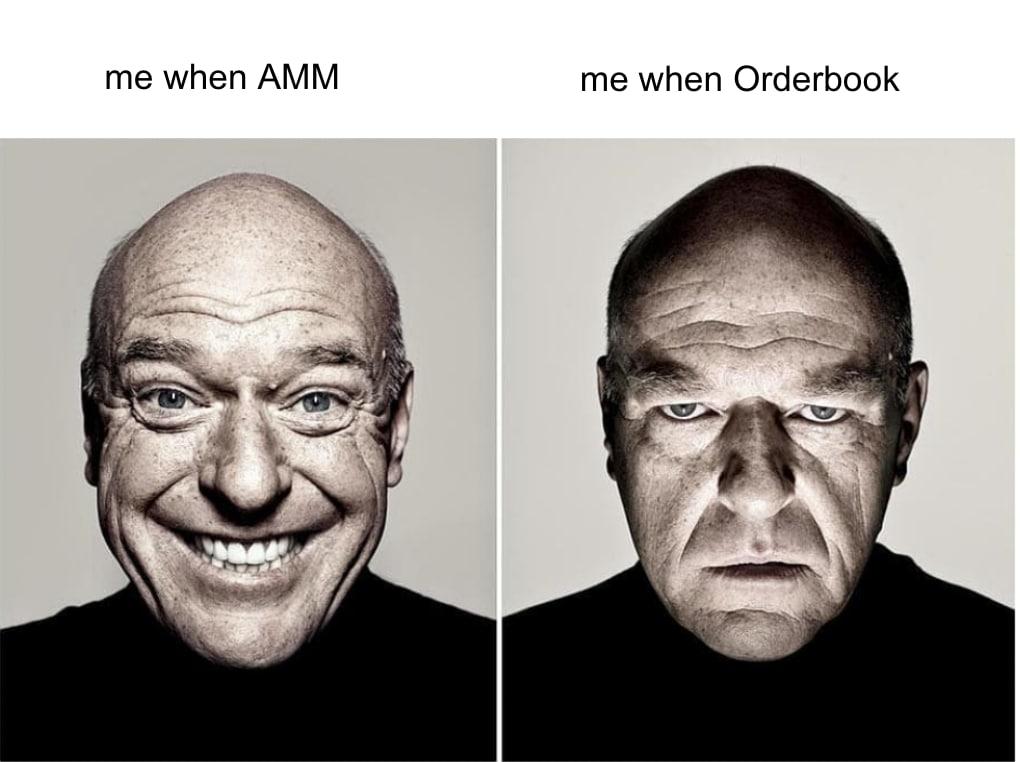
In Case 1, due to the privilege and technical barriers, some companies monopolize the industry. These "money printers" typically make a fortune, further solidifying their monopoly position. Fundamentally, they become the financial aristocracy.
In Case 2, although the privilege barrier has been removed, it is still the same group of people from Case 1 conducting business operations. If you understand the major players in crypto market-making, you will know what I mean. After all, they have been doing this for decades. Even without the privilege barrier, their technical advantages still place them in a clearly favorable position. This skill advantage is based on the order book mechanics. This is why the order book technology is adopted by the old "financial aristocracy" (i.e., Wall Street) to dominate the old land's financial empire and expand into the new realm of cryptocurrency.
In Case 3, typically, people only need to click a few times to provide liquidity for any trading pair. This process requires almost no specialized knowledge of market-making, and it truly opens the door for ordinary people.
The fees generated by the USDC_ETH pool on Uniswap V3.
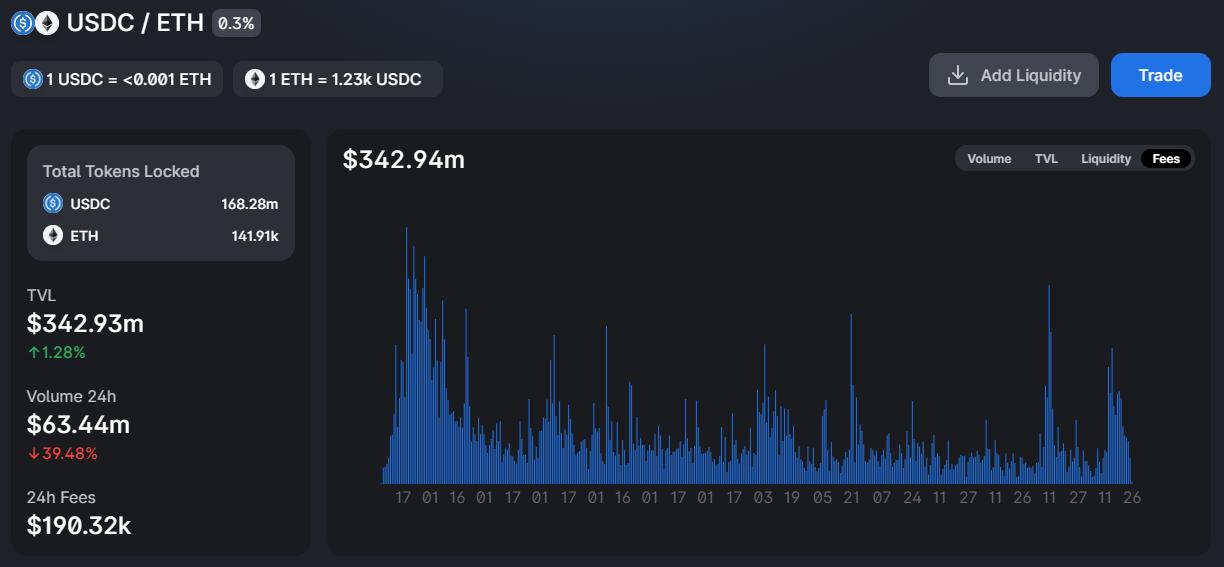
Anyone can participate in providing liquidity, sharing these fees without needing market-making skills. (Screenshot taken from info.uniswap.org as of June 25, 2022)
In short, AMM is a financial technology that is owned, governed, and enjoyed by the people!
What About Order Books in DeFi?
Currently, the primary way to provide liquidity for trading is AMM. However, there are also DeFi platforms that adopt order book mechanisms, with dYdX being a leading example. In fact, most of them are fake DeFi. Trades on such platforms typically occur on their own dedicated servers (or AWS servers), merely connected to the blockchain network through some "L2 technology." Connecting a matching engine running on a centralized server to Ethereum via some L2 technology does not make it decentralized. The so-called "independent blockchain" (or application chain) announced by dYdX's fourth-generation plan is also not decentralized.
Although using an independent blockchain may make it more decentralized, as "each validator will run an in-memory order book," it does not change the fact that trading (order matching) occurs on off-chain servers. The role of validators is merely to ensure the legitimacy of transactions. Such platforms almost lack all the advantages that DeFi projects possess: composability, transparency, and interactivity.
Moreover, and most importantly, such platforms are usually dominated by the same group of Wall Street traders, which is still their old business. In other words, these platforms are merely an expansion of the old "financial aristocracy" (i.e., Wall Street). Just look at who is market-making for dYdX, and you will know the answer. The situation will be exactly the same after dYdX migrates to its fourth-generation version.
Note that this does not mean that the semi-decentralized approach adopted by projects like dYdX is useless. Platforms using this approach can also be excellent, such as Bitmex, Binance, FTX, etc.; they just are not DeFi. (Of course, to be an excellent platform, you do not necessarily need to be DeFi.) These platforms and centralized exchanges can typically provide high-frequency trading better than AMM (which is a basic institutional demand).
However, aside from lacking the typical advantages of DeFi, they also cannot operate like DeFi solutions—opening the doors of the market-making club to the people on the street, allowing them to participate and share profits. Due to the massive trading volume on dYdX, it generates huge profits for its market makers every day.
But this has nothing to do with you and me outside the aristocratic club. A good contrasting example to dYdX is Deri Protocol, which adopts the AMM trading model: anyone can provide liquidity for derivatives trading and share profits without mastering complex derivatives skills.
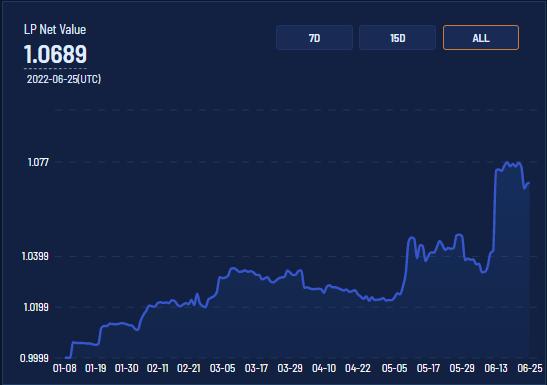
Since January 2022, the LP net value growth of Deri Protocol's main pool shows that anyone can share in the profits of derivatives market-making. (Screenshot taken from info.deri.io as of June 25, 2022)
This is why DeFi must choose AMM over order books as the paradigm for market-making.
 Risk warning
 Risk warning