The United States and AWS highlight the "centralization" issue after the Ethereum merger

 Similar concerns about centralization relate to the distribution of nodes. Three independent data sources show that the United States and Germany account for over 50% of all nodes.
Original Title: 《Recap of Metrics on the Eve of the Merge》
Author: Harith Kamarul
Translated by: Wu Says Blockchain
The exciting Ethereum merge is finally upon us, expected to take place from September 14 to 15.
As we prepare to enter the new world of Ethereum's Proof of Stake (PoS), let's review the key metrics related to staking.
The metrics examined include:
- Deposit balance
- Validator distribution
- Node distribution
- Client distribution
Deposit Amount
The Beacon Chain deposit contract is currently the largest single holder of ETH in the entire Ethereum network, holding 11.3% of ETH.

Top accounts in Ethereum
After gradually declining in 2021, the total amount of deposits in the contract surged to an all-time high in March 2022, maintaining this momentum until mid-May when it slowed down again.
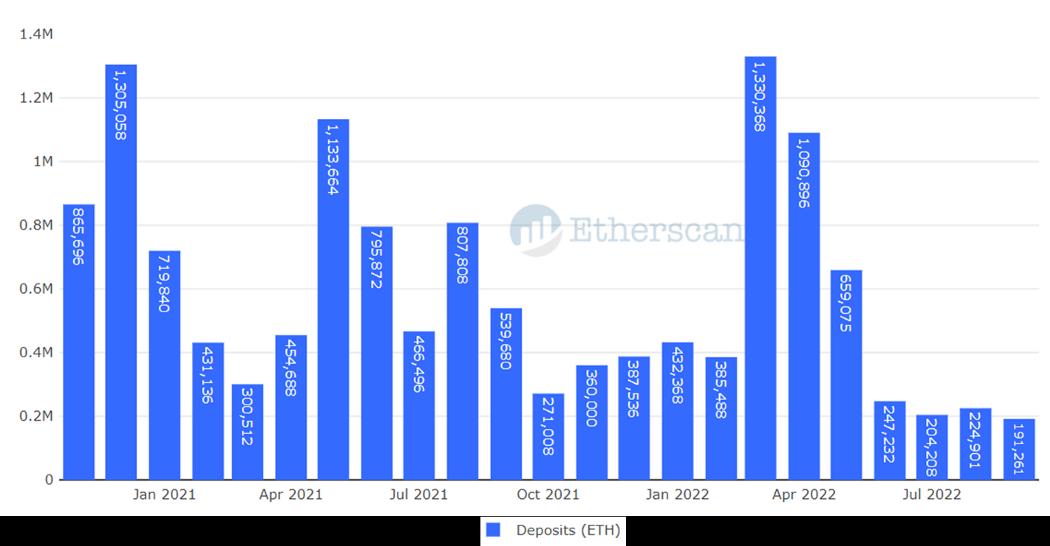
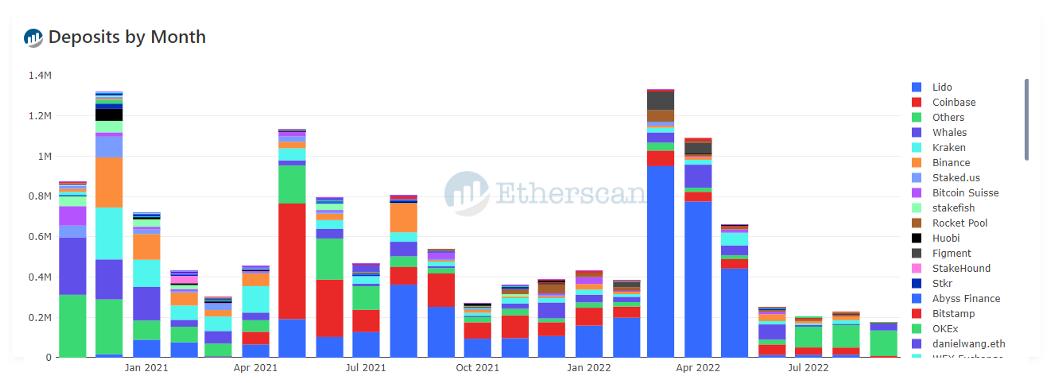
Grouping the data by holding entities shows that the additional deposits almost entirely came from Lido, thanks to key integrations with platforms like Aave. This has made Lido the leading validator. In May, as it approached nearly 33% of total staking, Lido imposed a self-limit—deposits were minimal starting in June.
Validator Distribution
Of course, Lido's rapid accumulation of staking share has raised concerns about Ethereum's decentralization. At first glance, it seems that Lido alone accounts for nearly 1/3 of the stake, with only 3 entities holding over 50% of Ethereum validators.
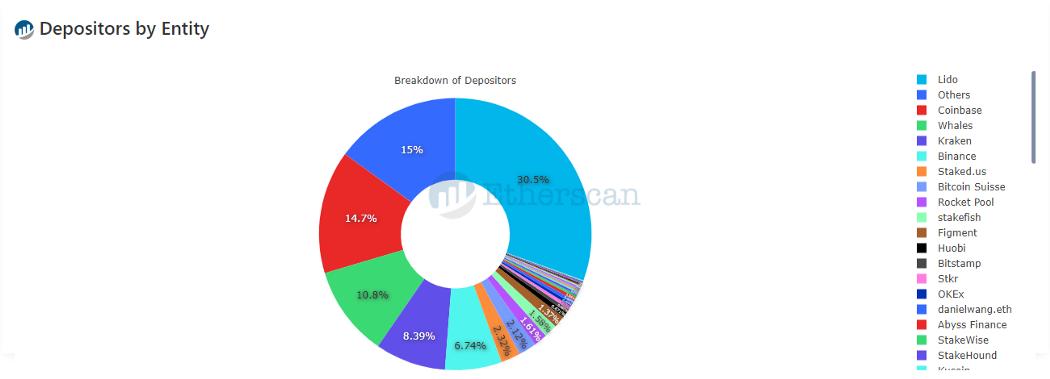
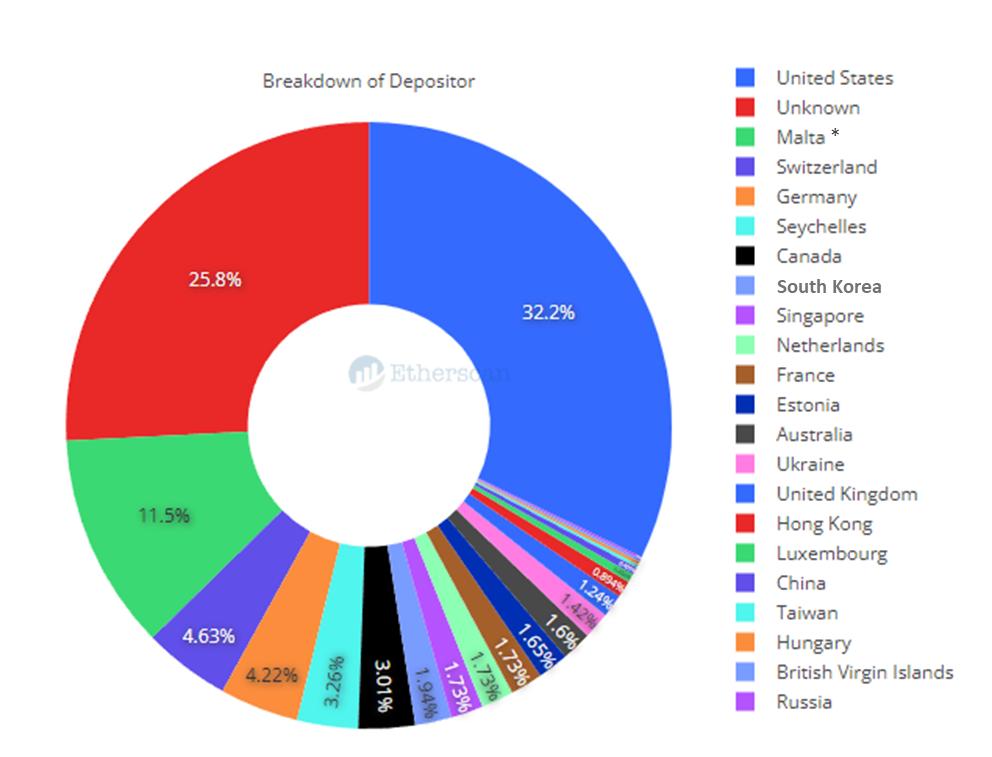
Top depositors by entity
How does this compare to Ethereum's Proof of Work (PoW)? In Ethereum PoW, just three mining pools account for over 50% of the hash rate.
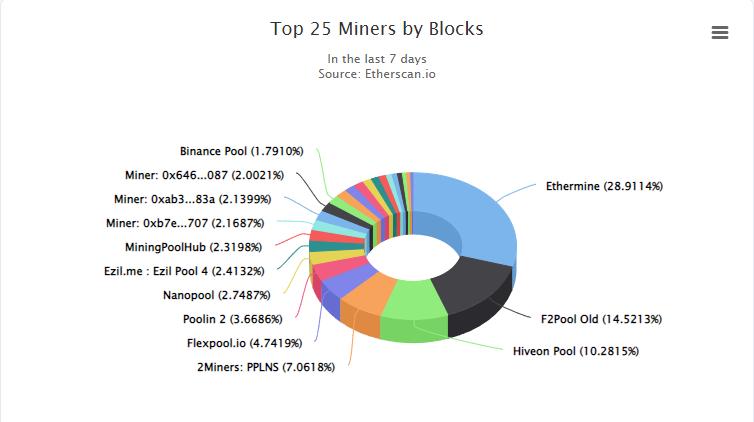
Top 25 miners
Since OFAC added Tornado Cash to the sanctions list, discussions about potential censorship have been lively within the Ethereum community. Some are concerned that if validators are subject to enforcement actions by authorities within their jurisdiction, the Ethereum protocol itself could face censorship.
Let's take a look at depositors divided by jurisdiction. By inferring the jurisdictions of the top 50 known entities from company registrations, we find that nearly 1/3 of validators are located in one jurisdiction (the United States).
One thing to note is that Coinbase, which accounts for nearly half of the U.S. market, has committed to shutting down staking if necessary, rather than censoring transactions.
Node Distribution
Similar concerns about centralization arise regarding the distribution of nodes. Three independent data sources show that the U.S. and Germany account for over 50% of all nodes.
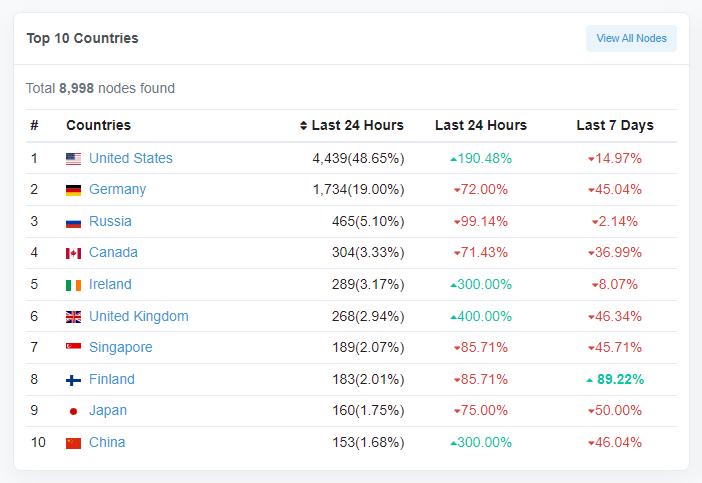
Etherscan node tracking statistics
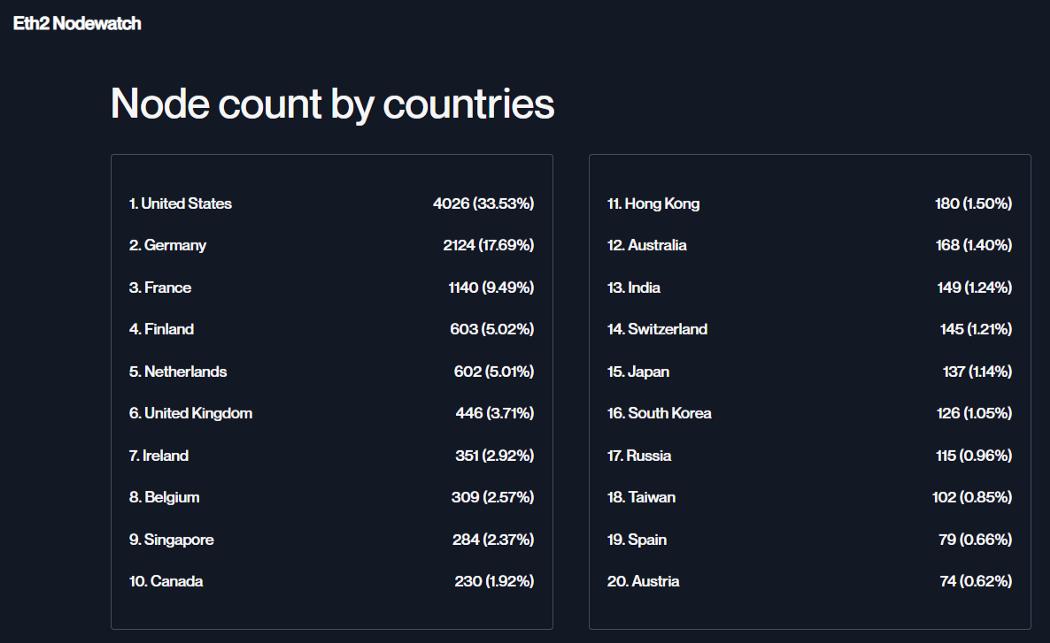
Eth2 Nodewatch
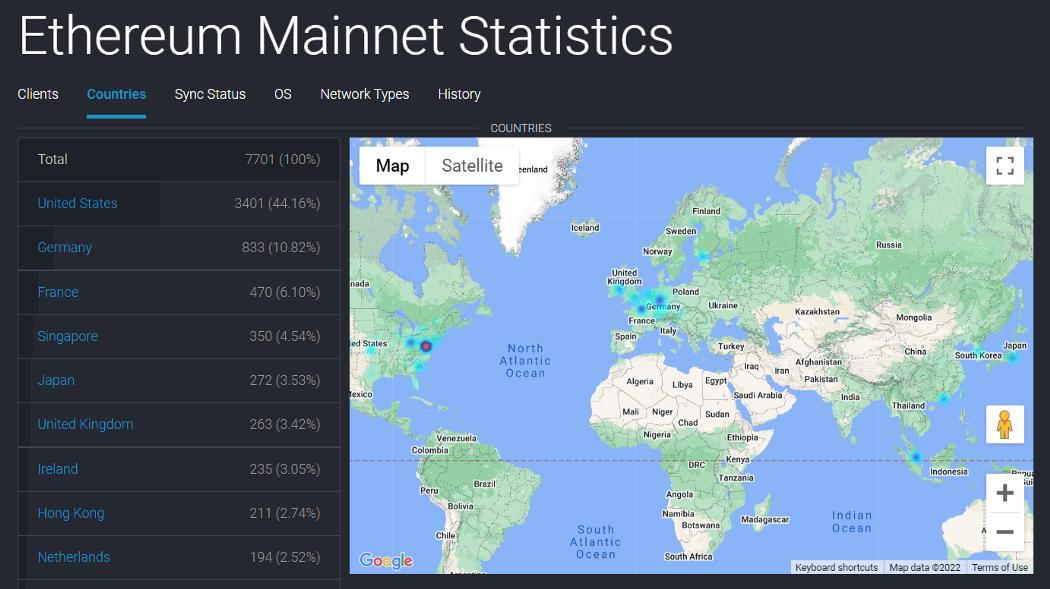
Ethernodes
For hosted nodes, the data results are quite inconsistent. Eth2 Nodewatch reports that 75% of nodes are non-hosted, while Ethernodes reports nearly the opposite—70% of nodes are hosted.
Digging deeper into the hosted node numbers from Ethernodes, we find that the vast majority are located in the U.S. and Germany, consistent with the geographic data above.
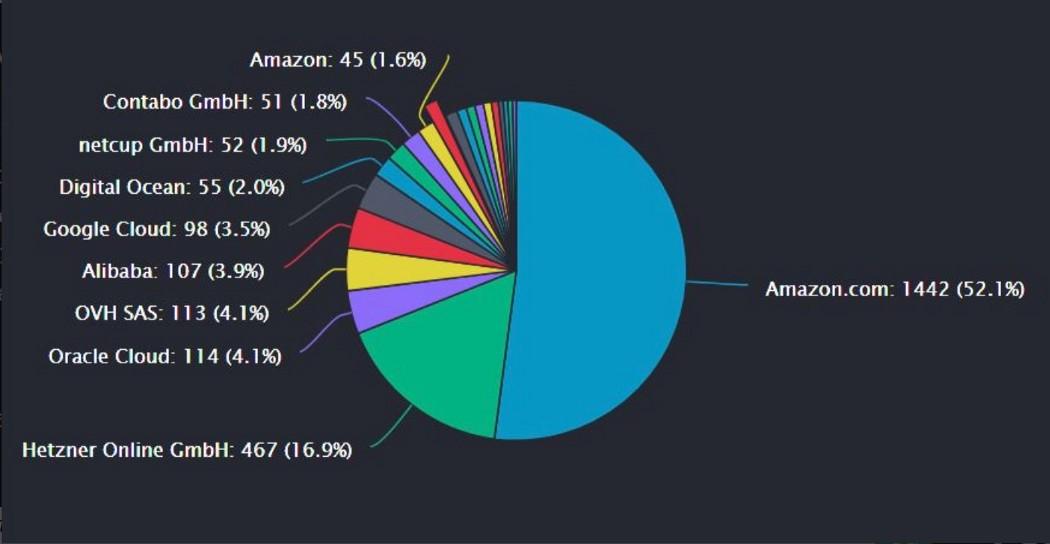
Ethernodes hosted node distribution
Staking service providers may want to consider diversifying their node distribution to ensure better stability for themselves and the network!
Client Distribution
Another important aspect of distribution is the diversity of clients at the consensus and execution layers. An over-reliance on a specific client could jeopardize the entire chain's activity and result in losses for all validators running that client if an error occurs.
At this point, there has been significant improvement in consensus layer distribution. A few months ago, Prysm accounted for 75% of all consensus clients. Today, client diversity is estimated to be only 30-43%. Ideally, no single client should hold more than 1/3 of the share.
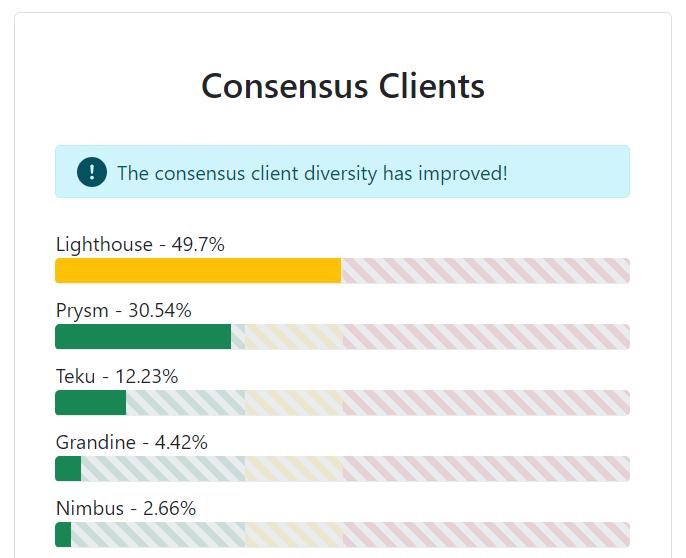
Consensus layer client distribution at clientdiversity.org
Maintaining client diversity remains a significant challenge. While clients like Erigon and Nethermind have been improving, Geth is still the client relied upon by most nodes. If Geth encounters a severe error, all validators using it for the execution layer will face penalties on their stakes.
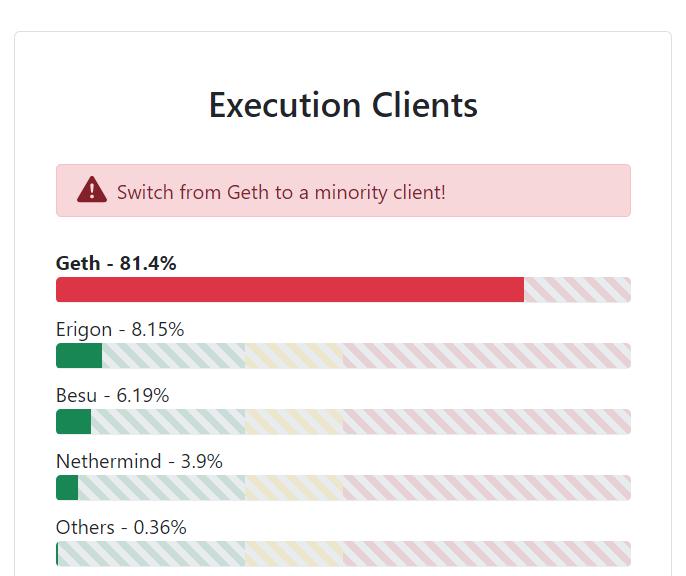
Execution layer client distribution at clientdiversity.org
As seen in this article, the work towards the robustness of Ethereum's decentralization is ongoing. Beyond these decentralization metrics, the last line of defense for the Ethereum network is its community. If an attack occurs on the chain and the above metrics are insufficient to prevent it, the community can support a social slashing to fork Ethereum, remove the attacker’s stake, and continue our Ethereum journey.
 Risk warning
 Risk warning