Forbes Special Report: After the fall of SBF and Alameda, crypto market maker Wintermute begins to emerge

 Gaevoy is seriously considering launching a financial derivatives exchange catering to professional traders, aimed at filling the gap left by FTX.
Original Title: 《With Sam Bankman-Fried's Hedge Fund Gone, Crypto Trading Firm Wintermute Emerges》
Author: Jeff Kauflin, Forbes
Translation: Qianwen, ChainCatcher
"Wintermute has navigated the frontier markets of cryptocurrency with skill and emerged victorious from the collapse of the Terra stablecoin, now becoming one of the world's leading cryptocurrency trading firms. Now, it must continue to move forward in a chaotic and perilous market."
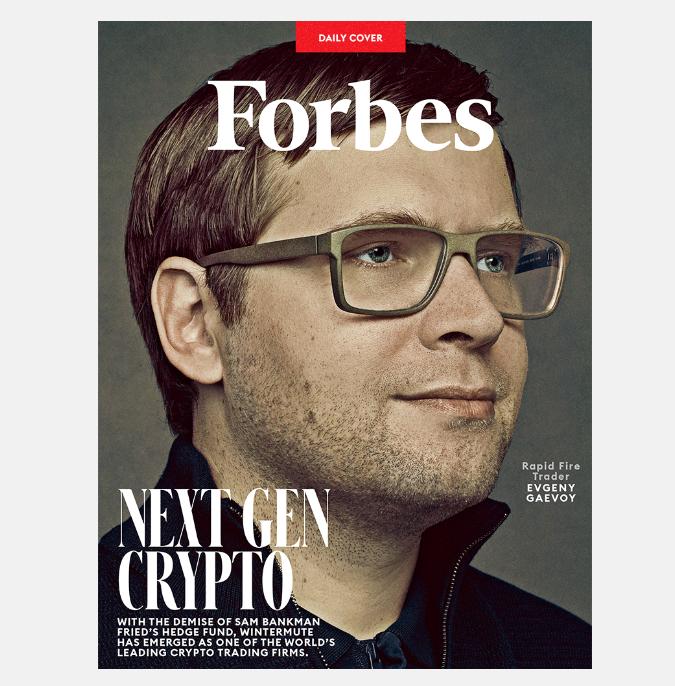
Evgeny Gaevoy is contemplating what to do if the dollar-pegged stablecoin terraUSD (UST) implodes. UST has a circulating market cap of about $15 billion, supported by large investors like Lightspeed Venture Partners. But as early as 2021, a small group of people on Twitter predicted its demise, arguing that algorithmic stablecoins not backed by government-issued currency were doomed to fail.
In February of this year, the 38-year-old Gaevoy told himself, "If it really happens, I hope we can be there in that moment." His company Wintermute, based in London, is a trading firm engaged in high-frequency trading of digital assets, extracting a few cents of profit from millions of trades each day. The more volatile the market, the more money they make.
That month, Gaevoy and Marina Gurevich—his wife and Wintermute's Chief Operating Officer—developed a battle plan. Wintermute's developers spent a month integrating their trading system with Terra's blockchain technology. Just as high-frequency trading firms seek to obtain stock market data as quickly as possible, Wintermute built its own servers and ran Terra nodes to gain the latest intelligence on UST trades and prices. They wrote 4,000 lines of code for the new trading algorithm. On May 7, when UST's price slipped to $0.98, Gaevoy instructed his team to start working night shifts in preparation for the coming week.
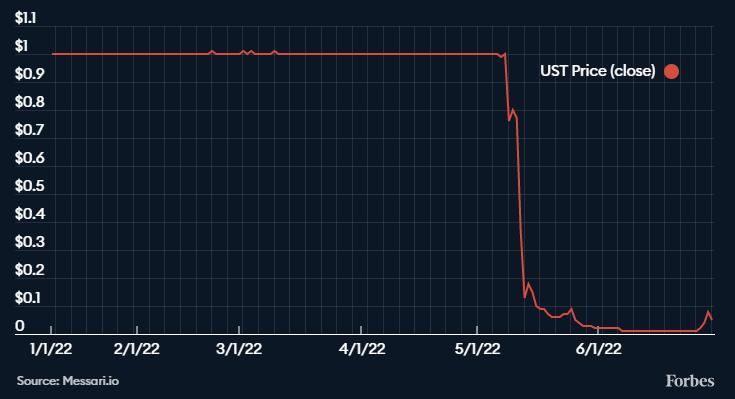
Two days later, UST began a dramatic price drop, and Wintermute started implementing arbitrage. Taking advantage of Terra's own design and the price collapse, Wintermute bought UST at $0.80 and redeemed it for Luna (its sister cryptocurrency) worth $1. They then quickly sold Luna, earning a profit margin of 10% to 15% on each trade. Wintermute's traders were sweating as the air conditioning in their London office broke down, with temperatures rising above 85 degrees Fahrenheit.
By the weekend, UST had nearly lost all its value, and Wintermute had traded over $250 million in UST, ultimately pocketing tens of millions in profits as UST's value fell to around $0.10. Gaevoy was not the mastermind behind Terra's collapse, but he became a major buyer as people frantically tried to sell UST, exacerbating the process to some extent.
According to those familiar with the matter, during the UST decline, Terra founder Do Kwon, who is wanted by the South Korean government for violating financial laws (Kwon claims the charges are baseless and will likely be dismissed), even borrowed millions of dollars worth of UST from Wintermute to assist in his trading. Kwon apparently hoped that this funding would make the UST market more liquid and prevent a market freeze.
Gaevoy's "Terra strategy" is a hallmark of his approach—not just betting against the failure of UST but daring to maneuver in the risky world of decentralized finance, something many companies are reluctant to try. Unlike more specialized market makers, Wintermute's strategy is to experiment with multiple assets. "It's not because we're good at everything," Gaevoy said. But its comprehensive penetration strategy and profits from over a billion trades add up to a significant amount. Despite having only 53 employees, Wintermute achieved $1.05 billion in revenue and $582 million in profit in 2021. Gaevoy owns one-third of the company, meaning his net worth is at least in the hundreds of millions.
Knife Catchers
(ChainCatcher Note: KNIFE CATCHERS refers to those who buy in a declining market, trying to catch the bottom and seize price reversals.)
During the crash of UST and Luna, Wintermute took on significant trading risks. It capped each trade at $5 million to prevent drastic losses but ultimately gained tens of millions in profits.
Recently, the fall of Sam Bankman-Fried's exchange FTX and hedge fund Alameda Research (one of Wintermute's closely watched competitors) shocked Gaevoy, Gurevich, and others. "We knew they were a bit reckless and had made big bets, but what actually happened was unimaginable. Frankly, their trading and management decisions seemed to have reached a level of foolishness," Gurevich said.
According to data from analytics firm Nansen, before Alameda's collapse, Wintermute was already one of the top five cryptocurrency trading firms in the world. Would the fallout from FTX's downfall also put Wintermute in jeopardy? Gaevoy insists that Wintermute will not take reckless risks like Alameda did. But as this disaster has shown us—nothing is guaranteed in the world of cryptocurrency.
Gaevoy grew up in Moscow in the late 1980s and early 1990s, during the dissolution of the Soviet Communist government, when Russians could finally buy Western goods from Italy, and he felt very optimistic. Gurevich grew up in Siberia, a thousand miles away, and felt the same excitement, but she was always ambitious. As a teenager, she convinced her parents to let her change schools four times in five years, always pursuing a better education. She said, "I always wanted more and better things."
The two met at the Higher School of Economics in Moscow, an elite math school founded in 1992. Gurevich said, "Its style was very Western, very capitalist. It shaped us completely." Both had their English skills in the top 10% of their class, and after that, they met and were assigned to the same group.
In 2006, Gaevoy and Gurevich got married. Gaevoy's first job after graduation was at Optiver in Amsterdam, a top global trading firm. He developed the exchange-traded fund business from a one-person operation into a profitable team of twelve and learned valuable lessons in risk management. He left Optiver ten years later because he wanted to step out of his comfort zone and explore other fields. In 2017, he moved to London with Gurevich and their two children, and Gaevoy began trading cryptocurrencies with his own $20,000.
Cryptocurrency fell into a bear market in 2018, and Gaevoy and his two co-founders, Yoann Turpin and Harro Mantel, spent nine months raising $900,000 from angel investors. To attract others interested in cryptocurrency, Gaevoy named the company Wintermute after an artificial intelligence entity from the 1984 science fiction novel "Neuromancer." The following year was terrible for Gaevoy and the cryptocurrency industry—retail investors had essentially lost interest, and trading activity was scarce after the 2017 bubble burst. Gaevoy had $500,000 in trading capital, generating less than $1 million in revenue. His startup survived on just a few months of cash in the bank.
But in January 2020, Gaevoy said he achieved a breakthrough. The arbitrage trading algorithm he developed began to generate real profits by seeking price discrepancies for a single cryptocurrency across different exchanges, allowing him to buy on one exchange and quickly sell on another. On March 12, when the pandemic caused the U.S. stock market to fluctuate by 10% in a single day, cryptocurrency trading volume surged, and Wintermute made $120,000 in just 24 hours. Gurevich said, "It was clear that if we had more capital, we would earn more."
In July, Wintermute raised $2.8 million in Series A funding, led by Lightspeed's Jeremy Liew. Liew said his impression of Gaevoy was "he's very smart… almost the archetypal very smart Russian mathematician." Gurevich, who had been working in management consulting, joined Wintermute full-time as COO, taking charge of everything outside of coding or trading, including finance, strategy, recruitment, and marketing. Co-founder Harro Mantel left Wintermute to spend more time with his family, while Yoann Turpin stayed on as head of business development.
That summer was dubbed "DeFi Summer," as decentralized finance applications for earning and trading surged, with explosive user growth. Uniswap, a decentralized trading platform operating on completely immutable open-source code, saw its daily trading volume grow from about $10 million in May 2020 to $1 billion just three months later.
Wintermute actively began trading on Uniswap and other decentralized exchanges, building arbitrage systems suitable for more channels. It also started trading newly invented tokens, including a new token called sushi, which had low liquidity, allowing Wintermute to capture the price difference—the spread between buying and selling prices—and then take a portion of it as profit.
By the end of 2020, Wintermute's revenue reached $53 million, and it began to aggressively develop different business lines. It increased its market-making efforts on trading platforms like dydx, where daily trading volume exceeded Coinbase for several days at the end of 2021. It negotiated contracts with new token issuers like Optimism, allowing Wintermute to borrow Optimism tokens interest-free for trading and profit. Typically, these contracts also gave Wintermute the option to purchase tokens at a fixed price and a later date. Some of these trades proved to be highly profitable, as the newly minted trading tokens and low-priced options to buy them quickly generated profits during the cryptocurrency bubble bull market of 2021.
Wintermute also began experimenting in a niche area of cryptocurrency known as MEV, or maximum extractable value, pursuing a trading strategy that exploits the slow settlement speed of blockchain transactions to gain optimal arbitrage trades in advance.
As cryptocurrency trading volumes began to set records in 2021, Wintermute's operational scale created compound benefits. It connected with 30 centralized exchanges, including Coinbase, Bybit in Dubai, and dozens of decentralized exchanges, trading 350 different tokens. This breadth was helpful for arbitrage, presenting a vast world of varying prices for assets. Being connected to numerous exchanges also provided rich signals to understand market trends, helping predict sudden rises or falls that could impact their trading profits.
This scale also brought two significant advantages. The larger Wintermute's scale and trading volume, the easier it was to obtain cheap financing from lenders and token issuers of the tokens it traded. Additionally, conducting large volumes of trades on centralized exchanges like Coinbase allowed it to secure lower trading fees.
The company reported that in 2021, Wintermute's trading volume reached an astonishing $1.5 trillion, generating $1.05 billion in revenue and $582 million in net profit. Some employees received millions in bonuses that year. Wintermute distributed $35 million in dividends to shareholders, and since Gaevoy owns 33% of the company, he received about $12 million in income. Lightspeed holds a 15% stake in Wintermute, and Jeremy Liew described the company's performance in 2021 as "they positioned themselves well, so when the tide came in, they were able to ride the wave that lasted."
This year has been somewhat different. With rising inflation and interest rates, nearly all asset classes have declined, and cryptocurrency has been one of the hardest-hit assets. In the first nine months of the year, Wintermute's revenue was only $225 million, a significant drop from 2021. Its ventures in DeFi also came at a high cost. Wintermute made a human error in the security of its digital wallet, resulting in a $160 million hack. Gaevoy said the company would not be profitable this year.
When Sam Bankman-Fried's exchange FTX announced bankruptcy last month, Wintermute still had $59 million in that exchange, and Gaevoy and Gurevich considered it lost forever. They have consolidated most of their funds held in the exchange into three places: Coinbase, Kraken, and Binance. As the entire industry is in crisis, their daily trading volume is now only $1 billion, down from $3 billion to $5 billion earlier this year.
This episode and its potential effects raise a question: Will Wintermute be the next to fall? They insist that their company (with 95 employees) is financially sound, with $400 million in equity and $720 million in assets, and a debt-to-equity ratio of 0.8, which is conservative compared to publicly traded market-making firms like Virtu. They also stated that $350 million of the equity is in stablecoins (mainly USDC) and cash, while the remaining $50 million is mostly venture capital investments.
Meanwhile, Gaevoy and Gurevich say they are working seven days a week, harder than ever, and Gaevoy is seriously considering launching a financial derivatives exchange catering to professional traders, aimed at filling the gap left by FTX. But he claims he will adopt a different structure to hold customer funds: their funds will be segregated and held by external custodians, following the same model as traditional financial exchanges like the New York Stock Exchange.
As for Wintermute's trading, "we are basically preparing for the next 2021," Gaevoy said, "we don't necessarily need to make the most now because we can earn more in the potential bull market that may come."
 Risk warning
 Risk warning
Popular articles