








Interview with the Head of OKX Web3 Wallet: How the Breakthrough Player in the Wallet Track is Forged?
 Zakk, the head of OKX Web3 wallet, detailed the competitive landscape of the wallet sector, the unique advantages of the OKX Web3 wallet, and the development story behind it.
Interview: Nianqing, ChainCatcher
Guest: Zakk, Head of OKX Wallet
As an important entry point for Web3, the wallet sector has always been a battleground. Since the FTX collapse, users' awareness of self-custody has been continuously increasing. The recent failures of many well-known banks such as Silicon Valley Bank, Silvergate Bank, and Signature have further sounded the alarm for institutions, enterprises, and users: centralized asset management methods always carry risks.
Decentralized custody has become the trend, and Web3 wallets, as an important form of self-custody, have become a significant choice for users seeking alternatives to banks.
With the increasing demand, more and more competitors are entering the wallet sector. Not only have leading DeFi projects like dYdX, Uniswap, and ParaSwap released their own mobile wallets, but many traditional large institutions such as PayPal and Reddit are also developing their own crypto wallets. In this increasingly competitive wallet sector, who will become the next winner?
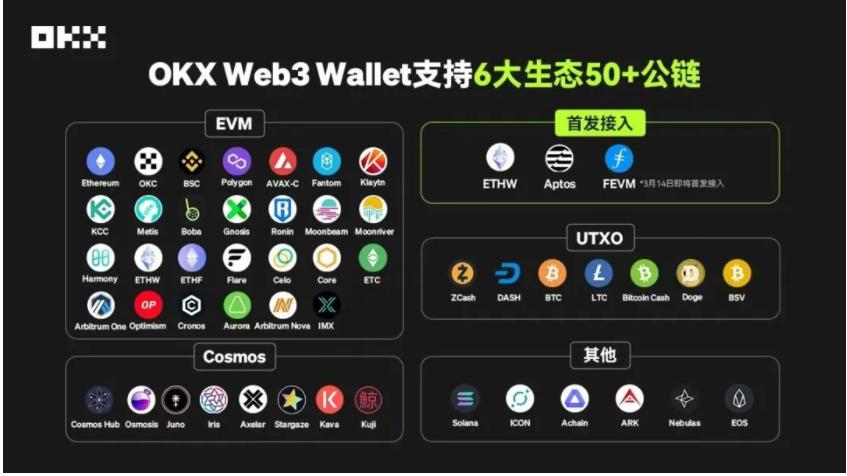
Recently, the OKX Web3 wallet announced that it now supports over 50 chains across six major ecosystems, including EVM, UTXO, Cosmos, Tron, Solana, and Move. As a relatively comprehensive heterogeneous multi-chain ecosystem wallet, the OKX Web3 wallet can be said to have "pushed user experience to the extreme." In addition to the seamless cross-ecosystem DApp switching feature, the OKX Web3 wallet is also one of the few multi-chain wallets that support creating multiple mnemonic wallets and deriving multiple accounts from a single mnemonic. Furthermore, in terms of security, the wallet integrates the OKX risk address database and supports authorization management as well as phishing detection for similar addresses.
Behind every optimized experience, there must be strong technical support and flexible development. To this end, ChainCatcher interviewed Zakk, the head of the OKX Web3 wallet, who detailed the competitive landscape of the wallet sector, the unique advantages of the OKX Web3 wallet, and the development story behind it.
1. How to Seek Differentiation in Intense Competition
1. ChainCatcher: What was the original intention behind OKX's decision to launch the Web3 wallet?
Zakk: OKX's mission has always been user-first. Whatever the users need, we do our best to provide responsive services. Currently, we see more and more users willing to interact on-chain, showing great interest in Web3, but they struggle to find a smooth platform. Therefore, OKX is very happy to provide such a Web3 entry point, which is the current OKX Web3 wallet.
Web3 traffic is growing rapidly. The industry started with only BTC, and as Ethereum smart contracts slowly developed, more technologies, gameplay, and users were accumulated. As an established exchange, OKX has years of accumulation in CeFi, and recently, with its expansion into the DeFi space, user traffic has been continuously increasing.
2. ChainCatcher: The FTX collapse event awakened centralized exchange users' awareness of self-custody. Did this event impact the establishment or progress of the OKX Web3 wallet project? Can you share the story behind the product's establishment?
Zakk: In fact, based on user demand for Web3, the OKX Web3 wallet was established in 2021, well before the FTX collapse.
On-chain users have always been troubled by this issue: before the advent of Web3 wallets, EVM-based public chains generally used MetaMask, and when playing with Solana, users had to switch to Phantom wallet. If users still held BTC at that time, they had to change to a BTC wallet for asset management. In a multi-chain ecosystem, it is difficult for users to find a comprehensive multi-chain wallet in the market.
Additionally, considering the DApp layer, there are more and more applications, and users need an application aggregation platform similar to the App Store.
To address these pain points, OKX created the current Web3 wallet. It is more like a Web3 portal that allows users to manage over 50 chains across different ecosystems in one place, including heterogeneous multi-chain. Once users create a wallet, it will automatically display different currencies and parse them. We constantly strive to enhance user experience, making the wallet more user-friendly and automated. For example, we have also built a Discovery module in the wallet that includes mainstream DApps on the market.
The FTX collapse actually strengthened our confidence in developing the Web3 wallet. I believe that CeFi and DeFi will coexist for a long time in the future, and the two are complementary. However, after FTX, it further proved the value of DeFi, and we will therefore invest more resources in this area.
3. ChainCatcher: The wallet sector is developing rapidly, with more and more competitors. Not only have leading DeFi projects like dYdX, Uniswap, and ParaSwap released their own mobile wallets, but many traditional large institutions such as PayPal and Reddit are also developing their own crypto wallets. Based on your research, what is the current competitive landscape and basic situation in the wallet field?
Zakk: Back in May 2021, when the OKX Web3 wallet was established, there wasn't yet a situation where "everyone needs to make a wallet." The early landscape was that EVM chains, Cosmos chains, and other non-EVM public chains each had their leading wallets, and there was no development towards cross-chain and multi-chain. However, we had already noticed this industry trend and began development. After that, everyone recognized this industry pain point, and supporting multi-chain began to become the main direction for wallets. Even DApps started to lean towards multi-chain.
From my perspective, wallets are a foundational tool, so it is a natural trend for everyone to launch wallets. The future development of this field will inevitably be a flourishing landscape, and in this case, whoever provides a better experience and can solve user pain points will gain competitiveness.
Moreover, the current wallet homogeneity is still quite serious, with functions mainly limited to a few areas. Therefore, everyone will continuously seek differentiation and push forward the optimization of wallet usage experience.
4. ChainCatcher: In the highly competitive wallet sector, where does the differentiation path of the OKX Web3 wallet lie?
Zakk: The OKX Web3 wallet is not only a multi-chain wallet but also an aggregator. The wallet includes sections for DEX, NFT markets, DeFi mining, and DApp Store, allowing users to trade in one place. For example, during DeFi interactions, users can experience different DEXs and cross-chain bridges within the wallet interface, obtaining the best prices and minimal slippage through this single entry point, while also experiencing different chains. NFT trading is similar; the wallet's aggregator gathers liquidity from mainstream NFT platforms like OpenSea, LooksRare, Magic Eden, and IMX Official.
So, if I were to summarize the differentiation path of the OKX Web3 wallet in two words, the first would be "one-stop," allowing users to access all scenarios through this single entry; the second would be "multi-chain aggregation," covering almost all mainstream heterogeneous chains on the market.
2. Over 700 Days Since the Establishment of the OKX Web3 Wallet
5. ChainCatcher: The OKX Web3 wallet has integrated 50 public chains across six major ecosystems, which is a significant breadth. I believe the technical development difficulty has also increased accordingly. I'm curious about the specific technical challenges the team encountered during the development process and how they were overcome.
Zakk: The technical routes for wallets vary, and the development difficulty also differs accordingly. We can feel this when using MetaMask, where users interact directly with nodes, and we need to manually add different currencies and RPCs for different chains, which requires user intervention. However, this is not convenient enough for users, so the OKX Web3 wallet has basically achieved automation.
The front-end automation relies on parsing capabilities. The automatic display of over 50 chains and currencies supported by the OKX Web3 wallet is not simply about configuring RPCs; it requires building a parsing foundation. We need to parse transaction records, contract types, and other data from each block of every chain according to a set logic to ensure assets are automatically displayed.
This is a technical accumulation, and clearly, it has a certain level of difficulty, but it is not insurmountable. We have established a very complete parsing link to enhance the user experience in this regard.
In fact, when the Web3 wallet was first established, we didn't expect to go this far because industry standards were built based on MetaMask. To provide a better experience, we must strive to break through these standards, seek innovation, and proactively discover user needs.
For example, in terms of security, the Web3 wallet integrates the OKX risk address database and supports authorization management as well as phishing detection for similar addresses. This feature was actually discovered during our data parsing; not all on-chain data is valuable to users. So, how do we determine whether this is a user's real and reasonable asset or a malicious phishing asset? We summarize the characteristics of different types of assets and continuously mark malicious assets, providing relevant risk alerts to users. Throughout this process, we also continuously receive user feedback.
6. ChainCatcher: From establishment to now, what are the most important things your team has done?
Zakk: There are two important things.
First is the full-link transformation. In the first half of last year, due to the lack of infrastructure, it would take us about half a month or even a month to integrate a relatively mainstream chain. At that time, new chains were emerging almost every week, which made it difficult for us to keep up with market demand. Therefore, we decided to carry out a full-link transformation for wallet integration. This process was quite cumbersome, but the team managed to run through the entire link in 3-4 months.
After completing the full-link transformation, the OKX Web3 wallet can now support EVM-based chains, Aptos and other Move language chains, as well as older chains like Bitcoin's UTXO, among various types of chains, with integration efficiency improving exponentially. Now we can integrate four chains a week, including structurally unique chains like Aptos and Core. These 50 chains were integrated as the team continuously evolved. Currently, this speed is already very advanced in the wallet infrastructure field.
The second is building security. Many browsers on the market can search for fake apps, and the construction principle of these fake apps is to use wrappers to conduct phishing scams. We first conducted many offensive and defensive drills, making it difficult for attackers to breach our fortified download packages. Secondly, we implemented a lot of on-chain data interception, including filtering out junk DApps and detecting risk addresses, as well as risk detection for fake smart contracts. These three aspects have significantly enhanced the wallet's security.
7. ChainCatcher: It is said that OKX has the most hardcore product and research team in Web3. What is your daily R&D routine like?
Zakk: The Web3 industry changes very quickly. We need to have a main axis to promote long-term work while also being highly flexible to sense market changes and implement operational and growth strategies in real-time. Overall, our team is flexible and focused.
In terms of focus, our goal is to create a DApp search world based on strong data capabilities, providing users with the best, smoothest, and most compatible wallet across multiple chains. Therefore, we have a roadmap as a compass to guide our R&D.
In terms of flexibility, we develop operational strategy products based on market changes. For example, during the Ethereum merge, we were among the first to provide support at the wallet and browser levels, so when the official Ethereum PoW wallet and browser experienced downtime, their official communication encouraged users to use OKX Web3 wallet and browser products because we were running stably. In fact, this type of event has occurred more than once; previously, when Polygonscan went down, the official also encouraged users to use our products.
All of the above is due to the long-term business focus of the OKX product and research team combined with high flexibility, allowing us to handle these sudden events and traffic. Behind this is the team's 24/7 R&D state to respond to any product-related emergencies. Of course, we are also developing solutions across various dimensions to improve efficiency and help the team maintain vitality.
Additionally, talent cultivation is also very important. We have post-00s product managers and R&D engineers who yearn for freedom and are passionate about Web3. Traditional management methods may not be suitable for them, so we give everyone enough space to unleash their energy.
It is not an exaggeration to say that every member of the product and research team is almost a small expert in their field. There is a team member who joined us right after graduating from university, and in less than four years, he can now lead a team of nearly 20 people. He and his team are undoubtedly leaders in data parsing and contract data analysis. There are many such examples; the gene of OKX's product and research team is not to blindly trust tradition or experts, but to believe more in the team's learning ability and ability to embrace change, ultimately transforming this ability into product-side services.
8. ChainCatcher: Currently, many wallets have abandoned mnemonic phrases to facilitate mass adoption, opting for a lower-threshold registration method. The OKX Web3 wallet is relatively more user-friendly in terms of interface and interaction compared to other wallets, but why is there still a need for mnemonic phrases?
Zakk: Wallets have been evolving. Initially, there were only public and private keys, and later, with the BIP-39 protocol, everyone reached a consensus on mnemonic wallets, which improved user experience. This is certainly not the end of the experience; in the future, there will be even lighter and more user-friendly wallets. However, in this process, we have accumulated a large number of users who use mnemonic phrases, and the current wallet product is still compatible with the previously popular private keys.
The OKX Web3 wallet, designed for user needs, will not abandon existing user experiences, so it will definitely achieve compatibility, offering various methods as options for importing wallets. Additionally, wallets like Coinbase allow users to store mnemonic phrases on iCloud, Google Drive, and other personal clouds, and the OKX Web3 wallet supports this as well. We are also developing the currently popular MPC wallet, which is planned to be launched by the end of March. Even the recently discussed account abstraction (AA) wallet, which can achieve 0 gas fees and lower the threshold for users to use applications, we will proactively implement the concept of AA and apply it to the existing OKX Web3 wallet.
Overall, the OKX Web3 wallet maintains a very open attitude; as long as users have needs, we will strive to technically support them.
9. ChainCatcher: You just mentioned that the MPC wallet will be launched at the end of March. Can you give us a sneak peek?
Zakk: The OKX MPC wallet has made certain innovations, and users will be able to experience them after the wallet is launched.
Currently, many MPC wallets on the market are custodial, generating 2-2 private key shards, one for the user and one for the platform, essentially making the user identity and platform equal. There is currently no purely self-custodial MPC wallet on the market; the OKX MPC wallet is a purely self-custodial wallet, with a shard ratio of 3-2, where the user holds two shards, one on their local device and the other on a self-chosen personal cloud.
The OKX MPC wallet has many innovative features. For example, this wallet is resettable. We always maintain a 3-2 state for users. If a user loses one shard, they can still use the other shard along with the one held by the wallet to reset a new MPC wallet.
Additionally, we have designed it to prevent single-point risks. The previously mentioned 2-2 structure has single-point risks; if the platform has issues or the phone has a bug, the security of funds will be threatened. The OKX MPC wallet addresses this by providing users with an emergency escape button, allowing them to transfer funds or recover the wallet using local private key shards and custodial shards.
So, it is a completely user-custodial wallet.
10. ChainCatcher: In terms of competitive advantages, besides the previously mentioned security and user-friendliness, what other competitive advantages does the OKX Web3 wallet have, and what is the current target user group?
Zakk: The on-chain user group primarily consists of two parts. The first part is Crypto Native users who are very familiar with on-chain activities like mining and yield farming and use some advanced features, such as deriving addresses and frequently switching across chains. The OKX Web3 wallet currently has a very good reputation among these professional users.
The second part is new users who are not very familiar with on-chain activities. These users may have previously been exchange users and are not very familiar with wallets. Unlike trading on exchanges, on-chain transactions require gas for everything. For this group of users, we will be targeting the launch of some beginner-friendly products in the future. For scenarios where new users do not have gas fees, the OKX Web3 wallet has implemented a flexible gas mechanism. For example, if a user has USDT but no Ethereum, making it impossible to trade, this product provides three options—top up gas, swap for gas, or buy gas. Users can purchase tokens with a credit card or directly swap their stablecoins for ETH to complete transactions.
The OKX Web3 wallet helps users solve some usage issues through these technical methods, which is innovative. Whether this can also be achieved through the previously mentioned AA is also a very imaginative aspect. Currently, the OKX Web3 wallet helps users solve usage problems from the application layer, and it can also be transformed into an industry consensus through the contract layer.
3. "The Future Wallet Will Compete on Low Threshold and User Experience"
11. ChainCatcher: Many wallets are currently building internal ecosystems similar to WeChat mini-programs to extend more usage scenarios and functions. What do you think wallets will look like in the future?
Zakk: Web3 is developing rapidly, making it difficult to predict the future business forms of Web3, and thus it is also challenging to predict the specific forms of wallets.
However, it is clear to see the demands of users. The most important thing is still to lower transaction thresholds; users need a lower-threshold usage experience, such as not needing to remember mnemonic phrases and having a very simple user experience like many Web2 apps, such as logging in or completing transactions through QR codes or facial recognition. In the future, wallets will definitely introduce similar features to lower user thresholds.
Users also need to make deposits conveniently, which is a common issue faced by many in the Web3 industry. There are now many payment solutions providing deposit services in compliant regions. The OKX Web3 wallet can also facilitate wallet deposits in some overseas regions through certain payment solutions, allowing users to no longer need to withdraw tokens from exchanges.
Additionally, it is necessary to lower gas thresholds as much as possible, aiming for gasless transactions and removing the concept of gas. AA could potentially achieve this well, such as allowing project parties to pay gas fees or allowing users to use other tokens in their wallets to cover gas fees; these are all technically feasible.
In the future, the form of wallets will be a tool with a very low entry threshold, and within this tool, there will be a rich "x to earn" ecosystem, which will be multi-chain and heterogeneous. Users will be able to automatically recognize and switch chains during use without needing to switch manually, achieving a very smooth experience.
12. ChainCatcher: The wallet sector is still in its early stages of development. For a product, its competitiveness depends not only on product capabilities but also on its ability to promote and capture market share. As a Web3 project, will the OKX Web3 wallet introduce community governance? What designs and ideas do you have for incentivizing early community users?
Zakk: Currently, the OKX Web3 wallet, as a very tool-oriented product, focuses on providing solid foundational support and ensuring a one-stop experience for traffic entry. As a foundational tool, the requirements for community governance are not very high, so there are no such plans at the moment. However, developing wallet products requires a deep understanding of what community users really need, so we are actively exploring many needs within the community to quickly meet user demands.
13. ChainCatcher: Will there be a traffic war in the wallet sector like in Web2? If we look 3-5 years ahead, what kind of wallet will succeed in the intense market competition?
Zakk: Wallets exist as tools and need to address traffic distribution issues. As transfer and payment tools, they handle a large volume of traffic, but the applications supported by this traffic are relatively thin, such as MetaMask, which only has a very singular Swap function. Now, the OKX Web3 wallet also aims to solve this problem by distributing the massive traffic that a single wallet carries to corresponding DApps, while ensuring smooth data-level integration. We are currently discussing specific solutions, such as implementing a DID system through "XXX Token."
Regarding the question of winning, wallets, as purely functional tools, are indeed seen as the traffic entry point for Web3, and competition will certainly intensify. However, I don't think there will be a traffic war like in Web2.
First of all, the term "buying traffic" does not hold much significance in Web3. From the user side, even if traffic is bought, users will still leave after taking advantage of it, unlike centralized platforms in Web2 that can retain traffic. Therefore, for a qualified wallet in Web3, providing better service is the most fundamental requirement.
Our team has always adhered to the principle of providing users with a better product experience through technology, following the trend of technological development rather than merely relying on operations or engaging in speculative activities to attract users, which often leads to greater confusion for users and even allows some malicious projects to exploit them.
14. ChainCatcher: In your opinion, what is the biggest obstacle to the current development of wallets? What measures will the OKX Web3 wallet take to address this, and what are the upcoming plans?
Zakk: First of all, this industry still has a long way to go. Take AA as an example; many people, including Vitalik, recognize it as a good direction, but implementing it requires time and a process. However, these specific issues will eventually be resolved one by one as industry standards.
I believe that the biggest obstacle in the industry right now is the lack of a fully unified consensus on certain product standards, which have not been accepted and implemented by on-chain participants. Therefore, the OKX Web3 wallet hopes to output some industry standards as much as possible, and even package some technical development capabilities into SDKs and open APIs for easier use, quickly popularizing cutting-edge and interesting products in the industry.
In terms of specific plans, on the product side, we will soon propose AA and MPC wallets, which will be launched shortly. On the operational side, we are also planning some interesting ideas, so stay tuned.
 Risk warning
 Risk warning

Popular articles





