Satoshi Nakamoto's historical emails reveal the past: Dreams and prophecies from 15 years ago

 Satoshi Nakamoto is a humble, cautious, selfless, and visionary person, and it is highly likely that he created Bitcoin in the United States.
Original: 《Satoshi Nakamoto's Early Statements and Email History Excerpt Analysis》
Author: Rizzo, Bitcoin Magazine
Compiled by: Fu He, Odaily Planet Daily
With the approval of the Bitcoin spot ETF, Bitcoin is gradually being accepted by the mainstream world. Watching the continuous influx of funds every day, one can't help but recall the difficulties Bitcoin faced at its inception. However, the light boat has passed through ten thousand mountains. Does the current development of Bitcoin and the crypto world align with the vision of its creator, Satoshi Nakamoto? Is there another reason behind Satoshi Nakamoto's sudden disappearance?
Perhaps an analysis of Satoshi Nakamoto's early statements and email history excerpts can provide some clarity. Thanks to Bitcoin Magazine editor Rizzo for analyzing and excerpting parts of the historical records, allowing Satoshi Nakamoto's will to reappear in the crypto world.
Odaily Planet Daily has compiled the key points of the email history based on Rizzo's thread published on the X platform.
Academic Discussion Between Satoshi Nakamoto and Adam Back Before Bitcoin's Release
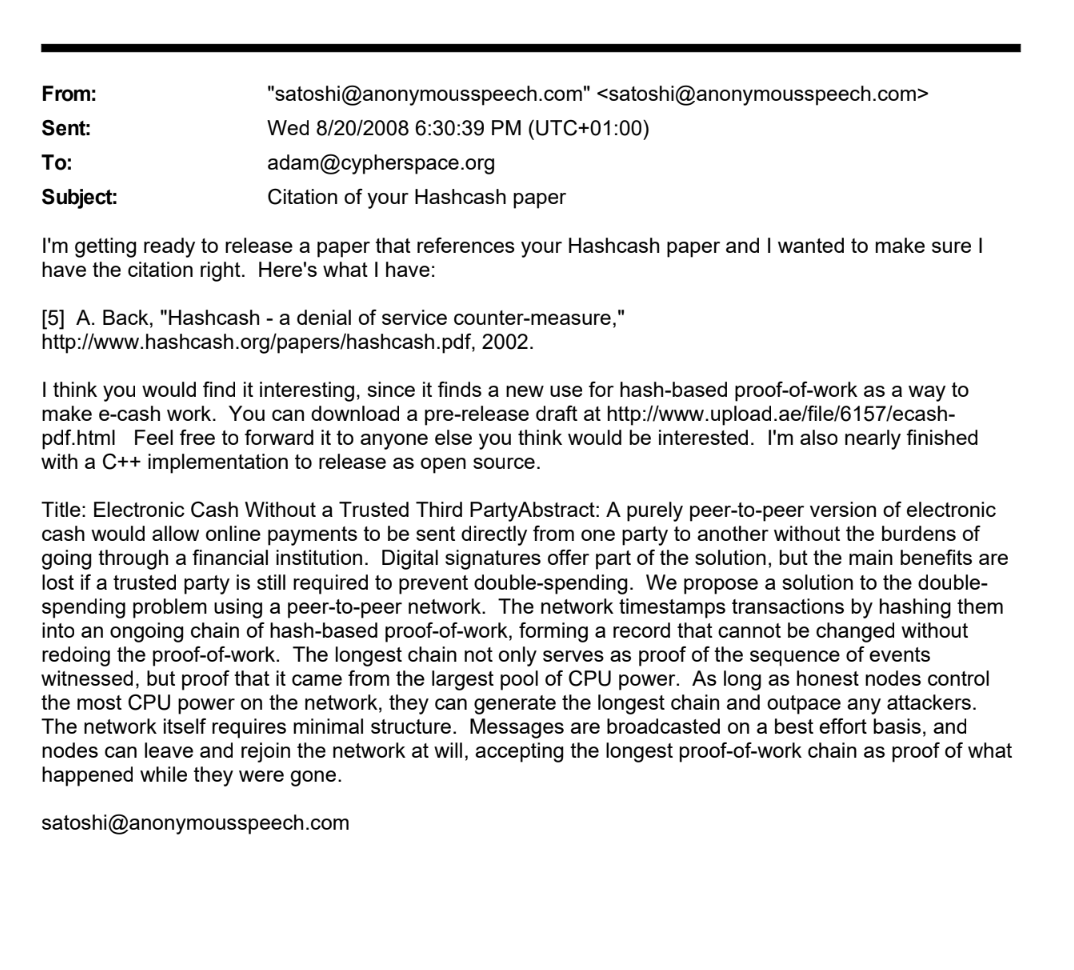
- The image below shows the first email record between the two (in 2008), where Satoshi Nakamoto references Adam Back's notification regarding the Hashcash paper. From the content, those familiar with the Bitcoin white paper should notice that most of the text is a summary of the Bitcoin white paper.
 The two subsequently discussed academic issues:
Adam Back replied to Satoshi Nakamoto, suggesting that he read Wei Dai's "B-money" paper. (Rizzo's note: Dai is a well-known cryptographer dedicated to the study of digital cash and is often mentioned as a possible candidate for Satoshi Nakamoto.)
Satoshi Nakamoto replied, thanking Adam Back and stating that he had not read the "B-money" paper. He also explained that Bitcoin's main innovation is the simultaneous use of proof of work to support a distributed timestamp server. When users generate proof of work to create new cryptocurrency for themselves, the same proof of work also supports network timestamps. This replaces Usenet.
Adam Back replied to Satoshi Nakamoto, apologizing for not having read Satoshi's paper yet. He also mentioned: "Another related paper is by Rivest et al., called micromint, which uses k-way collisions to provide a computational advantage over time for banks to create tokens. The situation you mentioned about a certain group of players gaining an advantage through computational cycles reminds me of micromint. In micromint, over time, the bank's advantage increases because some advantages accumulate in the partial results, which helps create further partial collisions more cheaply."
Satoshi Nakamoto again replied, thanking Adam Back for his help and for providing Wei Dai's "B-money" paper and other materials. He stated that he had released the open-source code related to the paper named Bitcoin v 0.1. He provided Adam with the link and a screenshot, introducing the main idea of the system as creating self-proving consensus through generating a series of hash-based proofs of work. Users earn new cryptocurrency by contributing proof of work to the chain. (Rizzo's note: According to Adam's public statement, he did not pay attention to Bitcoin again until the end of 2012.)
Note: The above email history between Adam Back and Satoshi Nakamoto concludes here. Adam may have only regarded Satoshi as a seeker of knowledge at the time, not realizing that Bitcoin would eventually rank among the top 10 global assets.
Q&A After Bitcoin's Release: Email Correspondence Between Satoshi Nakamoto and Early Collaborator Martii 'Sirius' Malmi
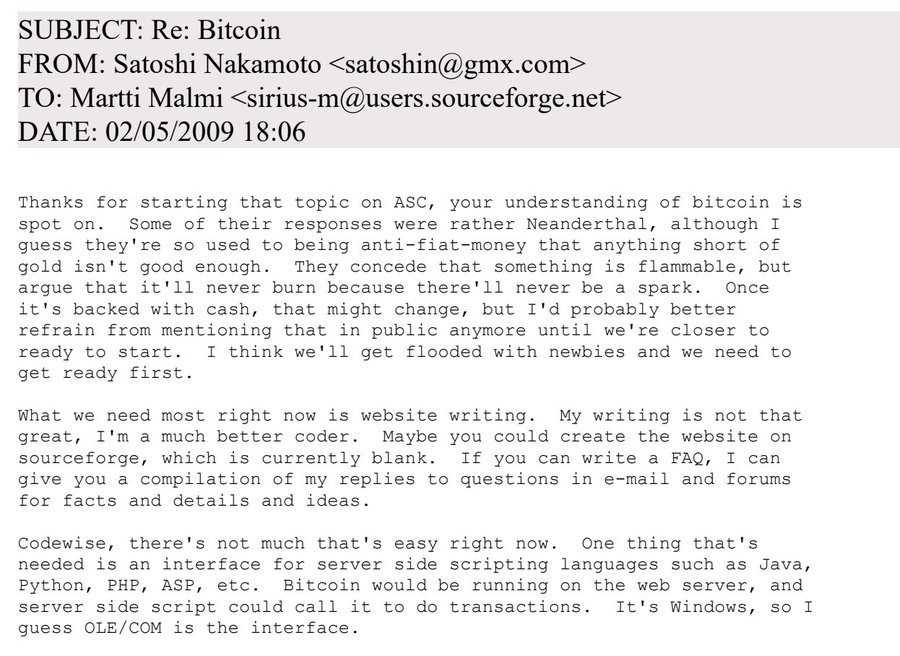
- Satoshi Nakamoto sought collaborators, and Martii became an early partner in Bitcoin. The image below shows the first email between Satoshi and Martii, where Satoshi thanks Martii for starting the topic on ASC and praises his accurate understanding of Bitcoin. He also states the main direction of Bitcoin at the moment and hopes Martii can create a website on Sourceforge to manage a FAQ compilation. Satoshi also mentioned that he could provide Martii with a compilation of materials, facts, and ideas for responding to emails and forum questions.
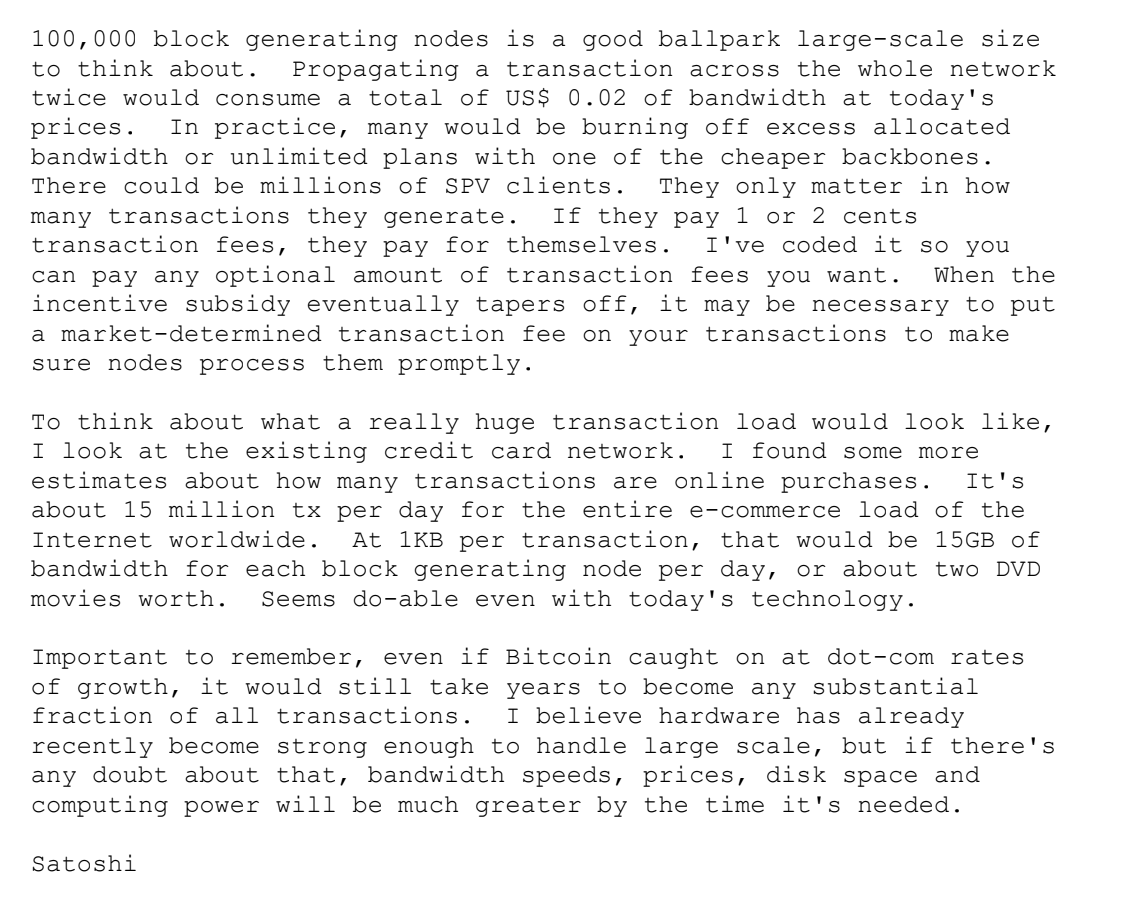
- When asked how Bitcoin should scale in the future, Satoshi replied that the Bitcoin network would have a maximum of 100,000 nodes and discussed the economics of large-scale networks based on the situation at the time. (Rizzo's note: Currently, there are about 50,000 nodes running Bitcoin clients.)
The image below shows Satoshi's statement.
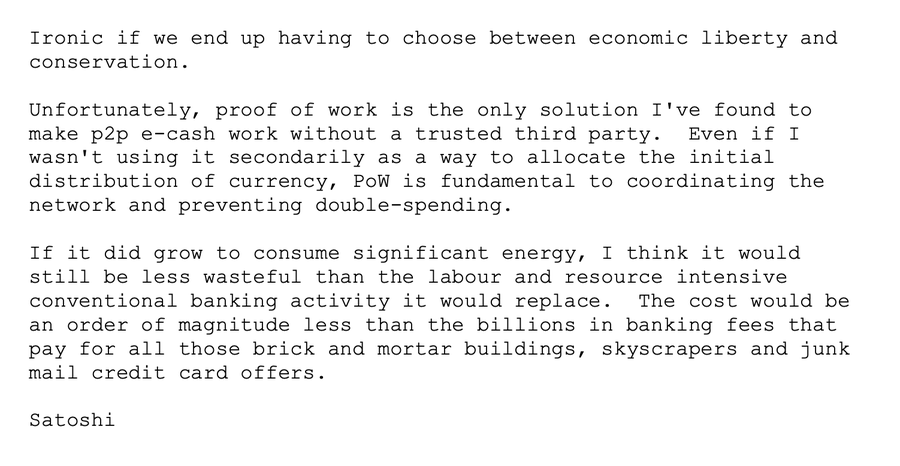
- Satoshi believed that Bitcoin mining would consume less energy than traditional banking systems. The original text below reflects Satoshi's foresight:
The original text states, "Ironically, we may ultimately have to choose between economic freedom and environmental protection. Unfortunately, the only solution I have found is proof of work (POW), which is essential for coordinating the network and preventing double spending. Proof of work is the key to making a peer-to-peer electronic cash system work without trusting a third party.
Even if energy consumption increases to a significant level, I believe it will still be more efficient than the labor and resource-intensive activities of traditional banking. Its costs will be far lower than the billions in bank fees required to pay for all those physical buildings, skyscrapers, and junk mail credit card offers."
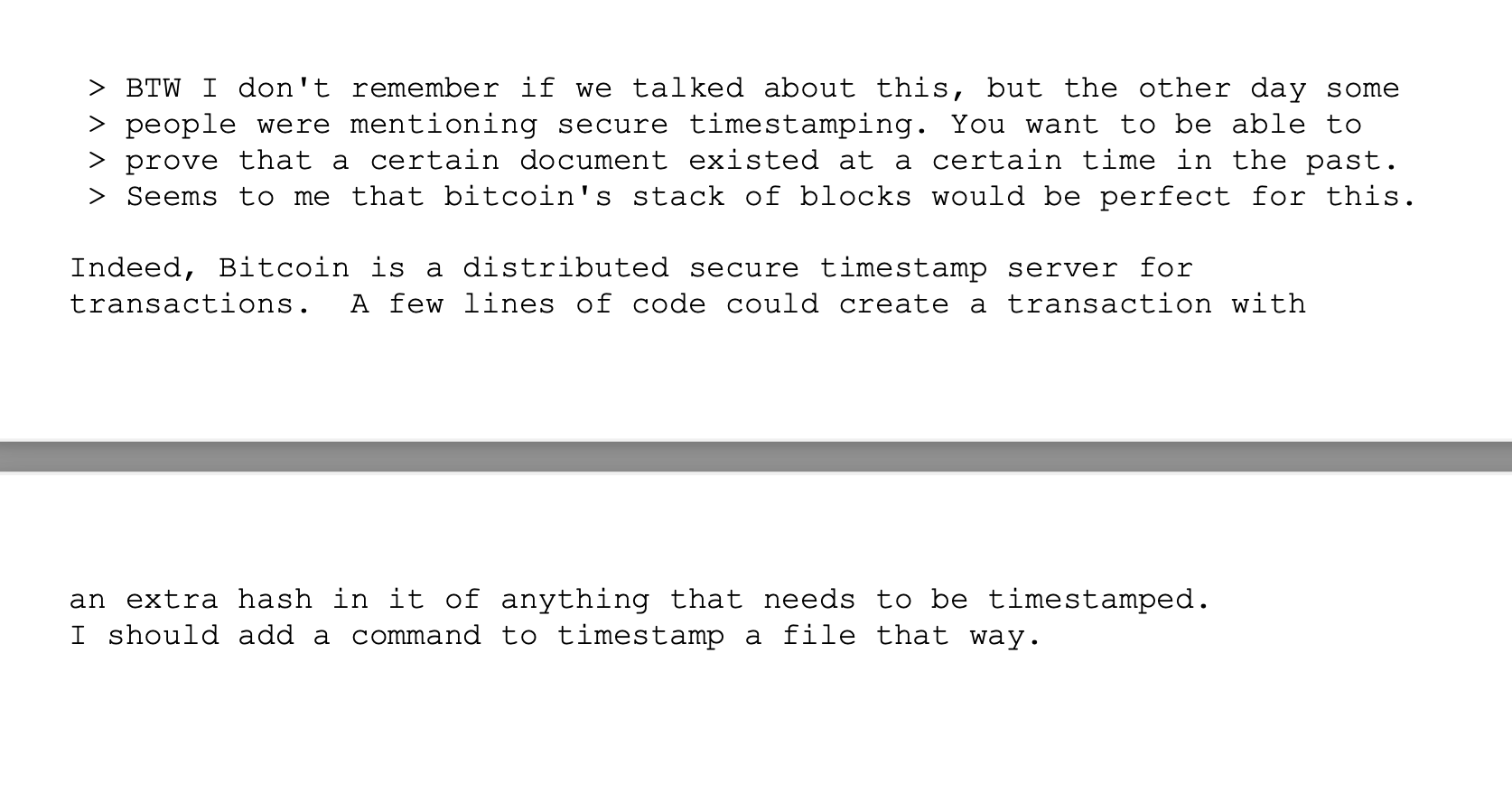
- Satoshi foresaw at least one viable non-monetary use for Bitcoin, supporting timestamp use cases.
The original text states, "A few days ago, some people mentioned secure timestamps. You want to be able to prove that a certain document existed at a specific time in the past. In my view, the Bitcoin blockchain is very suitable for this purpose. Bitcoin is a distributed secure timestamp server, and a few lines of code can create a transaction with an additional hash that can be used to timestamp anything needed. I should add a command to timestamp files in this way."
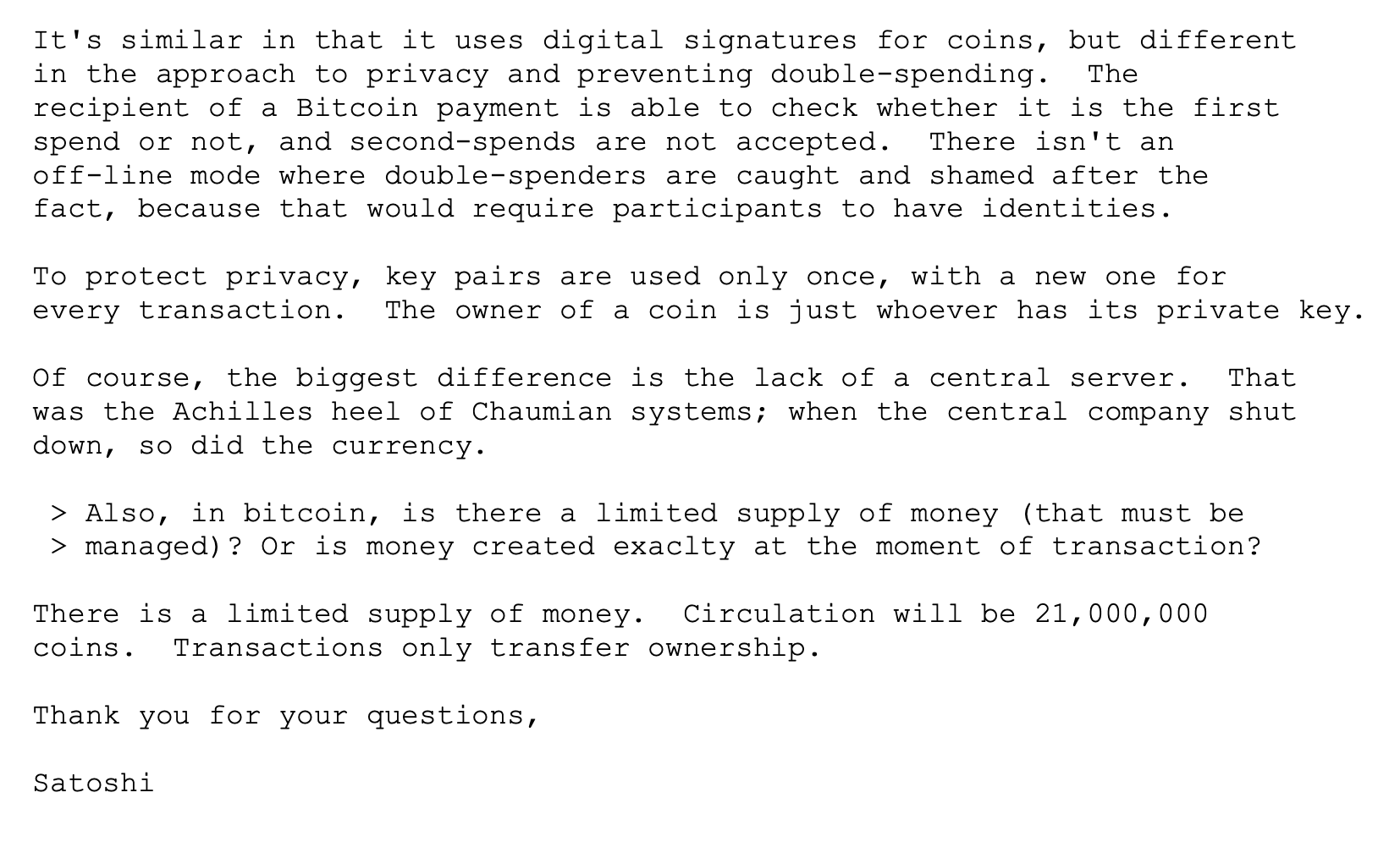
- Satoshi described the difference between Bitcoin and David Chaum's failed electronic currency DigiCash. (Rizzo's note: It is worth noting that Chaum's statements had a profound impact on cypherpunks, including Hal Finney.)
The original text states, "DigiCash is similar to using digital signatures to represent currency, but differs in privacy protection and preventing double spending. The recipient of a Bitcoin payment can check whether it is the first payment, and if not, they do not accept the second payment. There is no offline mode for later capturing and publicly exposing double spenders, as this would require participants to have identities. To protect privacy, key pairs are used only once, and a new key pair is generated for each transaction. The owner of the currency is the person holding its private key. Of course, the biggest difference is that there is no central server. This is the fatal flaw of the Chaumian system; when the central company shuts down, the currency shuts down with it. In Bitcoin, the supply of currency is limited. The total will be 21,000,000 coins. Transactions are merely transfers of ownership."
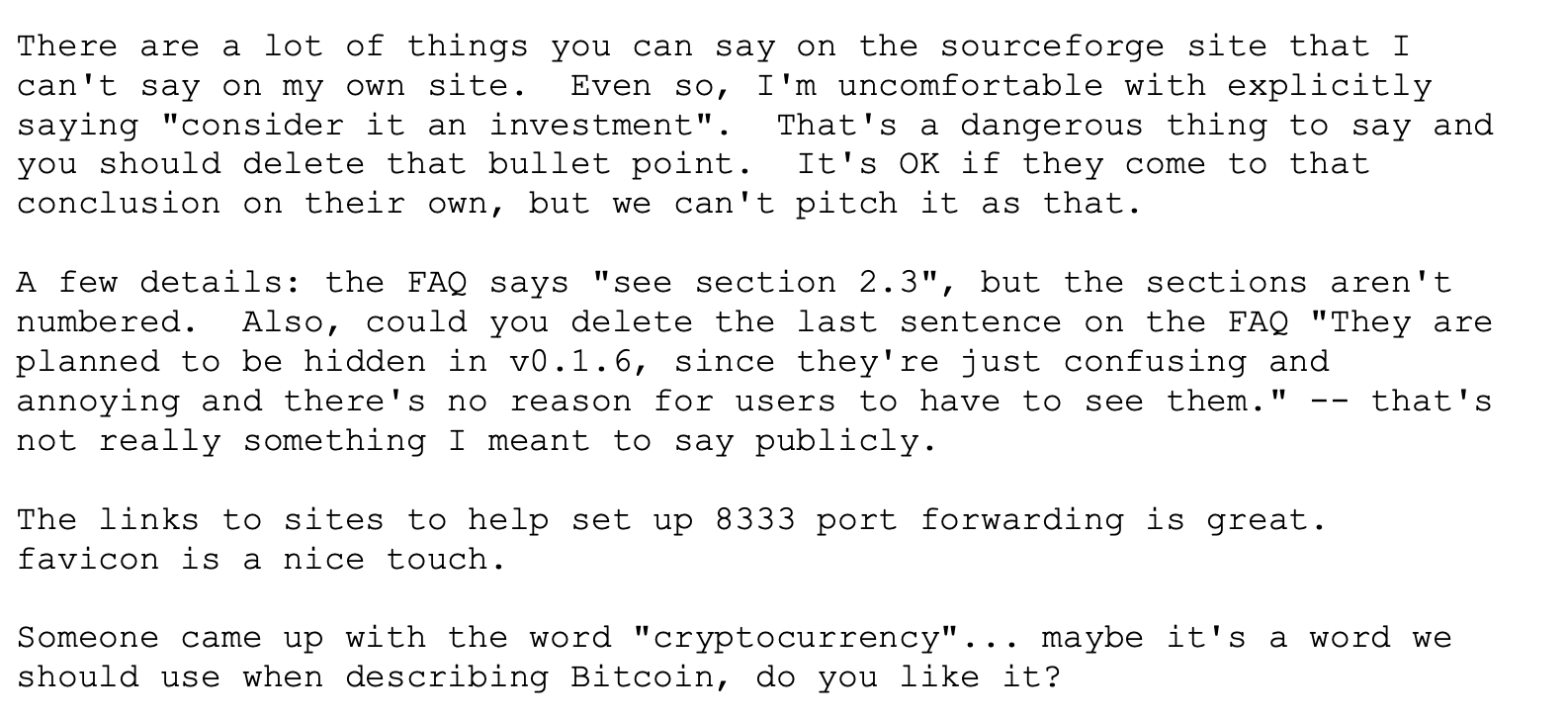
- Satoshi expressed reluctance to label Bitcoin as an "investment," fearing legal risks, and urged Martii to remove the corresponding statements. (Rizzo's note: The term "cryptocurrency" was not originally coined by Satoshi.)
The original text states, "There are many things you can say on the SourceForge site that I cannot say on my own site. Even so, I feel uncomfortable explicitly saying 'consider it as an investment.' This is a dangerous statement, and you should remove this project. If they come to that conclusion themselves, that's fine, but we can't market it that way; someone has proposed the term 'cryptocurrency,' and maybe we should use that term when describing Bitcoin, what do you think?"
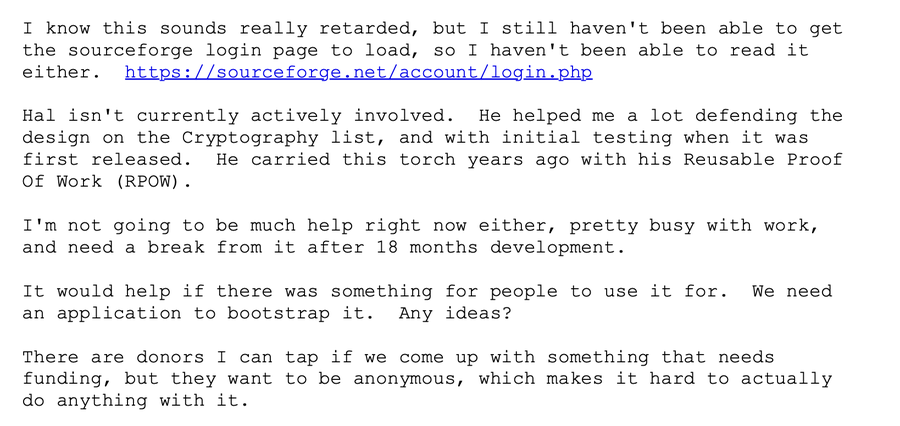
- In July 2009, after 18 months of development, Satoshi felt tired and needed a break, also mentioning Hal's absence from work.
The original text states, "Hal has helped me a lot on the cryptography forum, defending the design, but he is not currently actively involved. He did preliminary testing for Bitcoin when it was first released. He contributed a lot to the field with his reusable proof of work (RPOW) years ago. I can't provide much help right now; I'm busy, and after 18 months of development, I need a break."
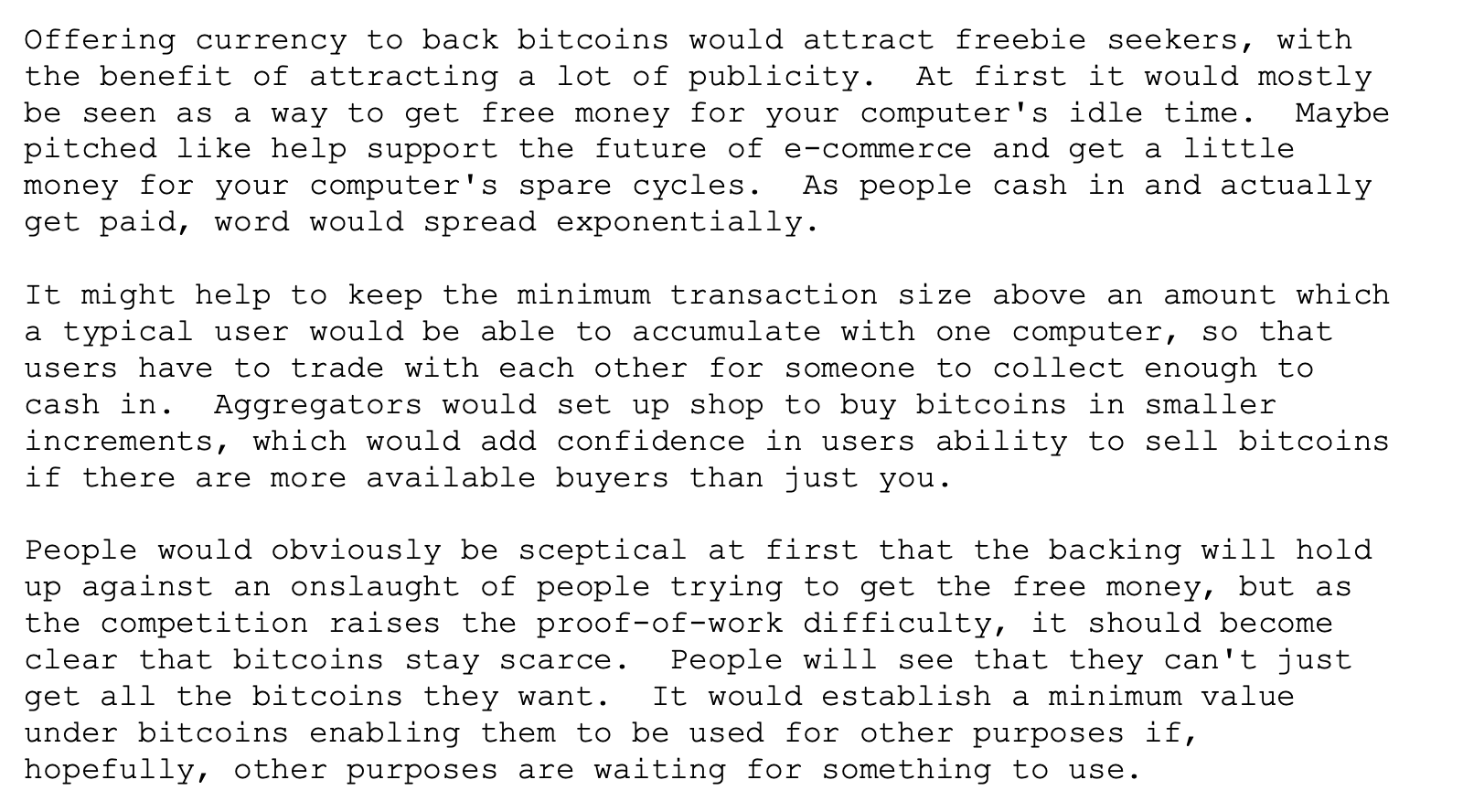
- Rizzo's interpretation here seems biased; Rizzo interprets that Satoshi discussed how Bitcoin might gain adoption. It is noteworthy that he emphasized the fact that Bitcoin is easy to obtain because you can mine it on a computer. This contrasts sharply with our current view of Bitcoin.
The author understands from the original text that Satoshi wanted to express that initially, Bitcoin was easy to obtain, but as scarcity and value increased, it became harder to acquire Bitcoin, which resonates with the current reality.
The original text states, "Providing currency to support Bitcoin will attract free seekers, which will bring a lot of publicity benefits. Initially, it will mainly be seen as a way to earn free currency from idle computer time. Perhaps it can be marketed as helping to support the future of e-commerce and earning some income during computer idle cycles. As people cash out and actually get paid, the news will spread exponentially. It may help keep the minimum transaction amount above what a typical user can accumulate, so users must trade with each other to collect enough to cash out. Aggregators (the early form of exchanges) will set up small exchange shops, which will increase users' confidence in exchanging Bitcoin, with more buyers to choose from. Initially, people will be skeptical about getting free currency, but as competition increases the difficulty of proof of work, Bitcoin's scarcity should become apparent. People will realize they cannot casually obtain all the Bitcoin they want. This will establish a minimum value for Bitcoin, allowing it to be used for other purposes, if there is hope, other purposes are waiting to be used."
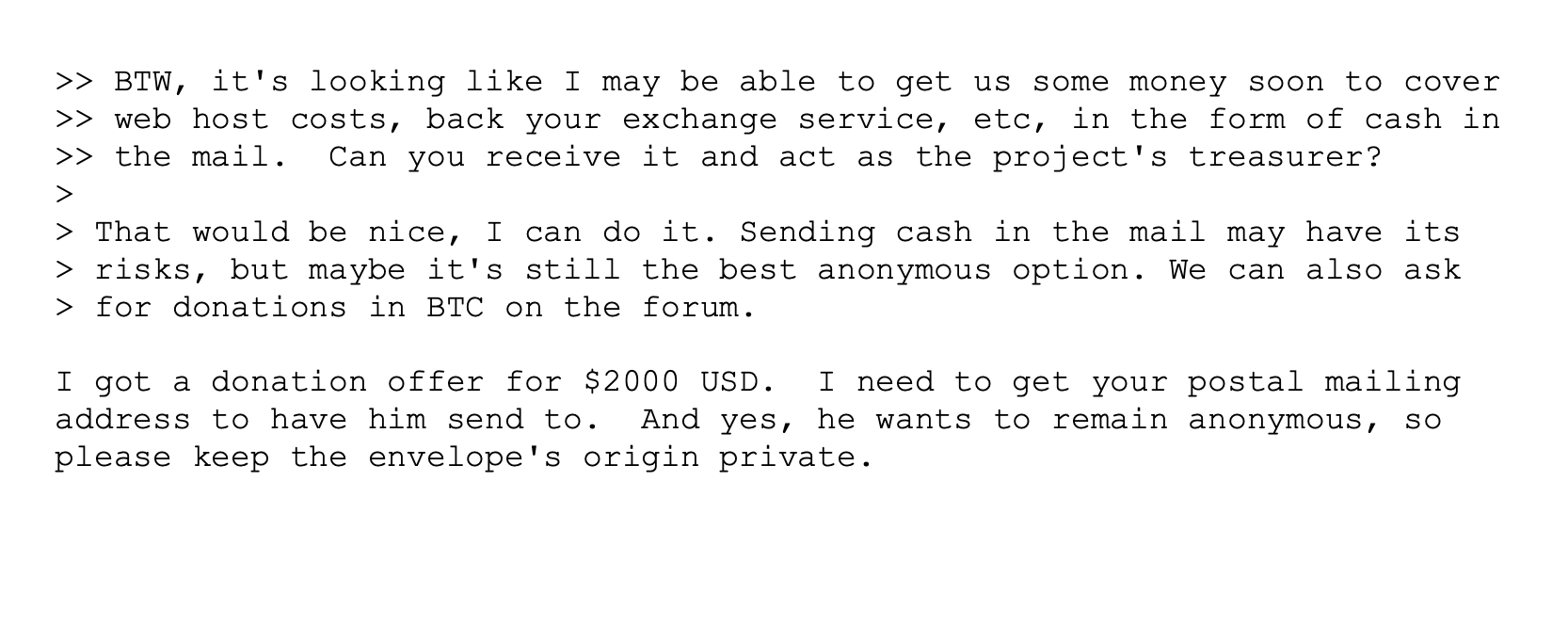
- Satoshi received requests for donations from others, but he transferred the funds to Martii.
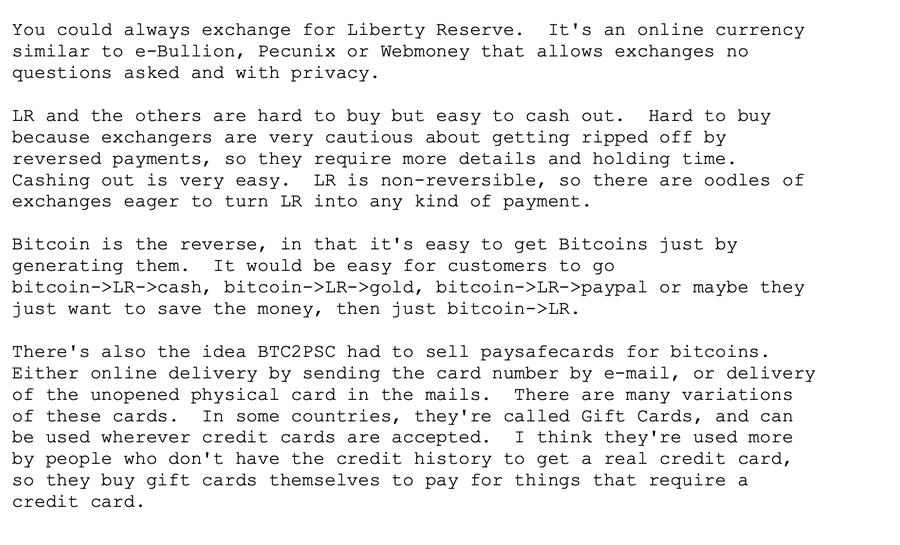
- Satoshi believed Bitcoin would become a way to trade other internet currencies (like Liberty Reserve). (Rizzo's note: Liberty Reserve was later shut down by the U.S.)
The original text states, "Exchanging for Liberty Reserve is also a way. It is an online currency similar to e-Bullion, Pecunix, or Webmoney, allowing transactions without questions and protecting privacy. Buying Liberty Reserve and other currencies is difficult because exchangers are very cautious, fearing reverse payment fraud, so they require more details and holding time. However, cashing out is very easy. Liberty Reserve is irreversible, so many exchangers are eager to convert it into any payment method. In contrast, obtaining Bitcoin through mining is very easy. Customers can easily exchange Bitcoin for Liberty Reserve and then cash out, gold, PayPal, or if they just want to save that money, they only need to exchange Bitcoin for Liberty Reserve.
Additionally, BTC 2 PSC proposed an idea to sell Bitcoin as paysafecards. The card number can be sent via email for online delivery or mailed as unopened physical cards. There are many different variants. In some countries, they are called gift cards and can be used where credit cards are accepted. Some people cannot obtain real credit cards due to a lack of credit history, so they buy gift cards to pay for things that require credit cards."
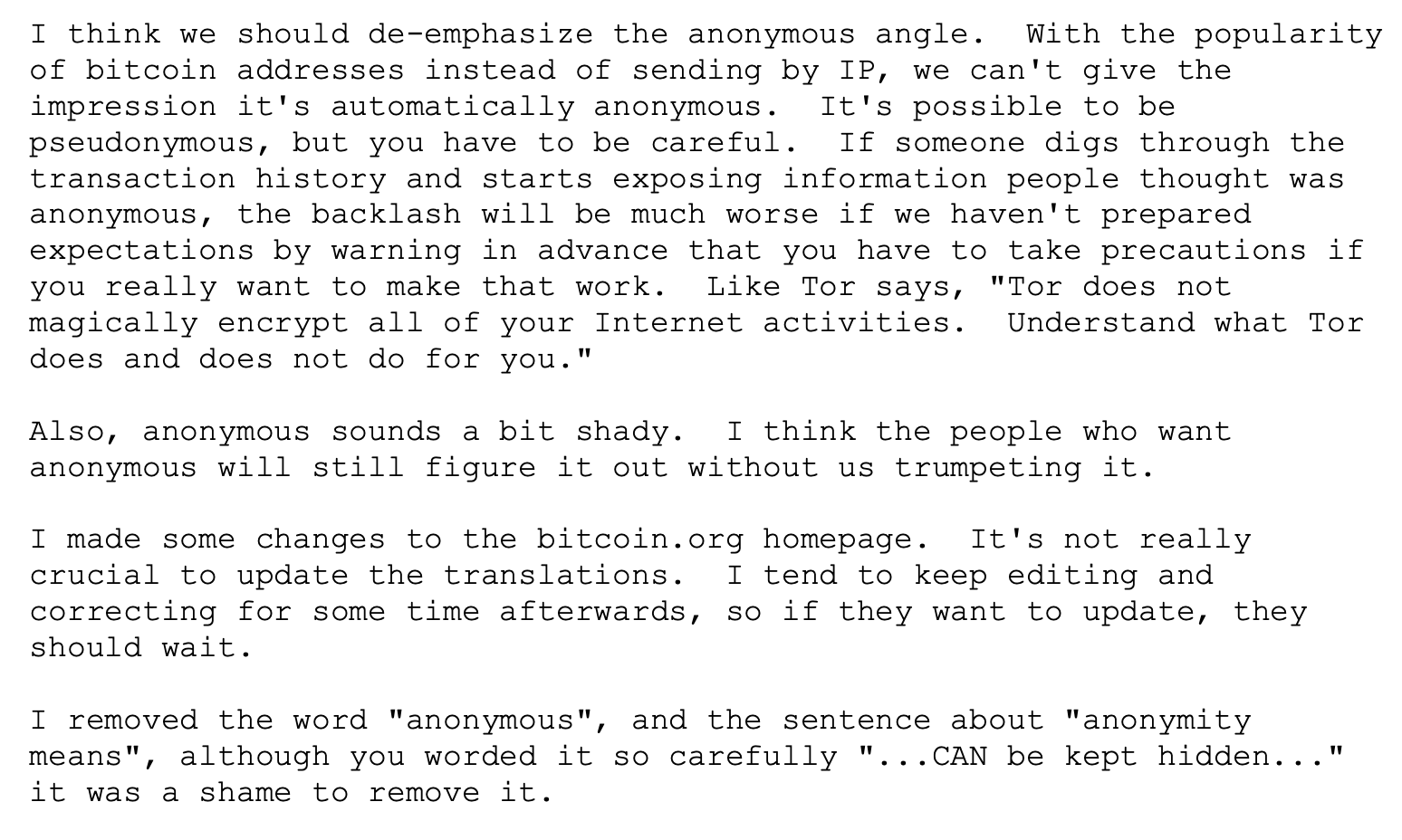
- Satoshi removed the term "anonymous" from the Bitcoin website, believing it sounded dark.
The original text states, "I think we should tone down the emphasis on anonymity. With the popularity of Bitcoin addresses, we cannot give the impression of automatic anonymity. If someone digs deep into the transaction history and starts exposing what people think is anonymous information, the consequences will be worse if we haven't warned in advance that precautions must be taken. As Tor says, 'Tor does not magically encrypt all your internet activities. Understand what Tor provides and does not provide.' Additionally, anonymity sounds a bit suspicious. I think those who want to be anonymous will find their own ways; we don't need to promote it widely."
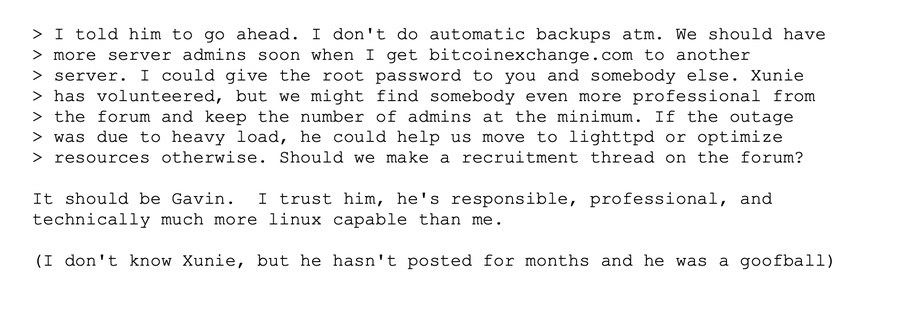
- Satoshi praised Gavin and recognized his development skills. (Rizzo's note: It is worth noting that considering the historical revisionism of this event, Satoshi was very complimentary of Gavin Andresen.)
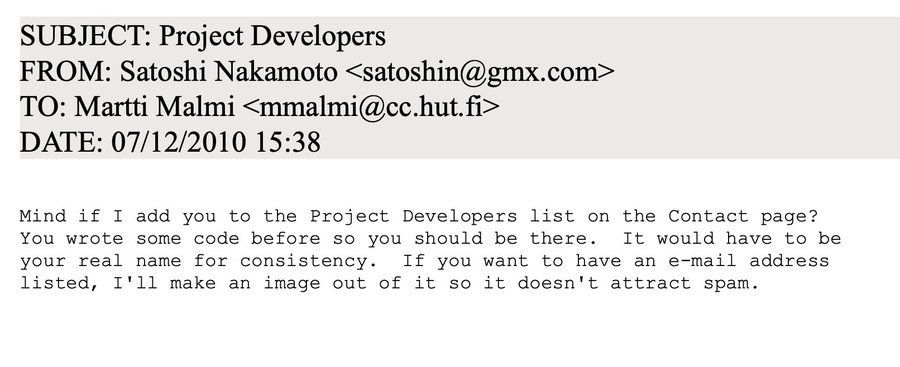
- Satoshi hoped to include Martii's name on the list of developers on the Bitcoin website, emphasizing that it must be a real name. (Rizzo's note: Finally, we see a copy of the email Satoshi sent to other developers regarding the online list before removing his own name from the project website. Satoshi did not mention his intention to withdraw from the project in the email.)
 Risk warning
 Risk warning