








Is the German government unable to sell coins? BTC may have reached a local bottom

 Is the impact of the German government's selling pressure exaggerated?
Author: Mary Liu, BitpushNews
On Monday, the cryptocurrency market stabilized after several days of large-scale sell-offs.
During the morning session, the German government addresses transferred over 10,000 bitcoins to cryptocurrency exchanges and market makers in several batches. The price of bitcoin briefly fell below $55,000; however, data from Arkham Intelligence showed that by the close of the U.S. stock market (around 01:56 AM Beijing time on Tuesday), the German government addresses received 2,898 bitcoins back from exchanges, worth approximately $163 million, mainly from Coinbase, Kraken, and Bitstamp.
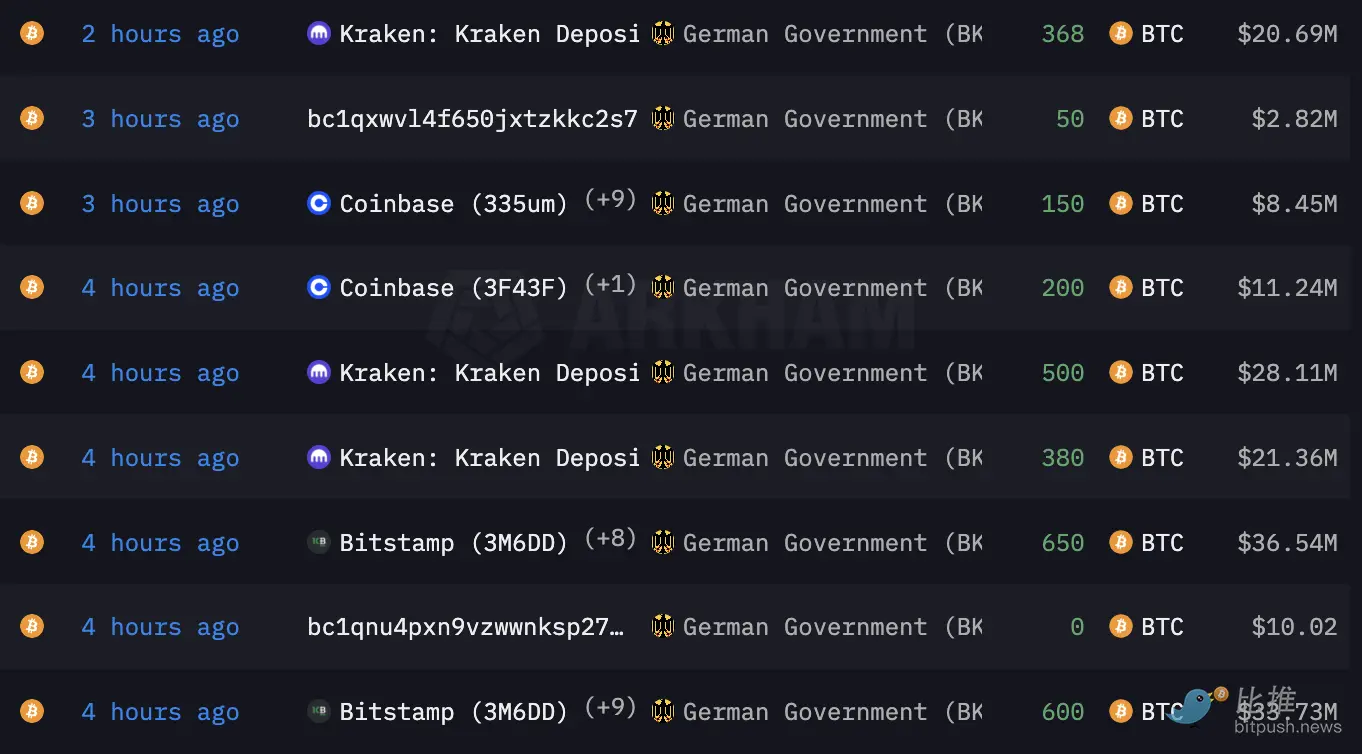
Steven Zheng, research director at The Block, analyzed that the exchanges likely returned the bitcoins because they could not sell them within the target price range.
Steven Zheng stated, "Considering that some bitcoins have returned from Coinbase to the German government addresses, it can be assumed that they are unsold bitcoins, part of the sales agreement between the cryptocurrency exchanges and the country."
Data from Bitpush showed that BTC reached about $55,200 earlier on Monday afternoon, then rebounded to $56,662.40 after the U.S. stock market closed, with a 24-hour increase of 0.58%.
Altcoins showed mixed performance, with more tokens in the top 200 by market capitalization declining than rising. Among them, aelf (ELF) led the gains, rising 21.5% to a trading price of $0.421, while Celestia (TIA) and Curve DAO Token (CRV) increased by 14.5% and 10.1%, respectively.
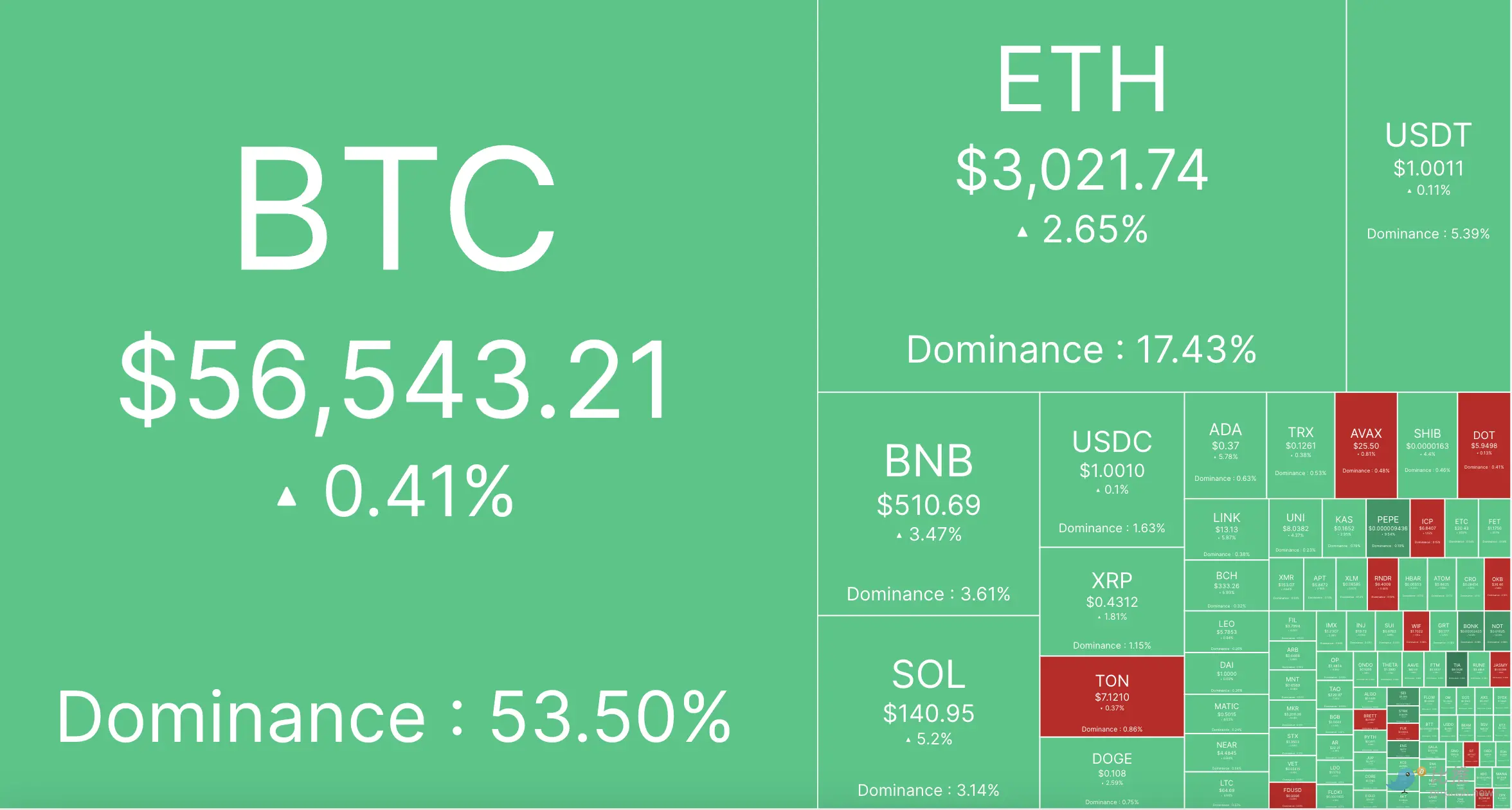
The overall market capitalization of cryptocurrencies is currently $2.07 trillion, with bitcoin's market share at 53.5%.
In the U.S. stock market, at the close, the S&P 500 index and the Nasdaq 500 index rose by 0.10% and 0.28%, respectively, while the Dow Jones index fell by 0.08%.
Is the Impact of the German Government's Sell-off Overstated?
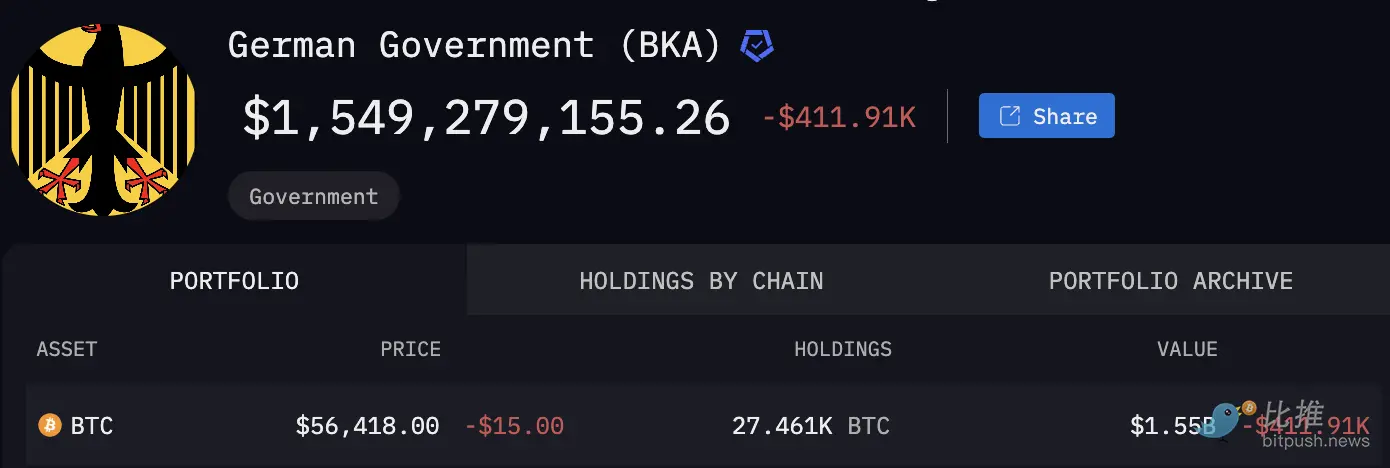
According to Arkham's data, the German government's sell-off progress is nearly halfway complete. Since starting the sell-off last month, its BTC holdings have decreased from nearly 50,000 to 27,461, with the current holding valued at $1.5 billion.
Recent industry headlines have focused on the German government's sell-off and Mt. Gox refunds, with many analysts believing these are the main reasons for the recent sharp decline in bitcoin. However, Bitfinex analysts attribute the drop to normal seasonal weakness.
Bitfinex analysts stated, "It is worth noting that the actual market value of bitcoins that have flowed into the market since 2023 has reached $224 billion. In contrast, the bitcoins seized and subsequently sold by governments, including those in the U.S. and Germany, amount to only about $9 billion. This accounts for just 4% of the total actual appreciation in the market since the beginning of 2023."
Analysts added, "Despite the nominal value being substantial, the actual number of bitcoins transferred to exchanges is only a few hundred million dollars, indicating that the impact of government-seized bitcoins on the market and supply surplus is relatively small. This suggests that while the sale of seized assets is significant in individual transactions, their overall impact on market dynamics and bitcoin price stability is not as great as it initially appears."
Institutional Investors See Buying Opportunity
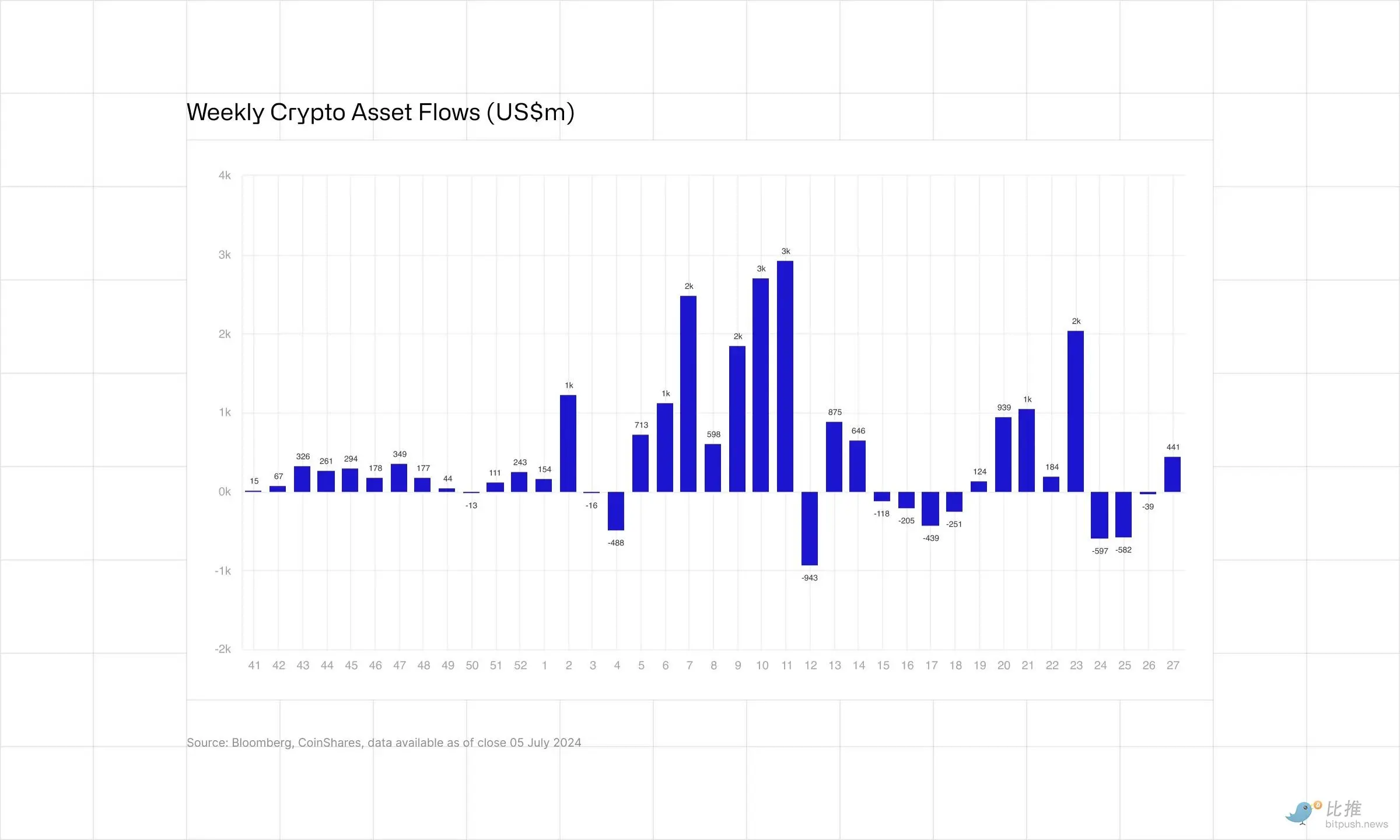
Despite the market downturn, data released by CoinShares shows that inflows into digital asset investment products reached $441 million last week.
Among them, bitcoin investment products accounted for the largest share of total inflows into crypto products ($398 million) at 90%. Regionally, the inflow of funds mainly came from the U.S., with an inflow amount of $384 million, while other significant buying came from Hong Kong, Switzerland, and Canada, with inflows of $32 million, $24 million, and $12 million, respectively. Germany saw an outflow of $23 million.
Analysts: BTC May Have Reached a Local Bottom
Bitfinex analysts stated that BTC may have reached a potential local bottom.
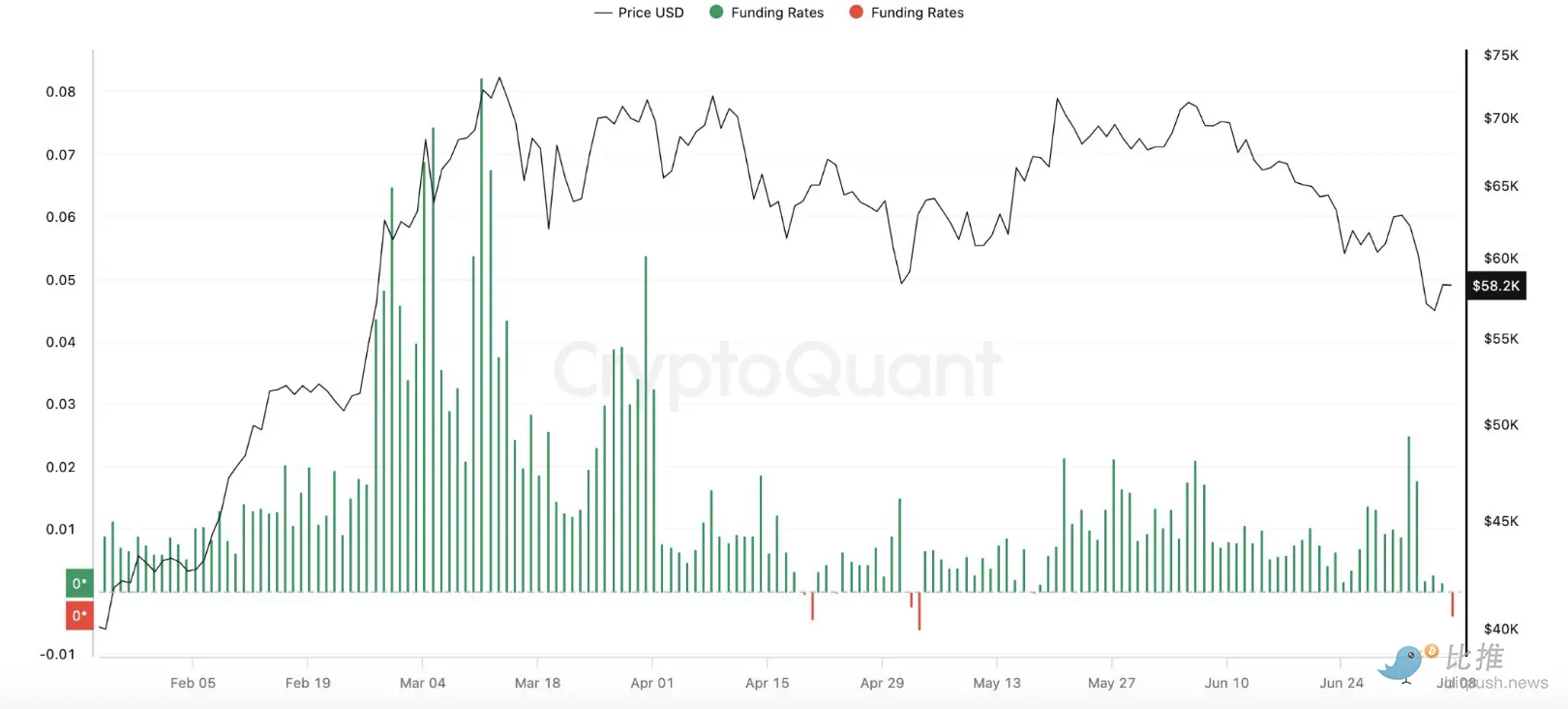
Data provided by Bitfinex shows that since hitting the bottom on May 1, the funding rate for BTC perpetual contracts has turned negative for the first time.
Historically, periods of negative funding rates combined with low short-term SOPR values (a financial metric used to measure the profit or loss realized by a specific group of investors on a given day) typically signal a price adjustment bottom.
Analysts noted, "This may be seen as an increase in bearish sentiment, but it also reinforces the view that as buying and selling pressures balance out, BTC may be stabilizing or approaching a potential bottom. Negative indicators suggest significant selling pressure or that sellers dominate the market, but they may also indicate that the market is oversold. When this oversold condition coincides with a rebound in SOPR, it usually indicates that the market is bottoming out."
Analysts at Secure Digital Markets stated in their report, "The RSI indicator shows that bitcoin has entered an oversold state for the first time since August, just before the upward squeeze. For bitcoin to gain further momentum, the price needs to break through $58,500, and breaking through $60,500 would mark a return to bullish territory."
Ed Hindi, Chief Investment Officer of Tyr Capital, believes that the current pullback is only temporary and insists that BTC's price will reach six figures by the end of this year. Ed Hindi stated in a CNBC interview, "Due to miners and the government selling off bitcoin inventories, bitcoin is currently in a pullback range, but we believe that long-term investors and speculators will continue to buy on dips. We see no reason to change the target of $100,000 for bitcoin by the end of 2024."
 Risk warning Risk warning




Popular articles




