Lumoz: A New Paradigm for Rollup Platforms
 This article analyzes how Lumoz addresses the challenges of ZK-Rollup technology and market incompatibility by providing standardized ZK-Rollup solutions, a modular computing platform, and an optimized ZKP computing mechanism.
1.
Environment-Driven Rollup Changes ============
Layer1 Scalability is Urgent
As the number of Ethereum users continues to grow, the network is becoming increasingly busy, especially during the launch of primary market activities, where gas fees often spike. Additionally, the rising price of $ETH tokens has made high transaction fees a barrier for small transactions. Therefore, improving storage efficiency, transaction throughput, and reducing transaction latency is crucial for the development of Ethereum.

Figure 1 Changes in Ethereum Gas Fees
Traditional Layer1 scalability solutions generally include both On-chain and Off-chain forms. On-chain refers to updates and optimizations made on Layer1 by changing the consensus mechanism, implementing sharding, or increasing block size; Off-chain refers to off-chain scalability, mainly including sidechains and Layer2 solutions. The biggest difference between sidechains and Layer2 is that sidechains operate based on their own security protocols, while Layer2 relies on the security protocol of the mainnet, making Layer2 generally more secure from a security perspective.
In past developments, the logic of Layer2 implementation involved off-chain centralized computation processing information and transmitting results on-chain, which not only improved the computational efficiency of transactions but also fully utilized the high security of the ETH mainnet. The mainstream implementation solutions of Layer2 currently include: Channel, Plasma, and Rollup, and because Rollup is essentially a further extension of the Plasma solution, with higher security, state validity, and data verification capabilities, Rollup has become the fundamental direction for the future development of Layer2.
Who Excels in Rollup
There are two main branches in Rollup: Optimistic-Rollup and ZK-Rollup. In Optimistic-Rollup, it is assumed that the transaction results submitted to the main chain are optimistic, under this assumption there is no need to immediately verify every transaction, allowing for quick submission and processing of transactions; a challenge period of about a week is set, during which other validators can raise objections and submit corresponding evidence. If successful, the transaction will be rolled back, and the erroneous party will be penalized. ZK Rollup, on the other hand, immediately verifies the correctness of transactions through zero-knowledge proofs, ensuring almost 100% fraud-proof transactions. Overall, ZK-Rollup provides higher security compared to Optimistic-Rollup, and there is no challenge period delay in transaction confirmation, making it more promising for applications. For this reason, Vitalik has publicly stated multiple times that ZK-Rollup is the main line of future Layer2 development.
However, due to the significantly higher technical implementation difficulty of ZK Rollup compared to Optimistic-Rollup, the mainstream market for Rollup technology is still dominated by Optimistic-Rollup.

Figure 2 Distribution of Rollup Market TVL Shares
Among them, Arbitrum is currently the leader in Optimistic-Rollup, occupying 31.36% of the TVL share, while the corresponding zkSync Era only occupies 1.32% of the TVL share. Therefore, how to shape a standardized ZK-Rollup solution and gradually expand the application market of ZK-Rollup has become an important issue. The comprehensive solutions provided by Lumoz may become the key to breaking the deadlock.
2.
The Strong Background of Lumoz ==========
Lumoz is a Comprehensive ZK Platform
Lumoz network is a globally distributed modular computing network, combined with the DePIN network, creating a powerful, secure, and flexible computing platform that provides computational support for ZK-Rollup, ZK ML, ZKP, and more. At the same time, Lumoz focuses on ZK-RaaS construction, aiming to provide a complete set of deployment and implementation solutions for ZK Rollup, addressing various issues such as incompatibility among current ZK-Rollup solutions, centralized computing power, and concentrated risks.

Figure 3 ZK Rollup Promotional Image
Years of Deep Engagement in the ZK Field
Unlike many concept projects flooding the Web3 space, Lumoz has been deeply engaged in the ZK field for many years. Its founder, Nanfeng, has held executive positions in several top tech companies and investment firms, possessing rich technical knowledge and excellent blockchain project management capabilities. This cutting-edge thinking has led him to lead the team into the exploration and research of the ZK field since 2018.
- Project Establishment: In March 2022, Opside was established in Hong Kong, China, aiming to become a provider of blockchain scaling infrastructure, focusing on ZK-RaaS, helping developers create customized zkEVM chains through "one-click deployment."
- Seed Round Financing: In April 2023, Opside completed a $4 million seed round financing, with funds used to accelerate project development, expand team size, and operational scale to meet the growing market demand.
- Renaming and Brand Restructuring: In October 2023, Opside officially changed its name to Lumoz. The reason for the renaming was to avoid confusion with Optimistic Rollup and to better reflect its focus on ZK technology. The new name Lumoz comes from the Latin word "Lumos," symbolizing brightness and the promising future of ZK technology.
- Pre-Series A Financing: In March 2024, Lumoz completed a $6 million Pre-Series A financing, led by Hashkey Capital and OKX Venture, with a valuation of up to $120 million.
- Strategic Financing: In May 2024, Lumoz completed a strategic round of financing, with participation from IDG Blockchain, Blockchain Coinvestors, Gate Ventures, Summer Capital, EVG, 7upDAO, Sweep Ventures, etc., with a valuation of up to $300 million.
- Node Sale: In June 2024, the whitelist node presale began, attracting a large number of investors to participate.
- OKX Launchpad: In July 2024, the public sale of nodes began, and a Launchpad event was held in collaboration with OKX.

Figure 4 ZK Rollup Promotional Image
In addition to such a high valuation estimate, Lumoz has also delivered excellent results in practice. Lumoz launched its testnet in May 2023, and so far has 28,403 POW nodes, 16 allowed Rollups, 470,000 ZKP submissions, and 20 million transaction counts;

Figure 5 Lumoz Operational Status
On the technical side, Lumoz launched ZK-Rollup Launchbase, increasing support for ETH, BSC, and Polygon testnets, and providing various modular components such as data availability (DA) and shared sequencers. It has also achieved several groundbreaking inventions, including the ZKP Two-step Algorithm, NCRC, zkVerifier node verification mechanism, and Lumoz RaaS Launchbase high compatibility technology stack. Additionally, Merlin chain and ZKFair's ZK computation are supported by Lumoz, achieving preliminary technical implementation.
3.
Unified ZK Technical Solutions =========
Lumoz Provides a Modular Computing Layer
Modular Rollup offers a new approach to solving the blockchain trilemma, generally decomposing the blockchain system into different modules to achieve a layered structure, resulting in more efficient transaction processing and data management, thus balancing decentralization, security, and scalability issues to some extent. Conventional Rollup generally includes settlement layer, execution layer, consensus layer, and data availability layer.
- Settlement Layer: Updates the blockchain asset status on Layer1, ensuring asset security.
- Execution Layer: Processes transactions on the Rollup, recording and updating transaction status.
- Consensus Layer: Reaches consensus on transactions, ensuring transaction security.
- Data Availability Layer: Records and aggregates all transaction data, ensuring data traceability.
In addition to the four layers of conventional Rollup, Lumoz also includes a core module proof layer (Prover Layer), which provides censorship-resistant distributed computing, implements ZKP, and ensures the authenticity and validity of transaction states.
ZK Computing Resources + EigenLayer Re-staking Dual Narrative
Lumoz integrates powerful ZK computing resources with the EigenLayer re-staking mechanism through Lumoz Oracle, zkProver, zkVerifier, and Lumoz Chain, allowing users to re-stake already staked tokens into EigenLayer. Lumoz will enhance the security of its Active Verification Service (AVS); at the same time, the staked tokens will serve as collateral for nodes to prevent malicious behavior.

Figure 6 EigenLayer Re-staking Process
- Staking and Re-staking: Users stake tokens on blockchain networks like Ethereum, and these tokens are re-staked into Lumoz's AVS through EigenLayer's re-stake mechanism, increasing the security of the verification service.
- Data Processing and Storage: Lumoz AVS Oracle retrieves and stores data from EVM-compatible chains, ensuring data availability and integrity. This data provides computational input for zkProver and the necessary information for zkVerifier verification.
- Task Allocation and Execution: Lumoz Chain is responsible for task scheduling, allocating computational tasks to zkProver nodes; zkProver nodes execute computational tasks and generate ZKP.
- Result Verification and Confirmation: zkVerifier nodes verify the proofs generated by zkProver, ensuring the correctness of the computational results. Once verified, Lumoz Chain records the results on the blockchain and incentivizes participating nodes through a reward mechanism.
This process allows multiple verification servers to share a set of tokens, thereby improving resource utilization and computational efficiency, which is crucial for high computational demand in ZKP generation; through re-staking, Lumoz can better support various EVM-compatible blockchain environments, such as Polygon EVM, Scroll, etc., increasing the platform's scalability.
Optimizing ZKP Computation and Submission Mechanism
Lumoz optimizes the ZKP computation and submission mechanism, supporting parallel computation and sequential submission of ZKP, decomposing ZKP into multiple sub-tasks that can be computed on different zkProver nodes, and submitting the sub-tasks in the correct order.
Additionally, Lumoz proposes a novel recursive aggregation algorithm when processing ZKP, which can aggregate multiple ZKP into a smaller ZKP, reducing the size and complexity of ZKP through recursive methods, thereby lowering the occupation of blockchain storage and computational resources.

Figure 7 ZKP Optimization Scheme

Figure 8 High-Performance Component Aggregator of zkProver
The Aggregator serves as the core manager in zkProver, ensuring efficient allocation of computational tasks and precise scheduling of verifications.
The Most Compatible ZK-RaaS Solution
The goal since Lumoz's inception has been to provide the easiest-to-deploy and most compatible ZK-Rollup solution, and now, the ZK-RaaS Launch Base supports all mainstream zkEVM technologies, allowing developers to easily deploy and launch ZK-Rollup with just a few simple operations.
Base Layer Selection: Lumoz supports various networks, such as ETH, Polygon, Lumoz chain, etc.
zkEVM Configuration: Choose the type of zkEVM based on actual needs, such as Polygon zkEVM, zkSync, Scroll, and StarkNet.
Gas Token and Data Availability Layer: Choose gas tokens and corresponding data availability layers based on project needs to ensure transaction security.
Modular Customization: Lumoz provides a series of functional modules that can be directly integrated into ZK-Rollup as needed.
Specifically, Lumoz's ZK-RaaS platform supports multiple architectural models simultaneously.Modular Compute Layer: The modular compute layer provided by Lumoz can support various Layer 2 solutions, including Op Stack + ZK Fraud Proof, etc. This modular approach allows developers to choose different base layers, zkEVM types, data availability layers, and sequencers as needed.
Native Cross-Rollup Communication: Lumoz also supports native cross-Rollup communication between different ZK-Rollups on the same base chain, enabling addresses on one Rollup to directly interact with contracts on another Rollup, enhancing interoperability between applications.
Customizable Infrastructure Services: Lumoz offers various infrastructure services, such as bridging interfaces, customized zkEVM types, block explorers, decentralized exchanges, decentralized identity systems, wallet infrastructure, etc. These services allow developers to customize various aspects of ZK-Rollup according to their project needs.
Thanks to Lumoz's contributions, the deployment of ZK-Rollup will achieve a leap from difficulty to ease, which may signify the beginning of a wave of ZKP application trends.
4.
Seizing Opportunities in Node Presale ========
zkVerifier License Sale
Lumoz implements a zkVerifier certificate mechanism, offering 100,000 licenses divided into 10 different pricing stages, allowing only users with licenses to run zkVerifier nodes, and they can delegate the certificates to other nodes for operation to earn profits. The zkVerifier sale activity is mainly divided into three phases, including the whitelist phase (June 17, 15:00, UTC+8), the whitelist sale phase (June 25, 15:00, UTC+8), and the public sale phase (July 3, 15:00, UTC+8). Users who obtain the whitelist can enjoy a 10% discount during the whitelist sale phase, and inviting others to purchase can earn a 10% rebate.
Unlike traditional node license sales, Lumoz provides Lumoz points to users, distributing 1 million Lumoz points daily from June 25 to August 4, with point distribution referencing the staking license weight. Participating teams can enhance overall weight, and the earlier the license is purchased and staked, the greater the likelihood of earning profits. After the TGE, users holding Lumoz points can share 25% of the tokens.
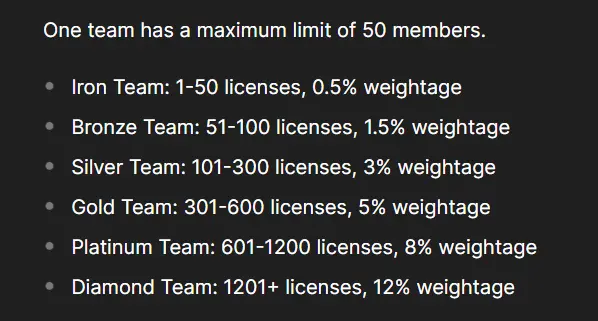
Figure 9 Team's License Weight Enhancement
Lumoz offers a refund mechanism for unsold licenses, allowing users to return 80% of the purchase funds within a 6-month window after the TGE, greatly mitigating risks.
Clearly, purchasing zkVerifier licenses is a very good business, allowing for high returns with low risks, which is why the license purchase activity is exceptionally intense. As of the time of writing, 64,708 licenses have been sold, reaching the 7th stage, with an FDV of an astonishing $79,131,216.

Figure 10 License Sales Data
OKX Launchpad Node Sale
OKX, in collaboration with Lumoz, launched the zkVerifier Launchpad event (from July 11, 18:00 to July 18, 00:00 (UTC+8)), including 200 Tier 3 nodes (265 USDT) and 800 Tier 4 nodes (304 USDT). During the event, completing tasks on the OKX webpage allows for node purchases at a minimum of 60% off, with current participation exceeding 36,352 people.

Figure 11 OKX Launchpad Event
Token Model
The Lumoz token economic model is a typical dual-token governance model, providing two tokens: MOZ and esMOZ.
MOZ is the native token of the mainnet, serving as the core asset of the mainnet.
- MOZ can be used as gas fees for transactions on the Lumoz mainnet.
- ZKP services and AI computing services provided by Lumoz require payment in MOZ.
- MOZ can be exchanged for esMOZ at a 1:1 ratio.
esMOZ serves as the ecological governance token for the construction and maintenance of the mainnet ecosystem. - Lumoz provides esMOZ as rewards to incentivize mainnet computing power providers and node operators.
- Users use esMOZ for network delegation, completing decentralized governance.
It is worth mentioning that the exchange ratio of esMOZ to MOZ changes over time: with a 10-day redemption period, the redemption rate is 100%; with a 7-day redemption period, the redemption rate is 70%; with a 3-day redemption period, the redemption rate is 50%; and with a 1-day redemption period, the redemption rate is 10%. This redemption mechanism can alleviate the market pressure from miner tokens and effectively prevent large-scale redemptions of esMOZ after hacker attacks, protecting the rights of MOZ purchasers.
5.
Why Lumoz is Promising ==========
As early as 2022, when Vitalik proposed that ZK-Rollup would be the best solution for Layer2 Rollup in the future, the vigorous development of ZK-Rollup was already destined.

Figure 12 Lumoz Structure
The emergence of Lumoz will integrate the previously fragmented ZK-Rollup landscape, optimizing the construction of ZK-Rollup while creating a complete set of easy deployment processes for ZK-Rollup.
- With the impending Rollup revolution, Lumoz's emergence meets the urgent demand for integrating ZK-Rollup and driving industry updates.
- Lumoz provides a modular computing layer, combining EigenLayer's staking concept to upgrade mainnet security and scalability.
- Lumoz optimizes the ZKP process, achieving full utilization of computational resources and enhancing computational efficiency.
- Lumoz offers a complete set of methods for deploying ZK-Rollup, which may initiate a rise in ZK-Rollup projects.
Overall, the emergence of Lumoz will address the past difficulties in deploying ZK-Rollup, the high demands for ZKP computational resources, and issues of computational centralization, marking a crucial step for the further development of ZK-Rollup in the future.
 Risk warning Risk warning