








Coinbase Monthly Outlook: The Global Monetary System Shifts, Bitcoin Begins to Enter Negotiations

 Against the backdrop of the accelerating trend of de-dollarization, Bitcoin is gradually becoming a global alternative asset with sovereign neutrality and store of value functions.
Original Title: Monthly Outlook: Dethroning the Dollar
Original Author: David Duong, CFA - Global Head of Research
Compiled by: Daisy, ChainCatcher
Editor’s Note:
This article is compiled from Coinbase's latest monthly outlook research report. The report points out that as the U.S. "twin deficits" continue to widen and trade protectionism intensifies, market confidence in the dollar is weakening, potentially leading to a large-scale restructuring of global asset portfolios. In this context, Bitcoin, due to its sovereign neutrality and lack of capital controls, is increasingly viewed by many countries as a potential supranational reserve asset. According to conservative estimates in the report, if the global reserve system gradually incorporates Bitcoin, its total market value could increase by approximately $1.2 trillion.
The following content summarizes the key points of the report.
Summary
Global capital flows are being reshaped by increasing trade protectionism, challenging the dollar's dominant position as the global reserve currency. As the U.S. fiscal and trade deficits continue to widen, the debt levels are becoming unsustainable, shaking market confidence in the dollar as a safe-haven asset. This trend may lead to a reversal of dollar inflows, prompting large global institutions to readjust their asset allocations, and in the long term, the dollar may face sustained and significant selling pressure.
Notably, we believe that the turmoil of the past few months has further exacerbated the decline of the dollar's dominance over the past decade. The upcoming changes may become a critical turning point for Bitcoin and the entire cryptocurrency market. The current changes in the dollar system make assets like gold and Bitcoin more attractive alternatives in the emerging monetary landscape. The elevation of gold from a Level 3 asset to a Level 1 asset under the Basel III framework is a typical example. Especially Bitcoin, with its sovereign neutrality and immunity from sanctions and capital controls, is expected to become a viable supranational unit of account in international trade.
We believe that the decline in dollar demand may prompt more countries to pursue international reserve diversification. According to conservative estimates, this trend could bring about an increase of approximately $1.2 trillion in Bitcoin's market value. This also partly explains why an increasing number of countries are beginning to focus on strategic Bitcoin reserves, further highlighting Bitcoin's growing importance in geopolitics.
Continuation of Dangerous Times
Over the past half-century, the U.S. economic management model has undergone profound changes. Since the stagflation crisis of the 1970s, economists like Milton Friedman have questioned Keynesian demand management theories, promoting the formation of modern central banking systems—this system is based on stabilizing inflation targets and the "natural rate of unemployment" theory. Subsequently, this framework was institutionalized through the political independence of central banks, which primarily rely on interest rate policies (and later some macroprudential tools) to regulate the money supply and achieve economic stability.
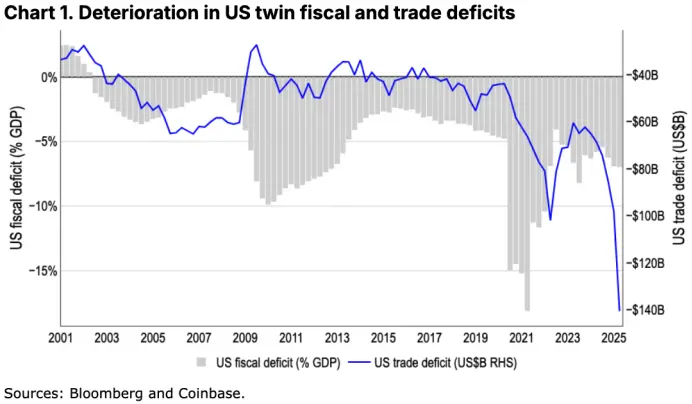
For years, this framework has faced ongoing pressure from fiscal radicalism, including massive deficit spending and multi-trillion-dollar stimulus plans. While some spending was indeed necessary to address challenges such as the global financial crisis and the COVID-19 pandemic, the U.S. debt-to-GDP ratio has soared from 63% in 2008 to approximately 122% today, clearly on an unsustainable path. Furthermore, the Federal Reserve's aggressive interest rate hikes during 2022 to 2023 have significantly increased the borrowing costs for the U.S. government, with surging interest expenses further exacerbating the fiscal deficit issue. See Figure 1.
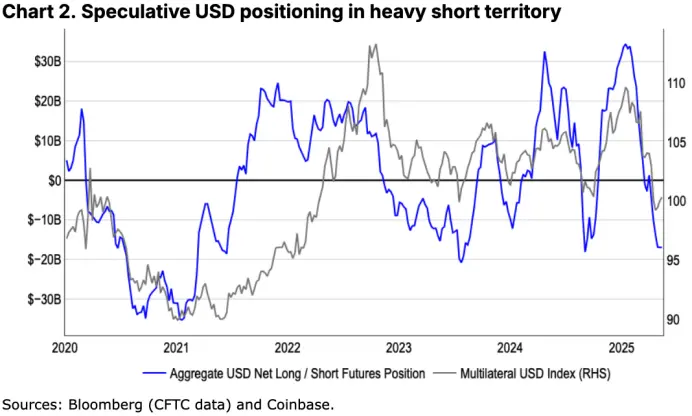
In this context, the rise of trade protectionism may reshape the global capital flow landscape. The dollar's status as a safe-haven asset is under pressure, meaning that some large institutions (such as non-U.S. pension funds, life insurance companies, and sovereign wealth funds) may change their previous investment strategies. Over the past two decades, these institutions have had approximately $33 trillion in dollar asset exposure (including $14.6 trillion in bonds and $18.4 trillion in stocks), with about half not systematically hedged (source: Reuters). We believe that in the coming months and even years, a new round of large-scale asset portfolio adjustments may emerge globally. See Figure 2.
This is not the first time that the U.S. has experienced a reversal of dollar inflows due to "twin deficits" (i.e., simultaneous expansion of fiscal and trade deficits), but this time it coincides with profound changes in the global economic landscape. We believe that the world is currently undergoing a significant transformation of the dollar system, and this trend may trigger a new wave of substantial selling pressure on the dollar.
Even if retaliatory tariffs are eventually lifted, we still believe that the aforementioned trend is difficult to reverse. The reasons are: (1) the impact of confidence shocks has left a deep impression on many investors; (2) tariff reductions and tax cuts will weaken government fiscal revenues, further increasing deficit pressures. Of course, a weaker dollar may help reduce interest costs and alleviate the debt burden through "inflation," while potentially boosting U.S. exports. However, the cost of this process is the undermining of the dollar's credibility as a store of value and global reserve currency, accelerating the market's search for alternative assets.
When we discussed the theme of "de-dollarization" in December 2023, we noted that the dollar was at a critical turning point, but at that time we believed that this process might take "many generations" to truly realize. However, a series of events in recent months seems to have significantly accelerated this process. In fact, the decline of the dollar's influence has long been observable—Harvard economist and cryptocurrency critic Kenneth Rogoff pointed out that the peak of dollar hegemony occurred around 2015, and since the outbreak of the Russia-Ukraine war, this trend has further accelerated due to sanctions against Russia.
The Next Windfall
But the question is, where are the alternatives? When the monetary system undergoes fundamental changes and the basis of currency value is redefined, store-of-value assets like gold and Bitcoin, which have gained widespread attention in recent years, often become particularly important. In fact, in recent weeks, Bitcoin's positioning as "digital gold" has become increasingly clear, especially against the backdrop of its risk-adjusted performance surpassing that of U.S. stocks, highlighting its value advantage. Coinbase Asset Management noted in a recent report that over the next decade, the global store-of-value asset market could grow from the current $20 trillion to $53 trillion, with an expected annual real return (adjusted for inflation) of up to 6%.
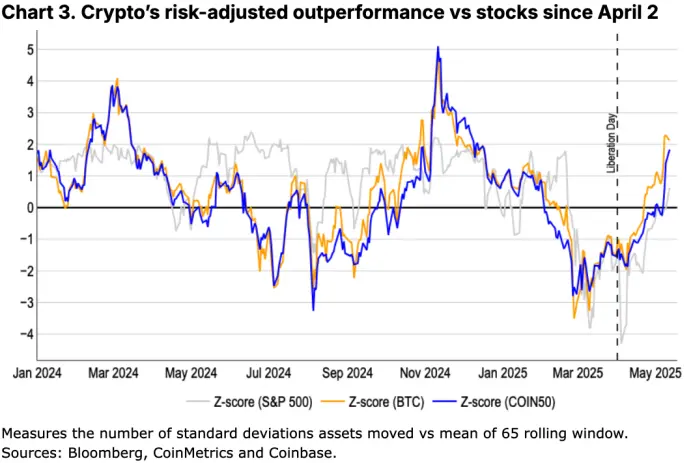
The logic is that incorporating assets like Bitcoin and gold into investment portfolios helps achieve risk diversification (we have previously analyzed this) and enhances the stability of returns during the transformation of the economic system. Although Bitcoin is more volatile than gold, its higher potential returns can complement gold's stability, thereby creating a more balanced wealth preservation strategy.
Moreover, we believe that Bitcoin's immunity to arbitrary government confiscation and capital controls significantly distinguishes it from gold. A typical case is the Gold Reserve Act signed by Roosevelt in 1934, which prohibited private ownership of gold and mandated its surrender to the U.S. Treasury. On an international level, because gold relies on traditional financial infrastructure and physical custody (such as banks and vaults), it is susceptible to sanction risks when held in large quantities; whereas Bitcoin can be digitally self-managed by various income groups. For example, in 2022, over 2,000 tons of gold held by Russia in friendly countries were frozen and could not be liquidated. As for capital controls, previous Argentine governments not only restricted citizens' access to dollars but also prohibited the sale of gold to prevent capital flight.
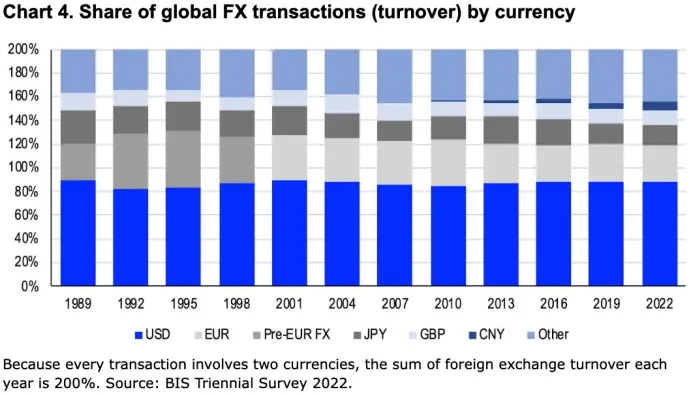
For this reason, we view Bitcoin as a supranational store of value asset and believe it has unique advantages in building monetary credibility in international trade. Currently, over 80% of international trade is still settled in dollars (see Figure 4), but as the world gradually moves towards a multipolar system, more and more countries are feeling uneasy about their continued reliance on the dollar as an intermediary in international payments. However, the reality is that the available alternative options remain very limited.
For instance, the currencies of countries with current account surpluses may not have sufficient global circulation (this is precisely the "Triffin Dilemma" proposed by economist Robert Triffin, who suggested establishing a new reserve currency unit to address this issue). Meanwhile, due to the highly decentralized fiscal policies of the Eurozone and various institutional limitations of the European Central Bank, although the euro is the second-largest reserve currency globally, its influence still pales in comparison to the dollar.
We believe that for politically sensitive trade relations, especially for countries with current account surpluses, assets that possess censorship resistance and sovereign neutrality (i.e., supranational assets) will be more attractive. Of course, the choices for such assets are very limited, so Bitcoin may currently be the most promising competitor. In the long run, this could bring significant asymmetric upside potential for Bitcoin. However, it should be noted that its widespread adoption may still face limitations, as many countries are reluctant to relinquish control over their monetary policies. Of course, given that most commodities are still priced in dollars, from a practical operational perspective, the Federal Reserve has largely influenced the policy directions of most central banks globally.
Why Now?
This is also why we emphasize not to conflate "store of value assets" with "inflation hedging assets," although the two are closely related. We define "store of value assets" as those that can maintain their value over long-term investment cycles, while "inflation hedging assets" are tools used to cope with price shocks and protect purchasing power in the short term. An asset, even if it is a high-quality store of value, may not necessarily be an effective inflation hedge, and vice versa.
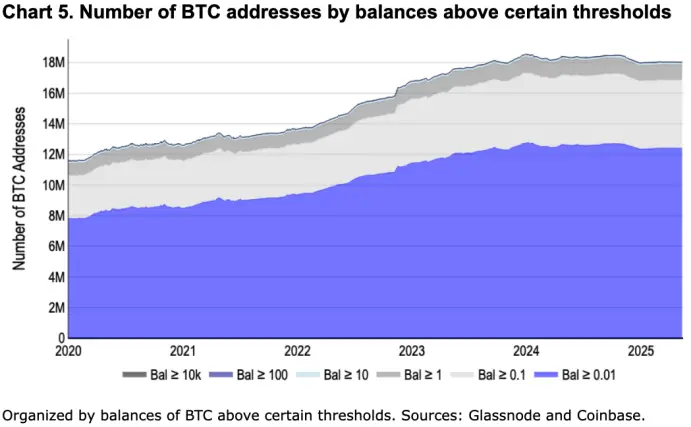
From this perspective, we believe that the potential capital inflow into Bitcoin could be substantial, especially in 2025, when cryptocurrencies are expected to truly enter the mainstream market. The surge in Bitcoin holdings (see Figure 5) is primarily due to the introduction of investment tools like spot Bitcoin ETFs, which have significantly lowered the investment threshold; at the same time, the market's liquidity and depth have also improved significantly over the past five years. In addition to Bitcoin, the crypto payment sector is also beginning to accelerate, with more institutional participants gradually recognizing the unique advantages of blockchain infrastructure in enhancing efficiency and controlling costs.
The expanding base of Bitcoin investors is synchronously advancing with the initiatives of several countries (and some U.S. states) to establish strategic Bitcoin reserves (or digital asset reserves). In March 2025, the White House officially established a strategic Bitcoin reserve through an executive order, utilizing Bitcoin seized by the U.S. government, totaling approximately 198,000 BTC. Notably, China may be the world's second-largest national holder of Bitcoin, estimated to hold around 190,000 BTC, primarily sourced from seized assets, although it has not yet officially launched a Bitcoin reserve plan. Meanwhile, countries such as the Czech Republic, Finland, Germany, Japan, Poland, and Switzerland are also exploring the feasibility of incorporating Bitcoin into their national reserve systems.
In contrast, according to data from the International Monetary Fund (IMF) and the World Gold Council, by the end of 2024, the global above-ground gold reserves will exceed 216,000 tons, of which central banks and sovereign fiscal departments hold approximately 17% (about $3.6 trillion) as reserves. On the other hand, affected by exchange rate fluctuations in 2024, global foreign exchange reserves fell from $12.75 trillion to $12.36 trillion in the fourth quarter of that year. This means that gold holdings (excluding foreign exchange reserves) currently account for about 23% of the global comprehensive international reserves, compared to only 10% a decade ago. Additionally, Basel III will officially take effect on July 1, 2025, at which point gold will be reclassified from a Level 3 asset to a Level 1 "high-quality liquid asset," which may further drive the global de-dollarization asset allocation process.
As demand for the dollar weakens, we believe that more countries will seek to diversify their foreign exchange reserves. Conservatively estimated, if only 10% of the total global international reserves were allocated to Bitcoin, in the long term, Bitcoin's total market value could increase by approximately $1.2 trillion as a result.
Conclusion
The global monetary system is undergoing a significant transformation, characterized by increasing concerns about U.S. fiscal and trade policies and the gradual weakening of the dollar's dominant position, creating unique development opportunities for alternative store-of-value assets. We believe that Bitcoin, due to its sovereign neutrality and immunity from international sanctions, is increasingly viewed by more countries as a potential strategic reserve asset and is expected to benefit significantly from this trend in the future. Meanwhile, the reclassification of gold asset categories under Basel III, along with the slowdown in some central banks' gold accumulation, further confirms this structural shift. Overall, we believe that the world is accelerating its departure from traditional reliance on the dollar, and Bitcoin could become a key component of the future global financial system.
 Risk warning
 Risk warning



Popular articles





