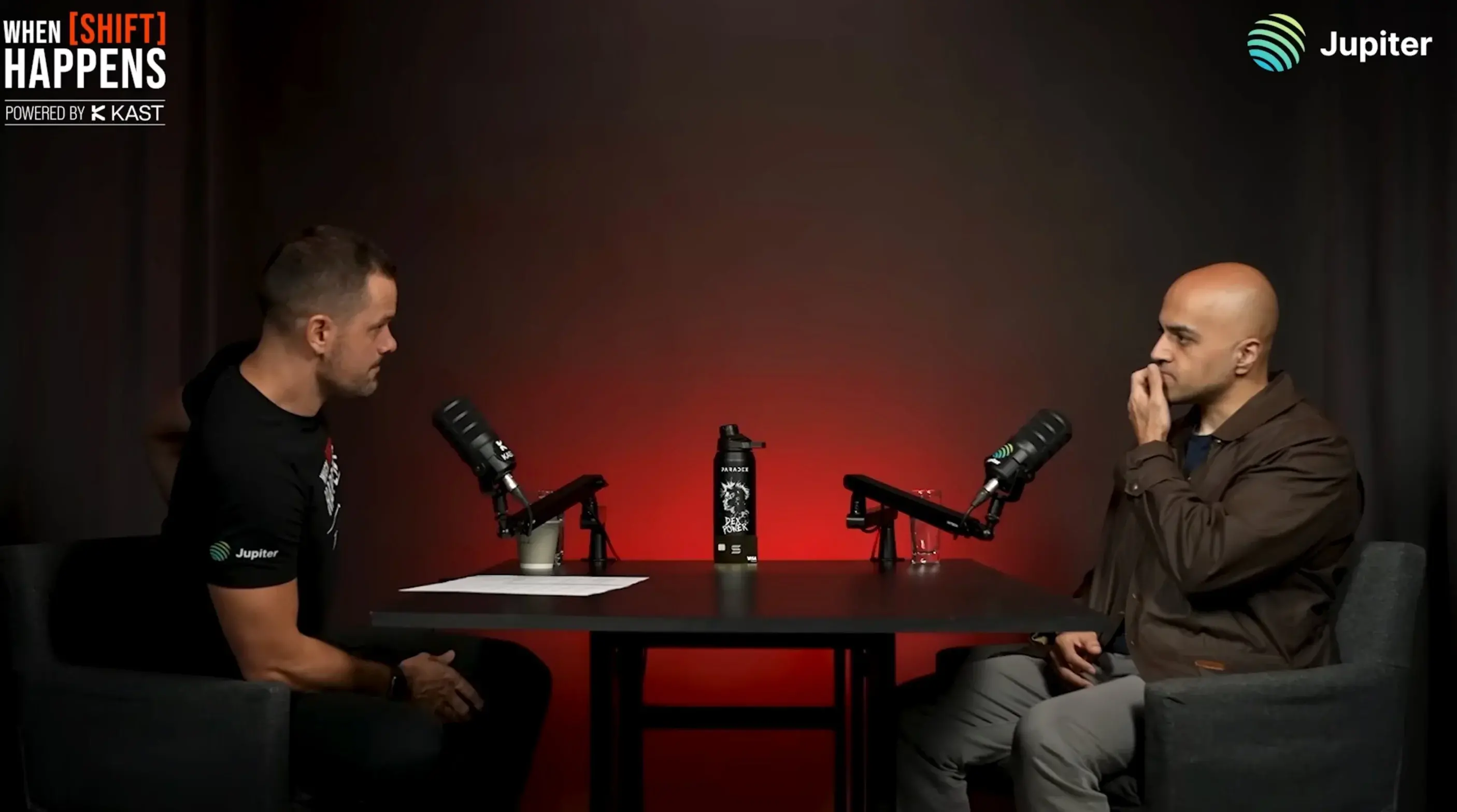
Dragonfly, Wintermute, and others discuss Movement events: The issues with market makers are harming the entire industry. How to improve?
 The progress of stablecoin legislation will provide important insights into the likelihood of market structure changes. If stablecoin legislation reaches a conclusion, the Senate finds a version they like, and the House generally accepts it, then this will be beneficial for market structure.
Compilation: Deep Tide TechFlow
Guests:
Evgeny Gaevoy, Founder and CEO of Wintermute
Hosts:
Haseeb Qureshi, Managing Partner at Dragonfly
Robert Leshner, CEO and Co-founder of Superstate
Tom Schmidt, Partner at Dragonfly
Key Takeaways
· $38 million token sell-off exposed: The deal between Movement Labs and Web3 Port reveals the dark side of crypto market making.
· Market makers or exit liquidity? --- --- A deep dive into an incentive structure that allows market makers to sell tokens and share profits with the foundation.
· Venture capital turns a blind eye --- --- Why top investors continue to support Movement Labs in the face of obvious risks and what this means for due diligence in cryptocurrency.
· Rushi fired --- --- The CEO of Movement Labs was dismissed after weeks of denial, but were other team members involved?
· Evgeny from Wintermute speaks out --- --- As one of the largest market makers in crypto, Evgeny shares insights on shadowy trades, sell-off mechanisms, and failures in transparency.
· Airdrops, market manipulation, and losses for ordinary investors --- --- We analyze how token issuance is manipulated behind the scenes and who really bears the losses.
· The importance of disclosure --- --- Haseeb believes that the cryptocurrency market needs mandatory public market-making agreements to prevent regulatory intervention.
· Self-regulation or SEC intervention? --- --- Can the industry self-correct, or are we triggering another wave of securities enforcement?
· The trust crisis in cryptocurrency --- --- A lack of transparency could lead to the collapse of entire token models. This episode explores how to address this issue.
Highlights of Opinions
· We hope ordinary investors lose as little as possible.
· I believe that for market makers, disclosure is ultimately very beneficial. I think it will help normalize the market as it creates standards.
· Many times, people just want to find someone to blame rather than understand the mechanisms of market structure and liquidity operations.
· For market makers, the incentive must be strong enough to drive prices up while also allowing for a payoff later.
· Sometimes, if you don't have deep connections in the crypto circle or lack recommendations, it's hard to tell who is reputable and who isn't.
· We have competitors in DeFi, centralized exchanges, venture capital, and decentralized market making, but only a handful of market makers can cover all areas.
· In my view, the ideal disclosure system is one where the information gap between exchanges and ordinary investors is virtually zero. When you apply for exchange listing, the information known to the public should be consistent with what the exchange knows.
· We can choose to disclose this information and be accountable to investors, or we can remain silent because we don't want to be criticized. This is the current state of our industry: no disclosure, but if you disclose, you will be attacked.
· There are three channels to effectively normalize disclosure. The first channel is through exchanges. The second channel is through venture capital firms. The third channel is through the market makers themselves.
· If we proactively create a disclosure system that suits us, it will benefit the industry more.
· As an industry, we need to mature and address these issues in advance to avoid truly losing the trust of ordinary investors. Such events will ultimately undermine confidence in the entire token industry.
· Any consensus reached by the industry may be supplemented, added to, or formalized by regulators.
· Those projects claiming "we didn't know it worked this way," I believe in most cases are not credible. In this situation, they do know.
Movement Labs Scandal: The Chaotic Inside of Market Makers
Haseeb: Recently, there has been a lot of interesting news, one of which was reported by CoinDesk regarding Movement. A company related to Movement Labs signed an agreement with a team called Web3 Port. The content of this agreement is that if Movement's fully diluted valuation exceeds $5 billion, Web3 Port can liquidate the tokens they hold and share all profits from the sold tokens with the foundation.
In other words, this market maker played the role of an "agent" in the token sell-off, and their incentive mechanism was to drive the token price up. This not only allowed the market maker to profit, but the Movement foundation could also benefit, which clearly raised significant questions. They also received 5% of the total supply of tokens, which is a huge amount relative to the circulating supply, which is currently less than 10%.
They sold $38 million worth of MOVE tokens, resulting in Binance banning the account. Initially, everyone involved denied everything, but eventually, Coindex reported on the matter and provided relevant contracts, leading to the dismissal of Movement Labs' co-founder and CEO Rushi. Now, it seems this incident has finally come to a close. Movement is forming a new team and has established a new organization called Movement Industries. Everything is chaotic, but Movement has been on a downward trend.
The industry is starting to reflect on why this happened, especially since it received a lot of support from major venture capital and all the marketing was very successful.
Evgeny, I don't know if you have a direct relationship with Movement, can you help us explain all this? How common is this situation in market-making agreements? What makes it different from standard market-making agreements? Help us understand what happened.
Robert: Before that, I want to disclose that Robot Ventures is a very small investor in Movement, and we know nothing about any contracts or market-making matters, nor have we participated in them.
Evgeny: This agreement is very non-standard for the market.**
Typically, standard market-making agreements would include some key performance indicators (KPIs), such as normal operating hours for market making, how much capital needs to be invested, etc. These are the responsibilities of liquidity providers and market makers. Correspondingly, they would receive some incentives. Market makers typically gain some benefits from this, and at the end of the agreement, they can repay the loan in stablecoins or dollars at a certain exercise price, which is usually 25%, 50%, or higher than the current price. This is the typical way of operation.
However, this contract is very non-standard because it has no options or similar mechanisms. Essentially, it has a very strange incentive mechanism to drive the token price up because once it exceeds $5 billion, the agreement and the market maker will split the profits.
The Real Operation of Crypto Market Making
Haseeb: So what is the role of market makers, and how do they participate in the token listing process?
Haseeb: Typically, if you have a token, you can launch it on a decentralized exchange (DEX) or through other similar platforms, which means you are actually providing liquidity. However, when you want to list on exchanges like Coinbase or Binance, you can't just launch the token and expect people to trade it.
These exchanges need to ensure liquidity for the trades. This means there must always be someone willing to buy and someone willing to sell. Typically, this role is taken on by market makers. Therefore, token issuers usually reach agreements with market makers like Wintermute. These agreements specify that market makers need to provide a certain level of liquidity, such as maintaining the bid-ask spread.
In exchange, market makers are compensated because they need to take on risk and invest capital. Typically, the project will lend tokens to market makers so they can perform market-making operations, and market makers will receive corresponding compensation. Sometimes this compensation is cash, and sometimes it is in the form of options, so if the token performs well, the market maker can retain some tokens at a predetermined price, which is usually higher than the price at which the token first lists.
Why aren't all market makers incentivized to drive up token prices? You have an options structure and an exercise price. Why isn't your motivation to raise all prices?
Evgeny: You could say anyone has that incentive. I understand why people think market makers have an incentive to drive up the price of the protocol token; the key is how strong that incentive is. In our case, we might receive about 0.5% of the token supply, but usually lower. Now that ratio has significantly decreased, and it actually depends on the market cap of the protocol.
But even if you, as a market maker, have such an options structure, you still need to keep the price high before the contract expires because in these contracts, at least in the ones we participate in, if you, as a market maker, do not show buy and sell quotes according to the procedure, the token issuer can cancel the entire contract, and then you have no options left; you have to try to sell the tokens you hold, which may lead to a price drop. Therefore, this incentive must be strong enough to drive prices up while also allowing for a payoff later.
In the case of Web3 Port, there is a very obvious incentive to sell when the market cap exceeds $5 billion, but there is another sign that provides a significant incentive to market makers. Large amounts of capital, like $60 million or $100 million, are absolutely not going to happen in our case because that is a huge amount. Even if the protocol gives you 5% of the token supply, as a market maker, profiting from the trade, if you put $60 million into perpetual contract strategies or market-making strategies, it incurs real costs. If you provide such a large collateral as $60 million in exchange for protocol tokens, you have an additional incentive to drive the price up and sell as many MOVE tokens as possible to get that money back. Otherwise, you are losing money every day because you have to bear the cost of that capital.
Was it manipulated from the start?
Haseeb: We are now discussing a very suspicious market-making agreement that is not a normal market-making structure. How common is this situation? How many market makers would adopt such operational methods? How many projects would be linked to these types of agreements?
Robert: For example, what if a new market maker you've never heard of suddenly appears? Is it easy to create a market maker, shut it down, and then rebrand it? What’s the story here?
Evgeny: It is possible. However, there are many market makers operating in Asia, but they do not publicly promote themselves, so it's hard for us to notice. I know Kelsey Ventures, but before this scandal broke, almost no one knew of their existence. What interests me is that I thought I knew all the important market makers, but these new faces keep popping up and getting involved in some operations.
I think such agreements are very rare in legitimate projects. But if we look at tokens that only list on second or third-tier exchanges and have never entered mainstream exchanges like Binance or Coinbase, I believe similar situations may still be prevalent there.
Haseeb: Robert, what was your first reaction when these things were exposed?
Robert: My first reaction is that this kind of thing happens often; the public just doesn't always know what happens behind the scenes. There may be more dramatic events happening every day, but they don't reach the level of exposure like CoinDesk. When I read this information, I felt it was like a farce. I wonder how many similar farces are going on in the current market environment. Some market makers might be doing crazy things, while project teams lack negotiation experience, leading to unreasonable terms and incentive mechanisms in the agreements. It's truly a disaster. However, I feel the public now has a better understanding of how market makers operate, and I hope to see more transparent reporting on the actual situation in the future, as the current transparency is simply too low.
Evgeny: But I want to add that it's hard for market makers to operate without agreements. So those parties claiming "we didn't know it worked this way," I believe in most cases are not credible. In this situation, they do know.
Tom: The Movement case is strange; it's not a top-tier project, but it's also not a completely unknown small project. The project still has some highlights, and there should be someone behind it saying, "This is wrong; this doesn't meet standards." But the team may have caused these issues due to a lack of experience.
This reminds me of the venture capital era before the YC Safe came out. At that time, every venture capital firm had its own convertible terms, and they would add very harsh terms during negotiations, such as extreme liquidation preferences. The emergence of the YC Safe brought transparency and standardization to the entire industry. Now, everyone can choose a public standard contract. However, market making is still in a state similar to the pre-Safe era. If you know the rules, you might negotiate a decent agreement for yourself, but there is no industry standard.
Haseeb: Indeed. While there are some services, like Coinwatch, that can help project teams navigate market-making negotiations, market makers are repeat players, while project teams typically only experience a token issuance once. The first collaboration with a market maker and getting a token listed on a major exchange is one of the most important decisions regarding liquidity. Therefore, there are good market makers and bad market makers.
Sometimes, if you don't have deep connections in the crypto circle or lack recommendations, it's hard to tell who is reputable and who isn't.
Evgeny: We have competitors in DeFi, centralized exchanges, venture capital, and decentralized market making, but only a handful of market makers can cover all areas.
Movement Labs and Its Industry Impact
Haseeb: Beyond the operation of the market-making mechanism itself, what stands out is the attention on the team and what motivated the founders to make such decisions. The Movement team was praised for being young, vibrant, and ambitious. Why did they choose this path? What made the founders decide not to compete fairly but to sell tokens and try to cash out early instead of focusing on delivering a real product?
They faced widespread criticism for launching tokens without a real product. Therefore, there are many rumors that they relied on contractors, had insufficient technical teams, and focused more on marketing than substance. Most of these are actually rumors, and no one can provide solid evidence to prove their specific actions. But people are saying they manipulated traffic, did not conduct airdrops, and had no real product before launching the token. All these point to possible misconduct within the project.
After discussing the post-analysis of Movement with several industry insiders, I have some questions. First, has this incident changed your view of startups or founders? What are the incentive mechanisms for founders in the industry? Are there really countless founders like Rushi? People are discussing these matters, but there is no solid evidence. I haven't seen many other projects like Movement. What are your thoughts on these issues?
Tom: I think this situation is indeed rare, which is why it has garnered so much attention. But I recently read an article from Coin Telegraph that mentioned market-making agreements, and I think people may underestimate the number of lesser-known but low-quality projects in the long tail; there are indeed many such projects. Just as you said, those people will seek out these second and third-tier exchanges and market makers. But for such a high-profile project to launch with a market cap of $30-40 billion and go through something like this is indeed crazy.
Haseeb: Evgeny, what are your thoughts on this? When the next token contacts you, what will you pay attention to? What should we focus on?
Evgeny: For me, I am very sensitive to founders who are very flashy and marketing-focused. But I know that in Silicon Valley, traditional venture capitalists often like these founders because they bring energy, and I know they are very strong, which often aligns with scamming others. After these incidents, I will be more selective and cautious.
Haseeb: I want to hear Robert's thoughts, but we actually didn't invest in this project, not because we thought they would sell tokens to retail investors or break lock-up agreements. I don't think any founder would be seen as someone who would break lock-ups and sell tokens.
The reason we didn't invest is that we thought their technology was not interesting. We believed it was just a derivative project. When I first met Rushi, I had only seen him once or twice, and my impression was that he was a very energetic, charismatic, and ambitious young man. Now, this has become a meme; Blockworks once had a promotional article about Movement that repeatedly emphasized their youth and the large amount of funding they raised. People seem to think that just because you are young and have raised funds, it means you are a great founder.
Haseeb: How do you view the investment in Rushi?
Robert: At the A round stage, this kind of investment relies relatively less on the founder, but in the early stages of our investment, such as the seed round, it is indeed entirely reliant on the founder. We don't pay much attention to the scalability of the technology and other issues; instead, we focus on the founder's vision, their ambition, and why they have such ambition. Do I believe they can succeed?
As the stages progress, this reliance gradually decreases, focusing more on the actual progress of the project, including technological advancements and fundraising progress from investors. By the C or D round, the founder's role is almost negligible because they have proven themselves, and the focus is more on the project's actual performance. Therefore, this is a gradual process, and when we invested in this project, we happened to be at this transitional stage.
Why Cryptocurrency Needs Market Maker Disclosure
Haseeb: In traditional markets, you need to disclose who your market makers are, while in cryptocurrency, exchanges know who your market makers are. Both Binance and Coinbase know. Before you apply for listing, you must provide this information. But ordinary investors and the public do not know. In my view, the ideal disclosure system is one where the information gap between exchanges and ordinary investors is virtually zero. That is, when you apply for exchange listing, the information known to the public should be consistent with what the exchange knows. I think we should move in this direction in the future, but we are still far from this goal. I even believe that the terms of market-making agreements should also be disclosed. This was also mentioned by Hester Pierce in her speech, where she detailed the disclosure system for cryptocurrencies and suggested that the terms of market-making agreements should be disclosed to the public.
What are your thoughts on this system? Would you strongly oppose it, believing it is absolutely impossible, or do you think it would be a good thing? What is your take on this issue?
Evgeny: I strongly support this idea because I believe we must acknowledge that although we pretend tokens are not stocks, their behavior is very similar to stocks. For example, in an IPO, stocks need to disclose a lot of information about market makers, investors, and various risks. Hester's speech was precisely on this topic. But we must discuss not only the issue of information parity between exchanges and retail investors but also that platform investors should have as much information as possible to make purchasing decisions. In reality, we are not achieving that.
I think the basic content of market-making agreements, such as loan sizes and exercise prices, is crucial. As an ordinary investor, you need to know the motivations of market makers, such as their incentives to sell above a certain price. Once the price exceeds that level, there may be more selling pressure, or they may continue to hold, but at least you are fully informed.
In fact, we once had a project that disclosed agreements, which was World Coin from about six months ago. I remember World Coin did disclose loans, market makers, and exercise prices, but they faced a lot of criticism. People began to question why such a structure was created, as if no token had a similar situation. They received a lot of criticism for it, and I believe they did not enjoy that experience. More importantly, all founders became more cautious after that.
We can choose to disclose this information and be accountable to investors, or we can remain silent because we don't want to be criticized. This is the current state of our industry: no disclosure, but if you disclose, you will be attacked.
Robert: So if disclosure is voluntary, it actually creates a balance where no one discloses. Under a mandatory disclosure system, everyone must disclose, just like we discussed with registered securities.
Do you think we need such requirements to achieve change? Or do you think it can be prompted through some self-regulatory steps to encourage issuers to disclose market maker information?
Evgeny: I've thought about this issue, and usually, we can organize a meeting like some companies do, reach a consensus, and decide to disclose information. I believe for those market makers, disclosing information is ultimately very beneficial. I think it will help normalize the market as it creates standards. Once these standards are established, other market makers will be forced to follow them or choose not to participate. Therefore, without the SEC's mandatory requirements, this is indeed very difficult.
Haseeb: I think there are three channels to effectively achieve this normalization. The first channel is through exchanges. This is the simplest; if Coinbase or Binance decides that if you want to list, you must disclose. This means everyone must disclose because they want to list on Coinbase or Binance. In this case, you must disclose before applying for listing. Therefore, everyone will disclose because they want to be listed on these platforms.
The second channel is through venture capital firms. Because there are a small number of high-reputation venture capital firms that can reach a consensus to promote a standard disclosure system, requiring their portfolio companies to make these disclosures. This acts like an additional agreement.
The third channel is through the market makers themselves. Those high-reputation market makers who are not afraid to disclose their market-making agreements can decide that if you work with a non-disclosing market maker, that is suspicious.
The issue with market makers agreeing to do this is that if there is no mandatory requirement to disclose all market-making agreements, then you might only have one or two market makers who do not engage in bad practices, while there are projects like Web3 Port. For example, Rushi may not be working with just one market maker; they may have multiple, and one of them is the seller.
I think some uniformity is needed to solve this problem, ensuring that all market makers are disclosed and that exchanges know. Because exchanges can see who is trading the assets and who is providing liquidity. Therefore, you cannot operate in front of the exchange without them knowing. So if you are Binance or Coinbase, you are a major liquidity provider for an asset, and ultimately you are also the main executor.
The last option is to wait for the SEC to do this. But I think the SEC will take too long, and ultimately the disclosure system will not be in the form we want. If we proactively create a disclosure system that suits us, it will benefit the industry more. If you try to synchronize it with traditional securities, you will encounter two problems. One is that you will get a lot of useless disclosures that no one cares about, purely formal or some unimportant disclosures. The second is that you cannot balance the cost of disclosure with the value of disclosure well.
Finally, I think there is a viewpoint that disclosure essentially means you agree that tokens are securities. I think it is worth exploring this idea in advance that disclosure is beneficial for anything. Making disclosures is always good; it does not mean you are a security or not a security. Many things that are not securities also disclose relevant information.
Therefore, ultimately, more disclosure is good. We can say this has nothing to do with securities; it is just how you want to list on an exchange. If you want to list on an exchange, you must make these disclosures. This has nothing to do with securities law and does not mean that this thing is an unregistered security.
When a token is ready to be listed, there is always a major counterparty involved in the negotiations, possibly a foundation or another entity holding a large number of tokens. Even if they have no direct relationship with the project, there is usually someone on the other side of the exchange, possibly just as a "representative." Even if the agreement is fully decentralized, this person may also be the one pushing for the token to be listed. Regardless of whether this person is the so-called "issuer," they need to be responsible for providing some necessary disclosures to help the token get listed and gain liquidity.
I believe that as an industry, we need to mature and address these issues in advance to avoid truly losing the trust of ordinary investors. Such events will ultimately undermine confidence in the entire token industry.
Evgeny: It's not just market-making agreements that need disclosure; there are many other important things, such as significant transactions. If any substantial transaction is involved, it needs to be disclosed.
Robert: This relates to whether people are willing to buy and sell a certain asset. We have finally reached a point in this industry where certain information begins to be disclosed to everyone. For example, the token unlock schedule, which did not exist a few years ago. Everyone is discussing this schedule, but there are also investors' cost bases, such as their sources of investment.
Haseeb: But there is still a lot of work to be done to establish the right disclosure structure. I believe the trust issue across the entire market, especially for all tokens, has the potential to gradually worsen. Therefore, I strongly encourage anyone seriously considering this issue to take action as soon as possible rather than striving for perfection.
Because you can always keep improving and refining. Moreover, any consensus reached by the industry may be supplemented, added to, or formalized by regulators. As an industry, the best practice is to take the initiative, demonstrate good trust, not only for regulators but more importantly for your own industry, to enhance investor confidence.
Do market makers control token prices?
Haseeb: There has been a lot of discussion about market makers recently, especially regarding the Movement Labs incident. As a venture capitalist, I feel somewhat relieved because in the past, people always viewed venture capitalists as the "bad guys," while now it seems people are more inclined to think of market makers as the "bad guys."
Can market makers really control token prices? How can we trust that you are not manipulating token prices? What is the actual impact of market makers on the market? For those who say, "As soon as Wintermute gets involved in market making, the token price drops," what are your thoughts?
Evgeny: Now market makers have become the new "bad guys." This is actually a cyclical phenomenon. In a bull market, people think market makers are driving prices up; in a bear market, people feel market makers are pushing prices down. In fact, two months ago, we were seen as the "bad guys," but now the situation has changed. I think people are always looking for new scapegoats.
Haseeb: Market makers play very different roles in different market cycles.
Evgeny: Many times, people just want to find someone to blame rather than deeply understand the mechanisms of market structure and liquidity operations. In fact, much of the discussion about market makers is based on misunderstandings. For example, some believe that after we receive tokens from Binance, we sell them to push the price down, allowing Binance to profit from liquidation. This logic is flawed because both we and Binance profit from ordinary investors.
Haseeb: So you don't want ordinary investors to lose money?
Evgeny: Of course, we hope ordinary investors lose as little as possible. Over the past few months, the liquidation situation for ordinary investors has been severe, leading many to exit the market. January was a good month for us, but the situations in February, March, and April were not so good.
Haseeb: When ordinary investor activity decreases, the attractiveness of market making also declines. How is your liquidity now?
Evgeny: It's not linear. If trading volume drops by 50%, our revenue won't decrease by 50%; it will decrease even more.
Haseeb: This relates to the volatility of the crypto market. Do you think the price volatility and momentum effects in the crypto market make market making more complex?
Evgeny: In fact, it doesn't. Our model operates across multiple trading platforms, and we buy and sell between different platforms. The problem is that if a large liquidity fund suddenly enters and starts buying a certain token, it can quickly push the price up, which is hard for us to respond to.
Haseeb: In that case, how are your losses?
Evgeny: About 50% of our contracts will incur losses.
Robert: But can your profitable contracts offset the losing contracts?
Evgeny: Yes, our business is quite diversified; for example, we also engage in over-the-counter (OTC) trading, which helps us gain more revenue in liquidity provision.
Haseeb: So, regarding the options structure, does this exist in traditional finance as well, or is it unique to the crypto market?
Evgeny: In traditional finance, there are indeed similar structures, but they are not entirely the same. In the crypto market, market makers often also play the role of investment banks.
Haseeb: Why has the crypto market developed in this way? Do you think it relates to the cash flow and volatility of tokens?
Evgeny: That makes sense. The evolution of the market may be due to the high volatility of tokens, making market makers more inclined to use options structures to gain profits. As the market develops, token pricing becomes more efficient, and volatility decreases; in the future, it may resemble traditional market making more.
Haseeb: If the market structure changes, how will the role of market makers adjust?
Evgeny: If new models emerge, such as Binance proposing a new market mechanism, market makers may provide liquidity in different ways. In summary, changes in market structure will affect how market makers operate.
Crypto Market Structure Bill: What Are the Stakes?
Haseeb: Recently, a new market infrastructure bill has been introduced. This bill is a comprehensive rewrite of the previous FIT21 bill. While it shares many similarities in spirit with the previous bill, there are also some significant differences.
This bill clearly defines digital assets and tokens, specifying under what circumstances tokens are considered securities or non-securities. The CFTC (Commodity Futures Trading Commission) will be responsible for the spot market of non-security tokens in the crypto space, while the SEC (Securities and Exchange Commission) retains enforcement authority over capital raising and fraud. Additionally, projects can raise up to $150 million in tokens annually, provided they plan to decentralize. Unlike the previous "code decentralization test," a so-called "maturity test" has now been introduced, which states that the standard for mature blockchain protocols is decentralized and/or autonomous, requiring that no one controls more than 20% of the voting rights, and that its value primarily derives from the programmatic functions of the blockchain system. This definition is somewhat vague, and I don't fully understand its boundaries; it may be intentionally designed to be ambiguous, but it is unclear how it relates to situations where a team or group controls the system. There are many issues in the crypto market regarding multi-signatures, security committees, and upgradability, and it is unclear how these intersect with so-called immature blockchain protocols. The bill also postpones regulation of DeFi (decentralized finance), and the current definition of DeFi is relatively narrow.
I would like to hear everyone's overall thoughts on this bill.
Robert: I haven't spent much time on this because all bills evolve; the initial draft is definitely not the final version. If you look at the current state of stablecoin legislation, you can clearly see this. I believe this bill will undergo significant changes, definitions will change, and some core structures will also change. There is still a long way to go before the law is signed. If this bill is signed into law as is, I think it would be a huge upgrade and improvement for everyone, whether you are a founder, venture capitalist, market maker, or ordinary investor.
As an outsider, I estimate the chances of this bill passing at about 40% to 50%. This is a cyclical estimate. Because we have about a year and a half until the next election, which will reset the game. Therefore, if it is to pass, it may happen in the short term.
The progress of stablecoin legislation will provide important insights into the chances of passing the market structure bill. If stablecoin legislation reaches a conclusion, and the Senate finds a version they like, which the House also generally accepts, then it will be favorable for the market structure. If the House says they don't like the Senate's version and need to revise it, then it will be detrimental to any crypto legislation. Therefore, if you want to know the outcome of the market structure, start with stablecoins.
Haseeb: We have already seen the Democrats starting to express significant opposition to this bill, primarily due to the Trump family's dealings. This situation seems to indicate that it will be difficult for us to reach meaningful compromises in legislation. Evgeny, how much time have you invested in this bill? What do you think its impact will be on your industry?**
Evgeny: I haven't read the bill in detail, but we will definitely provide feedback on it. Because we have deep ties in the crypto space. I noticed that the CFTC seems to have more power than the SEC, and I'm still thinking about whether that is appropriate. Personally, I lean towards the existing SEC structure, so my intuition is that if more power is to be granted, it should go to the SEC.
We need to look at the specifics of the law. If the law merely outlines the rules and states who is responsible for enforcement, then it is not very important.
Haseeb: I think this is very important. One thing we've learned over the past four years is that you can do a lot within the boundaries of the law, and those things are not always clear. We are now facing a similar situation.
Evgeny: I feel that having a clearer legal framework would be better.
Haseeb: Yes, although this may reduce some risks, the reality is that almost everything in the crypto market is complex and chaotic, and many operations do not fully comply with any legal provisions.
Tom, what are your thoughts on the market infrastructure bill?
Tom: I think it is still early, and I haven't spent much time on it, but it reminds me of how difficult it is to write good crypto legislation. It is always either too specific or not specific enough, ultimately leading to an undesirable solution. This applies not only to crypto legislation but also to general legislation, but the changes and ambiguities in the crypto market make this issue more pronounced.
Can we fix the problems before a crypto crash?
Haseeb: This means that if we only pass the stablecoin bill without the market structure bill, then as an industry, we need to self-regulate and establish some standards. This way, future governments or new regulators can see the current state of the industry.
Robert: This point has some validity, but it is not entirely correct. Forty years ago, the SEC led by Gensler could have set rules for the industry through exemptions, frameworks, and various interpretations, but that did not happen. The future SEC or CFTC can also do that. They do not need legislation to create frameworks for trading different securities or assets; they already have the power to establish these frameworks. This does not necessarily have to come from mandatory intervention by Congress. Therefore, even if Congress does not take action, it does not mean that everything falls on us.
Haseeb: I don't think that is entirely correct. The SEC has explicitly stated that they do not have authorization from Congress. This is what Gensler initially said, and it is also what the new SEC is saying; Congress needs to take action to give us clarity, otherwise, who will regulate?
The SEC and CFTC have both stated that Congress's position is very clear. The debate over the bill means that no one has clear authority. If there is no clear authority, the SEC will say, "We shouldn't be making rules." This creates a regulatory vacuum.
Robert: But they can regulate through formal and informal rule-making. They have been issuing many interpretative statements about different projects. While this is not ideal, they are indeed doing something.
Haseeb: But in most cases, these are almost all retractions of previous statements. A lot of what we see is speeches rather than rule-making. So far, the SEC has not issued any formal rules.
Evgeny: Our most basic understanding, such as Bitcoin not being a security, was not confirmed by Congress through legislation but was a decision by the SEC.**
Haseeb: So you can say, "I don't think this is within my regulatory scope." But I don't think the SEC will say, "These things are not securities; this is how they should operate." You can't do both at the same time. If they are not securities, then they are not within the SEC's regulatory scope. If you say you want to classify certain tokens as securities, then you have already ended it because the SEC is no longer the regulator of non-securities.
So will the CFTC step in? Will they say, "Okay, we will make rules requiring you to disclose this and that." I haven't seen the CFTC take action in this regard. Maybe they will, but for now, both agencies are saying they are waiting for Congress to act, and the authority differences between the two are constantly changing. If Congress does not take action, it means Congress deliberately does not want to legislate. This means the crypto industry will continue to remain unregulated.
So I really believe that as an industry, we have a responsibility to address this issue, not only for the potential regulatory framework that may be introduced in the future but also for our own interests. We need to reduce market volatility and enhance consumer confidence in token listings. People need to know whether the listed tokens are trustworthy and will not be sold off by unreliable market makers.
 Risk warning Risk warning