Wintermute: After ETF and DAT, RWA may take over the next round of the bull market
 Core Viewpoint

 The significance of RWA is not just to move traditional assets onto the blockchain, but more importantly, to bring the capital behind these assets onto the blockchain. It may become the liquidity entry that the next bull market is missing.
Author: Wintermute
Compiled by: Jiahua, ChainCatcher
In the past two weeks, the cryptocurrency market has moved out of a sideways trend, ETF capital flows have turned positive again, and the issuance of stablecoins has gradually stabilized. The most pressing question in the market now is: does this mean that the next bull market has begun?
Looking back, each bull market's acceleration has been backed by a new liquidity channel. From early token financing and stablecoins to ETFs and Digital Asset Treasury (DAT) companies, these new channels continuously attract off-market incremental funds into the cryptocurrency market, circulating between different assets and ultimately driving the entire market to reprice.
If a new bull market is brewing, which channel will bring new incremental funds into the market this time? We believe that RWA is one of the most likely candidates.
Each Bull Market Begins with New Funds Entering
Liquidity determines bull markets, and liquidity also needs an entry point. No matter how abundant global funds are, they will not automatically flow into the cryptocurrency market. Only when an attractive new channel appears to bring external funds into this asset class can the cryptocurrency market truly benefit from the global liquidity expansion.
In the past, when channels like stablecoins, ETFs, and DAT first emerged, they often brought sustained one-way capital inflows, driving the market to reprice. Over time, they gradually transformed from incremental catalysts into everyday infrastructure, allowing funds to enter through these channels and just as easily exit.
Today, as the latest two channels from the previous cycle, ETFs and DAT have become normalized. The market is still waiting for a new funding channel to drive the next bull market.
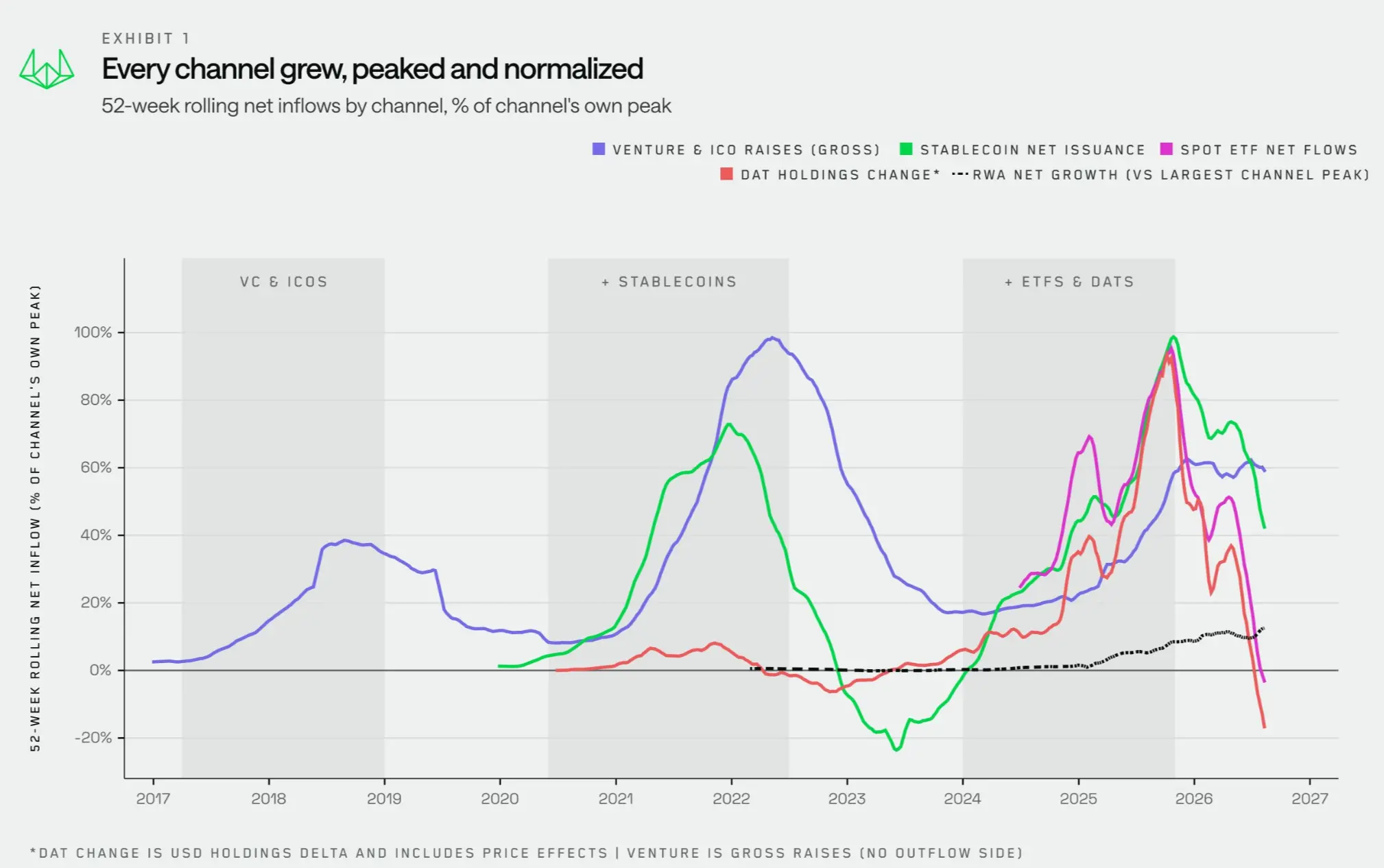
In each bull market, a different funding channel experiences expansion, peaks, and ultimately normalizes, entering a new cycle:
VC and Early Token Financing (2017-2018): Venture capital and token sales brought the first batch of institutional-scale funds into the cryptocurrency market.
Stablecoins (2020-2021): Net issuance exceeded $120 billion within a year, establishing an on-chain dollar base to fund DeFi and altcoin cycles.
ETFs and DAT (2024-2025): ETFs saw net inflows of $63 billion, while digital asset treasuries accumulated over $115 billion, primarily driving the repricing of mainstream crypto assets, with limited spillover effects on other assets.
The dashed line in Chart 1 represents the fifth funding channel that is forming. Although the net increment of RWA is still small compared to the peaks of previous channels, it is the only channel still growing when others begin to decline. Next, we will explain why RWA may become the next funding entry point capable of impacting market cycles.
Old Channels Retreat, New Funds Still Not in Place
After entering a bear market, incremental funds typically gradually deplete alongside the decline of the dominant channel. As shown in Chart 2, each cycle has a channel that contributes most of the incremental funds, and the overall capital inflow peaks in sync with this channel: reaching 12% of the total market cap in 2021 and 10% in 2025.
When the dominant channel transitions from an incremental catalyst to ordinary infrastructure, overall capital inflow quickly approaches zero. At recent lows, the total capital inflow from various channels was only equivalent to 2.4% of the total market cap of the cryptocurrency market.
ETF funds once turned into net outflows, and many DAT trading prices fell near or even below net asset value (NAV), making it difficult for them to rely on valuation premiums to finance and continue accumulating assets. Meanwhile, the supply of stablecoins experienced its largest contraction since the Terra collapse.
In the past two weeks, these capital flows have rebounded from their lows, but compared to the peaks of previous cycles, the scale remains very limited.
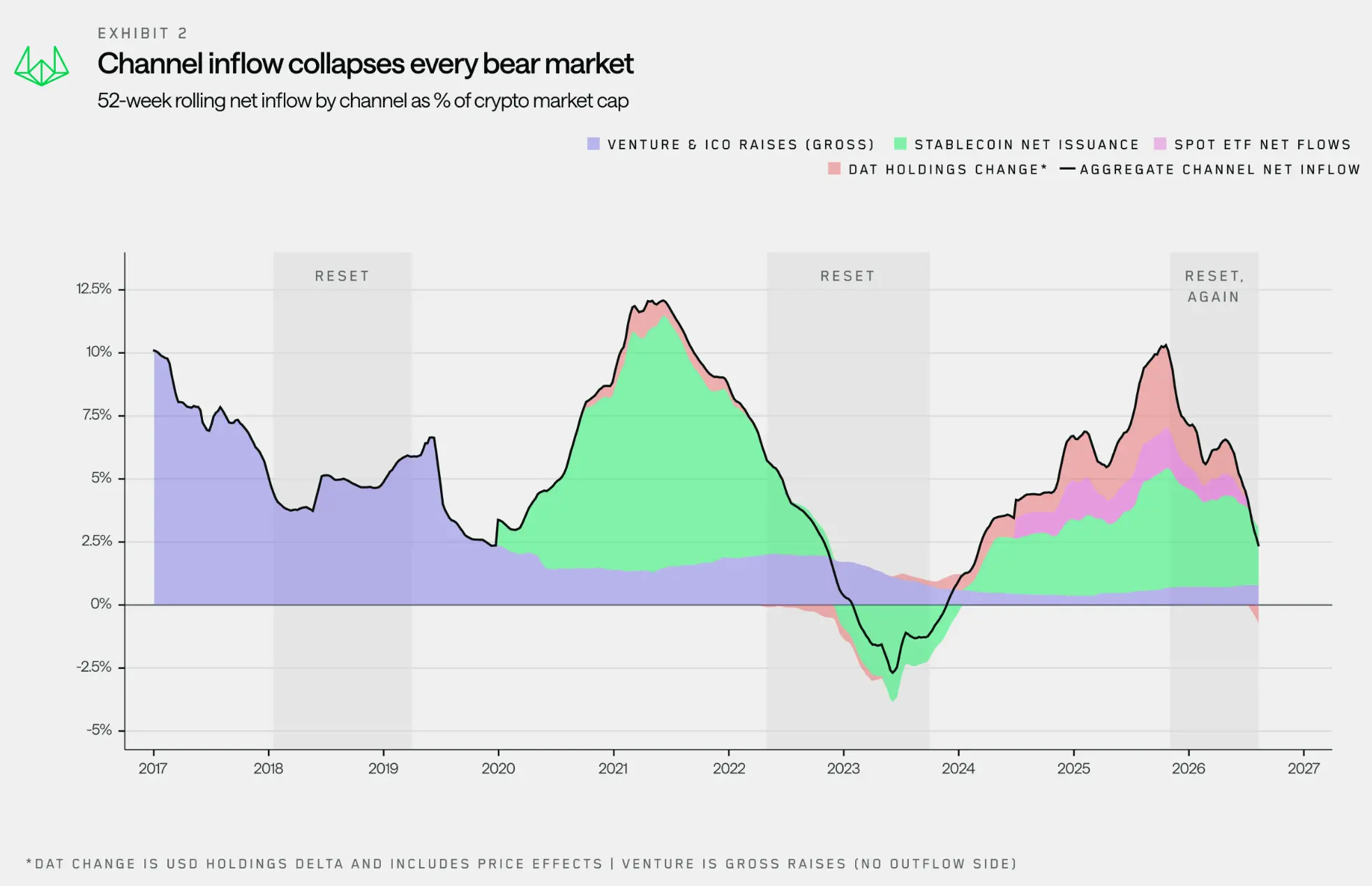
This contraction is not unusual. In past cycle resets, while old channels gradually declined, the next channel usually began to expand. However, this time, the scale of RWA is still insufficient to take over, falling short by about an order of magnitude compared to the previous dominant channel. Whether it can grow to a sufficient scale will determine whether the next cycle can truly unfold.
RWA is Not Just Asset Tokenization, But Also Liquidity Tokenization
The market often understands RWA as "asset tokenization," but we believe it also means liquidity tokenization.
In the past year, the scale of on-chain tokenized assets has grown by about two times, reaching over $30 billion. Even during the months when the total supply of stablecoins contracted, tokenized assets continued to grow. As funds can flow more freely between these two types of assets, the conversion threshold between tokenized assets and crypto-native assets is continuously decreasing.
Today, tokenized stocks, tokenized funds, and crypto assets are increasingly stored in the same wallet and traded and settled using the same stablecoins.
This enhanced ability for asset conversion makes tokenization not just a migration of traditional assets to the chain, but also a potential liquidity channel. We believe it may become an important entry point for delivering incremental funds in the next cycle.
Different Ways to Enter
The biggest difference between RWA and previous channels lies in how funds enter the market.
Each previous channel brought buyers for a specific type of asset. VCs and early token financing bought new tokens, stablecoin funds surged into DeFi and altcoin markets, while ETFs and DAT primarily bought mainstream coins and blue-chip altcoins.
Tokenization is different. These funds initially buy Apple stocks or U.S. Treasury bond funds, rather than crypto assets. However, once the funds enter the on-chain system, it becomes much easier to shift towards BTC or altcoins.
Past channels pushed funds directly towards specific assets, while tokenization first brings incremental funds into the on-chain system, and then the funds decide where to allocate.
Therefore, the short-term impact of RWA will not be as immediate as the capital inflows on the first day of ETF listings. However, over time, these institutional funds entering the chain may gradually allocate across the entire crypto ecosystem. Meanwhile, as the infrastructure connecting traditional assets with crypto protocols continues to mature, the costs of fund conversion and allocation will also continue to decrease.
Why Funds Have Not Yet Overflowed
In the past 12 months, RWA has attracted about $16 billion in funds, roughly equivalent to one-tenth of the best 12-month cumulative inflow of ETFs and DAT in the previous cycle. This channel is still in the early stages of expansion.
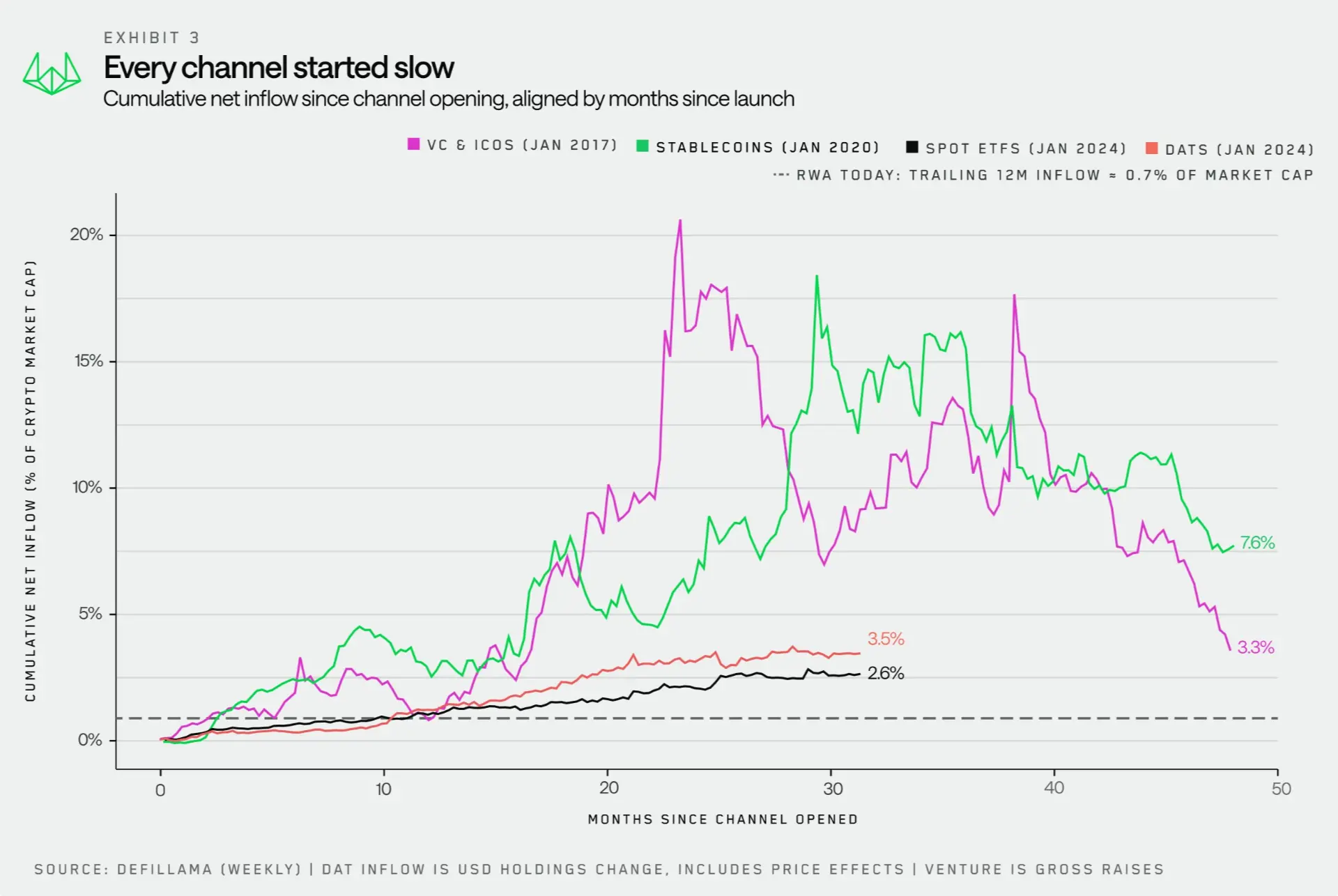
As shown in Chart 3, if we calculate from when each channel first reached observable scale, their capital inflow peaks typically occur 20 to 60 months after forming scale. ETFs peaked at the 20th month, stablecoins at the 33rd month, and VC and early token financing at the 54th month.
According to this timeline, the RWA channel currently has only 18 months of history, and the past 12 months of capital inflow is equivalent to 0.9% of the total market cap of the cryptocurrency market. This performance is ahead of DAT during the same period, only slightly behind ETFs. It is still in its early stages and does not mean that this channel has failed.
Currently, most tokenized assets are still cash management products, U.S. Treasury bonds, and money market funds, and are restricted within closed vehicles with entry barriers. The infrastructure connecting these assets with other on-chain markets has only recently begun to operate.
The catalysts driving this change come from both regulation and market infrastructure:
Regulatory Aspect: Market structure legislation and tokenization frameworks are expanding the eligibility of tokenized securities holders and clarifying the transfer rules for these assets, pushing them out of closed, permissioned capital pools.
Market Infrastructure Aspect: Tokenized U.S. Treasury bonds and funds are gradually being accepted as collateral by major trading platforms and DeFi protocols, allowing cash management assets that were originally parked on-chain to transform into capital that can be called upon throughout the entire on-chain system.
Why This is Important for Positioning
From 2024 to 2025, funds will primarily enter the market through various wrapped products, ETFs, and DAT, which mainly hold mainstream coins and blue-chip altcoins. Therefore, BTC, ETH, and a few altcoins have been repriced.
Aside from a small amount of capital overflow during the Memecoin market, the vast majority of altcoins have not received significant buying interest; this overflow mainly comes from the wealth effect brought by the rise of BTC and SOL.
Investors waiting for a comprehensive altcoin season are essentially waiting for a fund that structurally cannot reach these assets. This round of the bull market has passed without bringing about widespread market frenzy. Those who are more aware of the restrictions on ETF and DAT capital flows are also more likely to anticipate which assets will receive buying interest.
This time, two questions are crucial:
Where will RWA funds flow after entering the on-chain system? Besides remaining in their original vehicles, will they enter other on-chain markets?
If these funds start to flow, where will the value ultimately settle? Which assets will benefit from this? Which settlement networks, collateral platforms, and DeFi foundational protocols can capture these activities?
Understanding that tokenized assets are primarily held by institutions rather than short-term traders is very important. This means that if the next cycle is driven by RWA, the resulting market may not be overly frenzied but could last longer. At the very least, the structural support that RWA brings to the cryptocurrency market is more likely to exhibit moderate and lasting characteristics.
In the past two weeks, traditional channels, including new issuances of ETFs and stablecoins, have seen capital inflows again. This can drive market recovery, but to form a complete cycle, a new incremental funding channel may still be needed.
In each past bull market, there has been a sustained expansion of a new channel. Currently, RWA seems to be the only candidate developing along this path.
As the market enters a new cycle, we will closely observe whether the already tokenized institutional assets can exit closed vehicles, be used more as collateral, and enter DeFi, as well as whether they can generate capital flows beyond cash management needs. Only when these changes truly occur can RWA validate its potential as a liquidity channel for the next bull market.
 Risk warning



Popular articles