From retail frenzy to institutional dominance, is the four-year bull market cycle of Bitcoin coming to an end?

 Bitcoin has shifted from being dominated by retail investors to being led by institutions, which are accumulating long-term. Short to medium-term price declines will not shake them out of the market.
Original author: Two Prime
Original compilation: Tim, PANews
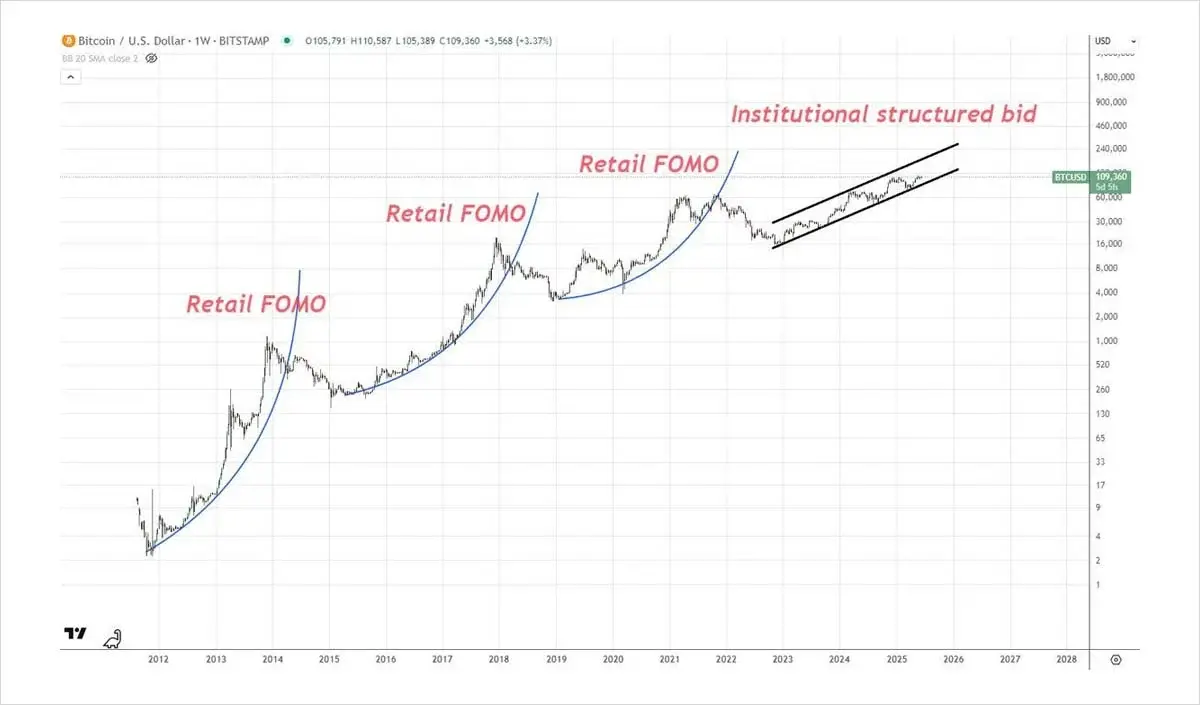
There has been a lot of discussion surrounding Bitcoin's four-year bull and bear cycle. This pattern of exponential rise, sudden collapse, and then reaching new highs has been present throughout most of Bitcoin's history. However, it must be pointed out that there is ample reason to suggest that this four-year cyclical pattern may be coming to an end.
First, a question needs to be raised: Why does a four-year cycle exist?
It can be summarized into three factors:
Halving Effect
Every time the number of blocks increases by 210,000 (approximately every four years), the Bitcoin mining reward is halved. This mechanism typically leads to a price increase in the following years by creating a supply shortage.
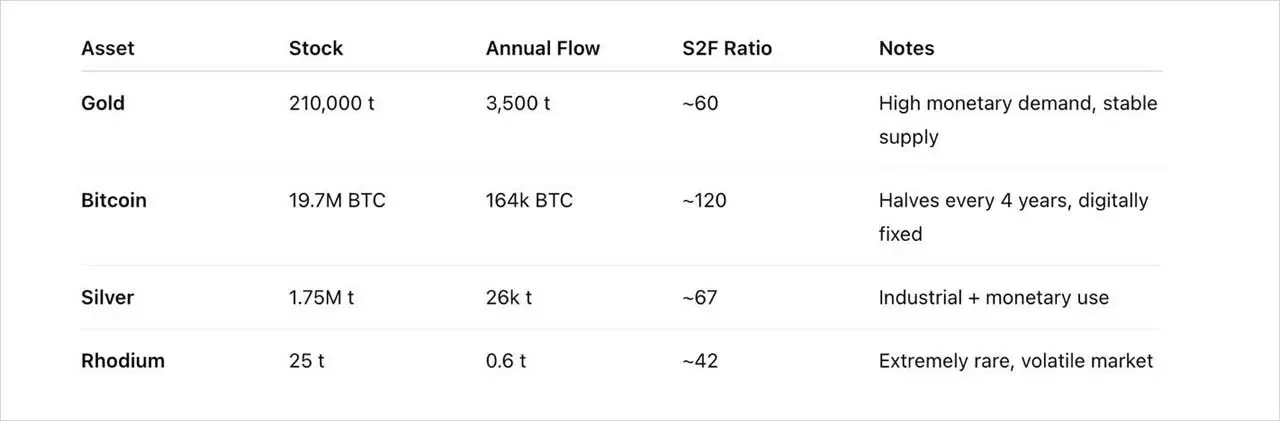
Asset scarcity is often measured by the stock-to-flow ratio (S2F), which is the ratio of the existing total supply to the annual new supply. Taking the scarce asset gold as an example, its S2F ratio is 60 (which can fluctuate slightly due to new gold mines being discovered). The current Bitcoin S2F ratio is about 120, meaning its annual new supply is only about half that of gold. This number will increase with each halving.
Global Liquidity Cycle
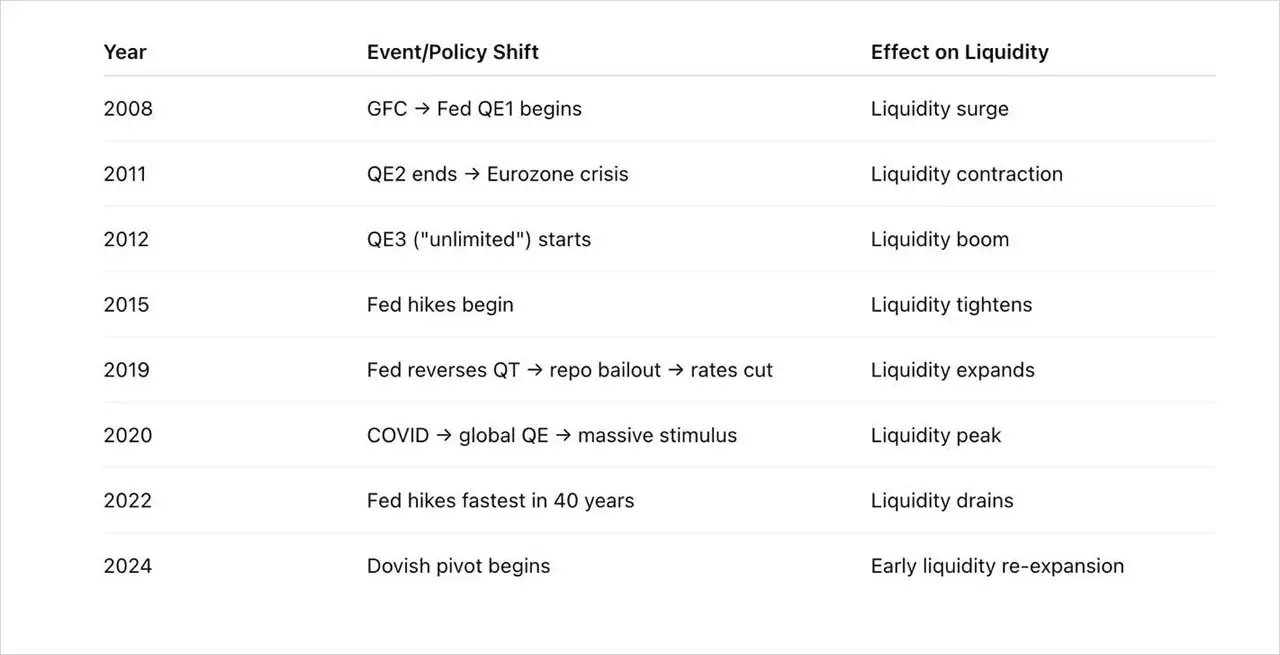
The correlation between Bitcoin and global M2 liquidity has been explained multiple times by us and various institutions. It is worth noting that many believe liquidity also follows a cyclical pattern of about four years. Although its precision is not as high as the metronome-like nature of Bitcoin halving, this correlation does exist. If this theory holds, the phenomenon of Bitcoin moving in sync with it makes logical sense.
Psychological Perspective
Whenever a wave of bullish market excitement occurs, it spawns a new wave of popularization. People's behavior patterns confirm Gandhi's assertion: first they ignore you, then they laugh at you, then they fight you, and finally you win. This cycle repeats approximately every four years, as people become increasingly accepting of Bitcoin's value, granting it stronger legitimacy. People always fall into excessive excitement, and the subsequent collapse brings the entire cycle back around.
The question now is, are these factors still dominating Bitcoin's price?
1. Halving Effect
After each halving, the proportion of newly added Bitcoin to the total supply decreases more and more weakly. When the new supply accounted for 25% of the total supply, the drop to 12.5% had a significant impact; however, now the drop from about 0.8% to 0.4% has a much less significant effect.
2. Global Liquidity Cycle
Global liquidity remains a relevant factor for Bitcoin's price, although this influence is undergoing a transformation. Bitcoin is shifting from being retail-driven to being institutionally driven, and trading behavior has changed. Institutions are making long-term accumulations, and short- to mid-term price declines will not shake them out of the market. Therefore, while global liquidity will still impact Bitcoin's price, its sensitivity to M2 liquidity will continue to weaken. Additionally, the behavior of over-the-counter institutions purchasing Bitcoin has also reduced price volatility, which is where Bitcoin's true confidence lies. Uncontrolled financial expenditures will be absorbed by Bitcoin, continuing its march towards a bright future.
3. Psychological Perspective
The broader Bitcoin is adopted, the stronger its stability in people's psychology becomes. The influence of retail selling behavior will weaken, and as market dominance shifts to institutional buyers, the volatility caused by retail will also decrease.
Overall, Bitcoin remains one of the most promising assets in the world, and its growth model is undergoing a transformation from cyclical growth to (on a logarithmic scale) linear growth. Global liquidity has become the dominant force in the current market, and unlike the top-down (from institutions to retail) propagation path of most assets, Bitcoin has achieved penetration from the grassroots level to mainstream institutions. Because of this, we are witnessing the market stabilizing as it matures, with its evolutionary model becoming increasingly standardized and orderly. (Image source: DeathCab)
 Risk warning
 Risk warning