Circle plummets 15%, can stablecoins still remain stable?

 Chasing is the favorite theme of Big A.
Author: Gelong
This morning, I woke up to see that the hottest stock in the US, the stablecoin pioneer Circle, plummeted by 15%. I immediately asked a friend of mine, as he had sold a put option with a strike price of 200 expiring on June 27. Last night, the price of this option surged unexpectedly.
Yesterday, Tianfeng Securities in the A-share market had a trading volume of 11.6 billion, with repeated circuit breakers and intense long-short battles. The leading broker in this wave, Guotai Junan International, also saw a nearly 15% drop yesterday. With Circle's crash last night, the bulls in these stocks are likely feeling anxious.
So what exactly is a stablecoin? Is it just a wave of speculation, or is it a future trend?
A stablecoin, as the name suggests, is a currency with a relatively stable price. Like Bitcoin, it also belongs to the category of cryptocurrencies. The difference is that its price is pegged to a stable asset. Generally, stablecoins can be divided into four types, with fiat-collateralized stablecoins being the largest.
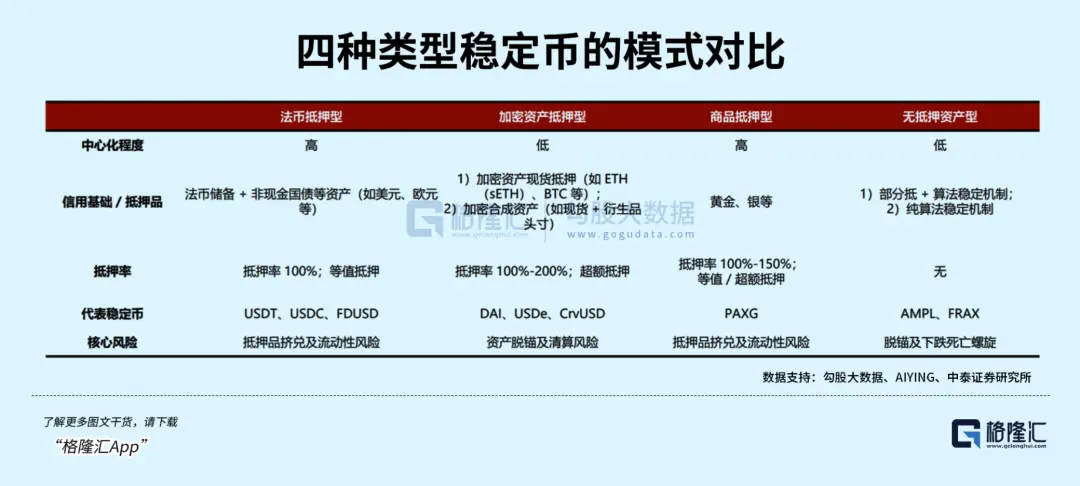
To give a simple example, if you give Circle 1 million USD, Circle will mint USDC worth 1 million in your wallet. The USDC it issues must be backed by the assets it holds, which are usually fiat currencies (like USD) or short-term US Treasury bonds.
Because of this 1:1 peg, stablecoins like USDC basically achieve price stability. Of course, there have been brief periods of significant drops, such as in March 2023, when Circle had 3.3 billion USD in Silicon Valley Bank, which suddenly closed, causing market panic and USDC to drop to around 0.88-0.92 USD. However, it regained its peg within two days because the Federal Reserve and FDIC guaranteed full repayment to depositors.
Many people may wonder why I would give 1 million to Circle in exchange for an equivalent stablecoin. It's important to note that Circle does not pay interest on the 1 million you give (the latest "genius" bill in the US explicitly prohibits it from paying interest), while it can take that 1 million and buy short-term US Treasury bonds to earn interest income. Essentially, it is getting a free loan without paying interest—where else can you find such a good deal?
This brings us to the trading of cryptocurrencies like Bitcoin. Before stablecoins existed, users wanting to buy Bitcoin could only use fiat currency, and the conversion between fiat and Bitcoin had to go through banks, which was very difficult, slow, and expensive at that time. The buying and selling of Bitcoin had to wait for the buyer to prepare the funds, and only when the money arrived could the coins be released, leading to extremely low efficiency. At the same time, the trading infrastructure was immature, with significant price discrepancies across exchanges, lacking a bridging mechanism for cross-platform arbitrage.
This resulted in poor liquidity for early cryptocurrencies like Bitcoin. Stablecoins emerged to meet this demand, and their core significance is to break down the liquidity barriers in cryptocurrency trading. They can be quickly matched on the same exchange as Bitcoin, and stablecoins can also facilitate rapid cross-chain and cross-exchange fund transfers. Additionally, stablecoins have the advantage of protecting the privacy of digital currency investors. With the emergence of stablecoins, a barrier has been built between Bitcoin and bank accounts, blocking the association of sensitive information.
Thus, you can see that the scale of stablecoin development is largely synchronized with Bitcoin's price. The higher Bitcoin's price rises, the more it stimulates the expansion of Bitcoin's user base, leading to increased demand for stablecoins.
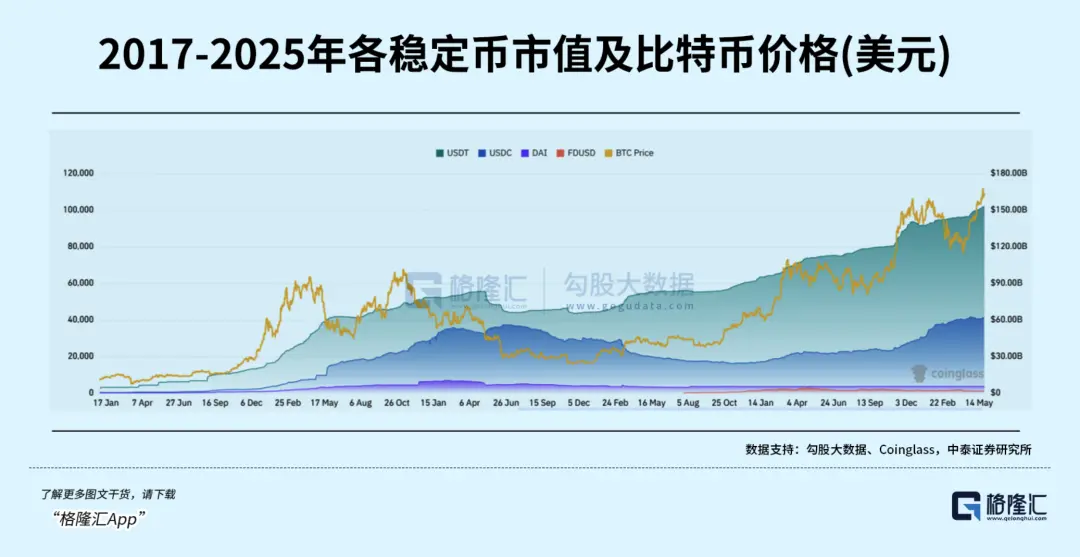
It can be said that stablecoins were born out of the trading demand for cryptocurrencies like Bitcoin.
At this point, you may realize a problem. We may not lack technological infrastructure to create a RMB stablecoin, but we lack scenarios—what would I use a RMB stablecoin for? Reflecting on this, when Nvidia's graphics cards were dominating us, people traced back to find that it might be due to the butterfly effect of our ban on gaming years ago. If the development of the RMB stablecoin lags significantly in the future, the reason may very well be traced back to the ban on cryptocurrency trading in 2021.
If stablecoins only cater to the trading demand for cryptocurrencies, it doesn't really matter whether we pursue them or not; such speculative trading in capitalism is not worth engaging in. However, the application of stablecoins in another scenario suggests that they could reshape the future global monetary system.
This scenario is cross-border payments. Stablecoins can serve as efficient settlement tools, supporting instant low-fee transactions for cross-border transfers and online shopping. Because they are based on blockchain technology, the two parties can interact directly through wallets without the need for intermediaries like correspondent banks and clearing institutions in the traditional financial system, completing settlements in as fast as 30 seconds with fees controlled between 0.1% and 1%. In contrast, banks can take hours to days and charge an average comprehensive fee of 6%.
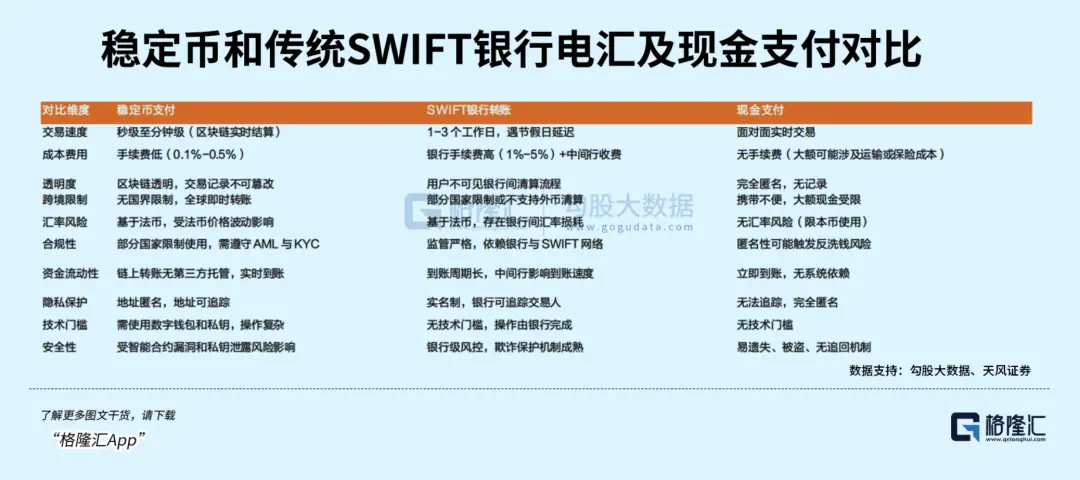
The replacement of high-cost tools with low-cost, high-efficiency tools is merely a matter of time.
Imagine if stablecoins were to penetrate the cross-border payment sector significantly in the future; whoever has a large volume of stablecoin usage would hold the power in the monetary system. Currently, by currency type, USD stablecoins almost occupy the entire market share. As of June 8, 2025, USD stablecoins accounted for 99.8%, while the Euro accounted for 0.2%.
Contrary to some people's claims, stablecoins have not weakened the USD; rather, USD stablecoins will greatly enhance the USD's position, not the other way around. How many countries have currencies that are worthless? USD stablecoins provide residents of these countries with another option to obtain USD-level assets, enjoy stability, and not have to worry like they would with Bitcoin (if Bitcoin rises, they feel they lost out when using it for payments; if it falls, their assets shrink).
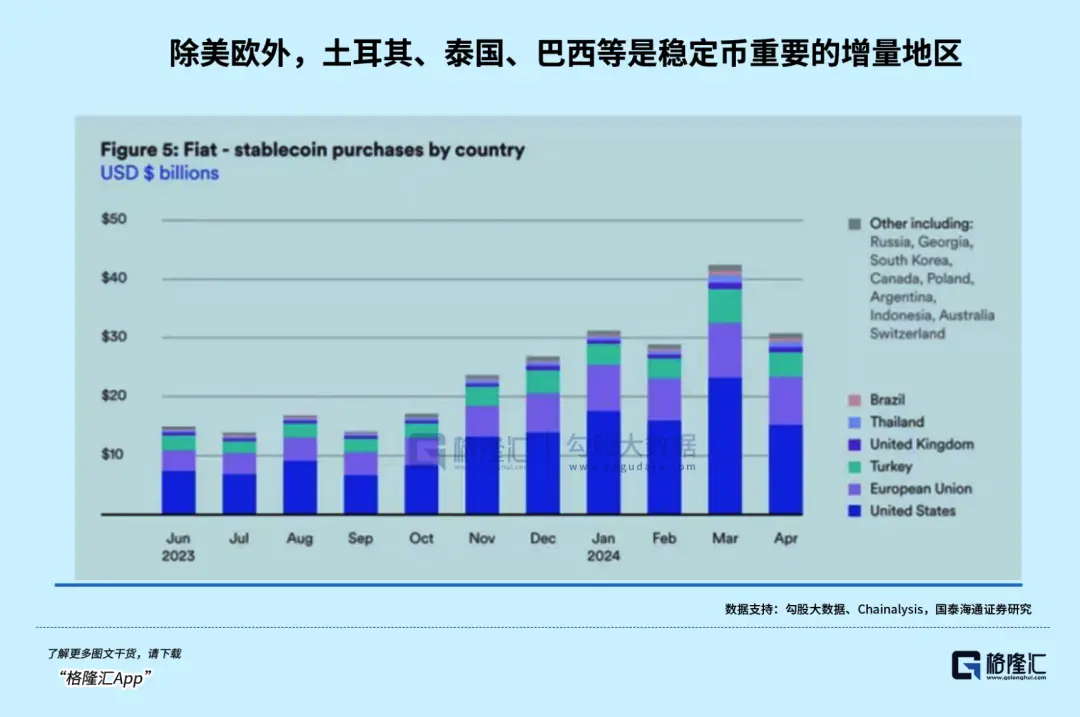
From this perspective, the domestic effort to develop a RMB stablecoin will certainly be pursued vigorously. Without the trading scenario of cryptocurrencies, whether it can be successfully developed is uncertain, but it is definitely something that must be pursued. And this pursuit is precisely the kind of theme that A-share investors love the most.
Therefore, stablecoins will be a major theme in the future. In the short term, Circle's crash has created a need for a correction. The crash of Circle is purely due to valuation. The total market value of USDC issued by Circle is around 61 billion USD, while at its peak, Circle's stock market value exceeded that of USDC.
Do you understand what this means?
As I mentioned earlier, Circle's business model is to issue USDC, getting a wave of interest-free funds to earn interest income. This is even better than banks, which have to pay deposit interest. And if the market value exceeds the value of USDC, it is equivalent to the Industrial and Commercial Bank of China's market value exceeding its deposits. The latest quarterly deposit figure for ICBC is 36 trillion USD; imagine an ICBC with a market value of 36 trillion USD—it's truly stimulating.
So, after this wave of speculation, a significant drop is very normal, but it will definitely rise again later.
 Risk warning
 Risk warning