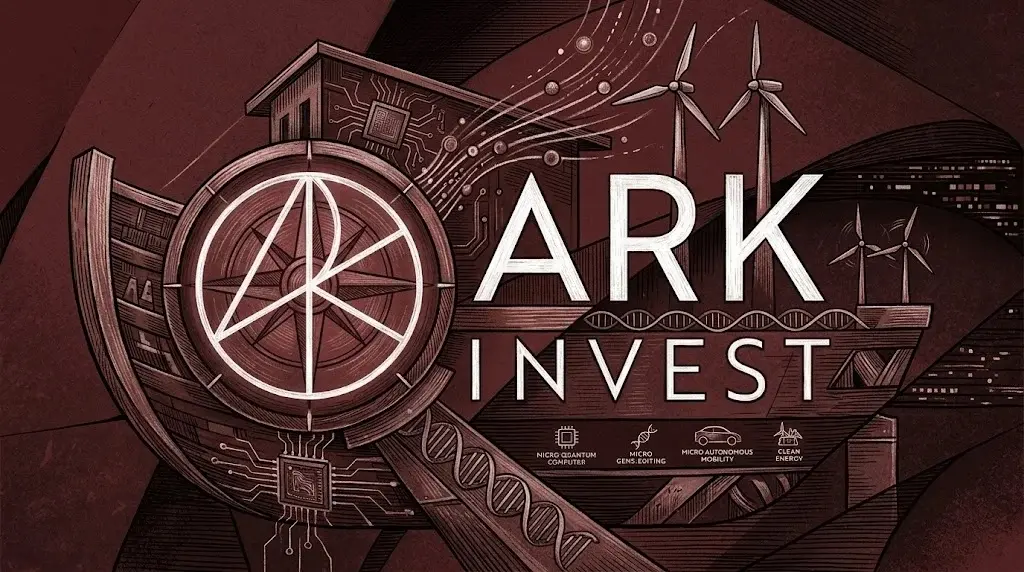
ARK releases "DeFAI Narrative": A new chapter of on-chain civilization officially begins

 Propose a logic-centered economic system and governance framework, ARK announces the launch of a future experiment for a decentralized intelligent society.
Today, in a globally synchronized live broadcast, the decentralized protocol project ARK officially released its civilization-level protocol blueprint, announcing the launch of a new narrative framework "DeF AI (Decentralized Financial AI)," marking a new stage in on-chain social governance.
This is not just a typical product feature release, but a "civilization launch ceremony" symbolizing institutional awakening. ARK proposes a complete design for a decentralized nation: an intelligent economic coordination system driven by logic, constructed by models, and co-managed by modules and citizens.
Genesis Signal Launch: "Not a Product, but an Institution"
The "Genesis Signal" released by ARK symbolizes its public architecture officially connecting with the global community, initiating a new design narrative for protocol-level governance and economic logic.
According to official statements, ARK does not adopt fixed-time token issuance, emotion-driven governance, or centralized intervention mechanisms, but establishes an overall operational rhythm through a modular logical architecture. Specifically:
- Token issuance is triggered only when conditions are ripe, with no preset schedule.
- Price fluctuations are automatically intervened by internal algorithms of the protocol.
- Earnings are automatically subjected to deflationary buybacks and destruction.
- Total supply is flexibly controlled based on actual treasury support and the lifespan of the protocol.
What ARK aims to build is not a product, but a decentralized financial system governed by models.
Five Modules Form the Backbone of ARK's Economic Logic
The core of the ARK protocol consists of five major modules, each responsible for key economic governance tasks within the protocol:
- EM (Smart Token Issuance): Dynamically adjusts the token issuance amount based on market premiums and treasury conditions, rejecting unfounded expansion.
- RBS (Market Value Stabilization): Sets intelligent price channels and automatically activates intervention mechanisms to avoid market overheating or stall.
- YRF (Earnings Buyback): Converts protocol earnings into regular buybacks and destruction, establishing a rhythmic deflationary mechanism.
- MCL (Minting Cap): Controls maximum supply based on real-time asset reserves, ensuring each token has value support.
- RCM (Operational Cycle): Predicts the sustainable cycle of the protocol and adjusts token issuance speed and reward strategies to ensure system sustainability.
These five modules form a self-regulating, risk-controlled economic system for the protocol, creating a predictable, feedback-driven, and governable digital nation institution core.
From "Users" to "Citizens": A Shift in Governance Perspective
In the ARK ecosystem, participants are no longer just passive token holders, but "ARK Citizens" with decision-making influence. Governance weight is determined by the amount staked and the lock-up period, with governance NFTs granting proposal and voting rights.
Every governance proposal must first undergo risk simulation, parameter suggestions, and outcome predictions by AI models. The models do not have decision-making power but serve as a suggestion engine, ensuring the entire decision-making process is more rational and forward-looking.
The deeper the participation and the greater the contribution, the higher the governance weight ------ ARK binds participation and responsibility closely, promoting bottom-up governance evolution.
ARKLand: An On-Chain Experimental Field for Modular Economy
Along with the Genesis Signal, the "ARKLand" modular social framework was also announced. This is a programmable and scalable on-chain application layer that allows every citizen to:
- Use AI protocol modules to handle finance, governance, life, and other fields.
- Provide data and contribute behavior training modules.
- Publish self-built modules and participate in module governance and profit sharing.
- Jointly establish module market order and governance structure.
ARKLand is not merely an application marketplace but a modular governance testing ground that can provide real-time feedback, is community-driven, and can self-evolve.
Built by the Alliance of Protocol Builders
"ARK is not the result of a single team, but a co-creation project of a cross-protocol builders alliance."
Currently, the teams participating in the construction of the ARK architecture include core contributors from Lido, Olympus DAO, and the GPT architecture team, covering multiple key areas such as staking economy, modular governance, and AI decision-making systems.
Institutional Promoters and Core Contributors
Morgan Clay Fund
A private equity fund from Silicon Valley, integrating the governance background of the Morgan family, with a long-term focus on the Web3 × AI × Digital Sovereignty Economy field. As an early investor and governance advisor for ARK, the fund is deeply involved in protocol model design and governance system construction.
Carmelo Ippolito
A well-known theorist of decentralized governance who participated in the early model design of Olympus DAO. Currently, he is the chief architect of ARK's governance module, responsible for promoting model governance and AI co-governance design.
Four-Phase Vision Blueprint: The Civilizational Process of ARK
According to the blueprint publicly released by ARK, its future will be implemented in four phases:
- Protocol deployment and modular economy launch (2025--2026)
- AI × Governance layer and community credit system construction (2027--2028)
- Virtual cities + decentralized identity standards implementation (2029--2030)
- Self-evolving governance and multi-chain civilization federation model (2031--2035)
This is not only a system upgrade process but also a construction plan for decentralized protocols to evolve into civilization-level institutional layers.
A noteworthy on-chain civilization prototype trial has officially begun.
The birth of ARK does not aim to create traffic and narrative hotspots, but to earnestly launch a new type of civilizational experiment based on logic, centered on models, and institutionalized through protocols.
This is not just a redefinition of decentralized finance but a rewriting proposal for Web3 governance and coordination order.
If the future of Web3 is an institution rather than a tool, it will emerge from such prototypes.
About ARK
 Risk warning Risk warning