








Tron Industry Weekly Report: Uncertain Interest Rate Cut Expectations, BTC Drops Below $80000, Detailed Analysis of RWA and AI Infrastructure New Directions of Pharos & ARO

 A detailed explanation of the high-performance parallel L1 Pharos with a total financing of 52 million USD, and the AI distributed network ARO with a financing of 7.1 million USD: new directions in DeFi, RWA, and AI infrastructure.
I. Outlook
1. Macroeconomic Summary and Future Predictions
This week (May 11 to May 17), the macroeconomic landscape overall presented a "high inflation + high interest rates + geopolitical risks" resonance pattern. The U.S. April CPI was announced on May 12, rising to 3.8% year-on-year, higher than the previous value of 3.3%, with core CPI rising to 2.8%, indicating a resurgence of inflation, with energy prices being the main driving factor; meanwhile, the situation in the Middle East continued to disrupt oil supply, with Brent crude oil briefly surpassing $100, driving global inflation expectations higher. As a result, U.S. Treasury yields rose sharply, with the 10-year Treasury yield reaching over 4.5% at one point this week, and the 30-year yield breaking 5%, setting a new high for this phase, leading the market to begin readjusting its expectations for interest rate cuts this year. Overall, the core logic of the global market this week has shifted from "economic slowdown + interest rate cut expectations" back to "inflation resilience + long-term high interest rates."
In the coming week (May 18 to May 24), market focus will shift to U.S. retail sales, initial jobless claims, and statements from Federal Reserve officials, primarily to verify whether "high inflation is beginning to suppress economic demand." If consumption and employment data continue to show resilience, U.S. Treasury yields may rise further, and the market will continue to delay the timing of interest rate cuts, putting valuation pressure on risk assets; conversely, if economic data weakens marginally, it may alleviate the liquidity pressure brought about by the recent rapid rise in yields. Additionally, oil prices and the situation in the Middle East will remain key variables affecting global risk appetite in the coming week; if crude oil prices remain high, concerns about "secondary inflation" may further strengthen. Overall, the macro market is likely to maintain a state of "high volatility, strong data-driven" in the coming week.
2. Market Changes and Warnings in the Crypto Industry
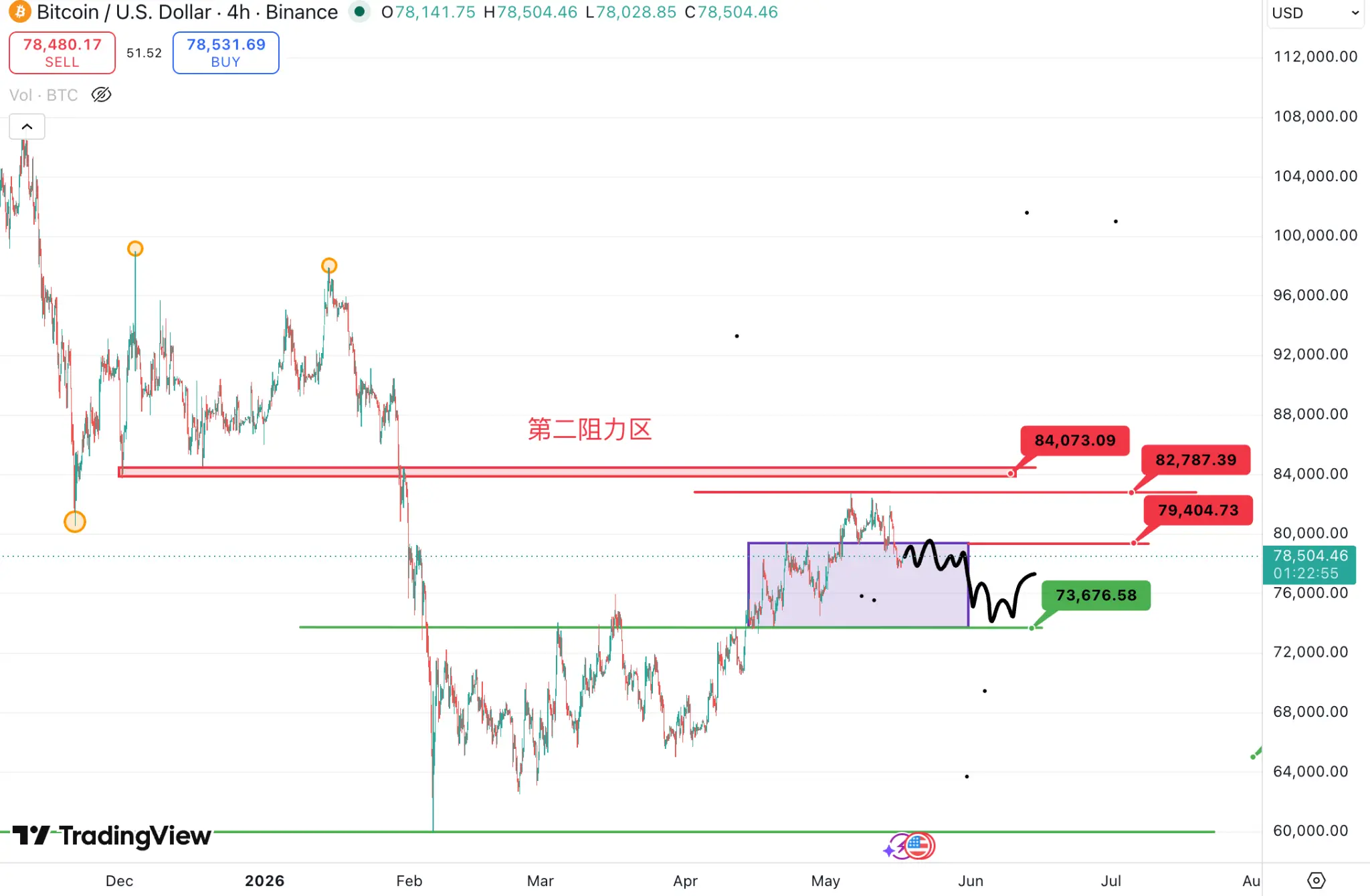
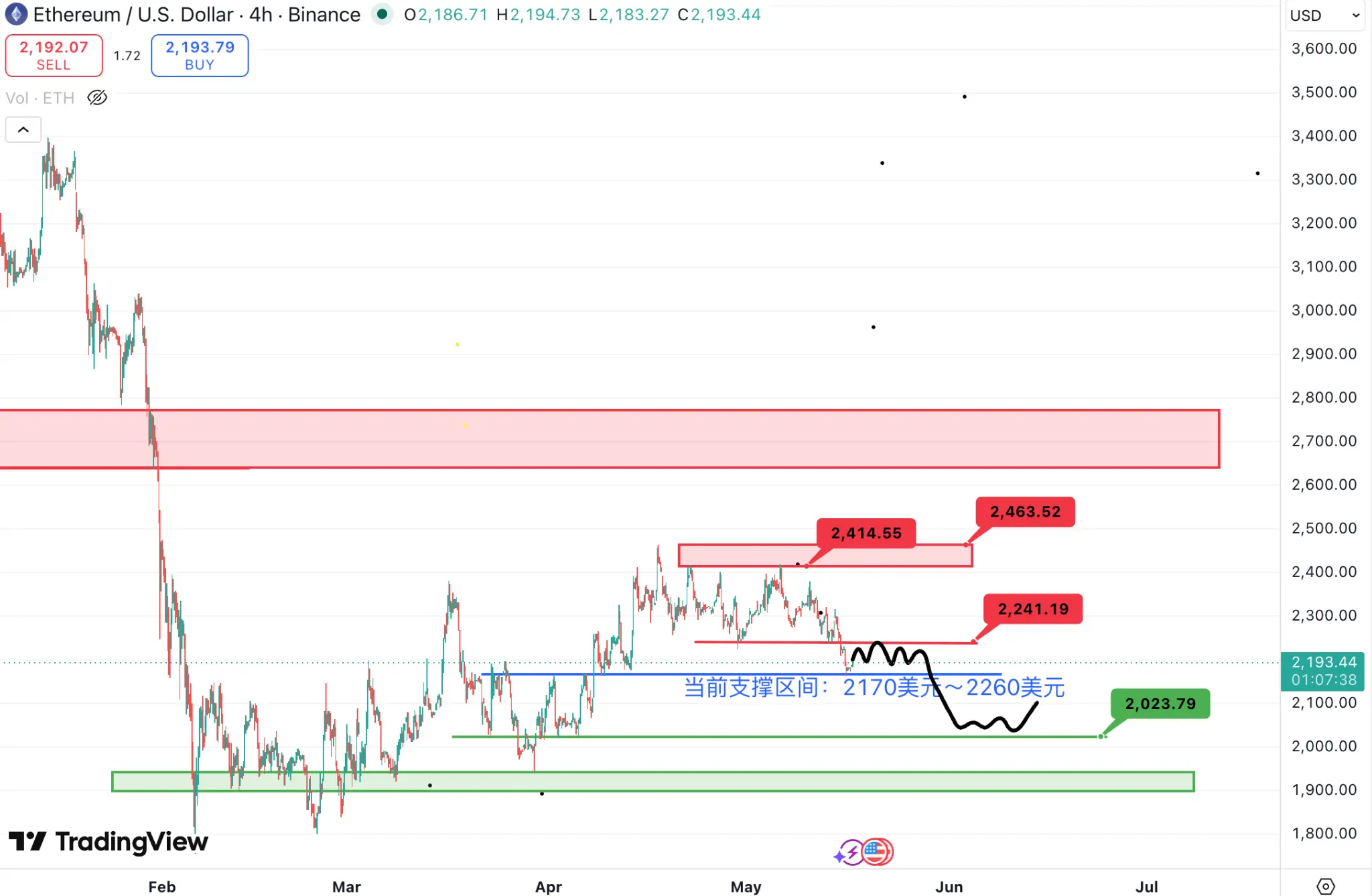
From May 11 to May 17, the crypto market overall exhibited a trend of "weakening after high-level fluctuations." Bitcoin (BTC) maintained a range of $81,000 to $82,000 at the beginning of the week, with a price of about $81,700 on May 11, but subsequently fell to around $78,000 to $79,000 around May 16 due to rising U.S. Treasury yields, the market re-trading expectations for interest rate hikes by the Federal Reserve, and an overall pullback in risk assets; Ethereum (ETH) was generally weaker than BTC, continuously retreating to around $2,180 during the week, with AI, RWA, and some high Beta altcoins experiencing capital withdrawals simultaneously. Meanwhile, the advancement of the U.S. CLARITY Act, continued net inflows into ETFs, and institutional capital maintaining allocations still provided medium to long-term support for the market.
In the coming week (May 18 to May 24), the core risks in the market still stem from the macro level, particularly U.S. Treasury yields, inflation expectations, and changes in the Federal Reserve's path. If BTC cannot regain a foothold above $80,000, there is a possibility of further testing the support range of $76,000 to $77,000 in the short term; if ETH falls below $2,150, it may further weaken to around $2,000. On the other hand, if U.S. crypto regulatory bills continue to advance, ETF funds maintain net inflows, and risk asset sentiment recovers, BTC still has the opportunity to challenge the range of $82,000 to $84,000 again. The current market has entered a phase of "policy benefits + macro suppression," and short-term volatility is expected to increase significantly.
3. Industry and Track Hotspots
Detailed explanation of the high-performance parallel Layer 1 Pharos with a total financing of $52 million, led by Chainlink, SNZ, and HACKVC, with star institutions like GCL participating—new directions for DeFi, RWA, and AI infrastructure.
II. Market Hotspot Tracks and Potential Projects of the Week
1. Overview of Potential Projects
1.1. Detailed explanation of the high-performance parallel Layer 1 Pharos with a total financing of $52 million, led by Chainlink, SNZ, and HACKVC, with star institutions like GCL participating—born for DeFi and RWA.
Introduction
Pharos is a Layer 1 blockchain network that adopts a deep parallel architecture, designed for high speed, scalability, and decentralized applications.
It is EVM compatible, allowing Ethereum dApp developers to use familiar toolchains while enjoying the advantages brought by Pharos, including 1-second finality confirmation, lower storage costs, and higher security based on the AsyncBFT consensus mechanism.
By providing a unified account system across multiple virtual machines, Pharos is committed to promoting innovative development in areas such as DeFi, real-world assets (RWA), decentralized physical infrastructure (DePIN), and cross-chain interoperability.
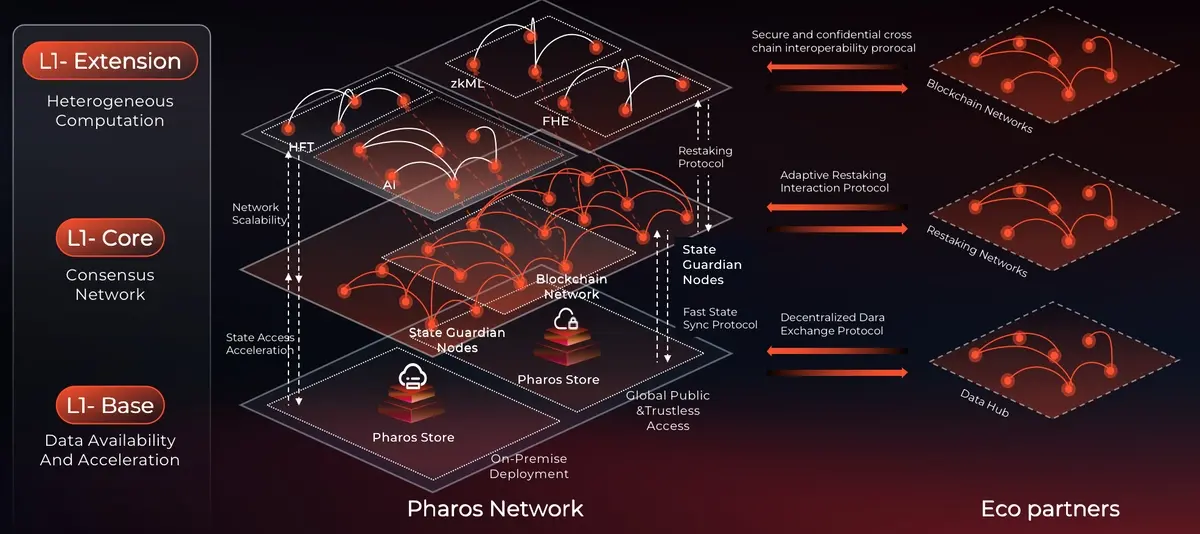
Brief Overview of the Protocol Framework
Pharos adopts a modular, highly parallel architecture, achieving high throughput, scalability, and security through the collaboration of the mainnet and SPN (Specialized Processing Network). Its core advantage lies in decoupling consensus, execution, settlement, and data availability, allowing developers to flexibly build SPN, Rollup, or sidechains, while enabling seamless communication and asset flow between different networks through cross-SPN protocols.
At the execution layer, Pharos provides dual execution environments of EVM and Wasm, and combines technologies such as ZK, TEE, and FHE to support high-performance and privacy-preserving complex computing scenarios; SPN can serve as a lightweight module, extending to GPU computing, data storage, oracles, and AI infrastructure, significantly enhancing the application boundaries of the network.
In terms of security and economic models, Pharos binds the mainnet and SPN through a Restaking mechanism, achieving shared security and enhanced liquidity; combined with cross-SPN protocols and data availability layers, it provides near-second finality confirmation, greatly improving cross-network interaction efficiency. Overall, this architecture centers on modularity + parallel execution, balancing performance, flexibility, and ecological expansion capabilities.
Pharos Node System (Pharos Nodes)
Pharos constructs its network structure through three types of core nodes: Validator, Full Node, and Relayer. Among them, Validator nodes are the consensus core, operating based on BFT + PoS mechanisms, responsible for transaction processing and network security, and can allocate resources to SPN or dApps through Restaking to earn additional income, thereby enhancing the network's security and liquidity.
Node Division of Labor and Network Support
Full Nodes and Relayer Nodes primarily undertake data distribution and basic service functions. Full Nodes store complete blocks and state data, support rapid state synchronization, and enhance execution efficiency by providing parallel hints; Relayer Nodes act as lightweight clients, responsible for transaction forwarding, simulated execution, etc., obtaining incentives through efficient message passing in the SPN network. This division of labor ensures a balance in the network's performance, data integrity, and security.
High-Performance Consensus and Real-Time Processing
In terms of performance, Pharos adopts a high-throughput, low-latency consensus mechanism, supporting multi-node parallel proposals, avoiding single-point bottlenecks, and dynamically adjusting based on network latency to maximize bandwidth utilization and enhance system resilience.
SPN and Node Coordination Mechanism
Pharos natively supports the construction of SPN (Specialized Processing Network), allowing users to create independent networks based on existing validator node sets and adopt different protocols as needed, such as AIoT networks or privacy computing networks. These SPNs can also combine with TEE or dedicated hardware to achieve higher privacy and customization capabilities, further expanding the application boundaries of the entire ecosystem.
Pharos Consensus Mechanism (Pharos Consensus)
Pharos achieves a high-throughput, low-latency, and scalable consensus mechanism through "no fixed block time + full node parallel proposals."
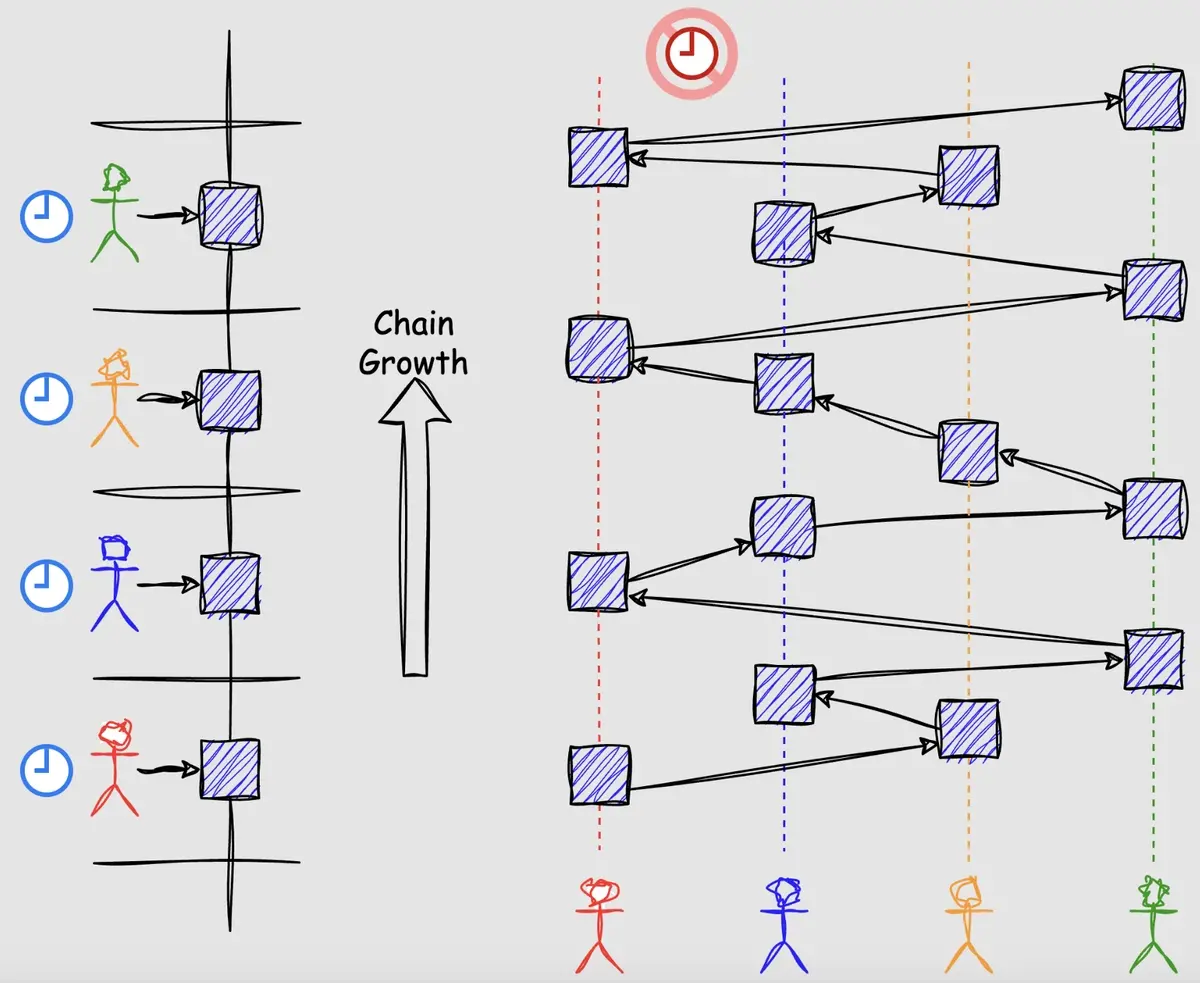
- Design Goals
Pharos consensus is designed around two core objectives:
1) High Responsiveness
The system's processing speed is determined by actual network latency, not relying on fixed time intervals or timeout mechanisms.
2) Efficient Bandwidth Utilization
All nodes participate equally in communication and proposals, maximizing the use of the entire network's bandwidth resources.
- Major Issues with Traditional Consensus
1) Fixed Block Time Limits Performance
Many blockchains adopt fixed time intervals for block generation, leading to a throughput ceiling that cannot scale with network capacity improvements.
2) Single Proposer Bottleneck
In the common "proposal-vote" model:
One node is responsible for block generation
Other nodes only vote
As the number of nodes increases:
The proposer’s load rises sharply
Network resources cannot be fully utilized
- Core Innovative Mechanisms
1) No Fixed Time Block
Block generation is dynamically based on actual network conditions rather than preset time intervals, thus improving responsiveness.
2) Full Node Parallel Proposals
All validator nodes can propose blocks simultaneously:
Eliminating single-point bottlenecks
Fully utilizing network bandwidth
Enhancing overall throughput capacity
- Flexible Advancement Mechanism
Nodes can dynamically participate based on their own network conditions:
Nodes with high latency or long distances can reduce proposal frequency
This will not affect overall network efficiency
Achieving better adaptability and stability.
- Performance Results
In a test environment with 100 global nodes:
- Throughput exceeds 130,000 TPS
Validating its high performance and scalability.
Pharos Execution Engine (Pharos Execution)
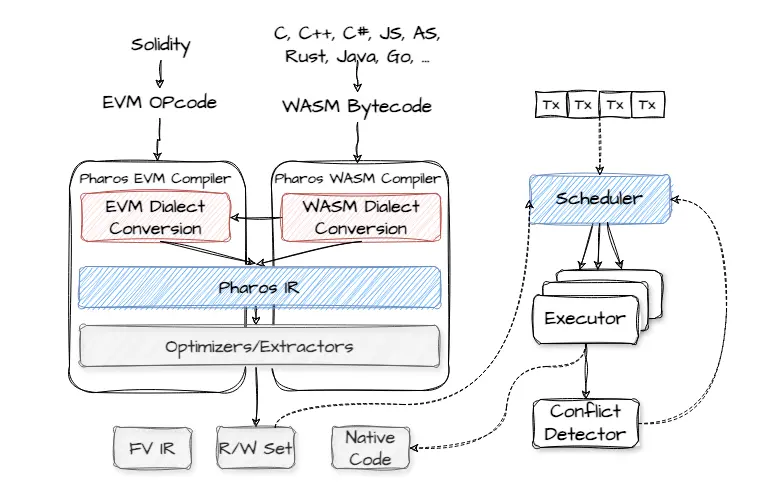
Pharos achieves high-performance and scalable transaction execution capabilities through "parallel execution + dual virtual machines + conflict optimization."
- Core Architecture
The Pharos execution engine consists of two core components:
1) Scheduler
Responsible for the parallel scheduling of transactions, achieving maximum parallelism and reducing conflicts through optimization algorithms.
2) Executor
Adopts a dual virtual machine architecture:
EVM: Compatible with Solidity contracts
WASM: Supports higher performance and multi-language contracts
- Parallel Execution Design Goals
Pharos focuses on optimizing two points:
1) Optimal Grouping
Dividing transactions into highly concurrent parallel execution groups to enhance overall efficiency.
2) Extreme Performance
Ensuring fast execution speed while guaranteeing correctness and consistency of results.
- Core Mechanisms of Parallel Execution
1) Parallel Hint Generation
Through static analysis + pre-execution, generating read-write sets in advance to reduce conflicts and improve parallelism.
2) Transaction Dependency Analysis
Analyzing dependencies based on read-write sets
Using union-find to partition parallel transaction groups
Batch loading state data to reduce I/O overhead
3) Optimistic Execution + Pipeline Finality
Execute in parallel first, then handle conflicts
Quickly converge execution results
Efficiently determine final states
- Parallel Optimization Capabilities
1) Resource Utilization Optimization
Fully utilizing multi-core CPUs and I/O
Collaborative division of scheduling and execution
2) Global Data Optimization
Optimizing parallel access for global states (e.g., counters)
Reducing conflict impacts
3) Conflict Detection and Minimal Re-execution
Fine-grained conflict detection
Only re-executing necessary transactions
Reducing performance loss
- Pipeline Finality Mechanism
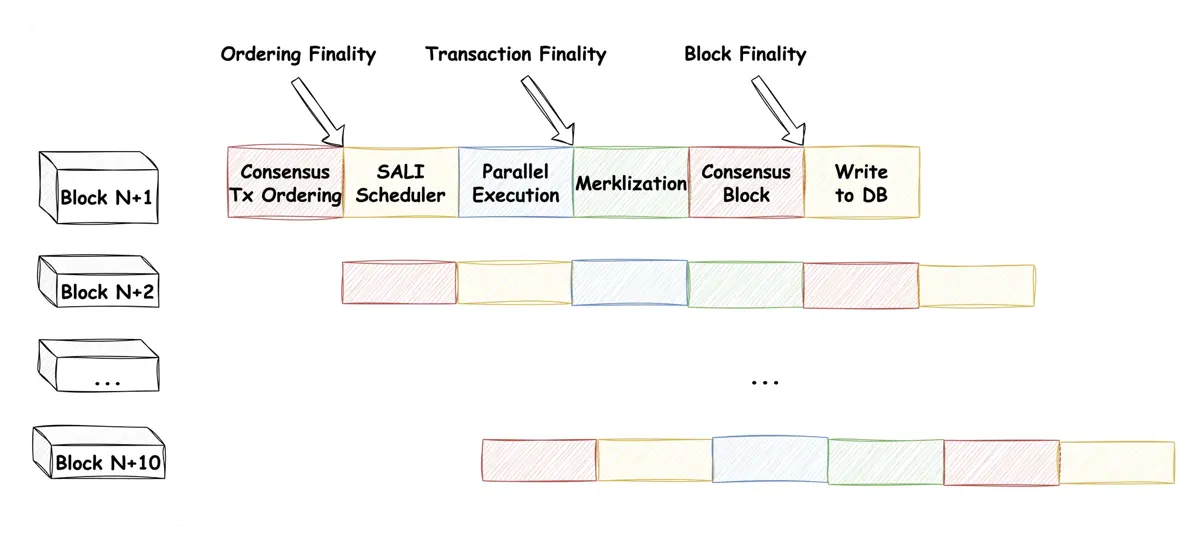
Pharos divides finality into three layers:
Ordering Finality: Transaction order is determined
Transaction Finality: Execution results are determined
Block Finality: Block is finally confirmed
Design focus:
Prioritizing transaction finality (user experience first)
While minimizing block finality time
Optimization methods include:
Setting a maximum finality block window (e.g., 10 blocks)
Accelerating block header generation
Reducing redundant calculations through state synchronization
- Execution Process (7 Steps)
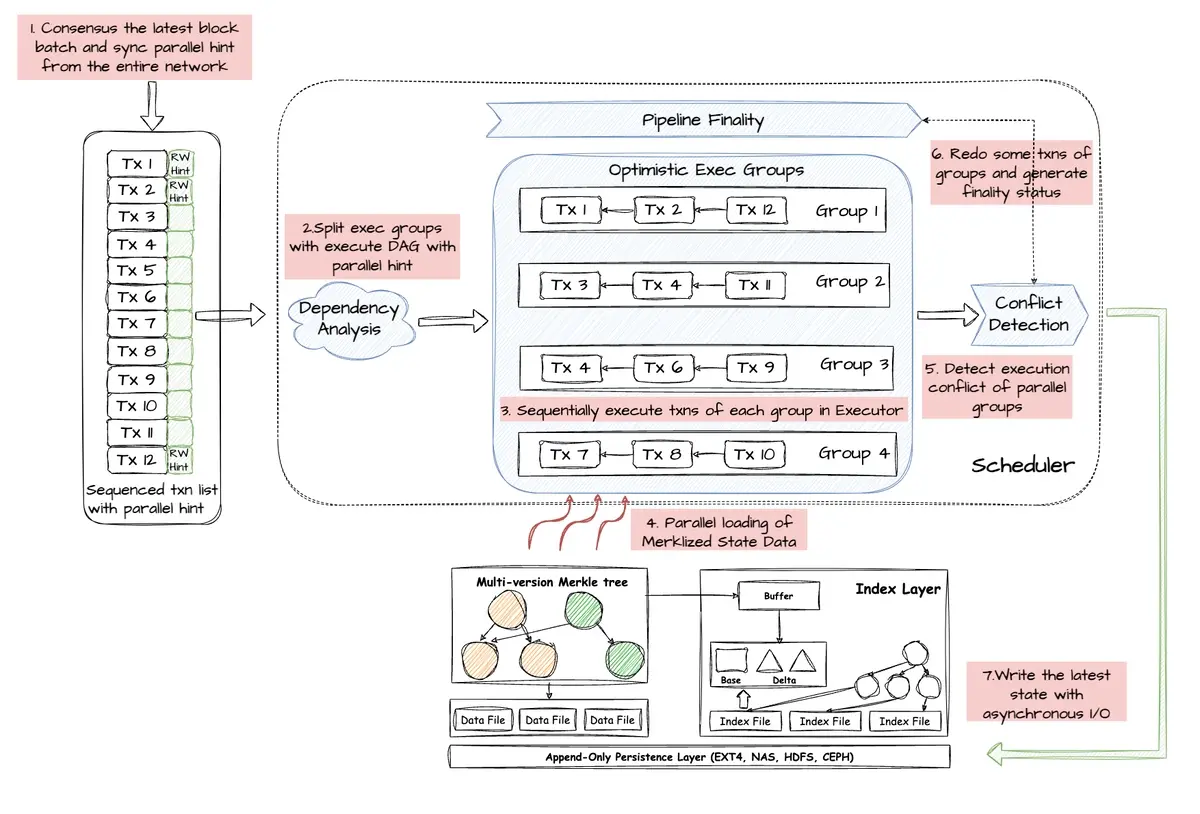
1) Consensus block and synchronize parallel hints
2) Partition execution groups based on dependency relationships
3) Execute transactions in order within groups
4) Parallel load state data
5) Detect and resolve conflicts
6) Re-execute and generate final results if necessary
7) Asynchronously write the latest state
Pharos Storage System (Pharos Store)
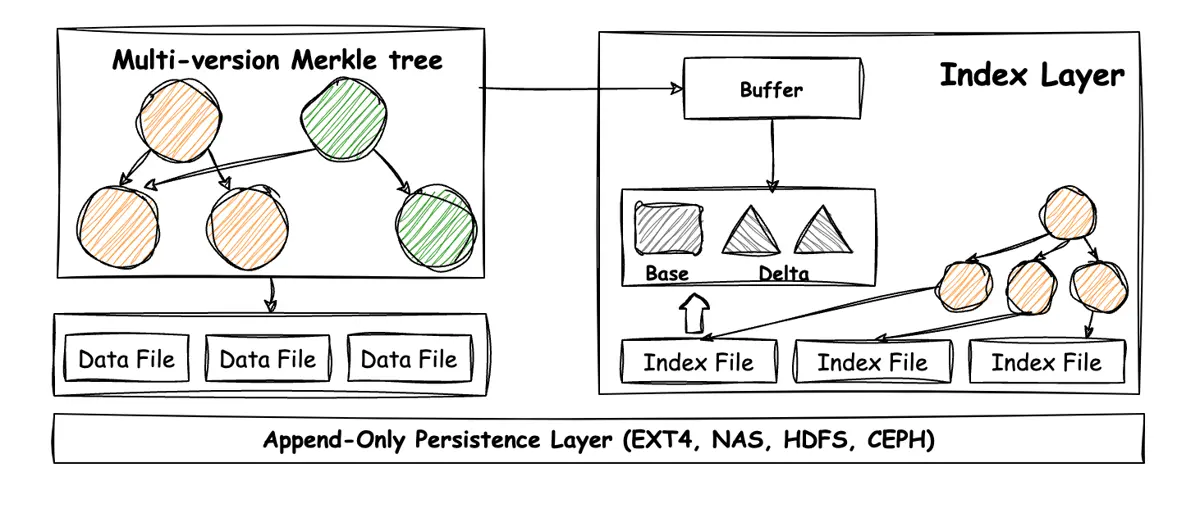
Pharos Store is a native blockchain storage solution that significantly enhances performance and reduces storage costs through structural innovation.
- Problems Addressed
Traditional blockchain storage mainly faces three major issues:
1) Long I/O Path
Separation of the storage layer and Merkle structure leads to low read and write efficiency.
2) Inefficient Hash Addressing
Relying on hashes to locate data increases computation and storage overhead.
3) State Bloat
On-chain data continues to grow, leading to rising storage costs.
- Core Innovative Mechanisms
1) ADS Pushdown (Authenticated Data Structure Pushdown)
Integrating authenticated data structures (such as Merkle Trees) directly into the storage engine, eliminating the performance bottleneck of the traditional "two-layer architecture" (Merkle + KVDB).
Core components include:
DMM-Tree: Multi-version Merkle tree structure
LSVPS: Paging index system connecting memory and storage
VDLS: Append-only data log stream
Achieving more efficient read and write and data verification.
2) Version-Based Addressing
Using "version numbers" instead of "hashes" to locate data:
Organizing data in version order
Avoiding frequent data compaction
Improving query efficiency
3) State Bloat Optimization Mechanism
Reducing storage and bandwidth consumption through various methods:
Internal compression (shortening node paths)
Page-based storage (improving write efficiency)
Incremental encoding (only storing changed data)
- Performance and Advantages
Throughput improvement of up to 15.8 times
Storage costs reduced by about 80%
Storage and bandwidth consumption reduced to below 20% of traditional solutions
SPN Architecture (SPN Architecture)
SPN is a scalable subnet built on the mainnet's security and Restaking mechanism, achieving flexible deployment and cross-network collaboration.
- Native Restaking Protocol
In Pharos, validator nodes participate in mainnet security by staking P Tokens, with each staked asset generating a corresponding certificate (stP), which can further participate in SPN's Restaking.
Core Mechanism:
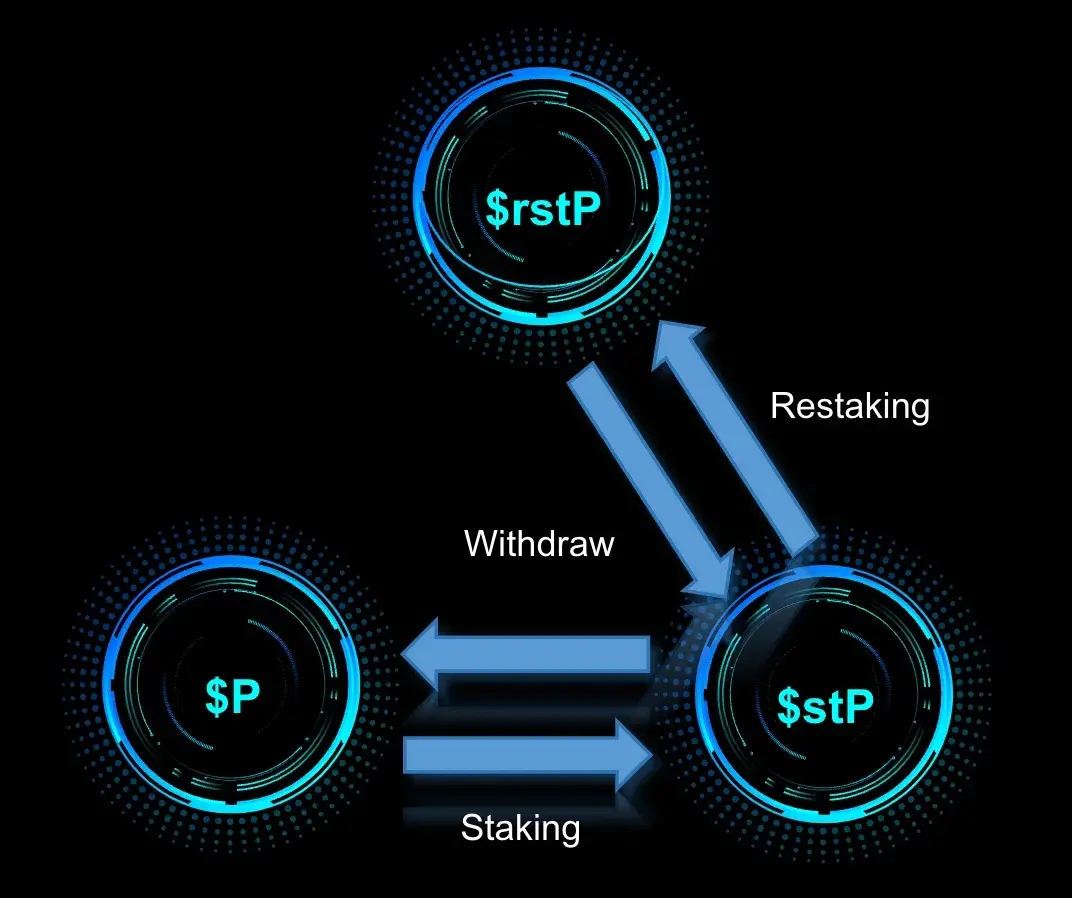
1) Restaking
stP can be allocated to different SPNs
Earning additional income
Also bearing higher penalty risks (slashing)
2) Custom Rules for SPN
Each SPN can independently set:
Number of validator nodes
stP limits (soft/hard limits)
Hardware requirements
Once conditions are met, the mainnet automatically creates the SPN and starts services.
3) Resource and Incentive Optimization
Dynamically allocating staked assets
Enhancing network liquidity and security
Optimizing resource supply and demand matching
- SPN Control and Data Flow
SPN achieves management and communication through a set of standard components:
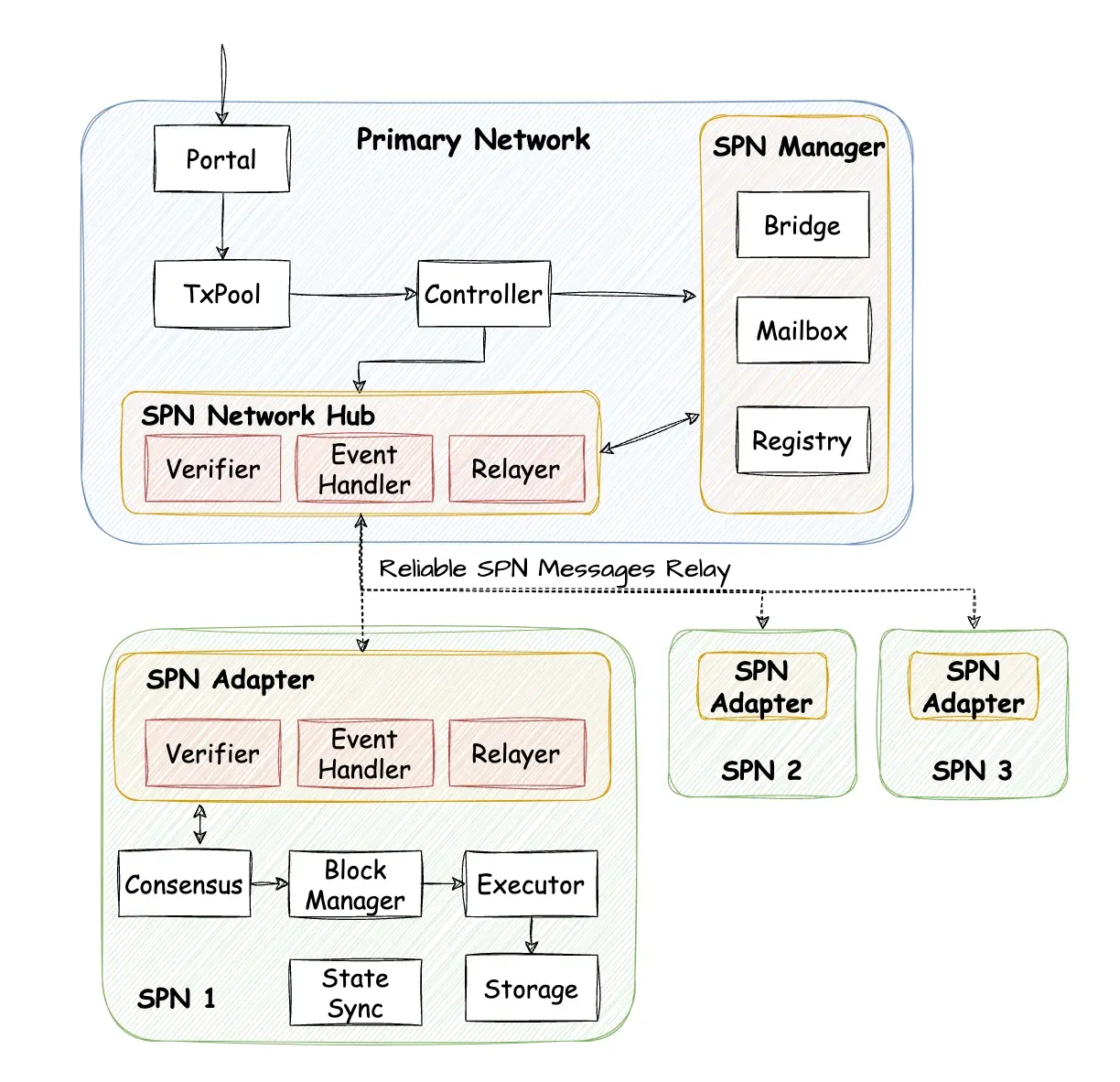
Core Modules:
SPN Manager: Responsible for the creation, destruction, communication, and asset flow of SPNs (recorded on the mainnet)
Registry: SPN registration and management
Mailbox: Records messages and events
Bridge: Handles asset transfers between SPN and the mainnet
SPN Network Hub: Responsible for cross-network message communication
SPN Adapter: Handles mainnet messages and executes them within SPN
- Cross-SPN Interoperability Protocol
Pharos supports seamless communication between different SPNs:
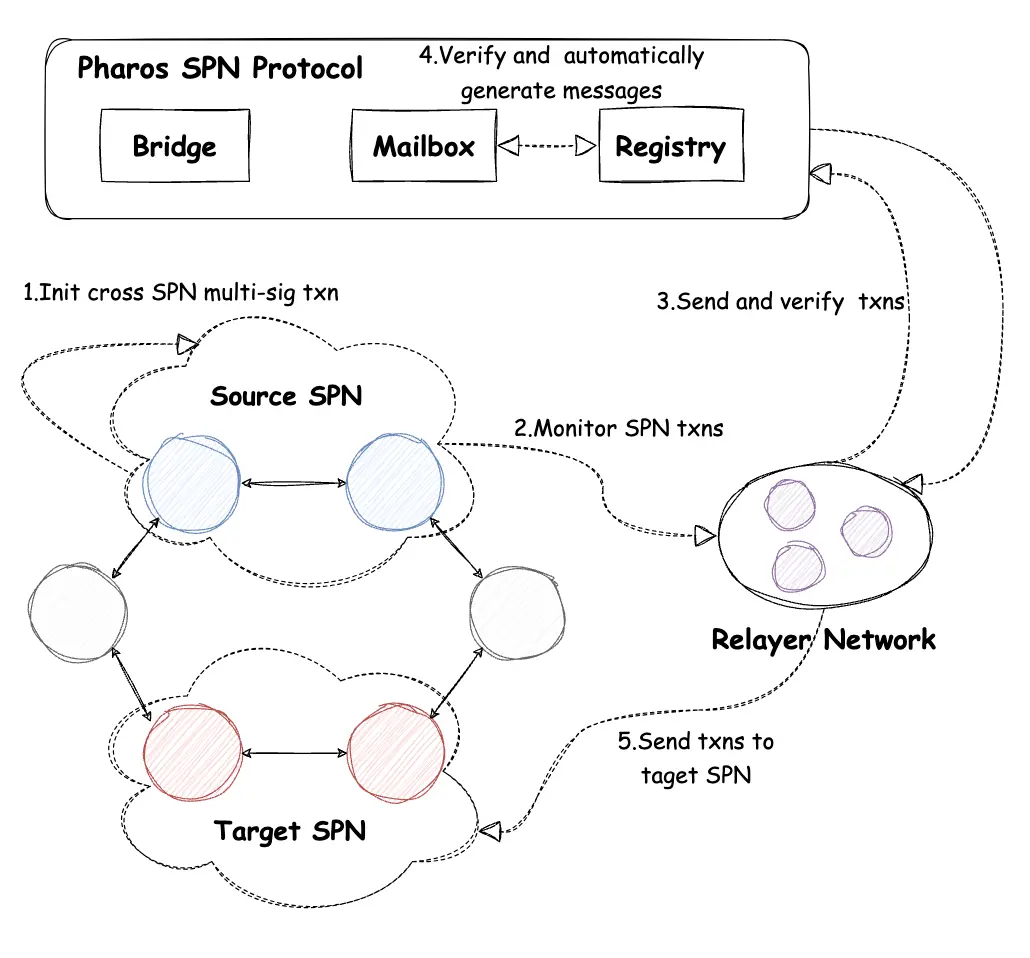
Execution Process:
1) User initiates a cross-network transaction in SPN1
2) Relayer submits the transaction and proof to the mainnet
3) Mainnet verifies and records it in the Mailbox
4) SPN2 reads the message and executes the transaction
Tron Comments
Pharos's core advantage lies in its architecture design, which is very aggressive and complete: by addressing the three key issues of performance, scalability, and ecological expansion through "deep parallel execution + modular SPN + Restaking shared security," it possesses significant technical differences, especially in parallel execution, full node parallel proposals, and unified accounts across VMs, with the potential to support high-performance scenarios in DeFi, RWA, and AI.
However, its challenges are also evident: the overall architectural complexity is extremely high, and the collaboration between multiple innovative modules (parallel execution, SPN, Restaking, cross-SPN communication) requires high engineering implementation and stability; at the same time, before the ecosystem is established, there are uncertainties regarding SPN's supply and demand matching, developer migration costs, and real application landing, which in the short term need to rely on strong execution to drive the formation of network effects.
2. Key Project Details of the Week
2.1. Detailed explanation of the ARO Network, which has raised a total of $7.1 million, led by No Limit Holdings and Dispersion Capital, with EV and Maelstrom participating—providing an open distributed network for AI.
Introduction
ARO Network is an edge network natively built for the "Agentic AI era." It is a decentralized, shared system that truly realizes the vision of "letting AI work for you."
In this network, AI agents run directly in your home and on your devices: data stays local, privacy is ensured, and everything is under your control.
Core Analysis of System Architecture
ARO Network adopts a three-layer architecture to build its edge cloud infrastructure:
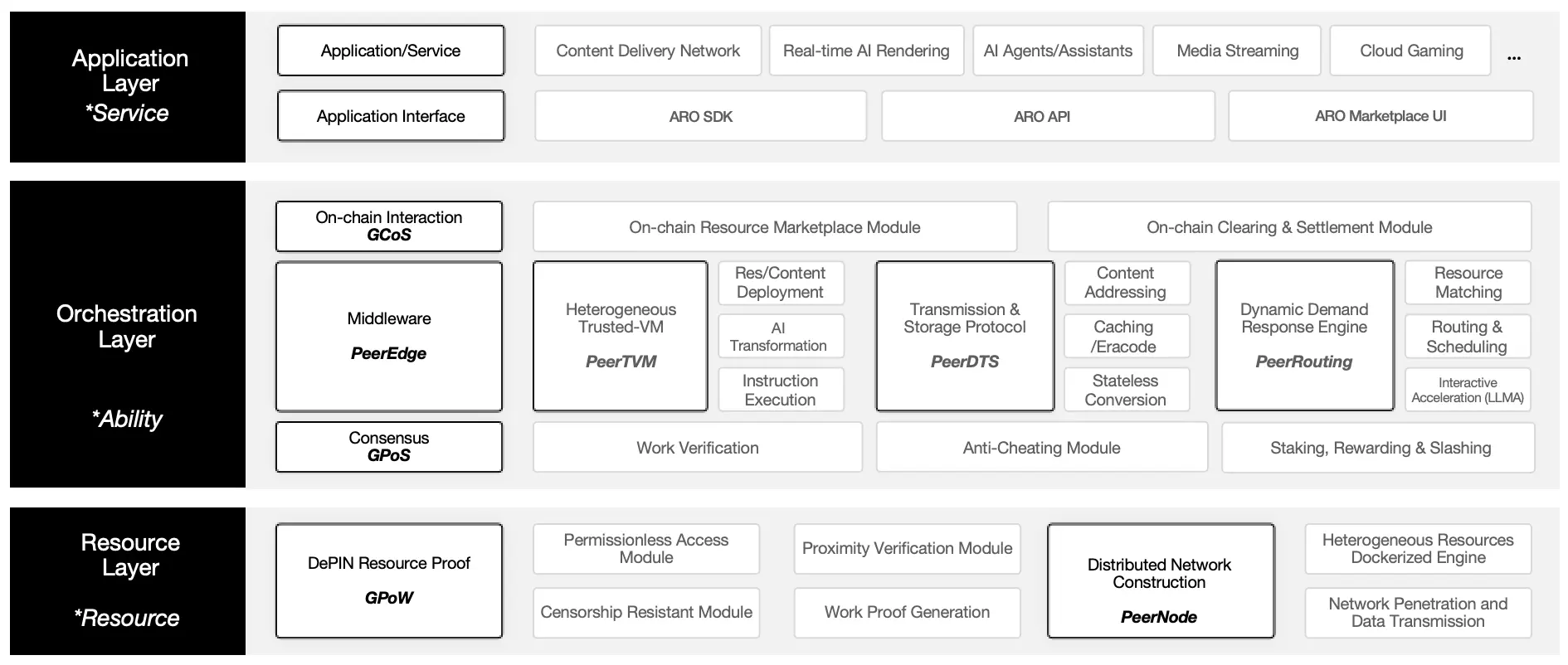
1. Resource Layer
This is the foundational layer of ARO, consisting of a large-scale, distributed, permissionless hardware network that provides bandwidth, storage, and computing power, serving as the base of the entire edge cloud.
At this layer, two core issues are addressed:
Trust Issue:
How to enable large-scale distributed nodes to verify each other and trust the verification results?
Functionality Issue:
In the case of highly diverse node types, how to achieve unified virtualization and containerization, and build a P2P network that can penetrate firewalls and intranets?
2. Open Layer
This layer is responsible for scheduling and optimizing network resources, better matching supply and user demand.
Its foundation is a trust mechanism for verifying node workloads, on top of which a capability abstraction engine—PeerEdge middleware—is built.
PeerEdge includes three core components:
PeerHVM (Heterogeneous Virtual Machine)
Abstracts resources in the P2P network and outputs standardized capabilities.
Enables different nodes to work together, forming a unified and interoperable network.
PeerDTS
A high-performance P2P transmission protocol that supports efficient distribution of large-scale content across the network.
PeerRouting
A dynamic scheduling engine that intelligently matches the most suitable resources based on changing user demands.
3. Application Layer
Based on middleware capabilities and on-chain interfaces, this layer provides user-facing:
Product interfaces
Service components
Application APIs
Supported services include: CDN, cloud storage, AI inference, real-time transmission, computing power scheduling, etc.
This layer will gradually open to developers, encouraging ecological application construction and promoting the realization of ARO's vision: Universal Acceleration.
Resource--Trust--Service Model
ARO organizes the entire edge network more clearly using the "Resource---Trust---Service" three-layer model:
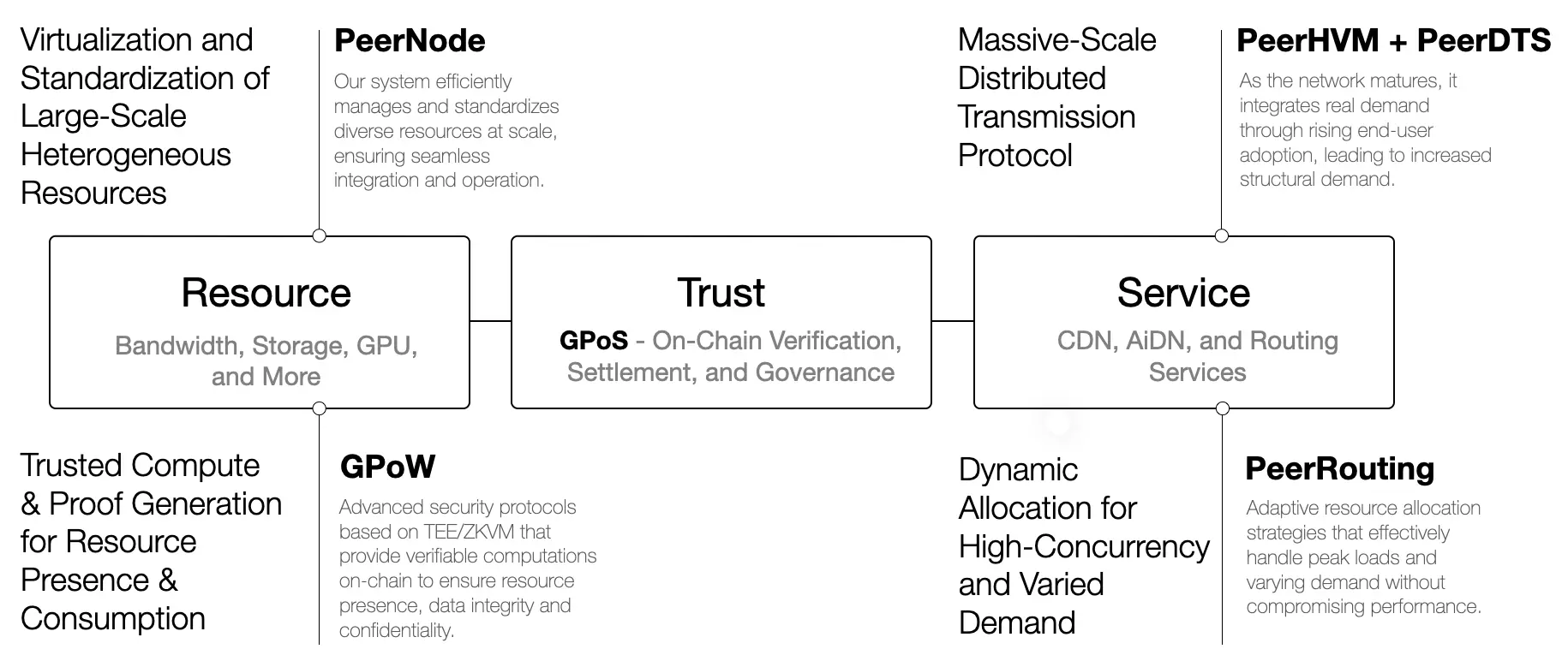
Resource (Resource Layer)
Responsible for virtualizing and standardizing a large number of heterogeneous nodes (PeerNode), providing decentralized computing power.
It also introduces GPoW (Guaranteed Proof of Work) to generate verifiable and trustworthy work proofs.
Trust (Trust Layer)
Through GPoS (Guaranteed Proof of Stake), it completes on-chain:
Verification
Settlement
Governance
Ensuring that all work proofs are trustworthy.
Service (Service Layer)
Based on PeerHVM, PeerDTS, and PeerRouting middleware, it provides external services, such as:
CDN
AiDN (AI Distribution Network)
Routing and scheduling
Network Topology
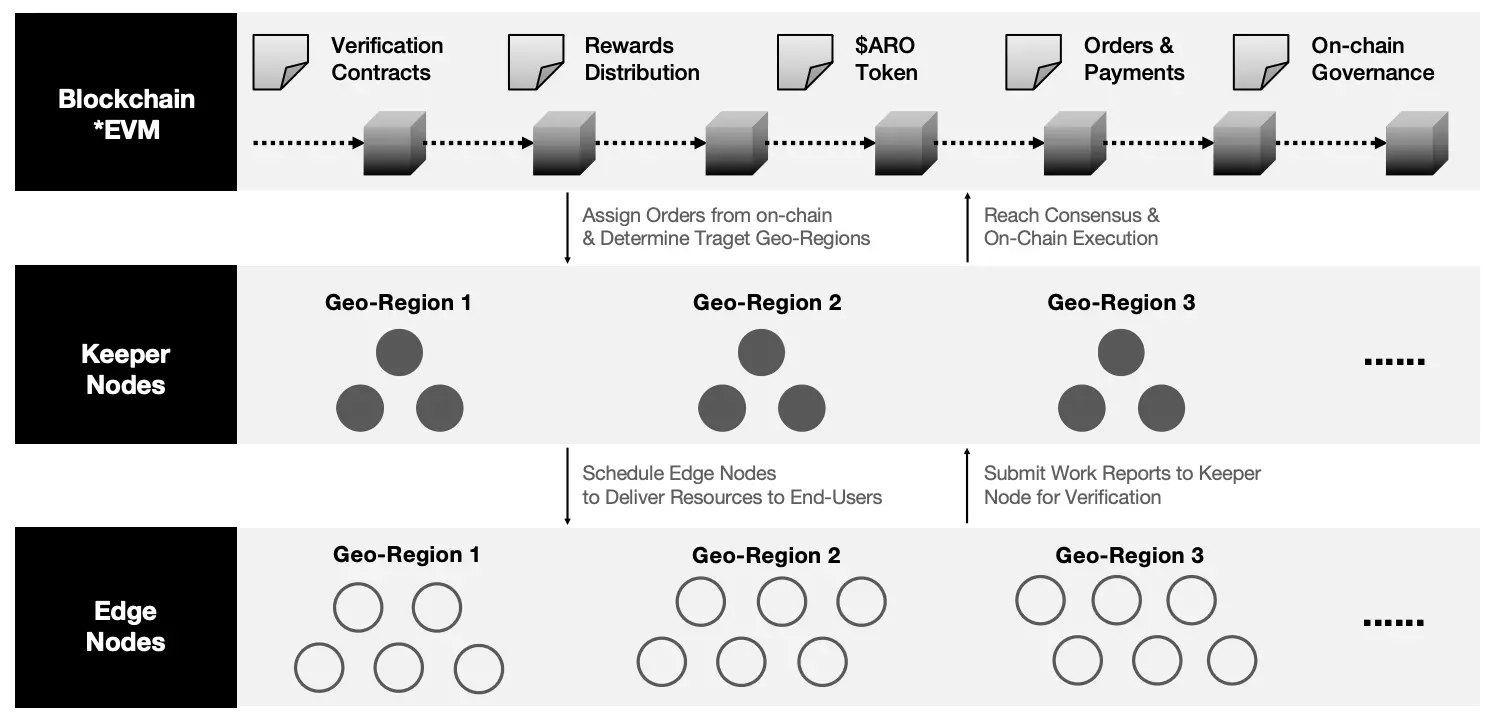
1. Edge Nodes
Edge nodes are the most basic units in the network, typically coming from users' own devices, such as:
ARO Pods
ARO Links
Laptops
NAS, etc.
These nodes are categorized into different regions based on geographic location and prioritize providing services to nearby users (reducing latency and enhancing experience).
Nodes interconnect through the PeerDTS protocol, which is the key foundation supporting large-scale P2P data transmission.
How Edge Nodes Operate
- Providing Resources
Edge nodes contribute to the ARO network:
Bandwidth
Computing power
Storage
Especially suitable for earning revenue from idle devices.
Need for Stable Service Capability
After joining the network, nodes need to provide stable resource and service capabilities and cannot arbitrarily interrupt.Regularly Generate Work Reports
Nodes generate work reports at time intervals (epochs), recording their actual contributions.
However, cheating is not possible because:
Multiple Keeper nodes will cross-verify
Verification data sources include:
Heartbeat detection
Network traffic records
Random challenges
- Random Verification Mechanism
Each cycle, edge nodes are randomly assigned a group of Keeper nodes for verification.
Nodes cannot predict in advance who will verify them, preventing collusion and cheating.
2. Keeper Nodes
Keeper nodes act as the "supervisors" of the network, responsible for:
Ensuring the system reaches consensus
Preventing cheating, attacks, and abnormal behaviors
They are also deployed in geographic partitions to ensure stable service capabilities in each area.
Two Types of Keeper Nodes
- Monitoring Nodes
High performance, strong stability
Usually deployed in quality network environments
Responsible for comprehensive verification
The "final arbiter" of the entire network
- Checker Nodes
Numerous and widely distributed
Randomly test edge nodes
Verify resource capabilities and behaviors
Similar to "inspections + random checks," complementing monitoring nodes.
Core Responsibilities of Keeper Nodes
Maintaining the on-chain ledger
Ensuring correct execution of smart contracts
Continuously monitoring multiple edge nodes in the area
Collecting work reports and real-time statuses
Initiating random challenges against edge nodes or cross-regional nodes
GPoW (Guaranteed Proof of Work)
GPoW is ARO's universal proof of work mechanism used to demonstrate "nodes are genuinely working," supporting various resources such as bandwidth, storage, and computing power.
1. Problems Addressed
Traditional proof mechanisms typically only verify a single resource (e.g., storage), while GPoW supports multiple types of tasks, including:
CDN traffic
GPU computing
Network transmission
Thus, it is more suitable for DePIN and AI scenarios.
2. Core Mechanisms
1) Resource Standardization (Underlying Capabilities)
Through virtualization and containerization (e.g., Docker, Kubernetes), different types of devices are unified into schedulable resources, including servers, personal computers, mobile devices, and browser environments.
2) Trusted Work Proof Generation (Core Innovation)
TEE (Trusted Execution Environment): Ensures work proofs are generated in a secure environment, preventing tampering
ZK (Zero-Knowledge Proof): Verifies computation correctness without exposing data
Random Challenge Mechanism: Prevents cheating and Sybil attacks by randomly sampling nodes
3) On-Chain Verification and Settlement
Work proofs are submitted to the GPoS module for verification
Nodes that pass verification receive rewards
Nodes submitting false or delayed proofs will be penalized
All verification and settlement processes are recorded on-chain, ensuring transparency
3. Key Values
Supports multiple resource types (bandwidth, storage, computing power)
Strong anti-cheating capabilities (TEE + ZK + random challenges)
Scalable architecture, supporting future addition of task types
Applicable to AI and DePIN networks
PeerEdge
PeerEdge is ARO's core middleware, consisting of three components: PeerHVM, PeerDTS, and PeerRouting, addressing resource abstraction, data transmission, and resource scheduling issues.
1. PeerHVM (Heterogeneous Virtual Machine)
Unifies and abstracts resources from various devices, allowing the network to call them uniformly.
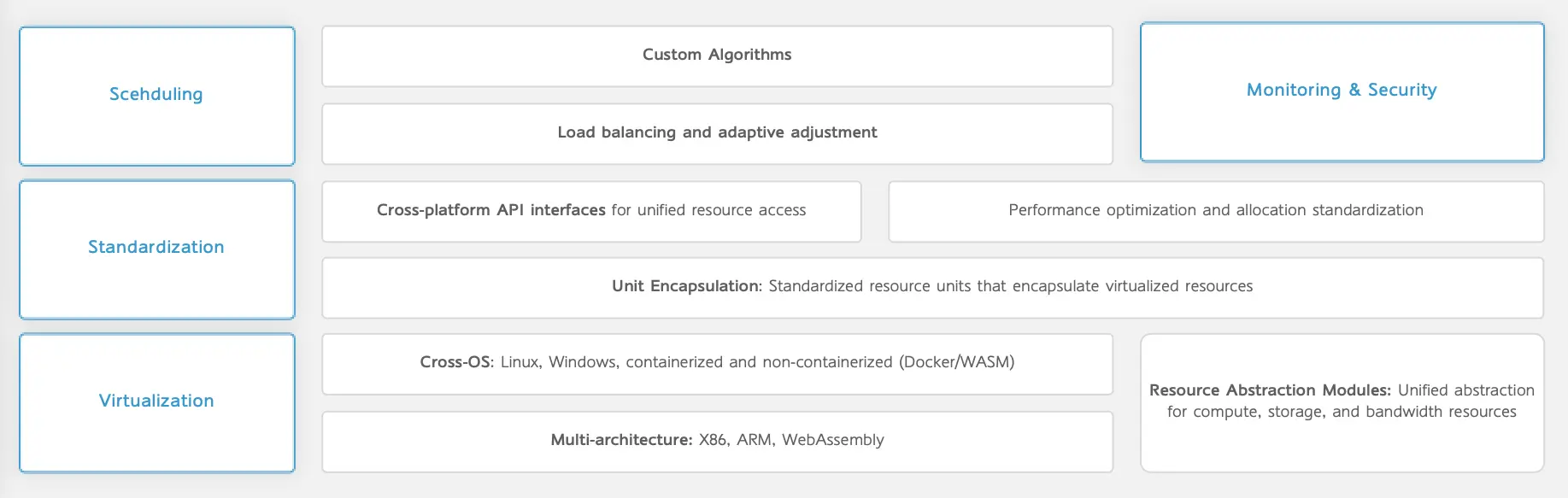
Core Capabilities:
1) Heterogeneous Resource Virtualization
Supports various hardware and environments, including:
x86 / ARM
WASM / browser environments
Various operating systems
Achieving unified access to the network from different devices.
2) Resource Standardization
Breaks down resources into standard modules and combines them into resource pools, providing a unified interface for rapid system calls and scheduling.
3) Scheduling and Management
Scheduling Layer: Dynamically allocates resources based on demand, achieving load balancing
Monitoring Layer: Continuously monitors node status, preventing anomalies and cheating
4) Self-developed Container Optimization
Optimized for edge devices (low-power operation)
Enhances computing efficiency across different hardware
Reduces overall edge cloud costs
2. PeerDTS (P2P Transmission Protocol)
A high-performance P2P transmission protocol designed for edge networks, more suitable for distributed scenarios than traditional solutions.
Core Capabilities:
1) Edge Network Optimization
Unlike traditional CDNs or general P2P, specifically targets:
Small nodes
Distributed environments
Achieving more efficient data transmission.
2) Multi-Channel Adaptive Transmission
Enhances bandwidth utilization through a multi-channel mechanism, bringing edge node performance closer to CDN levels.
3) Dynamic Encoding Mechanism
Splits data into multiple segments
Introduces error correction coding (erasure coding)
Reduces complexity to O(N)
Enhancing transmission reliability and efficiency without requiring dedicated hardware.
3. PeerRouting (Resource Scheduling Engine)
Achieves the optimal combination of "high-value demand + low-cost resources" through intelligent matching algorithms.
Core Capabilities:
1) Intelligent Matching (Core Competitiveness)
Achieves optimal matching under varying demand prices and resource cost fluctuations, directly impacting network revenue and efficiency.
2) Full-Link Perception Capability
Infers network status based on partial data
Dynamically adjusts transmission strategies
Reduces latency and packet loss
3) Pre-Deployment Capability (Key Advantage)
Allocates resources in advance before demand arises
Compared to the traditional "request first, then schedule" model
Resource utilization improves by over 50%
Tron Comments
ARO's core advantage lies in its complete and forward-looking technical system: building a trusted verification closed loop through GPoW + GPoS, and connecting the entire link of "resource abstraction---transmission---scheduling" through PeerHVM/PeerDTS/PeerRouting, especially demonstrating significant differentiation in heterogeneous device integration, edge scenario optimization, and intelligent matching algorithms, aligning with the development direction of AI + DePIN.
However, its challenges are equally evident: high architectural complexity, demanding strong practical implementation and engineering capabilities; multi-layer mechanisms (TEE, ZK, scheduling algorithms) bring trade-offs between performance and cost; and before network effects are established, uncertainties exist regarding resource supply and demand matching, node quality control, and commercial scenario validation.
III. Industry Data Analysis
1. Overall Market Performance
1.1. Spot BTC vs ETH Price Trends
BTC
ETH
2. Summary of Hot Sectors
May 11 | Pi Network Releases Protocol v23 Node Upgrade
Pi Network released the Protocol v23 Beta node upgrade package (mainnet-v1.1-p23.0.1) on May 12, focusing on optimizing node stability, database permissions, and synchronization anomalies, and laying the groundwork for subsequent Testnet2 and Pi DEX.
May 11 to 18 | Pi Network Advances Smart Contract Mainnet Upgrade Path
Pi Network continued to advance the Mainnet Protocol 23 upgrade route this week, with the core goal of introducing native smart contracts, RWA tokenization, and Web3 identity tools, promoting the network's evolution from a basic transfer network to a complete Layer 1 Web3 ecosystem.
May 16 | Pi App Studio Updates AI Application Access Capabilities
Pi Network updated Pi App Studio on May 16, allowing developers to quickly convert applications generated by external AI tools (such as Codex, Claude Code) into Pi native applications, further lowering the development threshold for AI + Web3 applications.
IV. Macroeconomic Data Review and Key Data Release Nodes for Next Week
Review of U.S. Macroeconomic Data (May 11 to May 17)
|-------|----------------------------|------------------------------------| | Date | Data/Event | Market Impact | | May 13 | U.S. April CPI: 3.8% year-on-year; Core CPI 2.8% year-on-year | Inflation rises, market further lowers interest rate cut expectations, U.S. Treasury yields and the dollar strengthen | | May 14 | U.S. April PPI: +1.4% month-on-month | Upstream inflation pressure significantly intensifies, "Higher for Longer" expectations strengthen | | May 15 | U.S. Retail Sales Data | U.S. consumption remains resilient, market reassesses the pace of economic slowdown |
Key Data Release Nodes in the U.S. Next Week (May 18 to May 24)
|-----------|-----------------------|-------------| | Date | Data/Event | Market Focus | | May 21 (Wednesday) | Federal Reserve Meeting Minutes (FOMC Minutes) | Whether to maintain a high interest rate stance | | May 22 (Thursday) | Initial Jobless Claims | Whether the job market is starting to cool | | May 22 (Thursday) | U.S. Manufacturing PMI, Services PMI | Changes in U.S. economic prosperity | | May 22 (Thursday) | U.S. New Home Sales Data | Impact of high interest rates on real estate | | May 23 (Friday) | U.S. Consumer Confidence Index | U.S. consumption and soft landing expectations |
V. Regulatory Policies
United States
May 14: The Bank of England signals "relaxing stablecoin restrictions," sparking intensified discussions on U.S. stablecoin regulation.
The Bank of England stated that previous stablecoin restrictions may have been "too conservative," with the market focusing on the implementation details of the U.S. GENIUS Act, including reserve assets, issuance thresholds, and AML rules. Stablecoin regulation has entered the "execution and landing phase."
United Kingdom
May 14: The Bank of England considers relaxing the stablecoin regulatory framework.
BoE Deputy Governor Sarah Breeden stated that they would reassess the strict requirements previously imposed on stablecoin reserves and holdings due to industry concerns that they undermine the competitiveness of the UK's digital assets.
European Union
May 11 to 17: The European Union continues to advance preparations for the final implementation of MiCA.
Regulatory focus is on stablecoin issuance, CASP (Crypto Asset Service Provider) licenses, and cross-border unified regulatory coordination. The EU is entering the "full execution phase" of MiCA.
Hong Kong
May 11 to 17: Hong Kong's stablecoin licensing system continues to advance.
After the first batch of stablecoin licenses is issued, Hong Kong continues to strengthen AML, reserve transparency, and issuer governance requirements, further consolidating its position as a compliant digital asset center in Asia.
South Korea
May 11 to 17: South Korea continues discussions related to the Digital Asset Basic Act.
Regulatory focus remains on the issuance qualifications for the Korean won stablecoin, reserve rules, and the boundaries of participation for banks and technology companies.
Japan
May 11 to 17: Japan continues to promote the reform of crypto asset financial productization.
Japan continues to push for the inclusion of crypto assets into a stricter financial regulatory framework, including exchange regulation, stablecoin rules, and institutional participation norms.
 Risk warning


Popular articles





