Tron Industry Weekly Report: Gold Weak, BTC Stabilizes at $73500, Detailed Analysis of Reconstructing On-Chain Trust and Decentralized Communication Infrastructure OmniPact & MarsCat

 OmniPact and MarsCat represent two directions: "on-chain trust execution" and "decentralized communication infrastructure," respectively. The former attempts to build a network similar to on-chain settlement through custody, arbitration, and cross-chain mechanisms. If implemented in RWA or AI Agent scenarios, it will have strong network effects. The latter achieves decentralized access to traditional services through P2P and protocol encapsulation, enhancing privacy and censorship resistance.
I. Outlook
1. Summary of Macroeconomic Trends and Future Predictions
This week, the macroeconomic environment exhibited characteristics of "strengthened expectations for high interest rates + differentiation in risk assets." The U.S. PMI and employment-related data showed overall resilience, leading to a further cooling of market expectations for short-term interest rate cuts. U.S. Treasury yields remained high, and the liquidity environment did not show significant improvement. At the same time, the divergence in tech stock earnings reports caused fluctuations in risk asset sentiment, but there was no systemic weakening. Overall, there has been no new directional change in the macroeconomic landscape, but the consensus on "high interest rates lasting longer" has further strengthened.
Next week, the macro focus will still revolve around interest rate paths and growth verification: if economic data continues to show strength, the market will maintain pricing for "higher interest rates for longer," which will suppress risk assets; if there are signs of marginal weakness, it may lead to a short-term risk-on rebound. Overall judgment: the macro environment remains in a volatile range, with no trend-based easing inflection point, and risk assets are more driven by sentiment and marginal changes in liquidity.
2. Market Movements and Warnings in the Cryptocurrency Industry
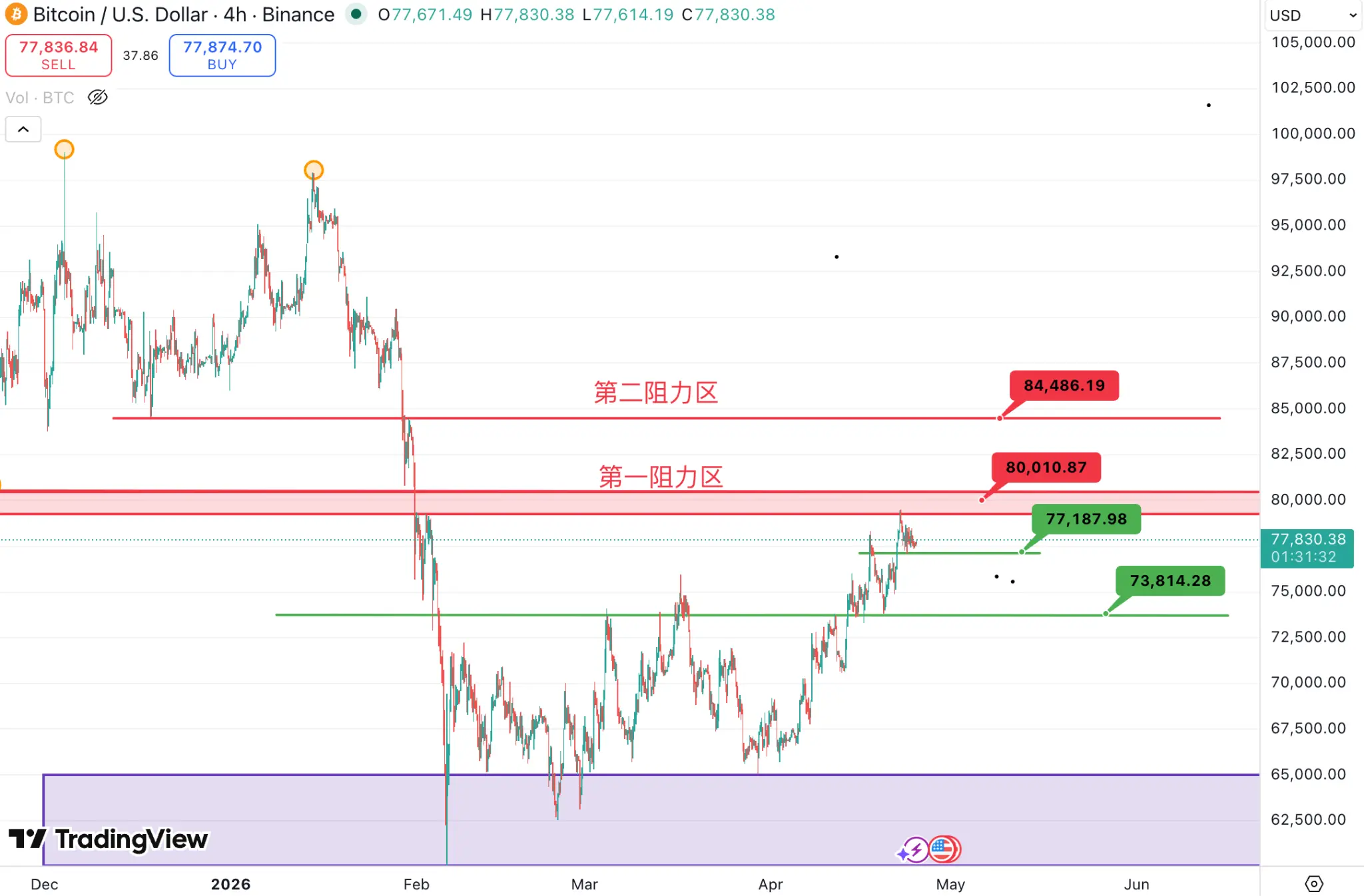
This week, the cryptocurrency market entered a phase of directional competition after high-level fluctuations. Bitcoin (BTC) repeatedly tested the upper range around 75K---78K but did not form an effective breakout, leading the market into a clear state of "volume contraction + waiting for directional choice." Ethereum (ETH) continued to underperform BTC, maintaining a following trend. Structurally, BTC remains dominant, altcoins are weak, and capital is not spreading. Discussions around AI and infrastructure narratives are ongoing but have not formed a sustained trend.
BTC has entered a critical range: the upper pressure zone is 78K---80K, and if it breaks out with volume, it may open up upward space; the lower support is at 75K, and a drop below this level could lead to a retest of 72K---73K. ETH remains a following asset; if BTC pulls back, its downside elasticity is greater. Overall judgment: the market is approaching a directional choice node, and short-term volatility may increase, necessitating caution regarding trends amplified by breakouts or breakdowns.
II. Market Hotspots and Potential Projects of the Week
1. Overview of Potential Projects
1.1. Brief Analysis of Total Financing of 50 Million, Co-invested by Renowned Institutions—Building a Decentralized Trust Infrastructure Full-Stack Solution, OmniPact
Introduction
OmniPact is a decentralized trust infrastructure protocol for Web3, building a guarantee-free transaction system through smart contracts, oracles, arbitration networks, and cross-chain technology.
Its core goal is to become a global settlement protocol similar to SWIFT, serving cross-chain transactions, cross-border trade, real-world assets (RWA), and the future machine economy.
Core Mechanism Overview
OmniPact adopts a typical three-layer architecture:
Protocol Layer—Trust Anchor
Positioning: Core layer for fund security and state execution
This layer is built directly on the blockchain (L1/L2) and consists of immutable smart contracts, retaining only the most core logic to ensure security and a minimal attack surface.
Core Functions:
Asset Escrow
State Transition (Create / Lock / Release / Refund)
Atomic Settlement Execution
Key Components:
Universal Escrow Contract
Omni Escrow Standard (OES) State Machine
Core Features:
Non-custodial design (no one can directly control the funds)
All fund operations must meet preset conditions for automatic execution
Service Layer—Capability Expansion Layer
Positioning: Connecting on-chain logic with the real world
This layer addresses the issue of smart contracts being unable to directly access external data, which is key to the protocol's scalability.
(1) Omni-Link Oracle Network
Functions:
Bringing real-world data on-chain
Supporting logistics, APIs, service statuses, and other business data
Mechanism Features:
Multi-node consensus (>2/3 verification)
Supports complex computations (TEE execution)
Multi-source data aggregation to prevent tampering
Essence: Upgrading from "price oracle" to "business oracle"
(2) Omni-Vault Decentralized Storage
Functions:
Storing transaction evidence, contracts, documents
Architecture Design:
IPFS (hot data) + Arweave (permanent storage)
Only hashes (CIDs) are stored on-chain
Features:
Reduces Gas costs
Supports end-to-end encryption
Long-term verifiability
(3) IoT-Anchor Real Asset Mapping
Functions:
Binding real devices with on-chain assets
Technical Means:
Hardware fingerprints (PUF)
IoT device access
Used for RWA and credible mapping of physical assets.
Application Layer—Business Entry Layer
Positioning: User interaction and scenario implementation layer
Main Forms:
DApp / SDK / API interfaces
Wallet plugins, platform embeds
E-commerce, DAO, OTC, and other business systems
Core Features:
Can be embedded into any Web3 or Web2 platform
Provides "Trust-as-a-Service"
Core Mechanism Analysis
Smart Escrow
Transaction Lifecycle:
Creation (Agreement)
Lock (Lock)
Fulfillment (Fulfillment)
Settlement (Settlement)
Features:
Automatic execution
No intermediaries required
Condition-triggered
Essence: Replacing platform guarantees with code
Decentralized Arbitration Network (DAN)
Functions:
Handling disputes
Ensuring transaction fairness
Mechanism:
Nodes stake $PACT to participate in arbitration
Earnings linked to reputation
Punishment for malicious behavior (Slashing)
Essence: On-chain "court system"
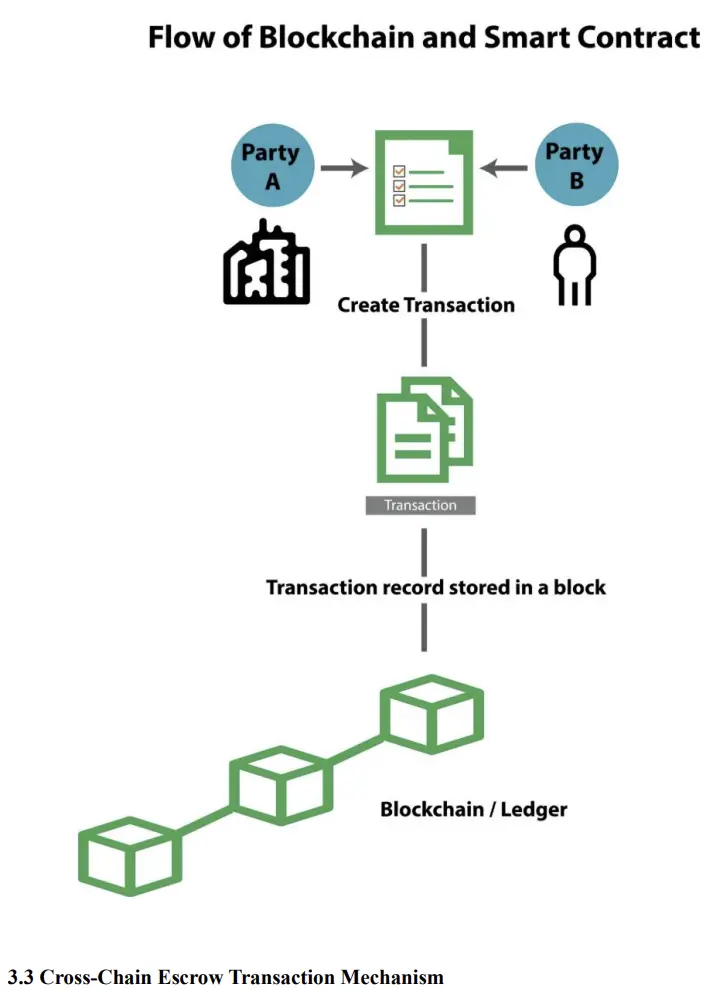
Cross-Chain Escrow Mechanism (X-Escrow)
Core Design:
Decoupling fund escrow from business logic
Cross-chain state synchronization
Process:
Source chain locks funds
Target chain generates mapped escrow
Fulfillment completed
Funds released back
Capabilities:
Payments on any chain
Receipts on any chain
Credit System (SBT)
Features:
Non-transferable
Records transaction history and performance
Multi-dimensional credit tags
Essence: On-chain credit assetization
- Atomic Settlement Mechanism
Either all succeed
Or all fail
Tron Comments
OmniPact's core advantage lies in its complete on-chain trust closed-loop design, addressing the trust deficit in traditional Web3 transactions through the combination of "smart escrow + decentralized arbitration + oracle + cross-chain settlement," and further expanding to RWA, cross-border trade, and even AI Agent scenarios, with the potential to become a universal settlement infrastructure. Additionally, its multi-chain compatibility and business oracle design significantly enhance its practical implementation capabilities.
However, its disadvantages are also quite apparent: the system architecture is complex, relying on the collaboration of multiple modules (oracles, arbitration, cross-chain), which presents compounded risks in terms of security and stability; arbitration and data authenticity cannot be fully trusted; furthermore, during the cold start phase, there is a strong reliance on liquidity, user scale, and ecosystem partners, leading to uncertainty regarding network effects and actual usage scale in the short term.
2. Detailed Explanation of Key Projects of the Week
2.1. Detailed Explanation of Total Financing of 3 Million, Led by Animoca, with CGV and COGITENT Co-investing—Building a Distributed Application Infrastructure Without Central Servers, MarsCat
Introduction
MarsCat is a decentralized Web3 platform and application engine built on a peer-to-peer (P2P) network. It provides infrastructure for decentralized applications to operate in a privacy-first, serverless environment without relying on centralized servers.
By leveraging a distributed network, MarsCat achieves secure communication, scalable application deployment, and censorship-resistant interaction capabilities.
Architecture Overview
RelayX Network
RelayX Network is a distributed network infrastructure built on P2P protocols, primarily providing message forwarding and data storage services for the RelayApp ecosystem. It adopts a decentralized architecture, ensuring network security through strict node admission mechanisms while avoiding the complexity and high energy consumption issues of traditional blockchain consensus mechanisms.
In design, the network emphasizes data independence and privacy protection, with each node operating as an independent unit, effectively reducing the risk of data leakage. Additionally, through encryption verification, data redundancy, and distributed storage mechanisms, it enhances overall security, availability, and censorship resistance. Global multi-node deployment further strengthens the system's stability, attack resistance, and infrastructure coverage.
Overall, RelayX provides a more efficient, low-cost, and practically applicable distributed network foundation while maintaining the advantages of decentralization.
Network Architecture Core (Node System)
RelayX Network adopts a layered mesh structure, with four types of nodes operating in collaboration:
RelayX Node (Core Node):
Deployed on high-performance servers, responsible for data transmission, application storage, and routing, serving as the core processing layer of the network, while also supporting project parties to deploy dedicated nodes to optimize services.Regular Node (Ordinary Node):
Distributed globally, responsible for message forwarding and data storage, providing redundancy backups to enhance network stability and fault tolerance.Client Node (Client Node):
Running on user devices, responsible for message sending, receiving, and forwarding, while participating in network computation to enhance overall efficiency and form edge computing capabilities.Self Service Node (Self-Service Node):
Specifically designed to support the Self Service protocol, responsible for related message forwarding and permission verification, providing a secure communication channel for application backends.
Relationship Between RelayApp and RelayX Client
RelayX Client plays a dual role in the entire ecosystem:
Network Participant
As a client node of the RelayX Network, it participates in P2P network communication, responsible for sending, receiving, and forwarding messages, supporting network operation and efficiency.Runtime Environment
Also serves as the execution container for RelayApp, providing a secure execution environment for applications, responsible for downloading, verifying, and running applications locally.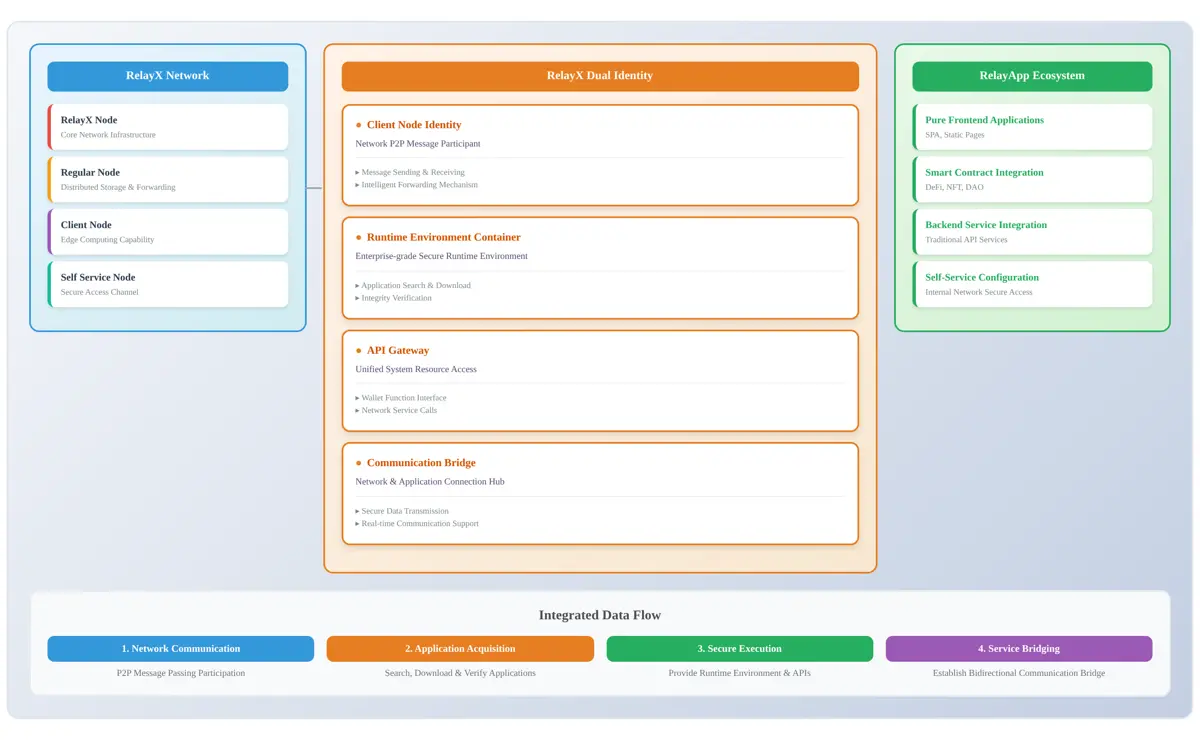
Essentially:
RelayX Client = Network Node + Application Container
Core Functional Modules
RelayX Client mainly includes four core capabilities:
- Client Node Functionality
Participates in network message transmission
Provides edge computing capabilities
Enhances network stability
- RelayApp Runtime Container
Searches and downloads RelayApp
Integrity verification and security validation
Local secure execution
- API Interface Layer (System Bridge)
Provides a unified API to RelayApp
Supports access to:
Wallet functions
User data
Network services
Essence: A secure intermediary layer for application access to system resources
- Communication Hub (Network Hub)
Connects RelayApp with RelayX Network
Provides standardized communication interfaces
Achieves data interaction and service invocation
Role of MarsCat
MarsCat is the current mainstream RelayX Client, implementing a complete set of functionalities:
Network Node (P2P communication participant)
Application Container (runs RelayApp)
Wallet System (asset management and trading)
API Gateway (resource invocation entry)
Self Service (intranet and backend access support)
- Self Service
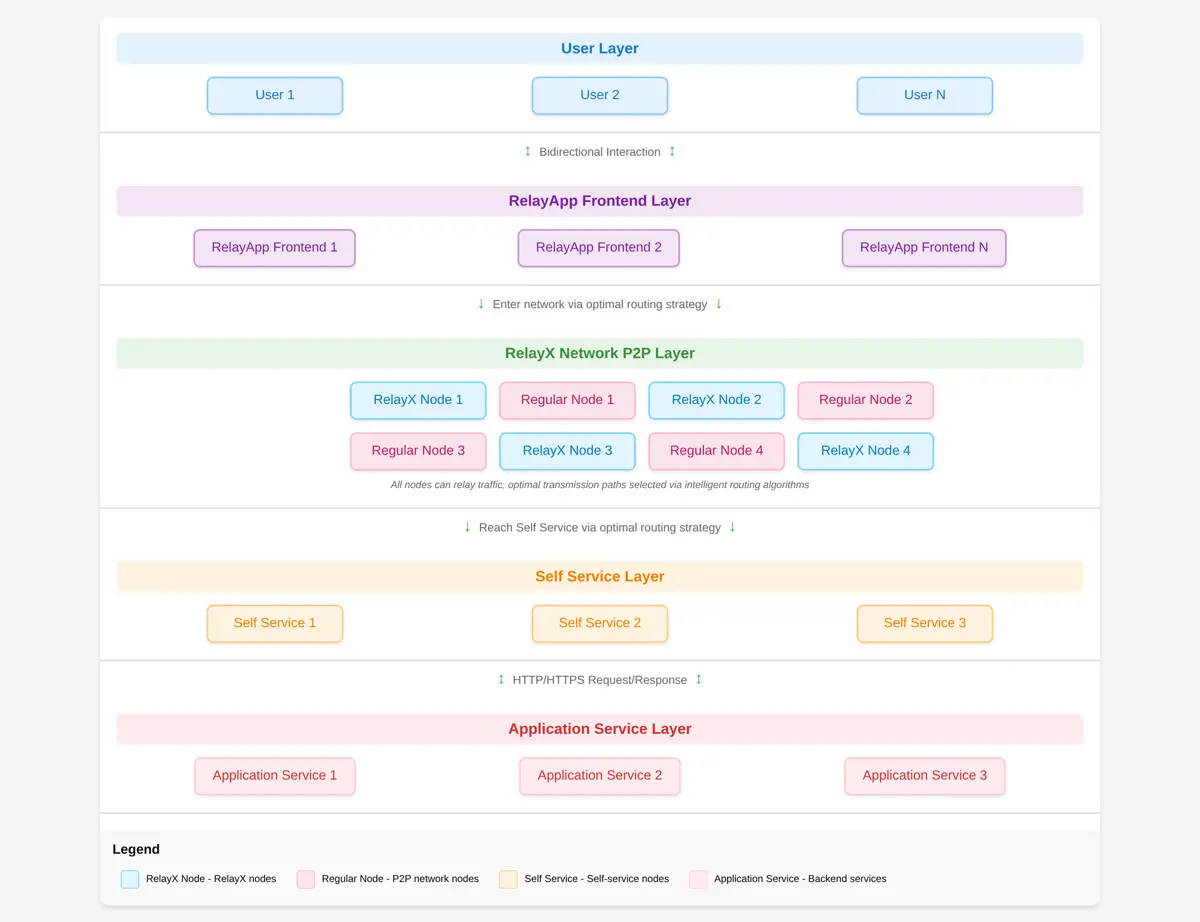
The system consists of five core modules:
- RelayApp Frontend
Role: User entry and request initiator
Functions:
Initiates API requests
HTTP → P2P protocol conversion
Receives and displays results
Local caching and offline processing
- RelayX Node (Core Node)
Role: High-performance message forwarding and routing layer
Functions:
Smart routing optimization paths
Load balancing
Encrypted forwarding
Network topology maintenance
- Regular Node (Ordinary Node)
Role: Network expansion and anonymity enhancement
Functions:
Participates in message forwarding
Provides random paths
Enhances anonymity and anti-censorship capabilities
- Self Service Node (Key Bridging Layer)
Role: Bridge between P2P network and Web services
Functions:
P2P → HTTP protocol conversion
Invokes backend services
Permission control and validation
Returns result encapsulation
Core Positioning: "Decentralized API Gateway"
- Application Service (Application Service)
Role: Business logic execution layer
Characteristics:
Maintains traditional architecture
Only communicates with Self Service Node
Does not expose public addresses
Uses standard HTTP API
Architecture Summary in One Sentence: Achieves decentralized access to traditional services without changing the backend
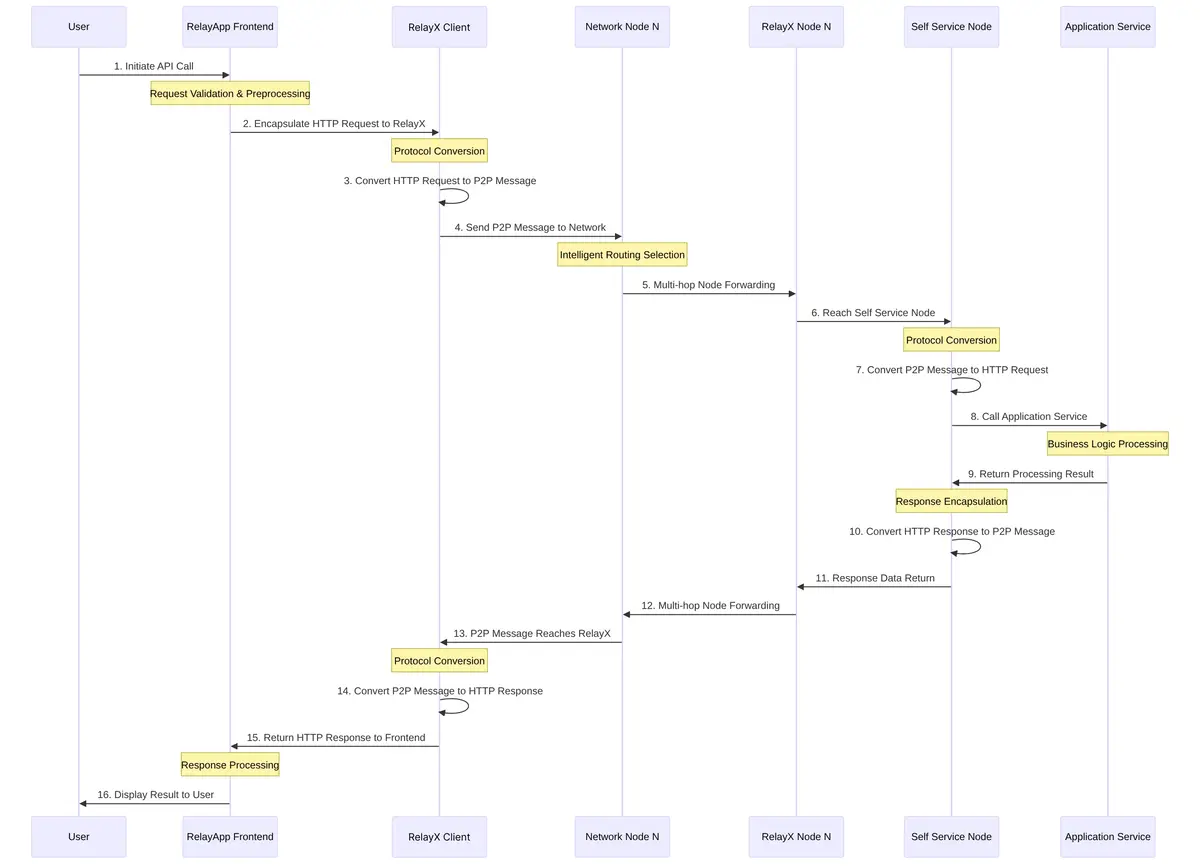
- Request Processing Flow (Complete Invocation Chain)
The overall process is as follows:
- Request Initiation
User initiates a request through RelayApp
Completes identity verification and parameter validation
Generates a unique request ID
- Request Protocol Conversion
HTTP request → P2P message
Encrypts data
Adds routing information
- Network Transmission
Propagates through RelayX Network
Random forwarding across multiple nodes
Dynamic path selection
- Service Invocation
Self Service Node receives the request
Converts to HTTP
Invokes backend services
- Return Result
Backend returns data
Encapsulates as P2P message
Returns through multiple node paths
- Response Parsing
RelayX Client converts to HTTP response
Returns to frontend for display
Process Summary in One Sentence: HTTP request → P2P network → HTTP service → P2P return → Frontend display
- Technical Features
Performance and Limitations
Latency: Approximately 1--3 seconds
Message Size: ≤ 10MB
Consistency: Eventual consistency
Concurrency Capability: Medium-low in a single node, scalable horizontally
Core Features
Decentralized communication
Data encryption and privacy protection
Strong anti-censorship capabilities
No need to expose servers
Tron Comments
The advantage of MarsCat lies in its realization of "decentralized access encapsulation" for traditional Web services through P2P network + protocol conversion, retaining the original backend architecture while significantly enhancing privacy, anti-censorship capabilities, and system resilience. Additionally, multi-node forwarding and anonymous path design provide unique value in scenarios involving sensitive data and cross-regional access.
However, its disadvantages are also evident, primarily in the trade-off between performance and complexity—network multi-hop forwarding leads to higher latency and instability, making it difficult to support high real-time or high-concurrency scenarios. Furthermore, the system relies on multi-layer node collaboration (client, routing nodes, Self Service Node), complicating operations, debugging, and security boundaries. Additionally, the eventual consistency model limits its application in financial-grade or strongly consistent business scenarios.
3. Industry Data Analysis
1. Overall Market Performance
1.1. Spot BTC vs ETH Price Trends
BTC
ETH
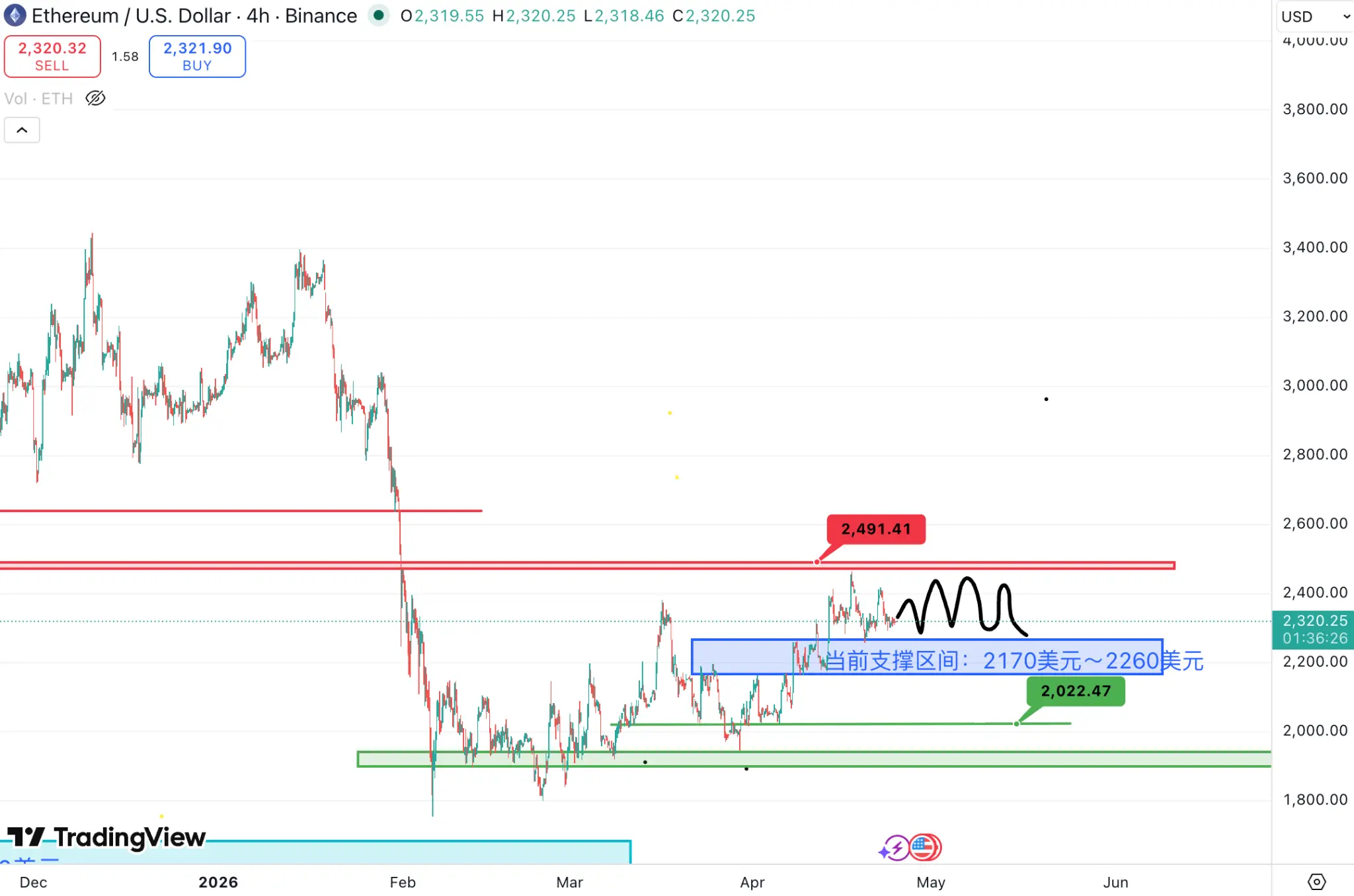
2. Summary of Hot Sectors
1) Fluent Labs: Unified Execution Layer (Blended Execution) Implementation
By using rWasm to unify EVM / WASM / SVM into the same execution layer, it achieves atomic combinations and shared state execution across VM contracts, with the core breakthrough being direct integration in the execution layer without relying on cross-chain.
2) Nava Labs: AI Trading Verification Layer Architecture Formed
Introduced Execution Escrow + Arbiter system, performing rule + inference verification before transactions go on-chain, with the core being the decoupling of AI execution and fund control.
3) OmniPact: Cross-chain Escrow and Business Oracle
X-Escrow achieves cross-chain atomic settlement while introducing business oracles, allowing real performance conditions to be handled on-chain.
4) MarsCat: Decentralized API Gateway Model
Through P2P + protocol conversion, it enables Web2 services to connect to the decentralized network without modification.
5) idOS: Data Sovereignty and Verifiable Credential Mechanism
Through encrypted re-sharing + access authorization, it achieves controllable flow and compliant access of user data.
4. Macroeconomic Data Review and Key Data Release Nodes for Next Week
This week's macroeconomic data focuses on confirming PMI and employment resilience: The overall PMI for the U.S. manufacturing and service sectors remains in the expansion range (above 50), indicating that the economy still has resilience; at the same time, initial unemployment claims data has not shown significant deterioration, and the job market remains robust. This combination reinforces market expectations that "rapid interest rate cuts are unlikely in the short term," leading to continued tightening in interest rate path expectations, with the macro environment maintaining high interest rate constraints but no signs of recession.
Next week, focus on three types of data:
Core inflation-related data (such as PCE forecast) → Determines the direction of interest rate expectations
Employment data (non-farm forecast, initial unemployment claims) → Assesses whether the economy is beginning to cool
GDP preliminary value (if released) → Verifies growth intensity
Key Judgment: If inflation and growth continue to be strong → High interest rate expectations persist; if there is a significant decline → The market will re-evaluate the interest rate cut path.
5. Regulatory Policies
1) United States: CLARITY Act Reaches a Critical Stalemate (Regulatory Uncertainty Rises)
This week's most critical regulatory development in the U.S. is that the Crypto CLARITY Act has not progressed as expected. As of April 21, the Senate Banking Committee has not scheduled a key review (markup), significantly reducing the probability of the bill passing by 2026. This means that market structure regulation (SEC vs CFTC jurisdiction division, stablecoin yield rules, DeFi protection clauses) has not yet been implemented, and U.S. regulation has entered a phase of "high attention but no short-term results."
2) United States (Enforcement Level): New York Sues Coinbase / Gemini (Predicts Compliance Conflicts in Prediction Markets)
This week, the New York Attorney General officially sued Coinbase and Gemini, accusing their prediction market products of being unlicensed "pseudo-derivative businesses" and demanding the cessation of related services. This event essentially reflects that:
New types of on-chain financial products (prediction markets) are entering a regulatory gray area and are beginning to face strong regulatory enforcement at the state level.
3) United Kingdom: Government Establishes Role in Promoting Digital Assets (Policy Shift Towards Support)
This week, the UK appointed former FCA executive Chris Woolard as the head of digital asset development, aiming to promote the development of blockchain finance and tokenization markets. This move indicates that:
The UK is shifting from "regulatory discussions" to a policy phase of "actively promoting the financialization of digital assets."
4) India: Institutional-Level Compliance Infrastructure Goes Live (Regulatory-Driven Market Structure Upgrade)
This week, India's BitDelta launched crypto infrastructure aimed at institutions, emphasizing compliance, transparency, and security standards. Although it is not direct legislation, it essentially reflects that:
Under regulatory pressure, the market is spontaneously evolving towards institutional-level compliance standards.
 Risk warning Risk warning