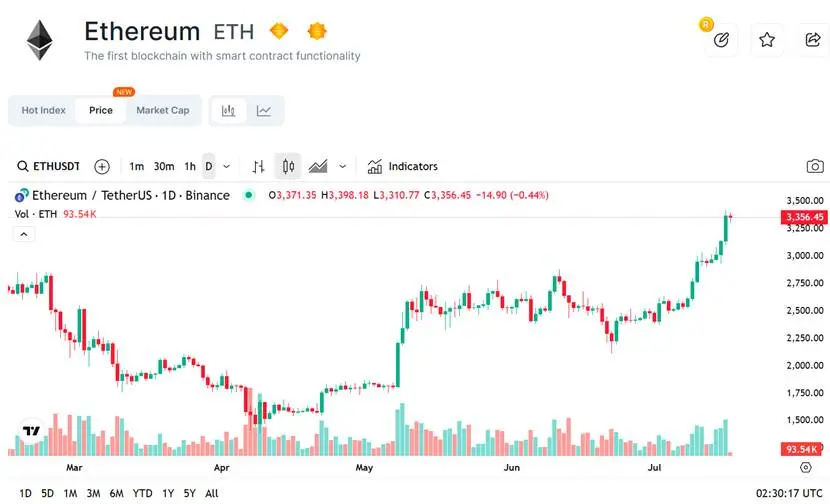
Prices remain strong, a brief overview of the four main "buying pressures" for ETH

 Wall Street enters, banks turn around, corporate reserves, whales sweep the market—Ethereum welcomes the strongest institutional buying spree in history, marking the end of the retail era.
Author: Zz, ChainCatcher
Editor: TB, ChainCatcher
Ethereum is undergoing a profound capital restructuring.
Four forces are quietly converging: institutions are entering through ETFs, banks are beginning to offer ETH trading services, publicly listed companies are treating ETH as a reserve asset, and large holders are continuously buying on-chain.
The era of retail-driven speculation is coming to an end, and an institution-driven transformation has begun.
Data Source: RootData
ETF Capital Wave: $2.72 Billion Net Inflow in One Week, BlackRock Bought $300 Million in One Day
Wall Street's attitude is undergoing a fundamental shift.
According to SoSoValue, last week saw a net inflow of $2.72 billion into Bitcoin spot ETFs, marking five consecutive weeks of inflows. This indicates a changing perception of crypto assets within traditional finance. BlackRock's Bitcoin ETF IBIT had a net inflow of $1.76 billion in one week, with a historical cumulative net inflow reaching $55.2 billion. 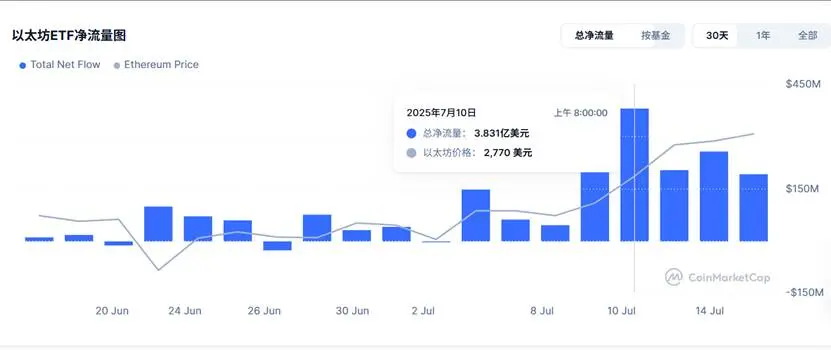
Data Source: CoinMarketCap
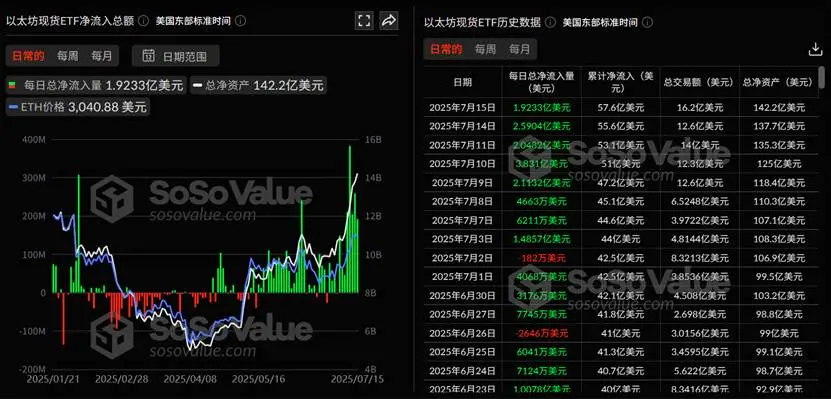
Ethereum's performance is even more remarkable. On July 10 alone, the total net inflow into U.S. Ethereum spot ETFs was $383 million, with BlackRock's ETHA contributing $300.9 million, followed by Fidelity. As of the time of writing, the total assets managed by all ETFs have reached $14.22 billion, accounting for 3.87% of ETH's total market capitalization. The historical cumulative net inflow has reached $5.757 billion.
Data Source: SoSoValue
These ETH are locked in institutional cold wallets such as Coinbase Custody. Each ETF subscription requires the actual purchase of ETH in the spot market, creating sustained buying pressure.
A larger transformation is brewing. EMJ Capital analyst Eric Jackson pointed out that once ETH can be staked in ETFs to generate returns, conservative institutions such as pension funds and insurance companies will also be able to participate. The market expects the approval of staking ETFs before October 2025.
Standard Chartered Opens ETH Trading, JPMorgan's 180-Degree Turn
Traditional banks, once cautious about cryptocurrencies, are quietly turning around.
In July 2025, Standard Chartered announced the launch of a digital asset trading platform for institutional clients. It is the first major bank in the world to offer physical ETH trading to clients.
Institutional traders can now buy and sell ETH directly through a familiar forex trading interface, enjoying bank-level security. Standard Chartered plans to introduce Ethereum forward contracts, treating ETH as a mainstream asset on par with the U.S. dollar and euro.
An even more dramatic signal comes from JPMorgan. According to CNBC host Jim Cramer, JPMorgan's CEO Jamie Dimon, who once called Bitcoin a "fraud," is now "fully embracing cryptocurrencies." This shift in attitude speaks louder than any data.

Corporate Accumulation of ETH: SharpLink Increases by 23% in a Month
A number of publicly listed companies are starting to treat ETH as a corporate reserve.
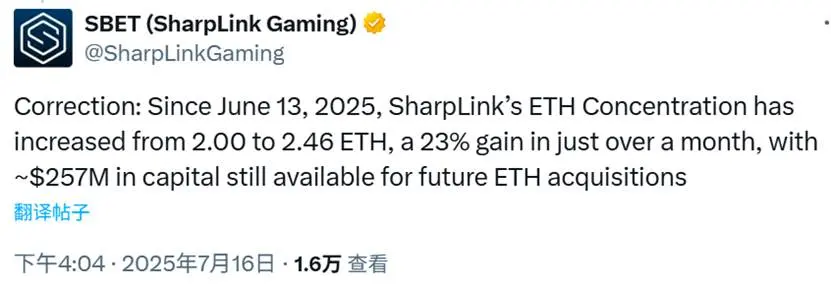
SharpLink Gaming (SBET) holds 280,706 ETH, with 99.7% staked to generate returns. In one month, ETH holdings increased by 23%, with approximately $257 million allocated for further purchases of Ethereum.
PayPal co-founder Peter Thiel acquired a 9.1% stake in BitMine Immersion Technologies. This company has transitioned from mining to becoming an ETH reserve company, holding 163,142 ETH, valued at over $500 million.
Traditional mining companies are also shifting towards ETH. Bit Digital has converted all its Bitcoin reserves into Ethereum, currently holding 100,603 ETH. BTC Digital has established a $1 million ETH reserve fund.
The stock prices of these companies are highly correlated with ETH prices. From early July to mid-July, when Ethereum rose by 22%, BitMine Immersion's stock price surged over 1100%, while SharpLink Gaming rose by 180%.
Whales Accumulate On-Chain, $89.5 Million Withdrawn in One Week
On-chain data shows that large holders are continuously buying.
Glassnode data indicates that the number of large holders holding at least 10,000 ETH has increased from 37.56 million to 41.06 million over the past nine months, a growth of 9.31%, reaching the highest concentration since 2020.
Specific movements tracked by Lookonchain include:
A suspected Cumberland withdrew 34,883 ETH from Binance within a week, valued at $89.5 million; a large holder bought 20,300 ETH within ten days, all deposited into DeFi protocols for long-term holding; another address withdrew 50,255 ETH from Binance within three weeks, valued at $114 million.
The behavior of withdrawing from exchanges to cold wallets or DeFi indicates that large holders are preparing for long-term holding.
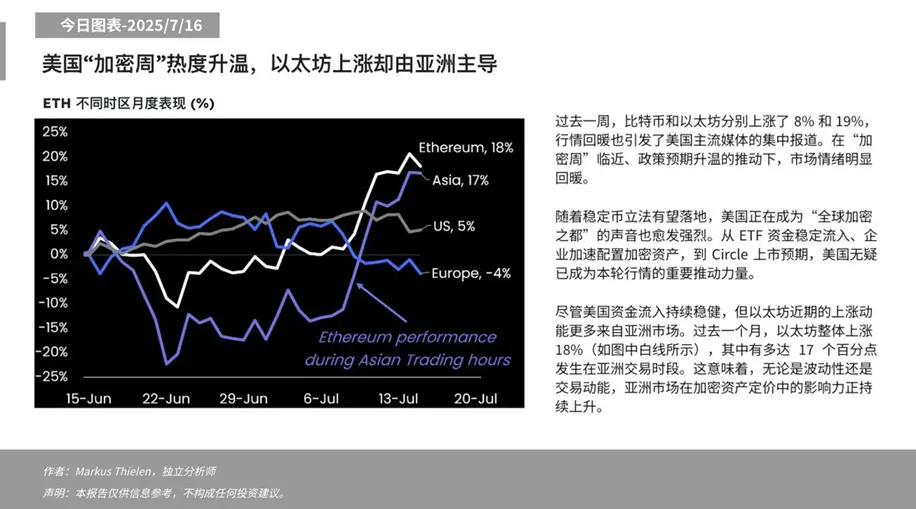
Matrixport research shows that Ethereum's 18% increase in July was driven by the approaching "Crypto Week" and policy expectations. Corporate allocations and the anticipation of Circle's listing have become dominant forces. Of the increase, 17 percentage points came from Asian trading hours.
Wintermute founder and CEO Evgeny Gaevoy stated on July 17 that there is almost no ETH available for sale on its OTC trading platform
Notably, when BlackRock's ETF experiences inflows, you can see institutional addresses simultaneously withdrawing large amounts of ETH from exchanges. The actions of institutions and large holders are highly aligned.
What Institutions Value: A Vast Stablecoin Ecosystem and Zero Downtime Record
Vitalik Buterin stated in an interview with CNBC at Cannes: "People think institutions only care about scale and speed. In fact, many institutions have directly told us that what they value about Ethereum is its stability and reliability, as well as its record of never having downtime in nearly a decade."
More importantly, Ethereum is at the core of the $230 billion stablecoin market. The higher the ETH price, the more secure the network. Each expansion of on-chain dollar scale requires more ETH for purchase and staking.
Regulation is also becoming clearer. The GENIUS Act will establish a federal regulatory framework for stablecoins, while the CLARITY Act clarifies regulatory responsibilities. Each time policies become clearer, it is an invitation for institutions to enter.
Transformation is Happening
Four buying forces are working together: institutions are continuously buying through ETFs, banks are incorporating ETH into their service systems, publicly listed companies are treating ETH as a reserve asset, and large holders are accumulating on-chain.
These forces promote each other: the compliance of ETFs encourages corporate allocations, the proactive adoption by companies drives banks to improve services, and all positive signals are validated on-chain.
Ethereum is transitioning from an experimental platform to financial infrastructure. At the current price of $3,200, the market is re-pricing this long-term trend.
When traditional finance begins to shift, inertia is often more powerful than expected.
Recommended Reading:
After a 70% Plunge, Still at a 100% Premium? The Mystery of SharpLink's ETH Bet Continues
 Risk warning
 Risk warning



Popular articles