The Narrative Economics of the Cryptocurrency Market: Vision Over Metrics, Sentiment Before Application

 The price of cryptocurrencies is not based on the present, but on potential futures.
Original Title: Narrative economics in crypto markets
Original Author: jawor
Original Compilation: Felix, PANews
"Human brains are naturally good at storytelling. And economics is built on human decision-making." ------ Robert J. Shiller (American economist, Nobel Prize winner)
1. Narrative as the Engine of the Market
In December 2017, something strange happened. Friends who had never cared about the crypto market began asking how to buy Bitcoin. Not because they had read the white paper or even understood what blockchain was. They had simply heard a story: someone they knew made life-changing money.
That was enough.
In what Nobel laureate Robert J. Shiller calls narrative economics, cryptocurrencies are the most fertile ground: infectious narratives that influence market behavior are no less impactful than traditional macro factors like interest rates or GDP.
Retail investors changed the game. In traditional finance, capital typically flows through structured channels: fund managers, analysts, investor reports. Now, capital flows through memes, viral posts, and high-quality Telegram groups. Narratives have become the new fundamentals. And this is most evident in the cryptocurrency space.
As the market heats up, narratives become a crucial factor in capital allocation. Not the white paper, not the balance sheet, but belief.
The core argument is that the volatility of the crypto market does not depend on technology, user growth, or revenue (at least not initially). It depends on belief, which is built on compelling stories.
2. How Narratives Work: Viruses with Capital
Robert Shiller believes that the spread of economic narratives is like a virus. The most powerful narratives are not necessarily true—they are simply contagious. They appeal to emotions, identity, and the psychology of FOMO. In the cryptocurrency space, this spread is instantaneous, global, and amplified by algorithms.
A typical narrative usually starts with a seed idea: Bitcoin is digital gold. Ethereum is a world computer. DeFi is a new banking system. These ideas are simple, intuitive, and emotionally appealing. Once such a narrative gains popularity, it begins to reshape people's values.
The lifecycle of a powerful crypto narrative typically follows this trajectory:
- A narrative is born: Someone writes a blog post, a key opinion leader hints at a trend, or a charismatic founder articulates a vision.
- This narrative spreads through social platforms, YouTube channels, and Discord.
- As the narrative's influence grows, it changes the way people think. Even if there are no changes on-chain, the related assets feel more valuable.
- Capital flows in, chasing this narrative.
People often talk about network effects in a technical context. But narratives themselves also have network effects. The more people believe in a story, the more real it becomes: socially, economically, and ultimately financially.
Two key elements make a narrative more infectious:
- A familiar face: A person who can represent the narrative. Think of Satoshi's mystery, Vitalik's wisdom, or Anatoly's product power. People are drawn to faces.
- A familiar plot: Great narratives often resonate with well-known storylines. For example, the underdog, the rebel, the revolution. Cryptocurrencies fit these themes perfectly. They are anti-bank, anti-establishment, and support freedom.
Ultimately, in the crypto space, narratives are not an additional layer on top of the product. The narrative is the product itself.
3. Case Studies: Narratives Create Markets
Bitcoin: Digital Gold
In 2020, Bitcoin itself did not change. What changed was people's perception of it. The mainstream narrative shifted from "peer-to-peer cash" to "digital gold." Suddenly, Bitcoin was positioned as a hedge against inflation, a safe haven in an era of money printing. What attracted MicroStrategy or Tesla was not Bitcoin's technology, but this idea.
The mysterious legend of Satoshi also played a role. This vanished founder made the story more compelling. It was not just code—it was a movement.
Ethereum: The World Computer
When Ethereum launched, there were almost no usable dApps. But its idea—a decentralized platform where anyone could build unstoppable applications—was incredibly appealing. The phrase "code is law" resonated deeply. The market was buying not the actual usage, but the potential.
Ethereum became valuable not because of its current state, but because of its promise.
The DeFi Summer of 2020
During the DeFi summer, yields were absurdly high. But the core driver was not the annual percentage rate (APR), but the narrative: permissionless finance, being your own bank, and financial primitives unrestricted by banks or borders. This idea spread rapidly. Most protocols had almost no revenue, few users, and flawed tokenomics—but that didn't matter. The narrative itself was enough to transcend reality.
NFTs as Cultural Ownership
Why would someone spend millions of dollars on a JPEG image? Because NFTs are not about the image itself—they are about identity. The narrative is simple and enticing: digital ownership will redefine art, music, and status. Owning a "Bored Ape" is not about aesthetics, but about signaling identity.
The narrative itself is more important than the product. That is why it succeeds.
AI Tokens of 2023 - 2024
Some projects with lacking product features and zero revenue skyrocketed simply because of the phrase "AI + cryptocurrency = the future." The AI concept, which had already been hot in traditional finance (TradFi), has now spread to the cryptocurrency space, bringing in a lot of speculative capital. Practicality doesn't matter; the narrative is key.
Meme tokens with "agent" in their names surged tenfold. Founders rushed to add "AI" to their roadmaps. Investors were optimistic about their potential, even if it was just talk for now.
4. Why the Crypto Market is Particularly Susceptible to Narrative Influence
Cryptocurrencies lack traditional valuation benchmarks: no balance sheets, no price-to-earnings ratios, and no regulatory filings. This makes the space particularly susceptible to narratives rather than fundamentals.
Additionally:
- It is a retail-driven market that thrives on speculation.
- The meme culture spreads rapidly through social media.
- The liquidity of tokens and the ability to list without permission.
These factors create a perfect breeding ground for narrative-driven price behavior. In other markets, narratives are merely accompanying phenomena. But in the cryptocurrency space, they are the driving force.
Cryptocurrency prices are based not on the present, but on possible futures.
5. Advantage: Trading Narratives
In a narrative-driven market, the advantage comes from early recognition.
Smart traders and funds do not just analyze charts or read code. They pay attention to the social aspect: who is tweeting, how dense the memes are, whether there is emotional interaction, and whether the narrative is moving from niche to mainstream?
Here are some popular narratives:
- Modular blockchains: "A new design space"
- Solana as the new Ethereum: "Fast, cheap, and clean"
- RWA: "Yield meets compliance"
- Agent-based decentralized finance: "AI protocols that think for you"
Each narrative follows the same lifecycle:
- Spark: The idea appears in alpha chats and early discussions.
- Spread: Influential people amplify it.
- Frenzy: Everyone gets involved, and tokens skyrocket.
- Disillusionment: The product fails to deliver, interest wanes.
- Exit or evolve: The narrative either dies or transforms.
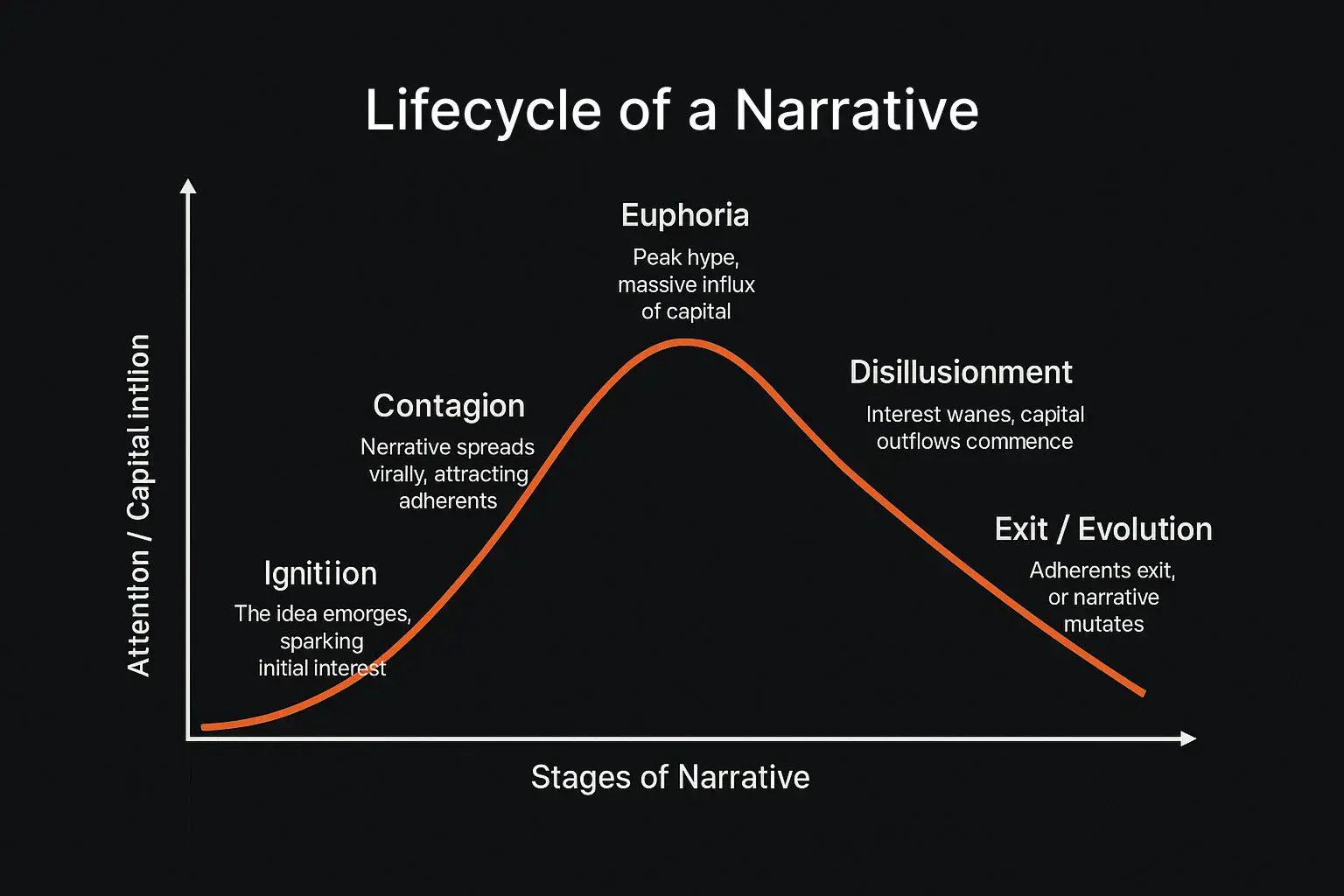
Timing is crucial. If you enter in the second phase and exit before the fourth phase, you are riding the wave. If you miss the cycle, you can only bear the "burden" of the narrative.
6. Can You Invest in Narratives?
Absolutely. In fact, in early cryptocurrency investments, narratives are one of the few reasonable frameworks.
Robert Shiller made a compelling point: ignoring narratives is ignoring macro forces. In the cryptocurrency space, this is amplified. Narratives not only reflect the market but also create it.
As cryptocurrencies gradually approach traditional finance, some noise may diminish. But this space will always attract speculators, dreamers, and builders who value vision over metrics.
In the crypto realm, the most successful individuals are not always the best engineers, but those who are best at interpreting market sentiment.
So, keep a long-term focus on narratives, pay attention to community dynamics (CT), and watch for the latest trends. Narratives may not be encoded but rather written.
If cryptocurrency is a grand narrative, perhaps the best traders are those who read a few chapters ahead.
Recommended Reading:
RootData: 2025 H1 Web3 Industry Investment Research Report
"Meme 2.0" Beginning? Pump.fun and the Future Path of On-Chain Financing
Price Resilient: An Overview of the Four Major "Buy Orders" for ETH
 Risk warning
 Risk warning