Stablecoins are reshaping B2B payments: a financial revolution in a trillion-dollar market

Stablecoins, as a special form of cryptocurrency, differ from highly volatile crypto assets like Bitcoin and Ethereum by significantly reducing price volatility risks through their peg to fiat currencies. This characteristic has allowed stablecoins to gradually expand from being "in-house payment tools" in the crypto industry to broader commercial and consumer scenarios.
In recent years, with the increasing global acceptance of digital payments, especially driven by hot topics like DeFi and NFTs, ordinary users' acceptance of crypto wallets and stablecoins has rapidly increased. Mainstream stablecoins, including USDT and USDC, are being used more frequently in e-commerce, subscriptions, gig payments, international remittances, and other scenarios.
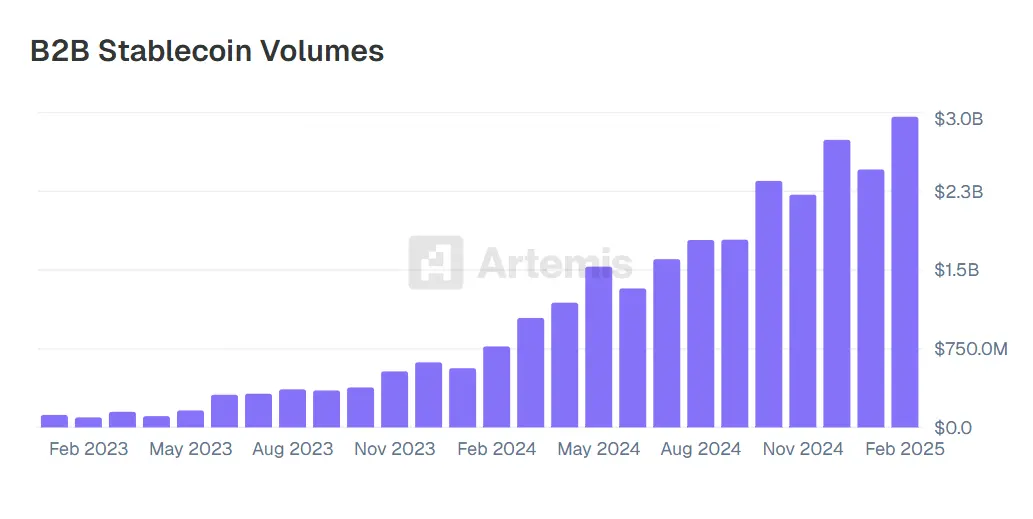
Compared to C-end payments, B2B enterprises are more eager for low-cost, high-efficiency global payment solutions. Due to features such as instant settlement, low costs, and transparency, stablecoins are gradually becoming a new choice for inter-company settlements. According to the report "Stablecoin Payments from the Ground Up" released by crypto risk analysis firm Artemis and crypto investment firms Dragonfly and Castle Island Ventures, the scale of B2B stablecoin payments surged from $10 million in 2023 to $3 billion in February 2025, a 30-fold increase. Stablecoins are gradually becoming a core financial sector for enterprises, stimulating vast market space.
The Rise of Stablecoins: From Crypto Niche to Core of Future Finance
In recent years, the market size of stablecoins has shown explosive growth. According to the report "Stablecoins: The Emerging Market Story" jointly released by Castle Island Ventures and Brevan Howard, the global circulation of stablecoins skyrocketed from less than $1 billion in 2017 to over $160 billion in 2024. In 2023 alone, the settlement amount of stablecoins reached an astonishing $3.7 trillion, with $2.62 trillion already achieved in the first half of 2024 (annualized at $5.28 trillion). These figures indicate that stablecoins are no longer just tools for cryptocurrency trading but have become important mediums for global value exchange.
This has also forced major global market regulators to take clear regulatory stances on stablecoins. On May 21, 2025, the Legislative Council of Hong Kong officially passed the "Stablecoin Regulation Draft," establishing a licensing system for fiat-backed stablecoins; on July 28, the U.S. House of Representatives passed three pieces of crypto-related legislation: the "CLARITY Act," the "GENIUS Act," and the "Anti-CBDC Surveillance National Act." These regulatory advancements send a clear signal that stablecoins are moving out of the gray area and into the fringes of the mainstream financial system.
In this trend, traditional financial giants are accelerating their embrace of stablecoin technology, with Visa and Mastercard also launching settlement functions that integrate stablecoins. This will further promote the application of stablecoins in the B2B payment sector, providing enterprises with more efficient and lower-cost payment solutions.
B2B Scenario Implementation: New Solutions Brought by Stablecoins
Compared to traditional bank wire transfers, stablecoins show significant advantages in the B2B payment sector.
First, in terms of speed, traditional cross-border payments usually take 1-5 business days to settle, while stablecoin transactions can achieve near real-time clearing on the blockchain, greatly shortening the capital turnover cycle for enterprises. Secondly, regarding costs, traditional cross-border payments involve multiple intermediary banks, each charging fees, with total costs reaching 3-5% of the transaction amount, while stablecoin transaction fees are typically below 0.1%. Additionally, the blockchain-based characteristics of stablecoins also bring high transparency, strong programmability, and year-round availability, which are difficult for traditional financial institutions to match.
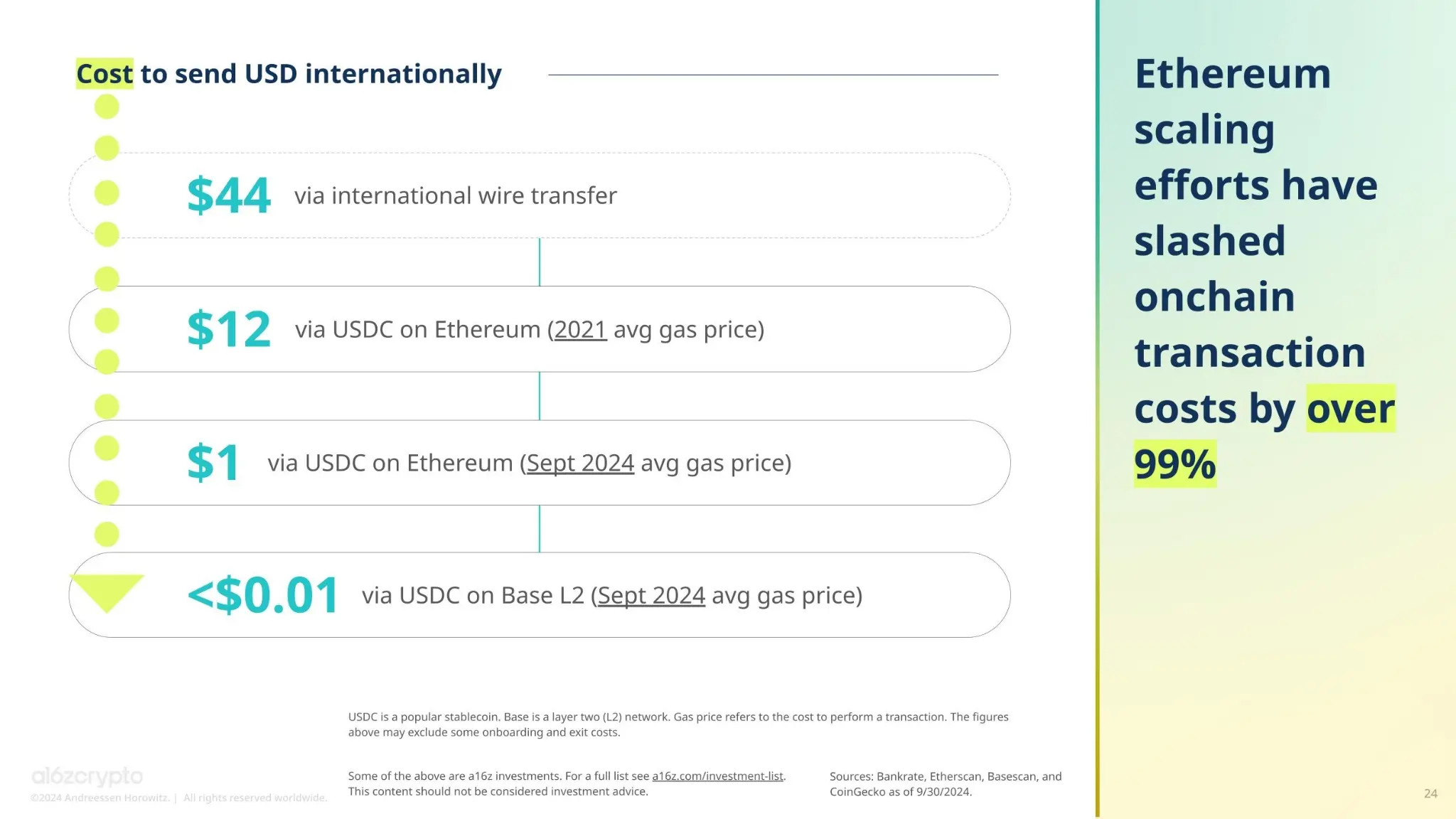
(The "State of Crypto Report 2024" released by a16z shows that the average fee for international wire transfers is $44, while the average cost of sending USDC on the popular L2 network Base on Coinbase is less than 1 cent.)
As the Web3 financial infrastructure and risk control compliance capabilities gradually improve, stablecoins are rapidly penetrating the B2B payment sector and entering the practical business implementation stage. Particularly in regions with significant currency value fluctuations, such as Latin America and Southeast Asia, many enterprises have begun using stablecoins for cross-border payments, salary disbursements, procurement settlements, etc., thereby optimizing payment processes, reducing operational costs, and improving capital efficiency.
Case 1: Cross-Border Trade Settlement, Taking Latin America's Import and Export Business as an Example
In traditional cross-border trade, especially transactions involving emerging market countries, the payment process is often lengthy and complex. For instance, if Colombia imports medical equipment from the United States, the Colombian importer needs to purchase U.S. dollars through a local bank, which often faces strict foreign exchange controls and limits; then, they remit through the SWIFT network, passing through multiple intermediary banks, each charging fees and requiring processing time; ultimately, the U.S. exporter receives the payment 2-3 business days later, but the amount has been reduced due to various intermediary fees.
However, using stablecoin payments revolutionizes this process. The importer can exchange stablecoins like USDC through a compliant Web3 payment institution and directly transfer them to the U.S. exporter's crypto wallet, arriving almost in real-time, with costs less than one-tenth of traditional methods.
Case 2: International Salary Payments, Stablecoin Salary Solutions for Global Enterprises
For companies with global teams, traditional salary payments also face many challenges: high remittance fees, exchange rate losses, long processing times, and low bank account penetration rates in some countries. Especially in countries like Nigeria, ordinary bank accounts cannot receive international currency transfers, forcing companies to seek alternative solutions.
For the international salary payment scenario, stablecoins also provide an efficient solution. Companies can use stablecoins like USDT to pay salaries to employees distributed across multiple countries, who can exchange them for fiat currency through professional compliance service providers or directly use stablecoins for consumption. Compared to traditional international wire transfers, this solution has clear advantages: first, costs are significantly reduced, especially for small payments, with fees dropping from fixed amounts of several dollars to approximately 0.5%; second, the speed of payment is fast, with employees receiving their salaries within minutes; third, financial inclusivity is strong, allowing employees without bank accounts to receive salaries through crypto digital wallets. Particularly in countries with strict foreign exchange controls, such as those in Latin America, stablecoins have become a practical solution for companies to pay international employees and outsourced teams. According to the report "Stablecoins: The Emerging Market Story," 25% of respondents have received or paid wages through stablecoins, with this figure reaching as high as 37% in India.
A comprehensive analysis of the above cases reveals the advantages of stablecoins in the B2B sector can be summarized as follows:
Settlement Efficiency: Transactions are completed in real-time or within minutes, significantly shortening the capital turnover cycle;
Cost Structure: Eliminating intermediary banks reduces costs to 1/10 or even lower than traditional methods;
Global Reach: Breaking through traditional bank account limitations, especially suitable for regions with weak banking infrastructure;
Transparency: All transaction records are traceable on the blockchain, facilitating audit trails;
However, enterprises also need to consider implementation barriers when adopting stablecoin payments, including the crypto acceptance of transaction counterparts, compliance and risk control, price volatility risks (even though stablecoins are designed to maintain their peg), and the complexity of technical operations. Collaborating with professional crypto payment service providers, rather than directly engaging in cryptocurrency operations, is a more prudent choice for most enterprises. For instance, innovative financial company Interlace, which links Web3 and Web2, offers products and solutions such as global accounts, Infinity Card, CryptoConnect, and CaaS API, providing payment, settlement, and fund management solutions for fiat and stablecoins to Web3 institutions, crypto exchanges, cross-border e-commerce, B2B trade, and other enterprises and transaction scenarios, covering over 180 countries and regions.
Regulation and Compliance: Key Barriers and Response Strategies for Enterprises Adopting Stablecoins
Although stablecoins have brought significant efficiency improvements to B2B payments, enterprises must still cautiously address various compliance risks and operational challenges during actual adoption. The primary compliance risk stems from regulatory uncertainty—different jurisdictions have vastly different legal classifications for stablecoins: some U.S. states regulate stablecoins as money transmission tools, the EU defines them as "e-money tokens" through MiCA, while some countries completely prohibit the use of stablecoin transactions. This fragmented regulatory environment requires enterprises to conduct comprehensive compliance assessments before using stablecoins cross-border.
Additionally, anti-money laundering (AML) and KYC/KYB requirements present another major compliance challenge for enterprises. For example, the Financial Action Task Force (FATF) has included virtual asset service providers (VASP) in its international standards, requiring the same AML/CFT control measures for cryptocurrency transactions as for traditional finance. This means that if enterprises directly use stablecoins for large B2B payments, they may need to assume corresponding customer due diligence and transaction monitoring responsibilities.
To address these challenges, enterprises can consider adopting the following compliance strategies:
Collaborate with regulated stablecoin issuers (such as Circle's USDC) and trading platforms to ensure the compliance of underlying assets.
Introduce licensed virtual asset service providers as compliance nodes in the transaction chain, allowing them to assume AML/KYC responsibilities.
Establish dedicated blockchain transaction monitoring systems or procure professional services like Chainalysis to ensure traceability.
Web3 financial companies like Interlace are helping enterprises meet these compliance requirements. Interlace integrates multiple protections such as intelligent risk control, compliance review, and user identity verification into its product and solution design, achieving KYC, KYB verification, and AML monitoring. Notably, for on-chain anti-money laundering, Interlace has also built KYT (Know Your Address) and KYA (Know Your Transaction) solutions—risk rating on-chain addresses through a vast data labeling library and real-time control of high-risk transactions. At the same time, it continuously monitors crypto addresses and conducts regular retrospective screening and address rotation to ensure platform and fund security.
Currently, Interlace has obtained licenses and qualifications from multiple jurisdictions, such as TCSP in Hong Kong, VASP in Lithuania, and MSB in the U.S., complying with the highest security certification in the international card payment industry, PCI-DSS Level 1. This means that enterprises can focus on business development with the support of Interlace's compliance and risk control resources.
Future Outlook: A New Landscape of Enterprise Payments Driven by Stablecoins
According to the report "Stablecoin Payments from the Ground Up," data analysis of 31 stablecoin payment companies shows that from January 2023 to February 2025, these companies completed over $94.2 billion in daily payment transactions. Among them, B2B payments are the primary usage scenario, with an annualized transaction scale of $36 billion, reflecting the practical application value of stablecoins in cross-border settlement, fund management, and supply chain payments. At the same time, stablecoin payments linked to bank cards are also showing rapid growth, with annualized transaction volumes exceeding $13.2 billion. With the stabilization of regulatory frameworks and advancements in blockchain technology, it is expected that by 2030, 40% of enterprises will adopt crypto payments.
In the long term, stablecoins and related blockchain technologies will profoundly reshape enterprise payments and asset management. The flow of funds will shift from relying on traditional financial institutions' processing models to real-time liquidity available around the clock; payments, settlements, and clearances will merge into a single step; and enterprises' cash flow visibility and control will be significantly enhanced. These changes collectively point to a more efficient and inclusive global enterprise payment system.
In today's irreversible wave of blockchain, enterprises that proactively lay out stablecoin payment capabilities will gain significant competitive advantages—faster capital turnover, lower transaction costs, and better customer experiences. Stablecoins represent not only an iteration of payment technology but also an important upgrade of global financial infrastructure.
 Risk warning Risk warning



Popular articles