Market Forecast 2025: How will the three major paths unfold? Which new projects are worth paying attention to?
 Core Viewpoint

 Capital sees three actionable items: sustainable transactions, direct monetization of channels, and clear regulatory pathways.
Author: Zhou, ChainCatcher
1. Capital Begins to Reinvest
Various capital sources are seriously allocating resources to the prediction market sector. According to statistics from the crypto data platform RootData, there are currently over 130 prediction market projects, half of which were established this year. Additionally, the total financing amount for this sector has exceeded $200 million this year, making it the highest year for financing historically, contrasting sharply with the overall decline in the financing market.
This year, one of the most intuitive changes in the prediction market is its scale. According to Polymarket Analytics, as of September 9, the top prediction platforms have accumulated nearly $1.2 billion in transactions, with approximately 25,000 active markets created, and the scale of open contracts in the market is around $300 million. Michael Hua, a partner at 1kx, stated that this sustained interest has restored confidence among many venture capitalists in investing in this market.
Secondly, the maturity of product forms is evident. More and more platforms are no longer just one-off transactions but are becoming tradable positions: they have order books, allow for position adjustments, and permit early profit-taking and stop-losses, with information being converted into transactions more frequently. For platforms, revenue has expanded from a single transaction fee to multiple lines including settlement, market-making, and data/API services.
Furthermore, the supply of topics and channels has been streamlined. Beyond politics, events such as sports seasons, technology company milestones, crypto industry events, and macro data releases can almost all be standardized into short-term contracts, with tradable news available at any time.
At the same time, licensed platforms like Robinhood have directly integrated event contracts from partnered prediction market platforms into their app, bringing in incremental users along with compliance, making trading and revenue more visible.
Putting all this together, capital sees three actionable items: sustainable transactions, direct monetization of channels, and clear regulatory pathways—this is why funding is willing to systematically increase this year.
2. Three Paths, Three Driving Forces
Currently, the landscape of prediction markets is divided into three paths: on-chain, compliant, and hybrid.
Among them, the on-chain path is represented by Polymarket, which is centered around USDC pricing and order book matching, turning predictions into on-chain exchanges. Data shows that the total transaction volume of this project is nearing $900 million.
Additionally, Polymarket announced the acquisition of QCEX, a derivatives exchange and clearinghouse authorized by the U.S. Commodity Futures Trading Commission (CFTC), for $112 million, enabling Polymarket to operate legally and compliantly within the United States. Brandon Potts, a partner at Framework Ventures, described this as evidence that regulators are now willing to engage constructively.
The compliant path is represented by Kalshi, which operates under DCM qualifications in the U.S. Its advantage lies in channel accessibility; after integrating with brokers like Robinhood, users can place orders within familiar apps, bringing substantial trading and revenue to the platform. Robinhood's management stated that integrating Kalshi's event contracts into the app resulted in approximately $1 billion in transactions and about $10 million in revenue for Q2. Furthermore, after completing a $185 million financing round led by Paradigm in June of this year, Kalshi's valuation reached $2 billion.
The hybrid path is promoted by The Clearing Company (TCC), which aims to directly embed compliance into on-chain protocols, creating system-integrated interfaces for accounts, KYC, settlement, and dispute resolution, while retaining permissionless market creation and programmable extensibility. This allows both institutions and retail investors to trade on the same infrastructure, connecting to the corresponding modules as needed for compliance. This project was founded this year by former members of the Polymarket and Kalshi teams, and recently TCC secured a $15 million seed round led by USV.
3. A Surge of New Projects
Alongside the three main lines, many new projects have emerged in the market, which can be roughly categorized into four types------
① New prediction subjects: expanding from betting on whether events occur to betting on beliefs/valuations/attention (e.g., Belief, Ventuals, Noise);
② New betting models: shortening cycles and creating continuous or interval forms (e.g., Limitless's hourly markets, O.LAB's continuous opinion markets);
③ New entry points: embedding trading directly into content/social links (e.g., fireplace's information flow, Myriad's in-content betting, Actions Protocol's "link equals trade");
④ New ecosystems: migrating the prediction market model to emerging ecosystems like Monad, MegaETH, Hyperliquid.
The following cases fall into these categories.
Belief Market proposes a new model for prediction subjects: betting on the outcome with the highest total stake, rather than the actual outcome. This project positions itself as a belief-based market, where the outcome with the highest betting amount becomes the winner, regardless of whether that outcome occurs. For example, in the U.S. presidential election event, if the total amount bet on the Trump option is the highest when the market closes, even if Trump does not actually become president afterward, the bettors can proportionally receive all funds in the prize pool. For fairness, users can only see the voting numbers after placing a bet, and the actual betting amounts are only visible until the market closes. The project lists investors such as Shima Capital and GSR among several well-known VCs on its official website.
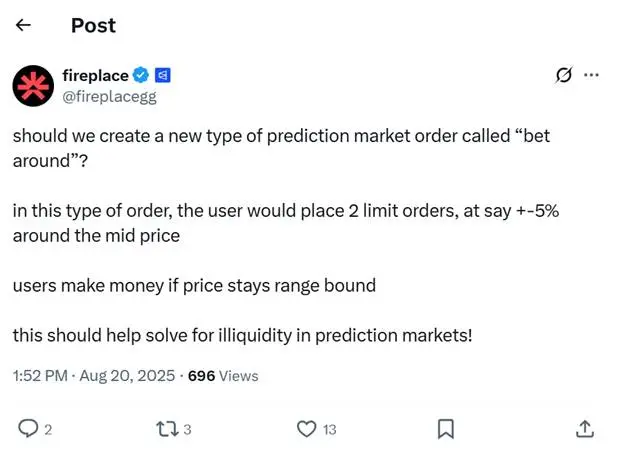
fireplace focuses on the social experience of prediction markets, presenting the latest trading dynamics of user-followed accounts in the form of information flow based on Polymarket's prediction events, allowing comments, replies, and copying on any transaction.
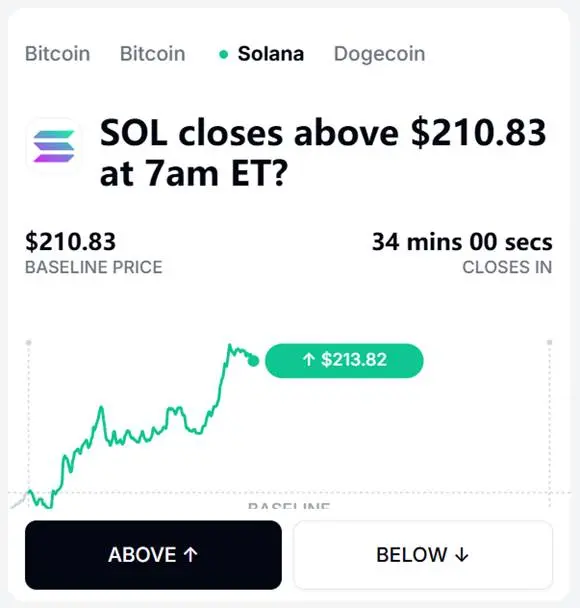
Limitless focuses on short-cycle event contracts, typically settled hourly. Its page provides clear topics, such as "Will SOL exceed $210.83 before 7 PM?" After the time is up, the official will settle based on specified data sources, with winners receiving payouts equivalent to 1 USDC per share. This project has completed $7 million in financing, with investors including 1confirmation, paper ventures, and bing ventures.
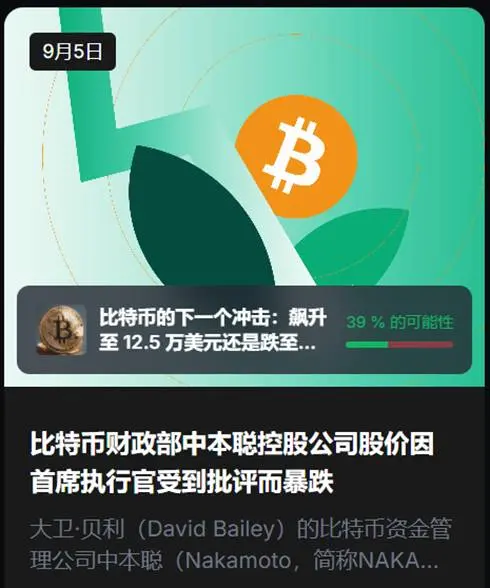
Myriad embeds prediction events into media/creator content scenarios. For example, if a mainstream media outlet publishes a message stating "Solana Treasury Company SOL Strategies is about to go public on NASDAQ," the platform can embed an interactive card asking "What's next for Solana: Will it rise to $250 or drop to $130?" Users can click the link to place bets directly after seeing the content, and a wallet confirmation will pop up in the browser.
Opinion Labs is deployed on Monad, supporting permissionless market creation and allowing trading with any ERC-20 token, with results adjudicated by on-chain optimistic oracles. Users can make judgments about the future trends of events and express their views or place bets through the market. In March of this year, O.LAB completed a $5 million pre-seed round of financing, with investors including YZi Labs, Amber Group, and Manifold Trading.
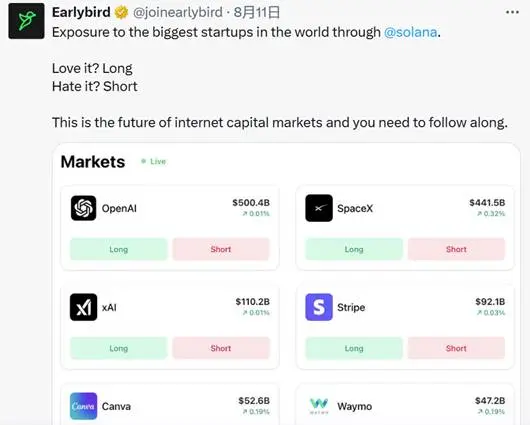
Ventuals is a platform focused on equity derivatives for unlisted companies, allowing long/short positions on primary market valuations of companies like OpenAI and SpaceX, with a maximum support of 10x leverage per transaction. This project uses Hyperliquid's margin and order book system as its underlying technology. A similar project is Earlybird, which also targets pre-IPO company valuations as prediction subjects, but Earlybird is built on Solana and is currently open for a waiting list. According to RootData, Earlybird's investors include Robot Ventures, Ouroboros Capital, and 6th Man Ventures.
Noise also proposes a new direction for prediction subjects, trading not on prices but on attention itself. Users can long or short the Mindshare of well-known projects like Monad, Farcaster, or Abstract. Noise is built on MegaETH and uses Kaito as its first Mindshare oracle to track the discussion volume of a project on cryptocurrency Twitter.
XO Market introduces the belief market, where creators can pose clear questions about future events, define possible outcomes and resolution criteria, and inject funds into the market based on initial stakes. Traders then place bets based on their thoughts, driving prices up or down. The platform emphasizes permissionless, user-driven creation, allowing any user to create a market on any topic within seconds while choosing any collateral token for trading.
 Risk warning
 Risk warning