The popular stablecoin project Falcon is about to launch its new offering. Is it worth participating?

 The token FF of Falcon Finance will soon be launched for sale on the Buidlpad platform.
Original Title: Falcon Finance ($FF) Sale Analysis: DWF's Stablecoin Play
Original Author: Stacy Muur
Original Translator: Luffy, Foresight News
Falcon Finance's token FF is about to launch on the Launchpad platform Buidlpad. This is not just another ordinary token sale, but the flagship stablecoin project under top market maker DWF Labs making its public debut, and the timing of the sale is impeccable.
My Rating:
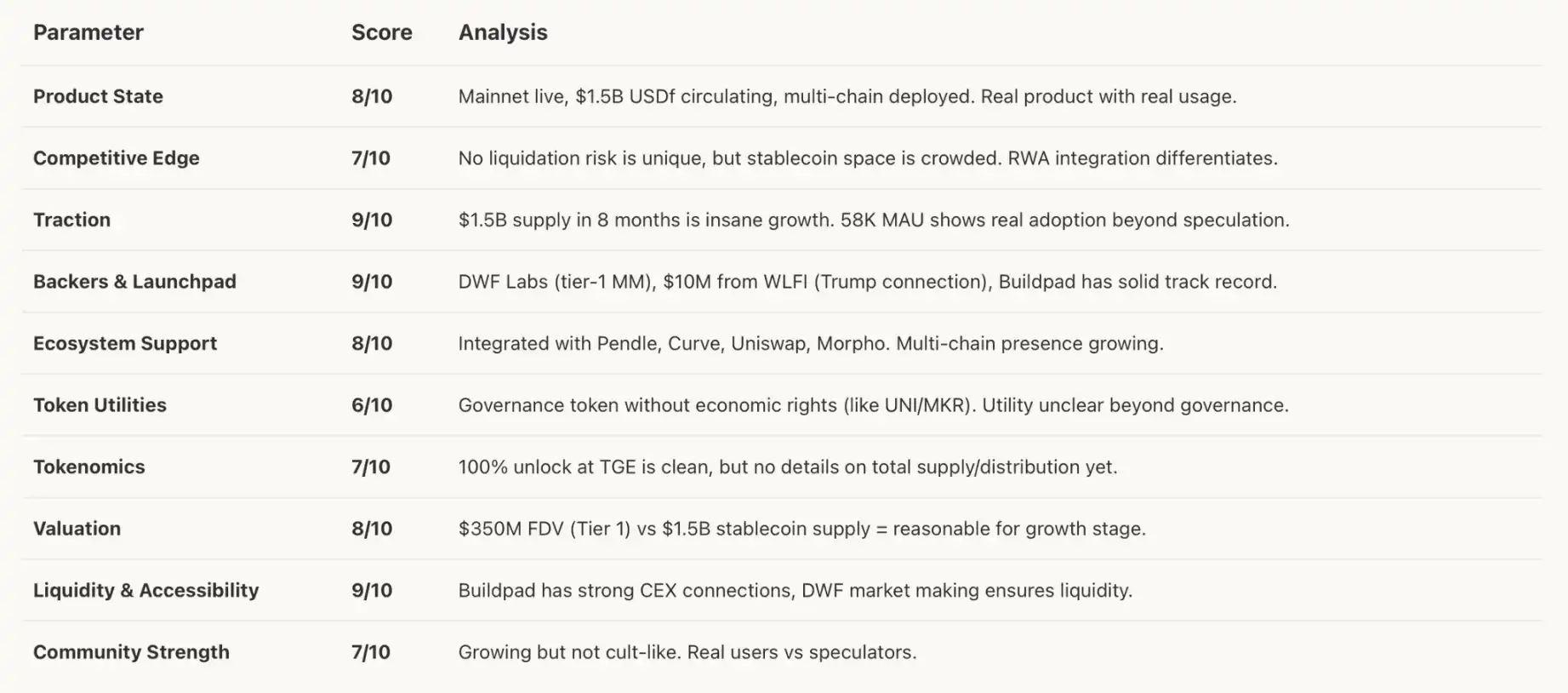
Overall Rating: 7.8/10. Strong fundamentals with clear upward catalysts.
Project Overview
Key Features of Falcon
· Universal collateral infrastructure: Users can collateralize Bitcoin, Ethereum, SOL, stablecoins, altcoins, and even tokenized real-world assets (RWAs) to mint the stablecoin USDf.
· No liquidation risk: Unlike traditional collateralized debt position (CDP) protocols, Falcon employs an over-collateralization mechanism with no liquidation process.
· Yield generation: Users can stake USDf to earn sUSDf, thus obtaining higher yields.
· Multi-chain strategy: Deployed on Ethereum, Arbitrum, and Base, with plans to expand to the Solana network.
Current Traction
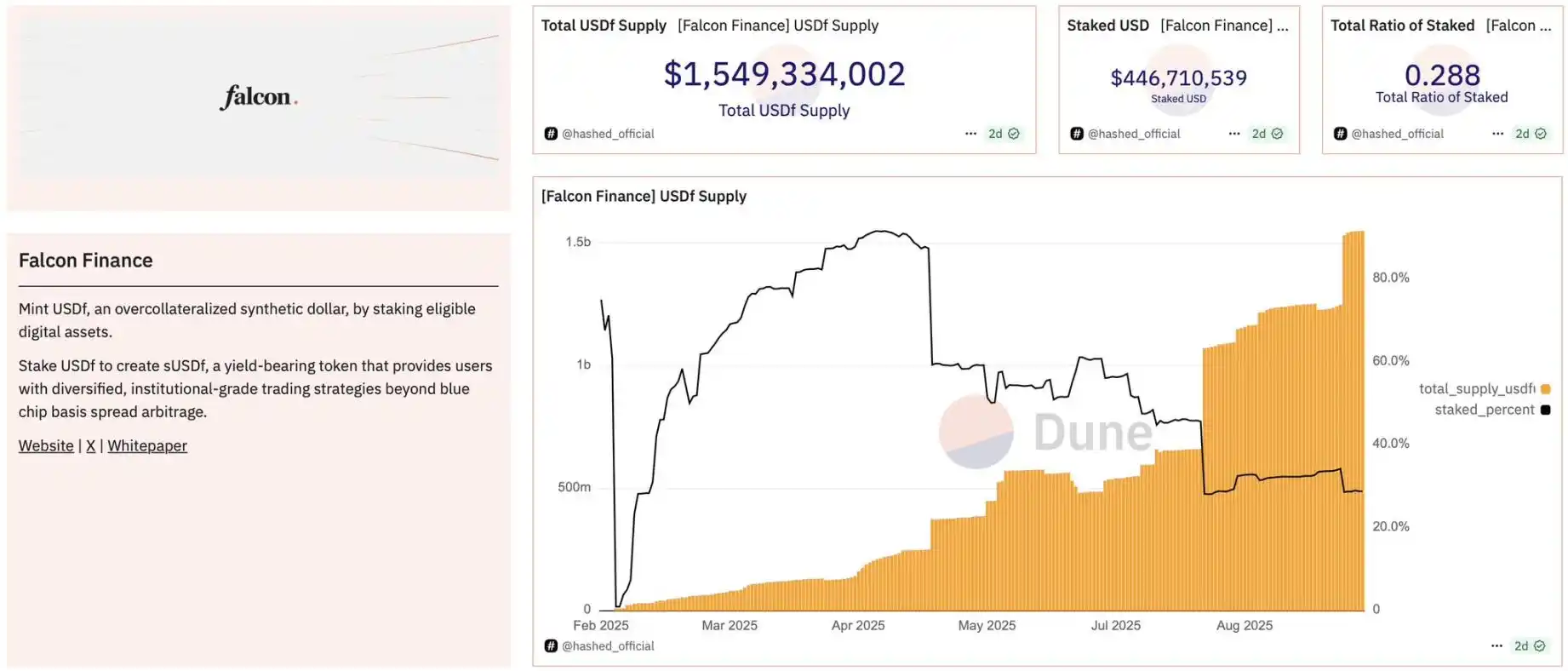
· USDf circulation reached $1.5 billion, ranking 8th among stablecoins just 8 months after launch.
· Reserves exceed $1.6 billion.
· Over 58,000 monthly active users.
· Total value locked (TVL) on Pendle exceeds $273.4 million.
Core Advantages of Falcon
Proven Product-Market Fit
Unlike most token sales that rely on "promise financing," Falcon's stablecoin already has a circulating market value of $1.5 billion. This is not a short-term operation to "inflate TVL," but a reflection of real stablecoin demand.
Heavyweight Institutional Support
· DWF Labs: A top market maker with strong financial backing and close cooperation with major exchanges.
· $10 million investment from WLFI: Associated with the Trump family, which could bring regulatory tailwinds and mainstream attention to the project.
· Past performance of Buidlpad platform: Previous projects like Lombard have performed exceptionally well.
Excellent Market Timing
· The narrative around stablecoins is gaining momentum, and regulatory frameworks are becoming clearer.
· The trend of tokenizing real-world assets (RWA) is accelerating.
· The Trump administration's crypto-friendly policies are about to be implemented.
· Decentralized finance (DeFi) yield products are gaining recognition from institutional investors.
Sustainable Revenue Flywheel
Unlike pure governance tokens, Falcon has real sources of income:
· USDf minting fees.
· Interest income from sUSDf staking operations.
· Fees related to RWA integration.
· Revenue from cross-chain expansion.
Main Risks of Falcon
Doubts About Token Utility
The biggest concern: FF is merely a governance token without economic rights to profits. Unlike MKR or AAVE, where token holders can participate in protocol profit distribution, FF holders only have voting rights. This limits the long-term value accumulation potential of the token.
Intense Competition in the Stablecoin Market
The competition in the stablecoin space is "brutal": USDC and USDT dominate, while newcomers like PYUSD (PayPal stablecoin) and FDUSD (Fidelity stablecoin) are backed by large institutions. Falcon needs to prove that its stablecoin demand can surpass the "DeFi yield mining" scenario and is sustainable.
Regulatory Uncertainty
Despite ties to the Trump camp, stablecoin regulatory policies are still evolving. Any negative regulatory developments could impact the overall project model.
Controversies Surrounding DWF Labs' Reputation
Despite being a top market maker, DWF Labs has faced criticism for employing "pump and dump" strategies in some investments, making its involvement a double-edged sword for the project.
Sale Terms Analysis
Advantages
· Dual pricing mechanism: USDf/sUSDf stakers can enjoy a $350 million fully diluted valuation (FDV) discount, while non-stakers face a $450 million valuation.
· 100% unlock at TGE: No lock-up period, allowing for direct exit if needed, providing high flexibility.
· Reasonable financing scale: A $4 million fundraising amount is not too high and is sufficient to support project advancement.
· Low entry threshold: Investment amounts range from $50 to $4,000, allowing ordinary retail investors to participate.
Disadvantages
· High valuation risk: Even at a $350 million FDV, the pricing remains high for a governance token without profit-sharing.
· Only supports USD1 payments: Forces users into the WLFI ecosystem, which, while a strategic layout, limits user payment options.
Catalysts and Upside Scenarios
Short-term Catalysts (1-3 months)
· TGE and exchange listings: With DWF's resources, it is highly likely to be listed on major exchanges like Binance, OKX, and Bybit.
· Cross-chain expansion: Deployment to the Solana network could double the user base.
· RWA product launch: Integration of tokenized government bonds and other assets.
Mid-term Catalysts (3-12 months)
· Institutional adoption: Corporate finance departments will use USDf for yield management.
· Regulatory clarity: Implementation of stablecoin regulatory frameworks could drive the entire industry upward.
· DeFi ecosystem integration: More protocols will include USDf as acceptable collateral.
· Profit-sharing mechanism: The token economic model may upgrade to allow FF holders to participate in protocol fee distribution.
Price Predictions
Optimistic Scenario (30% probability)
· Target valuation: Fully diluted valuation (FDV) exceeds $1 billion (3-4 times increase from the $350 million entry price).
· Driving factors: Listings on major centralized exchanges, airdrop enthusiasm, and large-scale institutional adoption; timeframe: 3-6 months post-TGE.
Baseline Scenario (55% probability)
· Target valuation: FDV reaches $500-700 million (1.5-2 times increase from the entry price).
· Growth logic: Steady growth through DeFi ecosystem penetration; timeframe: 6-12 months.
Pessimistic Scenario (15% probability)
· Target valuation: FDV drops to $200-300 million (breakeven to a 15% loss).
· Risk triggers: Intensified competition in the stablecoin market, regulatory issues erupting, or DWF Labs withdrawing.
Conclusion
Falcon Finance is a project with real implementation capabilities. As a functional stablecoin protocol, Falcon has achieved a $1.5 billion actual usage rate, has institutional backing, and clear growth catalysts. The terms of the token sale are reasonable, and the timing aligns with multiple macro trends.
The main risk lies in the weaker utility of FF compared to governance tokens with profit-sharing mechanisms.
My conclusion: For investors optimistic about stablecoins, RWA tokenization trends, and the Trump administration's crypto policies, this presents a high-certainty investment opportunity. Given the project's current progress and backing, the $350 million FDV entry price is attractive.
Action Plan
· Aim to secure the $350 million valuation tier (immediately stake USDf/sUSDf).
· Complete identity verification on Buidlpad.
· If you agree with the project logic, consider participating in the investment up to the limit.
```
 Risk warning Risk warning